|
Many of our municipalities are working to enhance their Complete Streets projects. A big part of this effort includes the implementation of bike lanes that work best for the safety of all pedestrians, cyclists, and vehicles in their communities, while still considering parking, needs, and traffic flow.
Conventional Lanes: Conventional bike lanes are the most common type of bike lane and design highlighted by painted lines on the road. These lanes are typically narrower than other types of bike lanes and are intended for use by experienced cyclists. They are most commonly found on roads with lower traffic volume and slower speeds.
Shared Lanes: also known as sharrows, are designated by painted arrows and symbols on the road. They indicate that cyclists and motorists should share the lane and are often used on roads that are too narrow to accommodate separate bike lanes. Shared lanes can also be used to connect different types of bike lanes.
Buffered Lanes: Buffered bike lanes are a popular type of bike lane that provide an extra layer of protection for cyclists. These lanes are marked by a painted buffer area between the bike lane and the motor vehicle lane, typically ranging from 1 to 3 feet in width. The buffer space serves as a physical barrier, separating cyclists from motor vehicles and creating a sense of safety and comfort for riders.
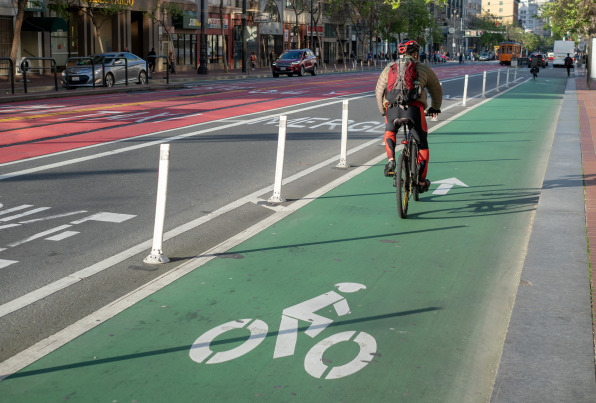
Protected Lanes: Protected bike lanes are an essential component of any cycling infrastructure, as they provide a safe and secure space for cyclists to ride without the fear of sharing the road with motor vehicles. These bike lanes are typically found on busy roads or intersections, where there is a high volume of traffic. They are designed with a physical barrier, such as curbs, planters, or bollards, to separate cyclists from cars and trucks. The purpose of protected bike lanes is to create a dedicated space for cyclists that is free from the dangers of motor vehicle traffic.
Contraflow Lanes: Contra-flow bicycle lanes are bicycle lanes designed to allow bicyclists to ride in the opposite direction of motor vehicle traffic. They convert a one-way traffic street into a two-way street: one direction for motor vehicles and bikes, and the other for bikes only. Contra-flow lanes are separated with yellow center lane striping. Combining both direction bicycle travel on one side of the street to accommodate contra-flow movement results in a two-way cycle track.
Ther are many options for bike lanes and just as many considerations. We appreciate all the work our municipalities are doing to increase access to physical activity and improve safety for all.
An Overview of Bike Lanes: Understanding the Different Types (bicyclecouncil.com.au)
Types of Bikeways (chicago.gov)
Bicycle Lanes | FHWA (dot.gov)
|