|
Important Dates
|
*All times are Central Time
December 11-12:
January 13, 2020:
Regional Tribal Engagement Work Group Quarterly Conference Call - 2 PM*
January 23-24, 2020:
Tribal Radioactive Materials Transportation Committee (TRMTC) Meeting - Scottsdale, AZ
January 27-31, 2020:
April 13, 2020:
Regional Tribal Engagement Work Group Quarterly Conference Call - 2 PM*
May 18-21, 2020:
NTSF 2020 Meeting - Scottsdale, AZ
July 13, 2020:
Regional Tribal Engagement Work Group Quarterly Conference Call - 2 PM*
|
|
Join Our List
|

|
|
|
COMMITTEE HAPPENINGS

|
|
|
|
 |
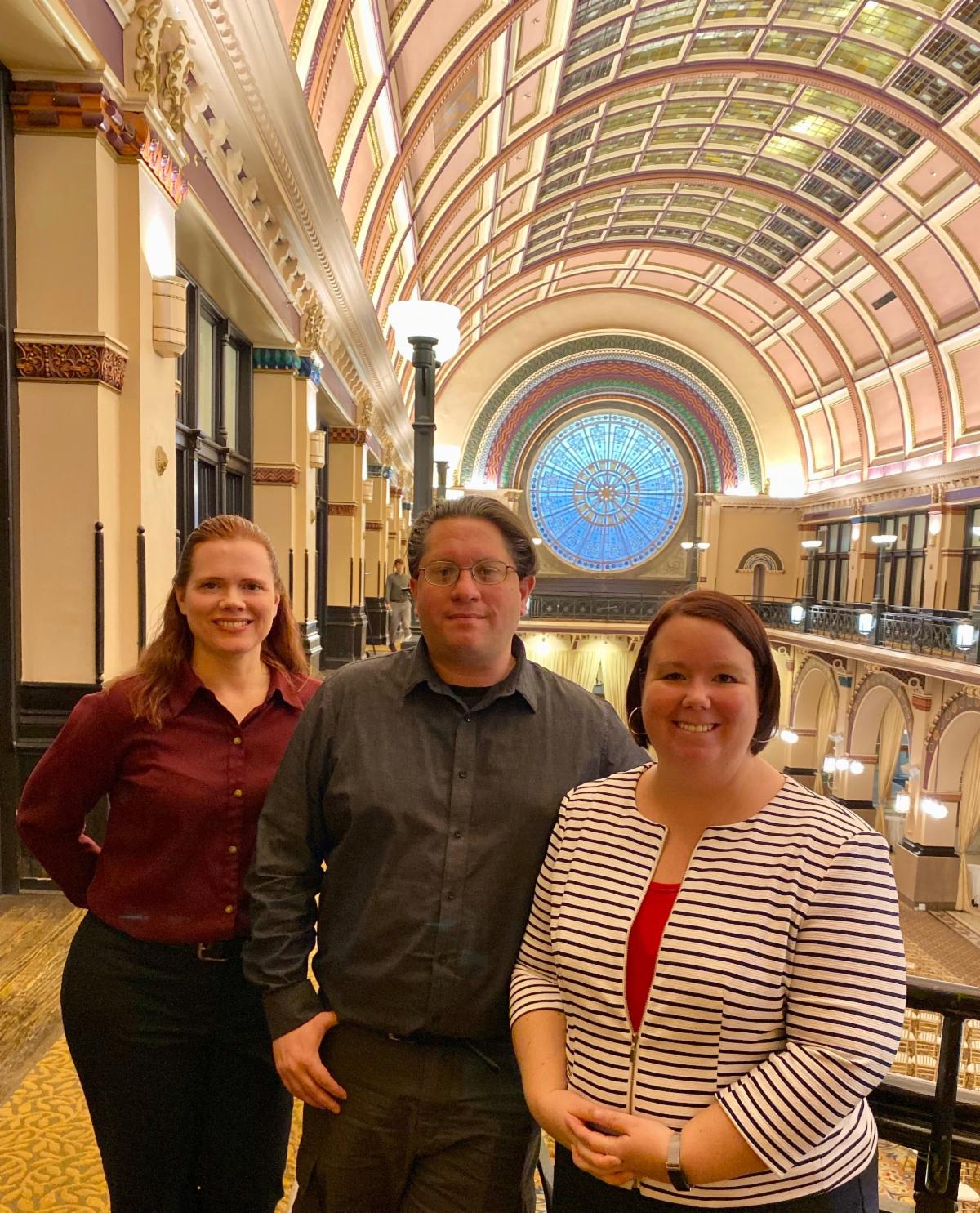
| Left to right: Newly elected Co-Chair Tiffany Drake (Missouri) poses with outgoing Co-Chair Greg Gothard (Michigan) and current Co-Chair Kaci Studer (Indiana) |
|
The Midwestern Radioactive Materials Transportation Committee's (MRMTC) Fall Meeting took place on November 13 and 14 in Indianapolis, Indiana. Thank you to all who attended, presented, and participated! During the meeting, there were great updates from the three Department of Energy (DOE) offices that the MRMTC has cooperative agreements with, the Carlsbad Field Office (CBFO), the Office of Packaging and Transportation (OPT), and the Office of Nuclear Energy (NE). Attendees also heard presentations from the Nuclear Energy Institute (NEI) about the political and legislative landscape for radioactive materials transportation, from the Nuclear Regulatory Commission (NRC) about packaging approvals, from Interim Storage Partners (ISP) about their proposed spent nuclear fuel (SNF) consolidated interim storage facility (CISF), and from Orano TN Americas about their decommissioning activities at the Vermont Yankee Nuclear Power Plant.
Aside from these presentations, there were also plenty of committee business decisions made. After being nominated by past Co-Chair Kelly Horn of Illinois, Tiffany Drake of Missouri was unanimously elected MRMTC Co-Chair for the 2020-2021 biennium! She will serve as the junior co-chair with Kaci Studer of Indiana in 2020. Congratulations to Tiffany and many thanks to outgoing Co-Chair Greg Gothard of Michigan for his hard work these past two years.
The committee also made decisions regarding the semi-annually published
Planning Guide for Shipments of Radioactive Materials through the Midwestern States
, the number of meetings per year, and the committee's website. Questions about these three topics arose from the results of the annual committee member survey. After round-table discussions, it was decided that the Planning Guide will only be published electronically going forward, that the number of meetings will be kept at two per year, and that options to upgrade the committee website will be explored in 2020.
|
NATIONAL TRANSPORTATION STAKEHOLDERS FORUM
|
|
 Aside from continuing preparations for the Annual Meeting of the National Transportation Stakeholders Forum (NTSF) in Scottsdale, Arizona, in May 2020, other NTSF-related activities have slowed down towards the end of the year. The Rail/Routing Ad Hoc Working Group (AHWG), the most active AHWG of the NTSF, will have its next web-meeting some time in January after members of the Federal Railroad Administration (FRA) finish addressing state and tribal comments on the new draft of the Safety Compliance Oversight Plan (SCOP). Because work on the SCOP may be a long-term activity, the Rail/Routing AHWG will concurrently conduct its SCOP review while also working on a reciprocal rail safety inspection protocol. Aside from continuing preparations for the Annual Meeting of the National Transportation Stakeholders Forum (NTSF) in Scottsdale, Arizona, in May 2020, other NTSF-related activities have slowed down towards the end of the year. The Rail/Routing Ad Hoc Working Group (AHWG), the most active AHWG of the NTSF, will have its next web-meeting some time in January after members of the Federal Railroad Administration (FRA) finish addressing state and tribal comments on the new draft of the Safety Compliance Oversight Plan (SCOP). Because work on the SCOP may be a long-term activity, the Rail/Routing AHWG will concurrently conduct its SCOP review while also working on a reciprocal rail safety inspection protocol. |
| FOCUS THIS MONTH |
|
|
|
|
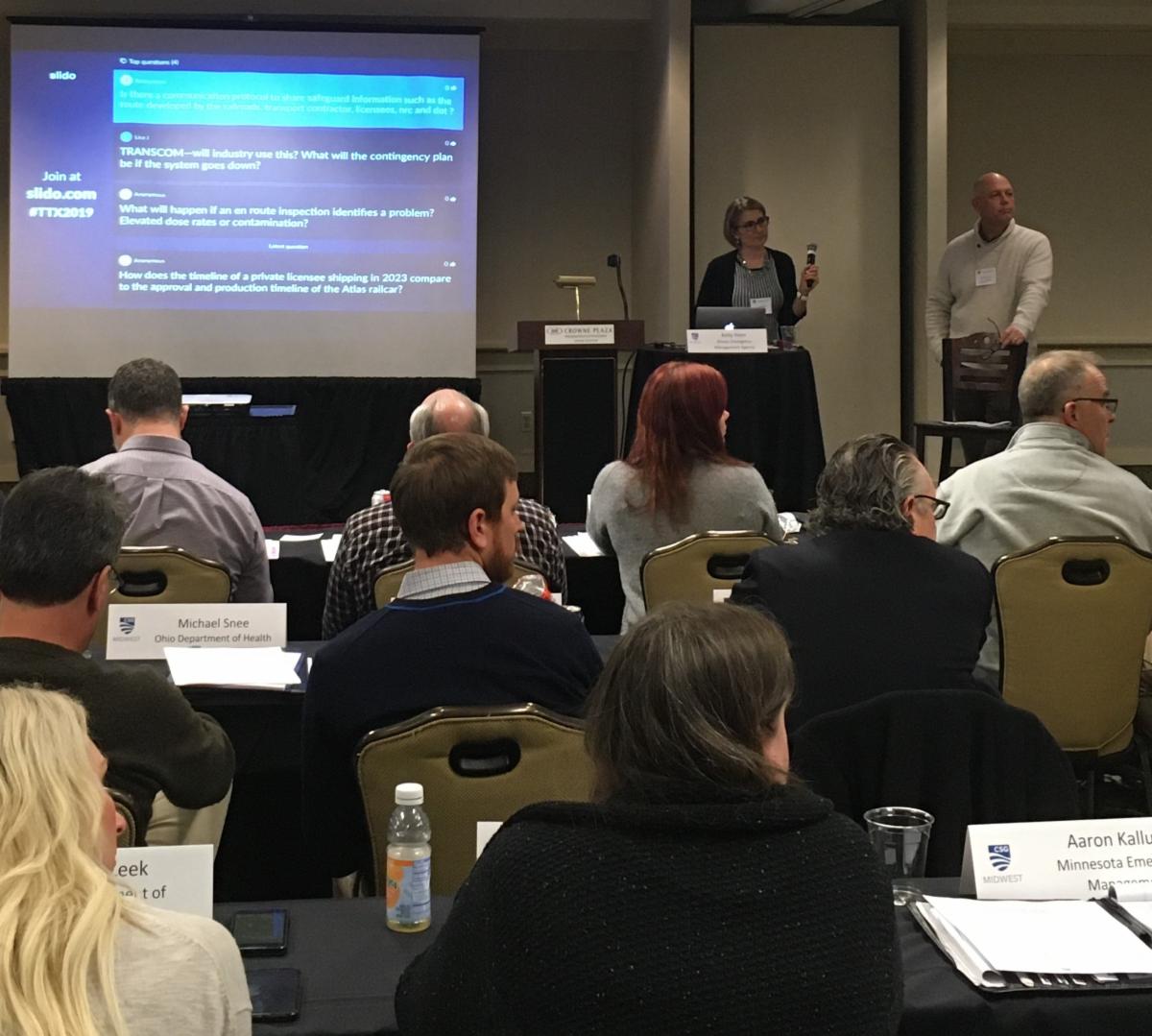
| Lisa Janairo and Kelly Horn listen to an attendee's question during the "SNF Transportation Workshop" |
|
On November 13, the first day of the Fall MRMTC Meeting, attendees were able to participate in and observe the committee's very first "SNF Transportation Workshop." This tabletop aimed to allow our state members to identify their ability to integrate into a DOE SNF shipment, identify their strengths and areas for improvement, and demonstrate an ability to perform state-specific activities. The tabletop scenario followed a bi-modal shipment, heavy haul truck (HHT) to S-2043 Atlas Railcar, from Big Rock Point in northern Michigan to an unspecified location outside the Midwest. Attendees were given an insight into how a transportation plan and route are decided upon, hearing a hypothetical negotiation between the DOE representative (gamely played by our own Lisa Janairo) and a SNF licensee (portrayed by Rod McCullum of the NEI).
After considering a suite of route options, it was decided that the shipment would start in Michigan and pass through Indiana, Illinois, Missouri, and Kansas. Representatives from these five states participated throughout the tabletop, informing attendees of their respective policies regarding inspections, escorts, fees, etc. Attendees from the other Midwestern states were very active observers, asking and answering questions and offering their own unique expertise. Non-state participants included representatives from the FRA, the NRC, and the Burlington Northern Santa Fe (BNSF) Railway.
There were several lessons learned from this exercise and many action items that states and Tribes should undertake going forward. Some of the more important lessons learned include the following:
- Licensees are aiming for 2023 SNF shipments pending approval of the proposed CISFs,
- Route approvals last five years for highway shipments and seven years for rail shipments,
- Railroads may require state inspectors to have specific training in order to access railyards and may deny access regardless,
- States and Tribes would be able to receive Section 180(c) financial assistance under DOE shipments but NOT licensee shipments, and
- Secured escorts do not cross state lines and different states have different requirements.
Some of the more significant action items include:
- Relevant attendees will work to get more people on the Stakeholder Tool for Assessing Radioactive Transportation (START) system,
- States will work to give SNF awareness training to local emergency responders,
- States and Tribes need to determine how they will protect safeguard information,
- States and Tribes must determine if railroads would allow them to do rad inspections at transload sites or while a shipment is en route, and
- Tribes must declare and/or opt in if they want to receive advanced notifications of shipments.
Keep an eye on the MRMTC website in the coming weeks for more information and lessons learned from the workshop. Finally, special thanks to Steve Bertonaschi, Kelly Horn, and Kaci Studer for helping organize, plan, and execute this informative exercise.
|
NUCLEAR NEWS
|
|
|
|
Nuclear Power Plants Under Duress at Home and Abroad
As covered in last month's newsletter, Exelon, Illinois' largest energy provider, recently threatened to shut down their LaSalle, Byron, Braidwood, and Dresden nuclear power plants unless the Illinois legislature provides a subsidy in 2020. This threat from CEO Chris Crane is not as simple as flipping an off switch. There are two major impediments Exelon would face before shutting down these sites. First, the company would have to submit a plan to PJM Interconnection, which manages the energy grid in a multistate region including northern Illinois, on how Exelon would ensure they can continue to provide power to their customers, including the majority of the Chicago area. Second, thanks to an Illinois law passed in the late 90s, Exelon would be on the hook to finance the entirety of decommissioning activities. The current funds for these activities are woefully underfunded. At Dresden, which is already scheduled to close its two reactors in 2029 and 2031, the fund currently sits at $660 million for the estimated final cost of $1.2 billion. At Braidwood and Byron, the largest plants in Exelon's portfolio, the decommissioning funds at the end of 2018 only sat at $344 and $379 million respectively.
|
|
|
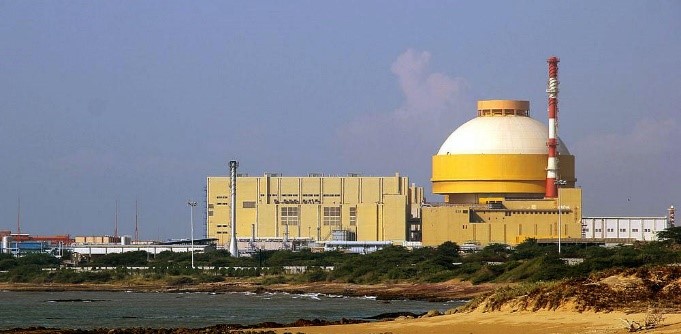
| Kudankulam Nuclear Power Plant, photo courtesy of ZDNet |
|
Meanwhile, on the other side of the world, the Kudankulam Nuclear Power Plant in the Indian state of Tamil Nadu suffered a cyberattack earlier this year. After initially denying it, officials at the plant acknowledged the attack on October 30. "DTrack" malware was discovered on an "administrative" computer that allows the hackers to monitor users' keystrokes, making it easier to launch further cyberattacks and gain access to sensitive information and personnel records. Hacking this "administrative" computer did not give hackers access to Kudankulam's reactors because the reactor control systems are disconnected from the internet via air-gaps, firewalls, and/or data diodes. Regardless, the cyberattack is troubling for the civil nuclear energy industry in India, and the rest of the world.
The Economist has more details including who the hackers may have been.
State and National Nuclear Waste Legislation
U.S. Reps. Debbie Dingell and Fred Upton, both of Michigan, recently succeeded in adding an amendment to
H.R. 2699
, the Nuclear Waste Policy Amendments Act (NWPAA) of 2019. Their
amendment
states, "It is the Sense of Congress that the Governments of the United States and Canada should not allow permanent or long-term storage of spent nuclear fuel or other radioactive waste near the Great Lakes." H.R. 2699 advanced from the full House Energy and Commerce Committee on November 20. If passed, the bill would restart the formal licensing process to determine if Yucca Mountain should be the nation's permanent repository, direct DOE to consolidate SNF at temporary storage sites while a permanent repository is sited, and reform the original NWPA's financing mechanisms. The bipartisan amendment comes on the heels of Canada's announcement that only two sites remain under consideration as potential locations for the country's SNF repository, and both are located near Lake Huron.
Thanks to Greg Gothard for forwarding this news.
In other temporary nuclear waste storage news, the Wyoming Legislature appeared to be moving forward with a proposed temporary SNF storage facility, only to back off the proposal less than two weeks later. This story was first covered in the MRMTC's September Newsletter. State Sen. Jim Anderson, Co-Chair of the Joint Committee on Minerals, Business and Economic Development, told committee members that Gov. Mark Gordon did not need legislative approval to pursue an agreement with the DOE. After learning that the state would only receive $10 million per year for the storage facility, Gov. Gordon has indicated that he believes there are better revenue sources for the state.
The Casper Star Tribune has more details. You can find the Spent Fuel Rods Subcommittee's report to the full joint committee here.
Finally, the Sustainable Fuel Cycle Task Force Science Panel recently released a letter to Nevada Gov. Steve Sisolak urging him to allow an independent public NRC adjudicatory hearing process to take place if Congressional funding is provided for the conclusion of the Yucca Mountain licensing process. This letter was in response to the Nevada Commission on Nuclear Projects' Biennial Report to the Governor and the Legislature of Nevada that says, "The State of Nevada has demonstrated convincingly that Yucca Mountain is an unsafe and unworkable site for a geologic repository." The Science Panel says this statement is inaccurate and that the proposed repository site meets all safety and environmental standards.
Read the full letter here.
News You Can Use
First, the International Atomic Energy Agency (IAEA) has established an e-learning portal with on-line training courses in SNF Management, Safe Transport of Radioactive Material, Decommissioning Implementation, and Preparation for Decommissioning. If you are interested in any of these courses, you must register with the
IAEA NUCLEAS portal
.
Thanks to Steve Maheras for sharing this training opportunity.
Thanks to Erica Bickford for sharing this report
.
Finally, for those interested in an international view, the International Joint Commission has compiled a volume of "unbiased background information" on all 38 nuclear reactors at U.S. or Canadian generating stations in the Great Lakes Basin. (The IJC oversees boundary water resources in Canada and the U.S.) The report will serve as background for a contracted report analyzing the "environmental hazards and significant differences in nuclear decommissioning approaches between Canada, Europe, and the United States." Both reports will inform the work of the IJC's Legacy Issues Work Group and Water Quality Board as they develop recommendations regarding any additional actions needed in the U.S. or Canada to "reduce or eliminate threats to the Great Lakes from the release of radioactive contaminants as a result of decommissioning." The recommendations are expected to be released in the fall of 2020.
Thanks to Greg Gothard for sharing this report.
|
|
Thank you for reading. Watch for the next edition to come out on
January 2, 2020
|
Missed a newsletter? Past issues are
archived
on the committee's webpage.
|
Please do not reproduce or create new content from this material without the prior express written permission of CSG Midwest.
This material is based upon work supported by the Department of Energy under Award Numbers DE-NE0008604, DE-EM0004869, and DE-EM0005168.
This report was prepared as an account of work sponsored by an agency of the United States Government. Neither the United States Government nor any agency thereof, nor any of their employees, makes any warranty, express or implied, or assumes any legal liability or responsibility for the accuracy, completeness, or usefulness of any information, apparatus, product, or process disclosed, or represents that its use would not infringe privately owned rights. Reference herein to any specific commercial product, process, or service by trade name, trademark, manufacturer, or otherwise does not necessarily constitute or imply its endorsement, recommendation, or favoring by the United States Government or any agency thereof. The views and opinions of authors expressed herein do not necessarily state or reflect those of the United States Government or any agency thereof.
|
|
|