|
Join Our List
|

|
|
|
|
COMMITTEE HAPPENINGS
|
|
Thank you to everyone who registered to attend the committee's spring meeting in Orlando on June 8, which is being held in conjunction with the National Transportation Stakeholders Forum (NTSF) Annual Meeting 2016 (see the second article). You can view the agenda and other materials on the
MRMTC Spring 2016 Meeting webpage. If you are responsible for one or more status reports on the agenda and need help compiling your talking points, please contact
Lisa Janairo.
The results of the
MRMTC Fall 2016 Meeting survey will be announced in Orlando. The
survey will remain open until Friday at 11:45 am CDT for committee members to indicate their preferences on the meeting dates and location.
In other committee-related news, a
new Wisconsin Statute (348.105) took effect on May 5 that requires shippers of highway route-controlled quantity (HRCQ) radiological materials to obtain a Radiological Materials (RQ) permit, request a Wisconsin State Patrol escort, and follow a designated route specified on the permit. An RQ permit costs $1,800 per vehicle, adding Wisconsin to the list of Midwestern states that charge fees for shipments of radioactive material through the state. Thanks to MRMTC Co-Chair Teri Engelhart (Wisconsin) for providing the information on this new statute.
Lastly, on July 26, CSG Midwest will co-host the second in a two-part webinar series to help state government officials learn more about the Department of Energy's (DOE) consent-based effort to site an integrated waste management system (
register here). The first webinar in the series, entitled "Nuclear Waste Policy: Defining the Problem, Searching for Solutions," was held on May 19 and featured presentations from Brian Rude with Dairyland Power Cooperative, and Georgia Public Service Commissioner Tim Echols. A recording and materials from the May 19 webinar are
available here.
|
NATIONAL TRANSPORTATION STAKEHOLDERS FORUM

|
|
NTSF News and Events

For those of you who are attending the 2016 Annual Meeting of the NTSF, we look forward to seeing you next week! Meeting co-host the Southern States Energy Board sent a final email this morning which included important meeting details and a final agenda. The meeting is being held from June 7-9 at the Rosen Plaza Hotel in Orlando, Florida.
In NTSF Ad Hoc Working Group (AHWG) news, the Section 180(c) AHWG will meet at the NTSF annual meeting in Orlando to conclude the Section 180(c) Proposed Policy Exercise, discuss lessons learned, and plan next steps for the coming year.
The Spent Nuclear Fuel Rail/Routing AHWG will also meet during the NTSF meeting to discuss the rail operations knowledge gained from the spring "Rail Transport Safety" informational webinar series, and fold that information into the group's ongoing work on rail inspections and routing. Recordings and materials from all four webinars in the "Rail Transport Safety" series are now available on the NTSF wiki site.
In other NTSF news, the inaugural edition of the NTSF Newsletter was distributed last week. The newsletter featured NTSF, Tribal Caucus, and State Regional Group updates; recaps of two DOE Consent-Based Siting meetings; and announcements from federal programs. The NTSF Newsletter will be distributed on a quarterly cycle. Please contact the newsletter's editor-in-chief Joe Martinez if you are interested in submitting an article for the next edition.
|
FOCUS THIS MONTH
|
|
NRC Issues Final Supplement to Yucca Mou
ntain
Report
In May, the Nuclear Regulatory Commission (NRC)
announced it had published the final supplement to its environmental impact statement (EIS) on a proposed permanent repository for spent nuclear fuel and high-level radioactive waste at Yucca Mountain in Nevada.
According to the report, NRC staff found that "the potential environmental impacts on groundwater and impacts associated with the discharge of any contaminated groundwater to the ground surface due to potential releases from a geologic repository" at Yucca Mountain were small.
Officials from the State of Nevada and leaders of the Timbisha Shoshone and Western Shoshone Tribes have voiced their opposition to the EIS' findings, reports the
Las Vegas Review-Journal.
According to the
Review-Journal, George Gholson, chairman for the Timbisha Shoshone Tribe in Death Valley, Calif., said, "We're asking down the road to accept the possibility of contamination. We can't pick up our reservation and move it."
The
Pahrump Valley Times reports that Nevada Agency for Nuclear Projects Director Robert Halstead said the state is ready to challenge "every conclusion" in the 300-page document before the licensing board.
Director of the Nye County Nuclear Waste Repository Project Office Darrell Lacy took no issue with the NRC's determination, reports the
Times:
"The next step would be licensing for the Yucca Mountain design. If Congress decides to provide funding for the licensing process, we hope they provide the needed funding for Nye County and the other local and state agencies to participate."
|
NUCLEAR NEWS
|
|
 |
|
|
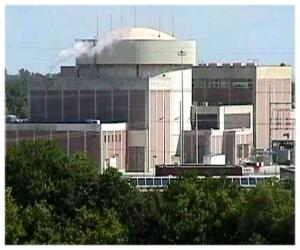
Fort Calhoun Station in Washington County, Neb.
|
Fort Calhoun Nuclear Plant Recommended for Closure; Other Midwestern Plants in Limbo
Officials at Omaha Public Power District (OPPD) announced last month a recommendation that the utility cease its operations at Fort Calhoun Station by the end of 2016 and begin the decommissioning process.
According to an OPPD news release, President and CEO Tim Burke attributed the recommendation to trends in the nuclear industry, including slow revenue growth, market conditions, and increasing regulatory and operational costs that would be passed along to their consumers. A vote on the recommendation is anticipated at a June 16 meeting of the OPPD Board of Directors.
Meanwhile, Exelon is expected to announce today the first steps toward closing two of its nuclear plants in Illinois, reports WTTW's Chicago Tonight. The utility was hoping state legislators would pass a bill that would provide financial assistance for its Quad Cities and Clinton plants, but the Illinois General Assembly adjourned spring session on Tuesday without acting on the legislation.
U.S. Senate Passes Rail Safety Bill
Last month the U.S. Senate unanimously passed a bipartisan bill intended to improve emergency responder training and resource allocation for hazardous materials incidents along railroads.
S. 546, sponsored by Sen. Heidi Heitkamp (D-N.D.), directs the Federal Emergency Management Agency to establish the Railroad Emergency Services Preparedness, Operation Needs and Safety Evaluation (RESPONSE) Subcommittee of the National Advisory Council.
According to the bill summary, the RESPONSE Subcommittee would be responsible for evaluating the following:
- the quality and application of training for local emergency first responders related to rail hazardous materials (hazmat) incidents, with a particular focus on local emergency responders and small communities near railroads;
- the effectiveness of funding levels related to training local emergency responders for rail hazmat incidents, with a particular focus on local emergency responders and small communities;
- a strategy for integration of commodity flow studies, mapping, and access platforms for local emergency responders and how to increase the rate of access to the individual responder in existing or emerging communications technology;
- the need for emergency response plans for rail, similar to existing law related to maritime and stationary facility emergency hazmat response plans;
- the need for a rail hazmat incident database;
- increasing access to relevant, useful, and timely information for the local emergency responder for training purposes and in the event of a rail hazmat incident; and
- determining the most appropriate agencies and offices for the implementation of the recommendations.
The bill passed the Senate on May 9 and awaits a hearing in the House Committee on Transportation and Infrastructure.
Thanks to MRMTC member Jon Schwarz (Nebraska) for sharing this news.
NRC Addresses Some Nuclear Misconceptions
On the lighter side of the news, the Nuclear Regulatory Commission (NRC) last month posted responses to some of the interesting comments received on their Facebook page in a two-part blog series entitled "A Bit of NRC Myth Busting." According to the blog, one Facebook user had several ideas for dealing with spent fuel including "mixing it in glass" and then burying it "in ice in Antarctica" or "blasting the glass off to Venus or Mars."
Read NRC responses to this comment and more, in Part I and Part II of the myth busting series.
|
|
Thank you for reading. With this edition the newsletter is shifting to a first Thursday schedule, so watch for the next edition to come out on July 7, 2016.
|
Please do not reproduce or create new content from this material without the prior express written permission of CSG Midwest.
This material is based upon work supported by the Department of Energy under Award Numbers DE-NE0000555, DE-EM0002121, and DE-EM00002327.
This report was prepared as an account of work sponsored by an agency of the United States Government. Neither the United States Government nor any agency thereof, nor any of their employees, makes any warranty, express or implied, or assumes any legal liability or responsibility for the accuracy, completeness, or usefulness of any information, apparatus, product, or process disclosed, or represents that its use would not infringe privately owned rights. Reference herein to any specific commercial product, process, or service by trade name, trademark, manufacturer, or otherwise does not necessarily constitute or imply its endorsement, recommendation, or favoring by the United States Government or any agency thereof. The views and opinions of authors expressed herein do not necessarily state or reflect those of the United States Government or any agency thereof.
|
|
|