January 2024 | The Council of State Governments | Midwestern Radioactive Materials Transportation Committee

Midwestern Radioactive Materials Transportation Committee Newsletter

Upcoming Events

*All times are Central Time

January 17-18:

Institute of Nuclear Materials Management 37th Spent Fuel Management Seminar - Alexandria VA

January 24-25:

Tribal Radioactive Materials Transportation Committee (TRMTC) Mid-Year Meeting - Carlsbad, NM

March 10-14:

Waste Management (WM) Symposia WM2024 Conference - Phoenix, AZ

June 3 - 6:

2024 Annual Meeting of the National Transportation Stakeholders Forum (NTSF) - Denver, CO

June 10 - 24:

IAEA International Symposium on the Management of Spent Fuel from Nuclear Power Reactors - Vienna, Austria

Join Our Mailing List!
Committee Happenings

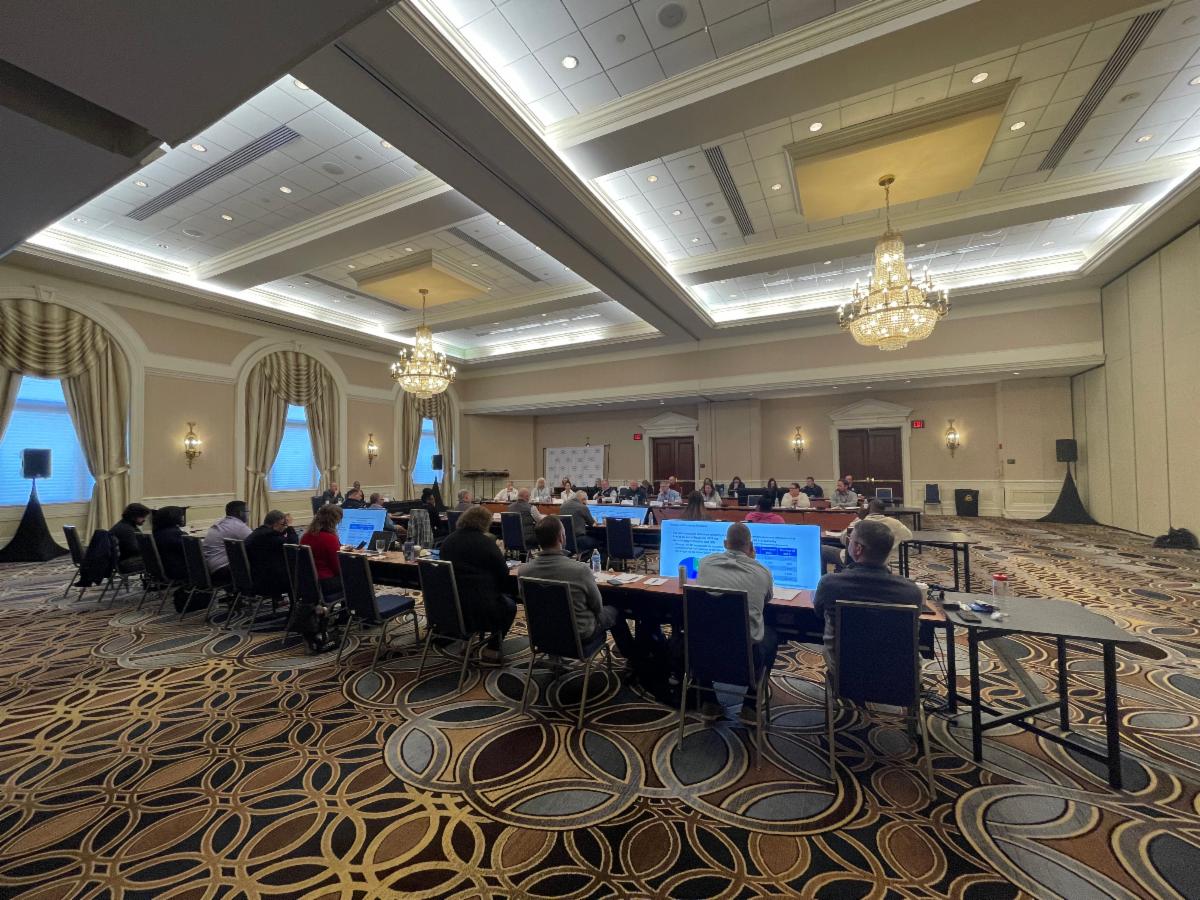
The Midwestern Radioactive Materials Transportation Committee (MRMTC)'s CSG-Midwest staffer Mitch Arvidson attended the Southern States Energy Board (SSEB), which convened a Joint Meeting of its Radioactive Materials Transportation Committee and the Transuranic Waste Transportation Working Group on December 13. Committee members from the 15-state southern region gathered with staff from the U.S. Department of Energy (DOE), national laboratories, and other interested parties at the historic Seelbach Hilton Hotel in downtown Louisville, Kentucky.


In a day filled with interesting sessions and presentations, a few stood out. The “Rail Transportation Panel” featuring Andy Elkins of the Association of American Railroads (AAR), Patrick Brady of BNSF Railway, and Jeffrey Moore of the U.S. Federal Railroad Administration (FRA) was a great overview of the complexity of transporting radioactive materials via rail whilst demonstrating the collaboration between the rail industry and state and federal governments. The “Planning and Execution of Texas Waste Isolation Pilot Plant Transportation Exercise (WIPPTREX)” demonstrated the intense, 16-month, state-led effort to bring a WIPPTREX to West Texas earlier this year. Finally, the “Package Performance Study/Stakeholder Engagement” was an interactive discussion of what stakeholders would like to see from an eventual DOE-led full-scale testing of spent nuclear fuel (SNF) transportation casks.


On Thursday, December 14, attendees were able to receive a training on the Stakeholder Tool for Assessing Radioactive Transportation (START), much like the attendees at the MRMTC Spring 2023 Meeting in St. Louis, Missouri.


In other news, we are happy to announce that Melissa Shahzadeh transitioned to a full-time member of the CSG-Midwest team on the first day of the new year. Melissa was serving the MRMTC in a part-time capacity since her onboarding in April 2023, and we are delighted to bring her fully into the fold in 2024. Mitch will continue in his role as Program Manager but will be delegating more of the day-to-day responsibilities of the MRMTC to Melissa in her new role as Senior Policy Analyst. Whilst Melissa's travel schedule for 2024 has not yet been set, anticipate seeing much more of her in future.

Who Wore It Better?

"Clothes make the man. Naked people have little or no influence on society." -- Mark Twain

CSG-Midwest's Mitch Arvidson and CSG-East's Uldis Vanags are featured in this, the inaugural Who Wore It Better e-newsletter segment, an insouciant study of panache made manifest in the MRMTC. This month we have the indisputable winning combination of plaid and mustachios. But Mitch really wants to know, "Who at CSG has the best mustache?" (Note: it is not Melissa.)

National Transportation Stakeholders Forum

Members of The National Transportation Stakeholders Forum (NTSF) Communications & Outreach Ad Hoc Working Group met on December 11 after a protracted hiatus. DOE's Gregory Harland is now the point of contact (POC) for the working group, and the December meeting was an hour-long info-session on DOE's Atlas Railcar project, the Consent Based Siting efforts, and the package performance demonstration (PPD) that is in process.


DOE's Patrick Schwab highlighted the success of the Atlas railcar project and described the vehicle designed in collaboration with the Navy as "one of the safest railcars ever built." Atlas will be used to transport commercial spent nuclear fuel (SNF). Whilst the project was expected to conclude by the end of 2023, the projected date is now mid-2024.


Michael Schultze from Oakridge National Laboratory also spoke about the development of the integrated security and safety monitoring system (ISSMS) for the DOE's SNF railcars that will meet Association of American Railroads (AAR) standard S-2043 safety requirements, standard S-9401 Railroad electronics environmental requirements and system management, and DOE security requirements for rail transport of SNF.


Pacific Northwest National Laboratory (PNNL)'s Miriam Juckett spoke about the PPD that is in planning. The intention driving the effort includes the desire to build trust and confidence in the safety of SNF transportation casks and SNF transportation by rail, to gather technical data to further validate computer models, and to explore opportunities to strengthen relationships between DOE and the public, among other reasons. The preliminary planning documents for the PPD were submitted in August and September of 2023 and are currently undergoing legal review.


Also in December, the NTSF Planning Committee met. NorthWind's Christie Selvig provided updates on the 2024 NTSF meeting by presenting hotel layout graphics that offered a visual understanding of how the NTSF might utilize the space, including location of registration tables, exhibit booths, newcomer breakfast, etc. The question of the relative benefits of theatre seating or crescent-round seating was also discussed. A draft agenda was presented, which included plans for which sessions would take place in which space. Subsequently NorthWind's Elizabeth Helvey spoke about the breakout sessions and indicated that one will focus on the package performance demonstration and another on Uranium Hexafluoride down-blending. There was also conversation about whether a registration fee will be charged to offset the costs of using a registration platform.


Melanie Synder of the Western Interstate Energy Board spoke briefly about the planning status of the 2025 meeting and provided an update on a proposed Civil Support Team webinar in January.


Updates on ad hoc working groups were limited, as COVID seems to be making the rounds again. DOE's Sara Hogan will provide an agenda for her next meeting on 180 (c) that will convene on January 8, and she noted that a fact sheet is under development.

Focus This Month

DOE-Office of Inspector General Audits DOE Nuclear Waste Fund (DOE-NWF)

The DOE Nuclear Waste Fund's Fiscal Year 2023 Financial Statement Audit Report was recently released and presented the results of an independent certified public accountants' audit of the balance sheets of the DOE-NWF at the conclusion of the Federal fiscal years 2022 and 2023 (FY22 and FY23).The report also includes related statements of net cost, changes in net position, and combined statements of budgetary resources for the years under review.


The 33-page report is effectively a review of the pecuniary disposition of the DOE-NWF, which was established under the Nuclear Waste Policy Act (NWPA) of 1982. The NWPA requires generators of nuclear waste to pay their share of disposal costs into the NWF, and it establishes a fee for electricity generated and sold by civilian nuclear power. Fees collected in excess of expenditures are invested in treasury securities that earn income for the NWF. The NWPA requires preparation of the annual financial statements that are the focus of this report.


In 2011, the Office of the General Counsel (OGC) became responsible for ongoing litigation and oversight of regulatory activities associated with NWPA, the NWF, and the Standard Contracts -- effectively understood as the agreement between DOE and producers of commercial nuclear waste for the disposal of SNF and/or High-Level Radioactive Waste. In 2013, DOE issued a strategy for the management of nuclear waste that hinged on three assumptions: 1) a pilot storage facility would be operational by 2021 to allow for the removal of SNF from shut down reactors; 2) a larger interim storage facility would be operational in 2025 to begin the removal of SNF from operating nuclear power reactors; and 3) a repository would be operational by 2048.


In accordance with the requirements of the NWPA, DOE entered into more than 69 Standard Contracts with utilities in which DOE agreed to begin disposal of SNF by January 31, 1998 in return for payment of fees into the NWF as described above. However, as DOE currently has no facility available to receive SNF under the NWPA, it has not been able to dispose of the utilities' SNF as required by these contracts. This has resulted in ongoing litigation.


As of September 30, 2023, cumulative billings from NWF fees and Defense Nuclear Waste Appropriations totaled approximately $25.4 billion. The cumulative interest earnings and other revenue totaled approximately $36.3 billion. Also as of September 30, the cumulative expenditures by the DOE totaled approximately $11.5 billion. Thus, at the end of FY23, the value of the NWF investments including fees and accrued interest due from utilities totaled $50.2 billion. The estimated remaining liability from SNF litigation associated with the partial breach of the contracts to dispose of SNF by 1998 was estimated at $34.1 billion at the end of FY23. It should be noted that judgments and settlements for damages related to that partial breach are paid out of a Judgement Fund and not the NWF, and that this value will continue to increase with each additional year of deferral of the storage and/or disposal of SNF.


Auditors also considered the NWF's internal controls over financial reports and tested for compliance with myriad provisions of laws, regulations, contracts, and grant agreements. The audit did not identify any deficiency in internal control over financial reporting. Additionally, the review unearthed no instances of noncompliance or other matters under Government Auditing Standards or other applicable guidance to be reported. The audit noted the deferral of SNF disposal represents a "significant issue" and outlined DOE's ongoing efforts toward improvement. The report highlights the continued work with multidisciplinary teams to further consent-based siting, storage design, transportation preparations, and other program areas as actions geared toward compliance with the Consolidated Appropriations Acts 2021, 2022, and 2023 in which Congress appropriated funds to finance the efforts to identify potential sites for Federal interim storage facilities.

Nuclear News

Illinois Governor Signs Law Lifting Moratorium on New Nuclear Reactors

In November 2023, AP News reported that the Illinois Senate approved lifting a 36-year old moratorium on new nuclear power facilities. On December 8, Illinois Governor Pritzker signed the legislation that now allows new nuclear development in the state. Under the legislation, Illinois will allow the development of small modular reactors (SMRs) beginning in January 2026, when a report on necessary safety measures and updated guidelines will be due. Whilst environmentalists argue that wind and solar power are sufficient to replace fossil fuels, supporters of the legislation emphasize that the state's plan to close coal-fired power plants by 2045 hinges in part on subsidies for two nuclear plants so that they can maintain operation to meet baseline energy needs. Read more about this development here.


New Nuclear Approved by the Nuclear Regulatory Commission (NRC)

The U.S. granted permission for a new type of nuclear reactor in December -- a significant decision and the first in more than 50 years. California's Kairos Power received a construction permit from the NRC to build its Hermes demonstration reactor in Tennessee. The Kairos technology employs molten fluoride salt as a coolant, which is a deviation from traditional water-cooled reactor technology that has dominated the commercial field to date. Kairos' construction will begin in 2024 on its $100 million project with a completion target of the end of 2026. Their goal is to demonstrate the viability of their design and the molten salt technology, which is occasionally described as being a "passive safety" design. As molten salts remain liquid at high temperatures and low pressure, some argue this technology has a safety advantage over traditional water-cooled systems. Fortune reports that the NRC last approved a new nuclear design in 1968. Read more at the Kairos Power website.


CN to Acquire Iowa Northern (IANR)

It was reported on December 6 that CN signed and closed an agreement to acquire IANR, an approximately 275-mile U.S. regional railroad that interchanges in Waterloo and Cedar Rapids, Iowa. IANR is the railroad servicing the Duane Arnold Nuclear Power Plant. Whilst the terms of the agreement were not disclosed, the transaction "represents a meaningful opportunity to support the growth of local business by creating single-line service to North American destinations, while preserving access to existing carrier options," according to a CN representative. Established in 1984, IANR "serves upper Midwest agricultural and industrial markets and handles approximately 60,000 carloads annually of commodities such as biofuels and grain." IANR interchanges with Union Pacific (UP) at Manly, Iowa; Canadian Pacific Kansas City at Nora Springs, Iowa; and UP at Cedar Rapids, Iowa. Read more about the acquisition at the Railway Age.


Holtec Plans Two Small Modular Reactors (SMR) Units at Michigan's Palisades Site

Holtec announced on December 4 that they have begun a program to build two SMR-300 reactor units at the Palisades site in Cover Township, Michigan. The extant Palisades refurbishment program is in process and the plant is on track to be restarted in 2025 with myriad enhancements. The existing 8000-megawatt (MW) plant with be augmented by the additional SMRs, which will nearly double the site's total energy generation capacity. The filing of the Construction Permit Application (CPA) for the Holtec SMRs is expected in 2026 after the existing plant is returned to service. The target commissioning date for the first SMR-300 is mid-2030. Holtec's SMR has been in development since 2011 and the design has evolved to include "forced flow capability overlayed on gravity-driven flow in the plant's primary system." The SMR remains "walk-away safe," according to Holtec, with its redundant passive safety systems that operate without any operator action or any external source of electricity or cooling water. Read more about this project at the Holtec website.

Thank you for reading. Watch for the next edition coming out on

February 1, 2024.

Missed a newsletter? Past issues are archived on the committee's webpage.
DOE Nuclear Awardee Logo

Please do not reproduce or create new content from this material without the prior express written permission of CSG Midwest.


This material is based upon work supported by the Department of Energy under Award Numbers DE-EM0005277, DE-NE0009117, and DE-EM0005281. Logo was developed by the U.S. Department of Energy to indicate receipt of DOE funding. Not an endorsement by DOE.


This report was prepared as an account of work sponsored by an agency of the United States Government. Neither the United States Government nor any agency thereof, nor any of their employees, makes any warranty, express or implied, or assumes any legal liability or responsibility for the accuracy, completeness, or usefulness of any information, apparatus, product, or process disclosed, or represents that its use would not infringe privately owned rights. Reference herein to any specific commercial product, process, or service by trade name, trademark, manufacturer, or otherwise does not necessarily constitute or imply its endorsement, recommendation, or favoring by the United States Government or any agency thereof. The views and opinions of authors expressed herein do not necessarily state or reflect those of the United States Government or any agency thereof.