|
Call for Papers: Special Issue of Action, Criticism, and Theory for Music Education
Music Education in the Age of Capitalist Realism
Sean Powell, Guest Editor (University of North Texas)
| |
The late British philosopher, music critic, and political theorist Mark Fisher (1968–2017) coined the term capitalist realism to describe the ideological frame that undergirds our current social, cultural, economic, and political life-worlds. He summarized the concept with the phrase, “it’s easier to imagine the end of the world than the end of capitalism.”[1] As he explained, “That slogan captures precisely what I mean by ‘capitalist realism’: the widespread sense that not only is capitalism the only viable political and economic system, but also that it is now impossible even to imagine a coherent alternative to it.”[2] Fisher further described the ideological nature of this concept thus:
Capitalist realism as I understand it cannot be confined to art or the quasi-
propagandistic way in which advertising functions. It is more like a pervasive
atmosphere, conditioning not only the production of culture but also the regulation of
work and education, and acting as kind of an invisible barrier constraining thought and
action.[3]
After the fall of the Berlin Wall and the dissolution of the Soviet Union, philosopher Francis Fukuyama famously claimed in 1989 that we had reached “the end of history”—that, with the defeat of “actually existing socialism” by capitalism, we had reached the “the end-point of mankind's ideological evolution and the universalization of Western liberal democracy as the final form of human government.”[4] The future development of political and economic systems was therefore, in his view, foreclosed. For Fisher, capitalism is “realistic” in that it serves as the unnoticed background within which we act. It seems to be the natural state of the world to those who have lived their lives in capitalistic societies. In this way, capitalist realism is ideological, in that it structures the parameters of reality while going largely unquestioned.
Similarly, American political theorist Wendy Brown sees our current predicament as one in which the market tenets of neoliberal capitalism have spread—without significant resistance or debate—from the economy proper to all areas of social, cultural, and political existence. Invoking Frankfurt School philosopher Herbert Marcuse, she describes this situation as the “closing of the political universe—the erasure of intelligible, legitimate alternatives to economic rationality.”[5] Not only has neoliberal capitalism constructed a new economic and material reality, its advance marks “a new production of subjectivity.”[6] Within this frame, all aspects of life, even those previously outside the economic sphere, are subjected to the model of the market as human beings are configured “exhaustively as market actors, always, only, and everywhere as homo oeconomicus,”[7] even when direct profit-making is not enacted.
The capitalist base of society serves as the “pervasive atmosphere” within which music education exists in many nations. For example, in many contexts, teachers have developed a sense that organizing music education around competition is the only viable system, and it has thus become impossible for them to imagine alternatives to the competitive structures that undergird so many music programs, converting the use value of musical learning into the exchange value of competitive scores.[8] In these school music contexts, structuring music learning as competition “seamlessly occupies the horizons of the thinkable”[9] as an a priori, taken-for-granted substructure of music education.[10] In addition to this competitive structure, capitalist realism’s effects (market logic, business ontology, entrepreneurial ethos, instrumental aims, economic centering and marginalization, hierarchical structures, precarity and scarcity, etc.) appear in music education in myriad ways.
Capitalism is the pre-given, taken-for-granted base upon which the global hegemonic economic system’s social superstructures—including music education systems— are built. The effect of this system reaches people in nominally non-capitalist nations. Given these dynamics, this special issue of ACT invites manuscripts that examine and critique capitalist realism as it relates to the theory and practice of music education. While we seek manuscripts that employ Fisher’s concept of capitalist realism as a frame, a direct, explicit engagement with Fisher’s work is not required (although it is certainly welcome). [11] Authors are also strongly encouraged to engage with scholarship previously published in ACT that addresses issues of capitalism and socioeconomic status.[12]
Possible themes may include but are not limited to:
· How can music education (and/or the arts in general) contribute to a critique and/or amelioration of capitalism’s effects? Given Fisher’s background as a music critic (aka the music blogger k-punk), how does music, in particular, factor into this theoretical matrix?
· What possible alternatives can we offer to capitalist realism? What are the conditions of possibility for conceiving of such alternatives? How could or should music education appear differently under such alternative scenarios?
· How does an intentional (re)focus on a critique of capitalist ideology within music education scholarship and praxis—with its centering of the class struggle—inform, augment, intersect, or potentially conflict with scholarly critiques centered on other oppressive social structures (e.g., racism, sexism, homophobia, transphobia, ableism)?
· How can a return to the critical dimension (combating post-political ideology) offer space for envisioning alternative modes of music teaching and learning without succumbing to naïve utopianism? How can we combat “the commodification of political engagement and the reduction of politics to the performative signaling of political affiliation and support which forestalls an ‘actual’ political agency towards palpable material change?”[13]
· Given Fisher’s focus on post-Fordist finance capitalism as it manifests in the Global North (in the U.K. and U.S. in particular), how might the critique of capitalist infused music education practices appear different in other settings?
· What are the potential deficiencies within the capitalist realism concept of ideology critique as it relates to music teaching and learning?
· How have the technological, social, cultural, and economic changes that have occurred since 2009 (the publication year of Capitalist Realism) weakened or strengthened Fisher’s position, and what are the implications for music education?
· How can the explicit capitalist intervention in music education (e.g., corporate sponsorship of music education as a market-building strategy, public-private partnerships, outsourcing public education to private interests, the interpellation of music teachers and students as “entrepreneurs,” school choice, vouchers, charter schools) be critiqued and challenged, and what alternative models could be considered?
· How can an analysis of the capitalist commodification of music, which leverages desire by producing phantasmal objects for consumption, problematize the use of “popular” music in education?
· Can a renewed emphasis on economic class dynamics in music classrooms inform a reconceptualized framework for music education philosophy, advocacy, and praxis?
· Do current (or historical) philosophies or approaches to music education knowingly or unwittingly support capitalist exploitation?
Submission Deadline: Please submit your manuscript as a Word document via e-mail, no later than January 1, 2024 to Dr. Sean Powell at sean.powell@unt.edu, copied to the ACT Editor Dr. Lauren Kapalka Richerme at lkricher@indiana.edu.
Submission Guidelines
Action, Criticism, and Theory for Music Education is devoted to the critical study and analysis of issues related to the field of music education. ACT welcomes submissions from diverse perspectives (e.g. education, music, philosophy, sociology, history, psychology, curriculum studies), dealing with critical, analytical, practical, theoretical, or policy development concerns, as well as submissions that seek to apply, challenge, or extend the MayDay Group’s Action Ideals.
Article Length: ACT imposes no set restrictions on length. However, authors may be asked to shorten submissions where reviewers or the editor determine that an essay’s length is not warranted by its content.
Formatting: Please format submissions using the most recent edition of the Chicago Manual of Style’s “author-date system” with the following three adaptations: 1) omit quotations marks around titles in reference lists, 2) follow APA conventions for capitalization in reference lists, and 3) use closed ellipses (necessary for html formatting). Endnotes are permitted. Audio and video materials are encouraged. Also, ACT encourages the use of “they” (and any derivation) as a singular, gender-neutral pronoun. Consult a recent issue of ACT or contact the editors for more information if required.
Abstract and Keywords: Submissions must be accompanied by a brief abstract (ca. 100–150 words) and a short list of keywords.
About the Author: Include a 100–150-word biography for each author.
Languages: Following ACT’s special issue guidelines on the Decolonization of Music Education, and with the purpose of actively diversifying knowledge creation strategies, this special issue also welcomes manuscripts that were originally published in a language other than English and in a venue not commonly accessible by all. Submitters are required to provide the English translation of their submissions.
Peer Review Process: ACT submissions are subject to a rigorous process of anonymized peer review. Final publication decisions rest with the editors (in consideration of reviewer recommendations).
Notes
[1] Mark Fisher, Capitalist Realism: Is There No Alternative? (Winchester, UK: Zer0 Books, 2009), 2.
[2] Ibid.
[3] Ibid., 16.
[4] Francis Fukuyama, “The End of History?” The National Interest, no. 16 (1989): 3–18. http://www.jstor.org/stable/24027184.
[5] Wendy Brown, Undoing the Demos: Neoliberalism’s Stealth Revolution (New York: Zone Books, 2015), 68.
[6] Rachel Greenwald Smith, Affect and American Literature in the Age of Neoliberalism (New York: Cambridge University Press, 2015), 5.
[7] Brown, Undoing the Demos, 31.
[8] Joseph Michael Abramo, “The Phantasmagoria of Competition in School Ensembles,” Philosophy of Music Education Review 25, no. 2 (2017): 165.
[9] Fisher, Capitalist Realism, 8.
[10] Sean Robert Powell, The Ideology of Competition in School Music (New York: Oxford University Press, 2023), 29.
[11] For an example of the use of the concept of capitalist realism as an analytical frame in music education scholarship, see Chapter 2, “It’s Easier to Imagine the End of Music Education Than then End of Competition,” in Powell, The Ideology of Competition in School Music.
[12] For example, see (among many others) articles appearing in the special issue of ACT on neoliberalism and music education (volume 20, issue 3).
[13] Schutzbach, There is an Alternative, 47.
| | |
|
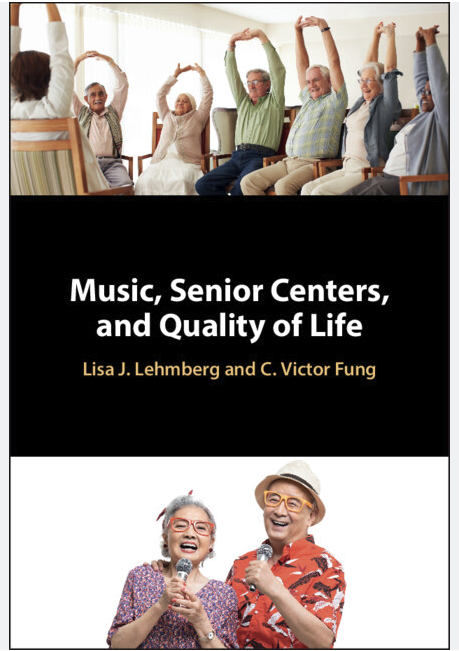
Music, Senior Centers, and Quality of Life
Lisa J. Lehmberg & C. Victor Fung
| |
Music, Senior Centers, and Quality of Life
By Lisa J. Lehmberg and C. Victor Fung
Published by Cambridge University Press
Link: https://www.cambridge.org/core/books/music-senior-centers-and-quality-of-life/7F75CD19DDE157B41758E1747492D275
“Lisa Lehmberg and Victor Fung present a groundbreaking look at quality of life via the music participation of older adults in diverse US senior centers. The state of musical activities in senior centers pre- and mid-pandemic is elucidated through original research conducted in senior centers across six states. Featured are older adults' stories told in their own words; insights from senior center activity leaders, management, and staff; and data, analyses, and syntheses from the authors' senior center visits and a survey of center managers. The authors document the adjustment process undergone by these centers during the pandemic and leading into a new normal. Recommendations are offered for policy makers, school and community music educators, music activity leaders, older adults, caregivers, and service providers to enhance the quality of life of older adults. The critical role that music plays in supporting their quality of life is emphasized” (Cambridge University Press, 2023).
Lisa J. Lehmberg is Professor and Coordinator of Music Education at the University of Massachusetts Amherst. C. Victor Fung is Professor of Music Education and Director of the Center for Music Education Research at the University of South Florida.
| | |
Conferences, Workshops, & Calls | |
ISME 2024 World Conference
Call for Proposals
| |
The International Society for Music Education (ISME) invites submissions for the 36th World Conference from July 28th to August 2nd, 2024.
The 2024 ISME World Conference aims to foster global understanding and co-operation among the world’s music educators. By strengthening ties and sharing ideas about diverse aspects and issues within music education, the 2024 ISME World Conference helps to promote music education worldwide for people of all ages.
The theme for the 2024 ISME World Conference is Advocacy for Sustainability in Music Education.
Music education has a crucial role in advancing the wellbeing of the individual, community and society. The uncertain times further highlight the importance of envisioning, exploring, and advocating for the many opportunities music education can offer for enhancing a sense of belonging, equity, and inclusion as well as ecological sustainability. What can we learn from the other arts, Indigenous traditions, and past and emerging musical practices around the world in our efforts of advancing resilient societies and ecosystems? And how could we ensure equitable access to music learning opportunities and participation within the wide variety of musics? The 36th World Conference provides a platform that invites music educators and other stakeholders to ask novel questions, imagine ways forward, and create new partnerships for change. The conference will open avenues to explore a sphere of possibilities for pursuing and advocating for sustainability in and through music education.
In addition to the World Conference each of the eight ISME Commissions will hold their own Pre-conference seminars in the week prior to the world conference.
Proposals for papers, posters, symposia, and workshops are invited from participants worldwide. ISME encourages submissions that align with the conference theme Advocacy for Sustainability in Music Education from researchers and practitioners at all career stages including graduate students and early career professionals.
Key dates
Call for submissions
Opens April 25th, 2023
Closes October 2nd, 2023
Acceptances January 31st, 2024
Call for performance submissions
Opens April 25th, 2023
Closes September 15th, 2023
Acceptances October 15th, 2023
Pre-conference seminars submission
Opens May 15th, 2023
Closes November 1st, 2023
Acceptances February 28th, 2024
Before starting your submission, please read carefully the instructions in Key Submission Information and Guidelines for Authors.
For more information, please visit: https://www.ismeworldconference.org/submission-instructions
| | |
Australian Society for Music Education Conference
Music Unleashed
| |
The Australian Society for Music Education exists to encourage and advance music education at all levels as an integral part of general education and community life, and as a profession within the broad field of music.
The ASME 2023 National Conference theme is Music Unleashed, which suggests music education that is unconstrained by conventions, politics, instrumental, or vocal forces. Music Unleashed is committed to promoting diversity, inclusion, and agency in all learning contexts.
Support the Conference!
The convenors of the ASME XXIV National Conference wish to invite your organisation to become involved as a sponsor for the ASME conference, being held from 3–6 July, 2023 at the Sydney Conservatorium of Music, Sydney, Australia.
Music unleashed is committed to promoting diversity, inclusion and agency in all learning contexts. We are confident your involvement will bring benefits to both your organisation and the wider music education community.
Being involved as a sponsor or exhibitor at the conference you will:
• have exposure to a receptive audience who are passionately committed to music education
• have access to decision makers in educational institutions
• have contact with a wide range of attendees from around Australia and overseas
• gain exposure through the promotion of the conference
We hope to see you at ASME 2023!
| | |
World Music Pedagogy Summer Offerings | |
The World Music Pedagogy course weaves together experiences in music, cultural meaning, and culturally sensitive pedagogical strategies, and provides for active listening episodes leading to participatory, performative, and creative musical experiences—all tailored to fit learners of various ages and experiences. The course emphasizes the teaching of global-local music for intercultural understanding, and attends to culturally relevant pedagogy as it pertains to music education practices. Featured resources in the course are selections from the reserves of Smithsonian Folkways Recordings and the World Music Pedagogy series of books/recording links, all directed to the ways of knowing the world of music, in music, and through music. All are welcome, including music educators, all-subject educators, artist-musicians, applied ethnomusicologists, curricular designers, community organizers, and all who are seeking further insights on musical-cultural diversity, equity, and inclusion.
Online Webinar Course
World Music Pedagogy: Teaching Music/Teaching Culture
Dates: June 26–28
Location: Online, Delivered by Zoom
Course Directors: Amanda C. Soto and Patricia Shehan Campbell
Texas State University
World Music Pedagogy: Teaching Music/Teaching Culture
Dates: June 19–23
Location: San Marcos, Texas
Course Director: Amanda C. Soto
University of St. Thomas
World Music Pedagogy
Dates: June 26–30
Location: St. Paul, Minnesota
Course Director: Karen Howard
West Virginia University
World Music Pedagogy: Celebrating Global and Local Music Culture
Dates: June 26–30 (9:00–4:30)
Location: Morgantown, West Virginia
Course Director: Janet Robbins
University of Hartford
Dates: July 5–8
Location: Hartford, Connecticut
Course Director: Juliana Cantarelli Vita
Laval University
Dates: August 14–18
Location: Quebec City, Quebec
Course Director: Valerie Peters
*Note: This seminar will be conducted in French, with a possibility of shadowing participants who need English translation
For more information and to register:
https://folkways.si.edu/world-music-pedagogy-courses
| | |
|
Assistant Professor of Music Education
North Carolina Central University
Durham, NC
The Music Department at North Carolina Central University seeks an Assistant Professor, Music Education. The position requires duties to coordinate the curriculum and course activities for NCCU’s Department of Music’s concentration in Music Education, under their Bachelor of Music degree. Duties will include being a liaison with the NCCU School of Education to facilitate matriculation for music majors in obtaining licensure and preparatory activities for teacher training.
The role of the Music Education Coordinator requires one year of experience in program administration or an equivalent combination of relevant education and/or experience involving academic, instructional, or advising activities to plan, coordinate and implement a variety of program activities and events for Music Education majors.This is a tenured/tenure track, full-time position to begin July 1, 2023. As a member of the faculty, the successful candidate will be expected to perform duties as assigned and required by the Music Department and the University including recruiting students, building professional relationships with local, regional, national, and international jazz organizations, serving as a liaison to high school music programs, participating in department, university, and professional service, and maintaining a roster of creative and/or scholarly activities.
Favorable candidates will have a record of national expertise with pedagogy associated with a variety of performance ensembles in several genres of music, a record of collegiality, working knowledge of music technology, and evidence of awards and recognition for professional and academic achievements.
The preferred candidate will have earned an MM, DMA, or PhD in Music Education, or equivalent Music degree, and a current North Carolina teacher’s certification. At least 5 years of successful K-12 teaching, and at least 1 year teaching at the university level is recommended. Experience with secondary choral music education, literature, and pedagogy and a record of, or potential for, research and scholarly contributions in the music education field is also necessary.
North Carolina Central University is an equal opportunity and affirmative action employer. All qualified applicants will receive consideration for employment without regard to age, color, disability, gender, gender expression, gender identity, genetic information, national origin, race, religion, sex, sexual orientation, or status as a protected veteran.
To apply, please click here. Review of applications will be begin May 31.
| | |
|
Assistant Professor of Music (Education)
Bethune-Cookman University
Daytona Beach, FL
Founded by Dr. Mary McLeod Bethune in 1904, Bethune-Cookman University (B-CU) is a historically Black, United Methodist Church-related university located in Daytona Beach, Florida. The university currently boasts an undergraduate population of 2,700 undergraduates, with 130 music majors, 60 of whom are Music Education students. Students graduating from the B-CU Music Education program receive a Bachelor of Arts in Music Education with K-12 vocal and instrumental certification in the state of Florida.
This tenure-track appointment reports to both the School of Education and the Department of Music, with teaching assignments that may be housed in either area. Primary assignments include teaching courses related to music education, including elementary and secondary music methods, and supervising student interns involved in both field observations and student teaching. Candidates with appropriate qualifications may also be assigned to teach other courses as teaching load allows.
ESSENTIAL FUNCTIONS:
- Teaching a variety of music education courses
- Teaching other courses in music or education as load and qualifications allow
- Supervising student teaching and practicum interns placed at schools throughout Volusia county
- Advising the department of suggested curriculum and program changes
- Assisting with student advisement, recruitment, and retention activities
- Maintaining strong working relationships with Volusia County music instructors, ensemble directors, and district officials
- Maintaining affiliations with appropriate state, district, and national professional associations
- Participating in department, school, and university committees and initiatives, as assigned
- Serving as an advisor to the student chapter of NAfME
EDUCATION and EXPERIENCE:
- An earned doctorate in Music Education, PhD preferred (ABD with considerable experience in the field/additional graduate work will be considered.)
- Collegiate level teaching experience is desired and preference is given to candidates with K-12 teaching experience.
- Orff Certification, Kodaly and Dalcroze training desired
- Preference given to candidates with vocal or wind instrument teaching experience
To apply, please click here.
| | |
|
Visiting Lecturer in Choral Conducting and Music Education
University of Maryland, Baltimore County
Baltimore, MD
The Department of Music at UMBC seeks a Visiting Lecturer of Choral Conducting and Music Education for the 2023-2024 academic year, to begin August 2023.
This individual will be responsible for conducting the Camerata Concert Choir and teaching undergraduate courses in choral music education with additional teaching responsibilities in conducting and/or vocal pedagogy. Additional duties can include other departmental instruction, service, or responsibilities in the candidate’s area of expertise. Applicants who demonstrate a commitment to diversity and inclusion by way of teaching, performing, publishing, or volunteer experiences are urged to submit an application. The UMBC Music Department is particularly interested in receiving applications from individuals who are members of groups that historically have been underrepresented in the professoriate.
A master’s degree or higher in music is required, along with evidence of teaching experience.
The complete application package must include: a letter of interest including a detailed statement of qualifications, a current CV, dated links for up to 3 video excerpts totaling no more than 30 minutes of material demonstrating choral conducting skills (diverse contexts welcome), a separate statement with examples addressing their capacity to respond in pedagogically productive ways to the learning needs of students from diverse backgrounds and three reference contacts. Additional materials may be requested later. Those with experience employing culturally responsive approaches or integrating musical, social-emotional, or social justice learning goals are encouraged to highlight that in their materials.
For best consideration, please submit all application materials through interfolio (http://apply.interfolio.com/124094) by May 22, 2023. Applications will be accepted until the position is filled. For questions, please contact Dr. Lisa Cella, Chair, Department of Music: cella@umbc.edu.
Located in the heart of the culturally rich Baltimore-Washington corridor, the Department of Music is a growing, diverse, and supportive community enrolling 160 undergraduate majors. Housed in the University’s striking new Performing Arts and Humanities Building, the music wing includes a 350-seat performance space with superior acoustics, 9-foot Steinway grand pianos, and fully equipped recording and keyboard labs. All tenure-track faculty maintain robust careers in performance, conducting, or composing on the regional and national level, with many having a research focus in contemporary art-music and some with creative activities that include music as a vehicle for civic engagement and social justice. In addition to its undergraduate degrees, the Department offers a post-baccalaureate Certificate in American Contemporary Music. See https://music.umbc.edu/ for more details.
UMBC, an Equal Opportunity / Affirmative Action Employer, is especially proud of the diversity of its student body and we seek to attract an equally diverse applicant pool for this position. We have a strong commitment to increasing faculty diversity and are particularly interested in receiving applications from individuals who are members of groups that historically have been underrepresented in the professoriate. We encourage applications from women, minority group members, veterans, and individuals with disabilities.
| | |
|
Visiting Assistant Professor, Music Learning and Teaching
Arizona State University
Tempe, AZ
Description:
The ASU School of Music Dance and Theatre seeks a colleague to help us broaden the ways people conceptualize music learning and teaching and expand where and how music education occurs throughout contemporary society. We seek a colleague to support the facilitation of communal music making centered around string instruments from diverse contexts, multiple perspectives, and varied practices. This is a one-year, full-time visiting assistant professor appointment beginning fall 2023. This position is on the ASU Tempe campus.
About ASU
Arizona State University is a new model for American higher education, an unprecedented combination of academic excellence, entrepreneurial energy and broad access. This New American University is a single, unified institution comprising four differentiated campuses positively impacting the economic, social, cultural and environmental health of the communities it serves. Its research is inspired by real world application blurring the boundaries that traditionally separate academic disciplines. ASU serves more than 80,000 students in metropolitan Phoenix, Arizona, the nation's fifth largest city. ASU champions intellectual and cultural diversity, and welcomes students from all fifty states and more than one hundred nations across the globe.
About the School of Music, Dance and Theatre
The School of Music, Dance and Theatre in the Herberger Institute for Design and the Arts at Arizona State University is widely recognized for preparing artists, scholars, visionaries and entrepreneurs to become creative leaders who transform society through their art. Our internationally recognized faculty artists, scholars and guest artists are motivating and compassionate mentors who work with students to cultivate excellence and personal growth. Our nationally recognized programs feature a comprehensive range of degrees plus minors and certificates and more than 600 concerts, events, performances, productions and recitals each year. Located in the culturally rich Southwest in one of the most vibrant, expanding urban centers, our programs afford students access to a diverse environment and engagement in Phoenix’s flourishing arts community. Above all, we value the creativity, personal experience and voice each student brings to the school. For more information on the School of Music, Dance and Theatre, visit musicdancetheatre.asu.edu.
The music learning and teaching area offers a dynamic future-oriented undergraduate degree built on principles of flexible musicianship, innovative practices, inquisitive thinking about music and education, community leadership, justice, and equity. The master’s degree addresses the diverse interests, circumstances, skills, and understanding of people interested in music learning and teaching in any context. The PhD supports a community of highly motivated national and international students to deepen their inquiry, propel their work, and engage as leaders in diverse contexts of music learning and teaching. Undergraduate and graduate students have varied opportunities to collaborate with faculty on research, creative projects and socially embedded community initiatives.
We are looking for someone who will collaborate with us, work in solidarity with our community and think deeply and expansively. We are looking for someone who imagines possibilities and embraces playful thinking. The successful candidate will help us grow the diversity of students entering our programs, help us expand the multiple pathways that students move through and beyond our programs, support the best of what occurs throughout music learning and teaching and help update and transform the status quo. Our new colleague will continue their own research and creative activity, teach and contribute to our learning community, serve with others to forward aspirational goals and collaborate with us and others to build and foster vibrant musical ecologies. Together, we will support our current students, partners, alumni and others to have a tangible positive impact in their communities.
Required Qualifications:
● ABD status or completed doctoral coursework in music education or related field.
● Four or more years of successful music teaching in public and/or private schools or other educational contexts.
● Scholarly/research achievement as demonstrated through publications and presentations;
● Exemplary pedagogical skills and knowledge.
● A record of professional activities in music education.
● Evidence of a commitment to equity and diversity in thinking and representation.
Desired Qualifications: Candidates should provide evidence of demonstrated ability in one or more of these areas:
● Completed doctoral degree in music education or related field.
● Demonstrated ability to provide pedagogical and musical leadership in global approaches to communal music making centered around string instruments from diverse contexts, multiple perspectives, and varied practices.
● Experience with teacher preparation programs.
● Ability to conduct socially engaged research in an interdisciplinary community of scholars and artists, including music therapists, performers, composers, digital artists and scholars in the sciences and humanities.
● Ability to advise and support graduate students’ research, thesis, and dissertation work
● Demonstrated ability to support and mentor equity work.
● Embodiment of and ability to support students’ flexible musicianship, inquisitive thinking, innovative practice, and community leadership.
● Experience with music technology, digital media and/or interactive media.
● Ability to develop, launch, and manage grants or large-scale initiatives.
● Experience working or collaborating with non-profit organizations, government agencies, NGOs, or the corporate sector.
● Ability to develop sustainable and equitable community partnerships and/or collaborations with other universities.
● 5+ years of successful K-12 music teaching in public and/or private schools, or other educational contexts.
Instructions to Apply:
Please submit the following materials as separate items:
1. Please submit a letter of interest, including a narrative addressing the applicant’s qualifications and ability to fulfill the required and desired qualifications and expectations of the position, in particular: work experience, creative activity and/or research, goals for your work at ASU, and commitment to innovative teaching as you imagine it in 2025.
2. A curriculum vitae.
3. A one-page statement addressing the candidate’s commitment to diversity, equity and inclusion.
4. Contact information for three references.
5. An example of research or creative work.
6. One course syllabus developed by the candidate.
7. An unedited video of 15 consecutive minutes of class instruction.
All applications must be submitted electronically via http://apply.interfolio.com/122495.
Application Deadline:
The application deadline is June 4, 2023. Applications will continue to be accepted on a rolling basis for a reserve pool. Applications in the reserve pool may then be reviewed in the order in which they were received until the position is filled.
ASU conducts pre-employment screening for all positions which includes a criminal background check, verification of work history, academic credentials, licenses and certifications.
Arizona State University is a VEVRAA Federal Contractor and an Equal Opportunity/Affirmative Action Employer. All qualified applicants will receive consideration for employment without regard to race, color, religion, sex, sexual orientation, gender identity, national origin, disability, protected veteran status, or any other basis protected by law.
In compliance with federal law, ASU prepares an annual report on campus security and fire safety programs and resources. ASU’s Annual Security and Fire Safety Report is available online at https://www.asu.edu/police/PDFs/ASU-Clery-Report.pdf. You may request a hard copy of the report by contacting the ASU Police Department at 480-965-3456.
COVID-19 Vaccination - Arizona State University is a federal contractor and subject to federal regulations which may require you to produce a record of a COVID-19 vaccination. For questions about medical or religious accommodations, please visit the Office of Diversity, Equity and Inclusion’s webpage
We acknowledge the 22 tribes who are native to Arizona, and more specifically the Akimel O’odham (Pima) and Piipaash or Pee Posh (Maricopa) tribes on whose ancestral homelands ASU’s Tempe campus resides.
| | |
|
Visiting Lecturer, Music Education
University of North Texas
Denton, TX
The UNT Division of Music Education is one of the largest music teacher preparation programs in the United States, with 8 full-time faculty, 8 full-time Ph.D. students, a robust summer master’s program, and an undergraduate student body of over 350. Music Education faculty have a broad array of teaching and research interests, and opportunities for collaboration with the College of Music’s renowned performance and scholarly programs are plentiful.
The University of North Texas College of Music Division of Music Education invites applications for a one-year position at the rank of Visiting Lecturer in Music Education.
Duties: 4/4 teaching load. Teach classes as assigned by the Chair of the Division of Music Education, including but not limited to string methods, secondary orchestra methods, introduction to music education, and the administration/coordination/instruction of the UNT String Project (see https://musiced.music.unt.edu/string-project/home).
Required Qualifications: Doctorate in music education (applicants who have reached ABD status will be considered); expertise as a string/orchestra teacher; and minimum of 3 years teaching experience in the string/orchestra music classroom.
Preferred Qualifications: Evidence of successful college teaching and potential to work with K-12 music teachers in guest clinics, professional music education conferences, and in-service workshops.
Submit a letter of application, curriculum vitae, link to a teaching video (string or orchestra classroom setting preferred), and contact information for three references.
Review of applications will begin immediately and continues until the position is filled.
Questions regarding the position may be directed to Mark Montemayor, search committee chair, mark.montemayor@unt.edu.
For more information and to apply, visit: https://jobs.untsystem.edu/postings/71482
| | |
|
Lecturer in Music (Music Education)
Indiana University, South Bend
South Bend, IN
The IU South Bend Music Department is comprised of a wonderful community of artists, scholars, and students. As part of the Raclin School of the Arts, we offer students a personalized interdisciplinary experience. Students and faculty interact with theatre, dance, fine arts, and communication to expand our boundaries as a musicians. We are proud of our talented, internationally known faculty and small-class settings. We offer a variety of ensembles including a philharmonic, wind band, jazz band, electronic music ensemble, as well as an array of choruses. We truly are a place where our students and faculty can develop their full potential.
We are seeking a Lecturer in Music, beginning August 1, 2023 with the following responsibilities:
- Demonstrate a commitment to leading the department’s Music Education program
- Teach a full-time (12-credit) load per semester including conducting large ensembles (choral or instrumental) and all Music Education courses such as methods, techniques, and introduction to music education as assigned by the Music Department Chair. Note – any faculty member may be required to teach online, on alternate schedules (evenings/weekends), and/or at our campus center in Elkhart
- Recruit students for the Music Education program and to support large ensemble needs
- Attend weekly faculty meetings
- Develop professional relationships with area K-12 teachers
- Mentor students and support student success
- Serve on department, school, and campus committees as requested
- Attend student juries, performance exams, etc. as needed.
DIVERSITY
Indiana University South Bend’s 2021-2026 strategic plan includes a commitment to remove diversity achievement gaps in student retention and graduation rates by fostering opportunities to promote belongingness and community. The campus is integrating anti-racism initiatives into campus programs. Of 4,326 students, 34% self-identify as minorities and 40% are first generation college students. All genders, minorities, individuals with disabilities, and veterans are strongly encouraged to apply. Candidates who have mentored minorities or other underrepresented groups are encouraged to highlight such efforts in the application.
CAMPUS SAFETY AND SECURITY
The Annual Security and Fire Safety Report, containing policy statements, crime and fire statistics for all Indiana University campuses, is available online. You may also request a physical copy by emailing IU Public Safety at iups@iu.edu or by visiting IUPD. https://protect.iu.edu/police-safety/annual-reports/index.html
ACCOMMODATIONS
If you have a disability and need assistance with an application, special arrangements can be made to accommodate most needs by contacting Academic Affairs at: 574-520-4183.
Basic Qualifications
REQUIRED
- Master’s Degree (or equivalent) required.
- Music Education focus either in degree or in K-12 music teaching experience
- Experience in directing a large ensemble such as a choir, band, or orchestra; strong musicianship and conducting skills
- Willingness to develop & support a recruitment plan for large ensembles in conjunction with faculty
PREFERRED
- State-licensed teacher for K-12 (any state)
- Documented evidence of effective K-12 and/or college-level teaching
- Enthusiastic collaborator with clear communication and effective organization skills
- A successful record of student recruitment for ensembles
Department Contact for Questions: Jennifer Muñiz at jemuniz@iu.edu
For more information and to apply, visit: https://indiana.peopleadmin.com/postings/18564
| | | | | |