|
|
Ohio- Crosby, Stills, Nash and Young
May 4, 1970, forty-eight years ago |
|
*How to print articles at bottom of newsletter.
|
|
|
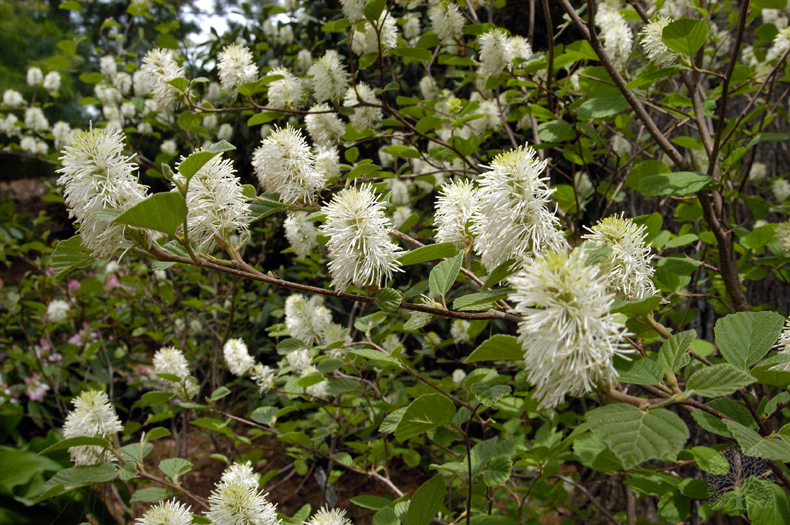
| May flowering Fothergilla Bottle Brush |
If you're looking for something unusual to plant in your garden this year that will catch the eyes of your friends and neighbors, look no further than the fothergilla. Of all the shrubs and trees I have seen in my many years of gardening, this plant stands out because of the flowers it makes in the springtime during April and May. The flowers are white and fragrant a real bonus. Each flower cluster will grow 1 to 2 inches long and about 1 inch wide, not very large, but it is shaped like a baby bottle brush used to clean the used bottle. Each flower petal is 1/2 to 3/4 inches long and tubular, with a tiny opening on the tip that is the thickness of a round tooth pick--delicate.
When the plant is in full bloom, it will look like a Fourth of July firework display on the plant. It is very unusual and the white color of the flowers is bright and showy. As the flower petals begin to form and open, they begin as a green-yellow thread that quickly turns white. The flowers form on the tips of the branches of the plant before the foliage develops and last well until the leaves form on the plant or longer. The best flowers are on plants grown in full sun but if the plant does get some shade, they are still nice, just not as plentiful. Fothergilla will flower every year no matter what the winter weather was like.
The foliage of this plant is also special; each leaf will grow 1 to 3 inches long and about 1 inch wide. It looks like a fat oval leaf with a somewhat blunt tip, and smooth-to-toothed leaf edge, depending on variety. The leaf is dark blue-green and some hybrids are almost blue--in the shade less blue and more green because of less sunlight. In the fall, more magic for your garden, as the foliage will turn yellow, orange, and red on each leaf at the same time. The color is more brilliant in full sun than in part shade, but still beautiful. The color lasts a long time on the plant, and it changes with the colder weather and frost during the fall season.
Fothergilla will do best in a soil rich in organic matter. The more peat moss or compost you add when you plant, the better the plant will grow for you. If your soil is sandy, dig a big hole, remove the sand and backfill with top soil that has been conditioned with compost, animal manure or peat moss. Acidic soil is best for this plant, so be sure to keep lime products away from the plant. Plants like a moist soil to grow in; adding bark mulch on the garden after planting will help retain moisture around the plant during the heat of summer. If your soil has clay in it, it's O.K.--but the plant will not tolerate standing water around its roots. Plant the fothergilla in a raised planting bed if drainage is a problem in your garden. This plant will also grow very well on the side of a sloping hill or embankment to keep the plant happy and healthy.
The branches of this plant seem to all come out of the ground individually in a cluster when the plant is young, and do not branch out until it matures. These branches are strong, upright-growing and gray. The plant grows thick with these branches. When the flowers fade, no fruit or cone will form on the plant. The winter shape is not special, but the plant can tolerate lots of snow on it because of the upright branching and has little to no winter damage. Fothergilla will do well in a climate with -20 degree temperature and grows throughout most of New England and south to Florida.
Fothergilla was not grown much as a landscape plant when I first started to work in the nursery industry during the 60's. In the past 20 years, the plant has created much interest because of its flowers, foliage and hardiness; it can now be found in many nurseries.
Use this plant in a foundation planting around your home, mixed in deciduous shrub beds with quince, forsythia, and the early-flowering Rhododendron mucronulatum or in mass planting with evergreen shrubs that flower at this time of the year, like 'P.J.M' rhododendrons, azaleas and hollies. This plant will make a wonderful background hedge when planted behind the perennial flower garden to draw entrees to your bleeding hearts, hellebores and spring flowering bulbs. In the fall with its yellow, orange and red foliage the plant will add extra excitement to that fall flowering mum growing in your garden.
Fothergilla will grow 2 to 3 feet tall and just as wide if pruned regularly as it finishes flowering. This is the best time of the year to prune the plant and help stimulate more flowers for next spring. If not pruned each year, the plant can grow up to 4 to 5 feet tall and wide. If you can prune every year, the plant will develop a mushroom cap-like appearance making it formal; not pruning it will let it open up, giving it a wild or more natural look.
If you like a taller growing variety, look for fothergilla major, as it will grow 6 to 10 feet tall and wide--if not pruned, often it can grow as tall as 15 feet. This taller growing variety is a bit hardier and will do very well in exposed area with lots of wind, weather, and temperatures to -30 degrees. The flowers are also larger--2 inches plus long and 1 .75 inches wide. If you like the size and shape of the burning bush/Euonymus alatus and where you live it is no longer available, this would be a good plant for you to substitute for it. It will make a great hedge; its fall color is more orange but just as outstanding to look at in the fall, with the bonus of spring flowers that the burning bush does not have.
Fertilize in the spring with Holly-Tone or Protilizer from Natural Alternative. Again, keep lime products away from the plant or you will have fewer flowers on the plant in the spring. The plant will attract butterflies and early hummingbirds because of the shape of the flowers, and early honey bees do love the fragrance of the flower and its nectar. Cut some of the taller growing stems and place the branches in a vase of water for wonderful cut flowers for the kitchen table. Enjoy!!
|
|
|
| The Animals - We Gotta Get Out Of This Place |
|
 |
|
|
|
June Flowering Mountain Laurel
|
When I was going to school at the University of Massachusetts, The Stockbridge School of Agriculture, I enjoyed my drive to and from school to my home in Scituate, Massachusetts, because of the mountain laurel that was in bloom during late May and June. As I drove home on Route 2 and other back roads from Amherst, Mass., the woods along the side of the road were filled with thousands of wild-growing and native mountain laurels. They loved growing just under the tree canopy on the side of the road but grew just as well all over the undisturbed woodland where they were able to get a bit of direct sunshine during the day.
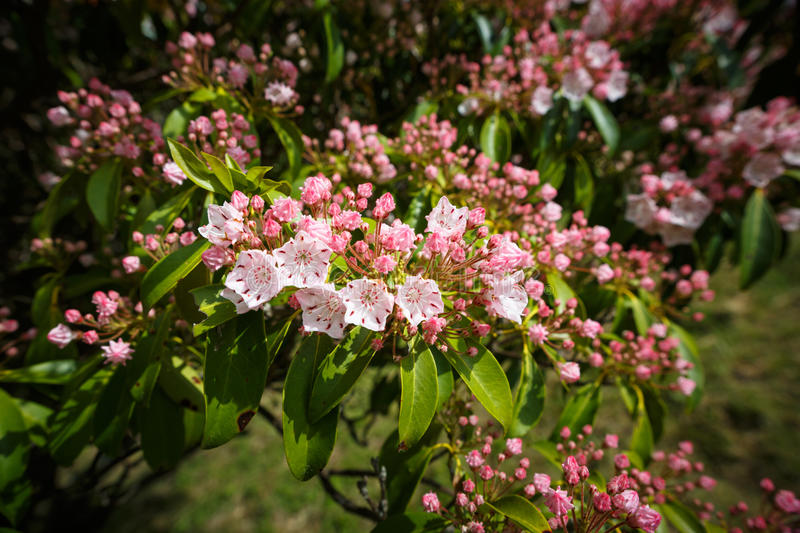
The wild mountain laurel grew rounded and very dense in a sunny location but where the shade was denser, the plant did grow taller and a bit more open. Mountain laurel is a broadleaf evergreen plant that makes flowers 3/4 to 1 inch across. These flowers come in clusters of 25 or more, and inside the cup-shaped flower, you will find 10 stamens that give the white flower a bit of color contrast. The flowers open slowly over a long period, lasting on the plant for 6 to 8 weeks. You seldom see flower clusters with individual flowers in all stages of development. The buds begin as small rounded ball shaped buds but as they mature, they begin to take the shape of a fat looking star getting ready to burst open. The flower resembles a five sided cup-type flower. The cluster has flowers and flower buds in all sizes and shapes in the same cluster, giving the rounded ball flower cluster much character.
I like the mountain laurel better than the rhododendrons--and much more than the azaleas--when they are in bloom, because the foliage and the flowers look so delicate together--almost like lace. The flower cluster can grow to 4, 5 or even 6 inches in diameter and form on the tip of the branches (the growth made last year). The wild forms will occasionally give you a bit of pink color in the flower but white is the norm. But the best is yet to come and you need to know about the foliage first.
The foliage is beautiful and evergreen, growing 2 to 5 inches long and about 2 inches wide. The leaf shape is oval with a point on its tip and it is deep green and shiny. New gardeners often confuse the mountain laurel with the bay leaf plant, as they look very similar at first glance. When the new growth first forms on the top of the plant, it will have a beautiful bronze tinge to it for several weeks before turning to the wonderful dark shiny green.
Plant mountain laurel in a location with half a day of shade; the secret to the best plant is a location with partial winter shade. I have several at my house and they are planted under tall pine trees, in the back of the house where they receive late-day sun or near a stockade fence where it is also sheltered from winter winds. If you plant them where they will get direct sun during the winter months you will have a lot of leaf damage cause by the winter sun and wind, so select a sheltered area for happy plants and no winter damage. If you're in a windy location, you can help your plant survive better during the winter months with 2 to 3 applications of Wilt Pruf or Wilt Stop anti-desiccant spray. You can also cover plants with sheets of burlap, if you live near the water, to cut down on the wind hitting the foliage.
Mountain laurel loves a moist soil but not standing water, so you'll need good drainage around the plant. A soil that is rich in organic matter like peat moss, animal manure or compost will be best. Remember these plants are native, growing in a wooded area where fallen leaves and pine needles cover the soil every fall and help to enriched that soil. In your garden, be sure to add 2 to 3 inches of bark mulch around the plant to control soil moisture during the heat of summer and to prevent frost damage as the ground begins to freeze and thaw all winter long.
The plant will flower before the new growth forms on the plant in July and August; those flower buds are on the tip of the branches. Now remember this, because if you prune your plants in the fall or early spring to control the size of the plant you will also remove ALL the flower buds from the plant. Pruning is done to control the size of the plant as soon as the flowers begin to fade on the plant in early July and not before or after! If your plants are getting tall, you can cut them back as much as 1/3 at the designated time in July.
Fertilize your plants in the spring with Holly Tone every spring to keep the plants flowering and to increase foliage production for thick plants. Mountain laurel should not be limed, as these wonderful plants love acid soil! When first planted, water the plants 2 times a week until the fall of the year and if you can treat plants with two or more applications of Holly-Tone with mycorrhizae, it will help get them established faster and make them hardier for the winter. Do not plant mountain laurel if you have deer that frequent your property--they will eat them, unless your yard is fenced in.
Now for the big surprise about hybrids of the mountain laurel family: if you like this plant, I have a real treat for you, because the new hybrids come with red buds, pink buds and white buds. Some of the red bud varieties will have red centers, pink centers or even white centers. The pink bud types will have white centers or white centers with red or pink markings inside the flower. The new white hybrids will have white buds with red, pink or burgundy markings inside the flower. Today there are over 75 hybrids and new ones coming out every year. Some new varieties are dwarf, some have miniature foliage, and some even grow more upright than spreading.
Your average mountain laurel will grow as tall as 10 feet or more but with pruning the height can easily be controlled. This wonderful plant is hardy from Northern Maine to northern Florida and west to the Rockies. Plant with azaleas for early color; your rhododendron will bloom for mid-season color and then you have the mountain laurel for late color, April to July. Mountain laurel will look great if you are trying to create a natural look to your shaded property. They love to grow near stone walls and look great in the same planting bed as hollies, ilex and boxwood.
Try planting them in a shady perennial garden, a shady rock garden, or as a foundation plant around your home. And do plant some mountain laurel if you have a grouping of tall tines trees near your home. Mountain laurel are at their peak color now, so visit your local nursery and pick out the flower type you like best or choose several different types for a beautiful May and June garden show and gorgeous winter foliage. Enjoy!
|
|
|
| Barry McGuire Eve of Destruction [1965] |
|
|
|
|
May Flowering DoubleFile Viburnum - Tomentosum
|
The month of May is filled with beautiful flowering shrubs and trees and if you had to pick just one plant to add to your garden this year, it would be a difficult choice for most of us to make. I want to make a suggestion of a plant for you to consider if you're making such a choice. The plant that I know you will love to add to your garden is called the Doublefile Viburnum, and for just one reason, because every year it will get more beautiful! This Viburnum, when young, has no real appeal, no pizzazz, but in just a couple of years in your garden it will quickly become your favorite. This plant has it all, and in just a couple of years in your garden, you will see flowers, fruit, fall color, and growth characteristics most plants would die for. There is only one word for this plant, "WOW!"
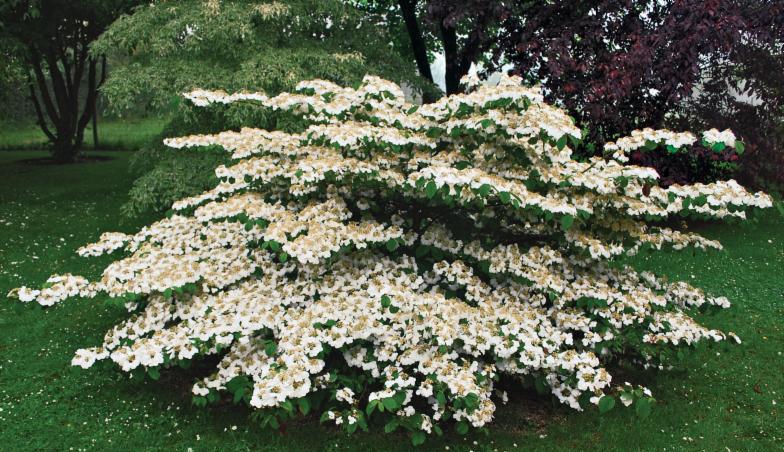
As the Doublefile Viburnum makes its new growth in the spring, the new branches that form will grow horizontally, and they are graceful because when the wind blows in your yard they will move like waves on the water. The plant will make foliage and flowers at the same time during May. The foliage is beautiful. Each leaf will grow from 3 to 5 inches long; they are shiny and clean looking, the shine on the leaf will last from spring to fall. The shape is oval, 2 inches wide near the stem but narrows to a point on the end, and along the edge of the leaf is a row of small teeth. The leaf is covered with a unique network of sunken veins, like stitchery. In the fall these leaves will gradually change from the deep green summer color, to rich red wine colored foliage that the plant will retain for several weeks. When the color changes occur to the foliage, the sunken veins become even more pronounced and the leaf seems to almost glow.
The flowers form on 2 inch stems placing them above the new foliage, like a pedestal. The flowers that form are unique because this flower cluster has two types of flowers in the cluster: a small fruit-bearing and a large sterile type of bloom. The inside of the cluster is filled with 25 or more fertile small, 1/4 inch, white, 5 petal flowers, and not showy. But around this flower cluster are 5 or more sterile, large, 1 inch, very showy, 4 petal white flowers. The flowers combine to make a wonderful 4 to 5 inch in diameter flat flower that will cover the entire stem of the plant from the main stems to the tip of every branch. The flowers will last on the plant for 4 to six weeks depending on the temperature and frequency of heavy rains. Bees and butterflies seem to flicker from flower to flower like in a dance around the Maypole. There are so many flowers on the branches they will bend with their weight and the lower branches will touch the ground. If you're able to enjoy a full moon night outside in your garden the plant will almost glow from the light the moon sends into your garden.
The fruit, "O the fruit," that this plant makes is wonderful to look at on the plant. You know those wonderful small fertile white flowers in the center of the flower cluster you enjoyed in May to early June have now become shiny, 1/4 inch, oval, bright red fruit. Each fruit cluster is 3 inches in diameter and the 25 or more fruit in the cluster lie flat on their stems above the foliage. The rich shiny green foliage below makes the fruit stand out just as wonderfully as the flowers did on the plant earlier in the season. The fruit ripens in July to early August and then without a notice turns bright shiny black in late August telling the birds that supper has been served. All of a sudden, all the berries are gone and the plant can now prepare for the fall by making flower buds for next spring and slowly change the foliage to the rich red wine color.
Doublefile Viburnum loves a soil that is moist, rich, and fertile; if planted in a dry, sandy soil it will not perform very well for you. Condition the soil before planting with lots of compost or seasoned animal manure. I always add Soil Moist granules when planting new shrubs to insure the roots stay moist as the new roots develop in your garden. Bio-Tone with Mycorrhiza has shown me how wonderfully Mother Nature's microbes work in the soil and I will never plant anything again without using this product. Your Garden Center should have either Protilizer by Natural Alternatives or Bio-Tone with Mycorrhizae available; use it and see the difference in the growth your plant will make.
Water the plant weekly or more often during warm weather to motivate plant growth. Fertilize in the spring with Plant-Tone to encourage good growth during the summer months. Place 2 to 3 inches of bark mulch or compost around the plant to control weeds around the plant and to help hold water in the soil during the summer months. Lots of moisture around the roots will result with more, bigger, and brighter fruit during the summer months on the plant.
Doublefile Viburnum will grow in full sun to partial shade in your garden. The flowers and berries will do as well in either growing locations. Just make sure the location you choose is well drained and has no standing water, especially during the winter. Give the plant room to grow as this plant needs room display the flowers and berries during the year. This plant will grow 8 to 10 feet tall and will spread its beautiful branches 10 to 12 feet wide. You can prune the lower branches on the plant as it matures and create a small tree-like plant with multiple stems.
This Viburnum will make a great plant to grow under tall trees that had the lower branches pruned out to let daylight in under them as an understory plant. If you want to create a tall growing privacy hedge along your property line or cut back the traffic noise from your patio during the summer this is your plant, space plant 10 feet apart. You can also use it as a vocal point or specimen plant in your yard or large planting of mixed plants like Rhododendrons, Azaleas, and Mountain Laurels. If you have a Japanese Garden this plant will make a great specimen flowering plant near a pond or small stream. Plant this Viburnum on the side of a hill to prevent erosion and to create a background of color all summer long with its beautiful flowers and berries. If you have bird houses or bird feeders this plant will ensure that the birds stay from season to season and because of its dense foliage and horizontal branching it also makes a great plant for the birds to build nest in.
The flower closely resembles the flower of the climbing hydrangea; many people think that this plant belongs to the hydrangea family but it does not. And best of all, no insect or disease problems with this plant and once established, it needs little to no maintenance. Look for it at your local nursery; you will not regret purchasing this wonderful shrub, the Doublefile Viburnum. Enjoy!
|
|
"Your garden is never so good, as it will be next year!"
Thomas Cooper
|
|
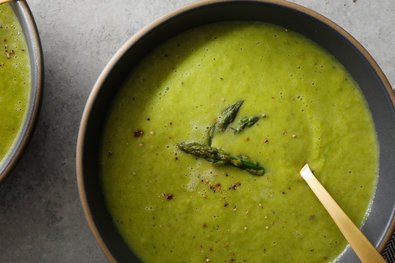
I love Asparagus in all forms: raw, steamed, boiled, broiled, baked, cooked on the grill, but my favorite is as a soup. Asparagus soup is definitely something you should try. I think you will love the apple prices added to this recipe.
Ingredients:
2 pounds of fresh asparagus
4 cups of vegetable broth
The juice of ½ a lemon
Salt and pepper
Fresh ground nutmeg
Sugar
2 green apples like Granny Smith
½ a cup of heavy cream or wiping cream
Garnish:
½ a cup of heavy cream or wiping cream
2 scallions
Directions:
1] Snap off the tough ends of the asparagus to also remove any yellow portions of the tips. Cut into 1 ½ inch piece, place in a pot and barely cover with water. Add a pinch of salt and Sugar, bring to a boil slightly covered for 10 minutes. Strain the asparagus and save the water.
2} Puree your cooked asparagus with a cup of the cooking water in your food processor or blender until smooth and set aside in large bowl.
3} Add 4 cups of vegetable broth in a medium pot and then 2 and ½ cups of additional saved water used for cooking the asparagus and mix well.
4} Add the pureed asparagus mixture and ½ cup of cream to the broth mixture and season with salt pepper and a pinch of nutmeg.
5} Peal your Granny Smith apples cut in half and coir out the seeds. Chop up the apple into 1 -inch cubes and add the apples to the soup mixture. If you want to make this fancy use a melon scooper instead of cutting cubes of apples.
6} Whip the soup mixture together and warm up over a low fire until ready to serve.
7} Garnish each portion with a dollop of your whip cream. Cut one of your scallions into small rings and the other split it in half the long way and again in half giving you 4 pieces to set in the bowl of soup with the rings of scallions.
8} optional: I like to toast a couple prices of pita bread, butter well, slice into 2 inches slices and serve with the soup. Enjoy!
|

Call today for a
FREE Soil Test for your lawn!
1-888-546-5941 Offer limited!
Tell Them
Paul Parent Sent you!
|
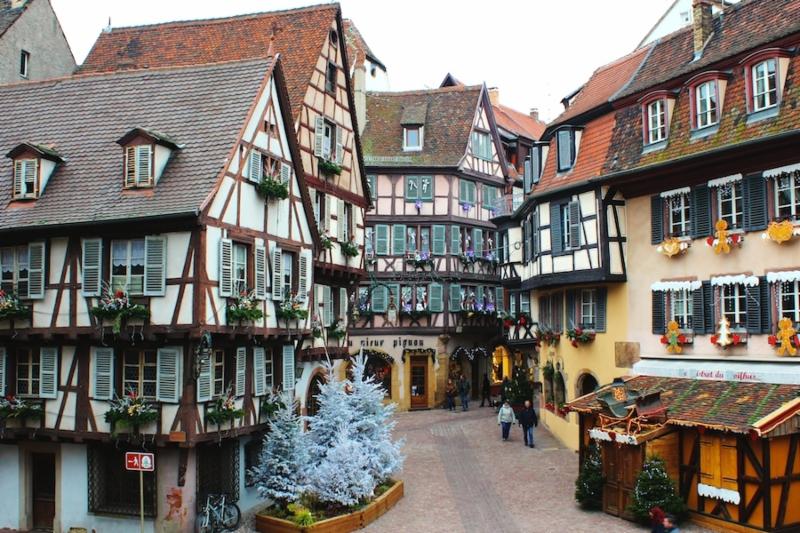
The Next Trip with Paul Parent
A Christmas market, also known as Christkindlesmarkt, is a street market associated with the celebration of Christmas during the four weeks of Advent. These markets originated in Germany, Austria and the Alsace. The history of Christmas markets goes back to the Middle Ages in the German-speaking part of Europe. The Nuremberg Christmas market, first held in 1628, is one of the oldest Christmas markets in the world. It attracts 2 million visitors annually and has over 250 wooden stalls offering traditional ornaments, gifts, handicrafts and fresh food. Generally held in the town square and adjacent pedestrian zones, accompanied by traditional singing and dancing, the market sells local food,drink and seasonal items from open-air stalls.
the trip information
Space is becoming limited so book soon to join our group of merry travelers!
|
Printing articles
1. Take the mouse cursor to the top of the writing which you want to copy.
2. Go right up to the left edge of the writing you want to copy, the cursor will change from an arrow to an I-like shape.
3. Now left-click and highlight the article from top to bottom. You will need to continue holding down left-click until it is all highlighted.
4. When you reach the bottom, first check that all the part you want to copy has been correctly highlighted, then right-click and select 'Copy.'
5. Open a word processor such as Notepad, Word Pad or Word.
6. Right click and select 'Paste' - the copied article will now immediately transfer to your computer screen (some word processor systems will require you to use a 'paste' button/symbol at the top of the screen).
7. If the article appears in bold or a font size which is too big, simply highlight again and while it is highlighted take it out of 'bold' or whatever.
8. Now just select 'Print' from file options.
Using this system for copying articles will save an enormous amount of ink, as well as paper.
(Please Just Note: Just about everything here is subject to Copyright - this means that while you are perfectly free to copy and print, it is not permitted to add any text to, or to change any article written by anyone or indeed most other writers - if you intend distributing it or putting it on your own website. No article should be put on another website without e mailing me first).
|
|
|
Telephone:
(855)660-4261 Sunday
Morning(6AM to 10AM)
Fax:
(207)985-6972
Regular Phone Hours:
(207)590-4887(cell)
Mon-Sat 9AM to 5 PM
Sunday: Closed
|
|
|