Snow Drought Update


May 14, 2026


Snow Drought Status Update

West Braces for Critical Water Shortages After Unprecedented Snow Drought

Key Points


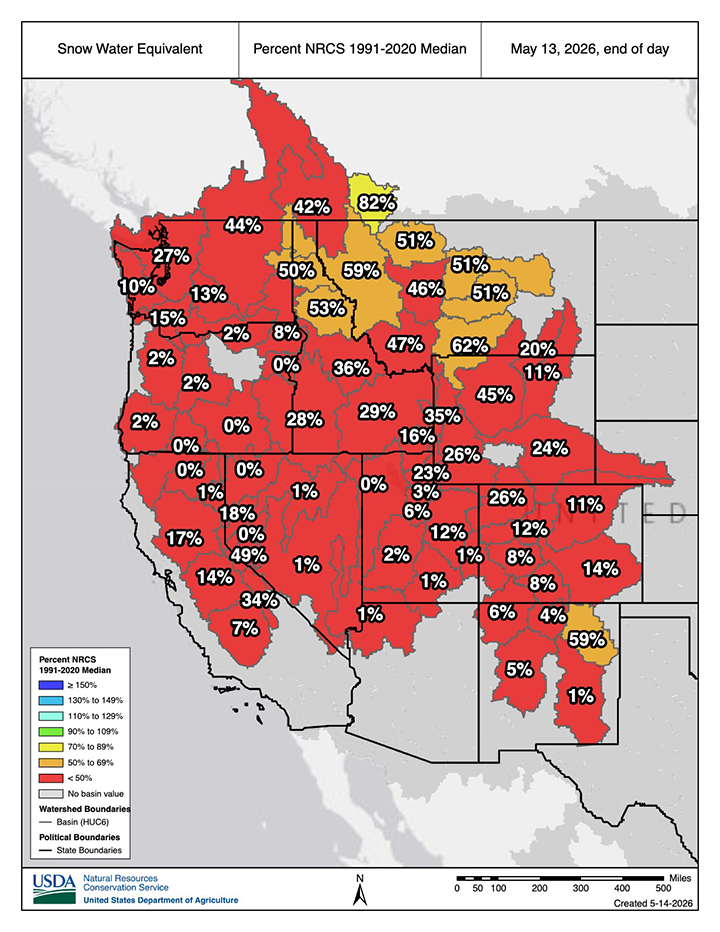
  • Snowpack, the western U.S.’s largest non-man made reservoir, is already gone in many places. Significant hydrological drought impacts (low water supply) are already occurring and will continue through summer across much of the West. Compounding these impacts, the West continues to experience long-term drought. Drought conditions can be expected to deteriorate, and impacts to become more pronounced. 


  • April and May snowfall in some areas did not offset seasonal snow deficits, but increased soil moisture and slowed high-elevation snowmelt, which may slow drought deterioration and temporarily mitigate early season wildfire risk. Snow did not fall in all states. 


  • This year’s peak snowpack will be the new benchmark low for Wyoming, Utah, Colorado, and New Mexico; there are no comparable years. In these states, snow water equivalent (SWE) around April 1, the usual peak date, was 32- 53% lower than the previous record low during the SNOTEL era. In Idaho, record warm temperatures pushed snow to only the high elevations, leaving the state with no historical comparison.  


  • Earlier-than-normal meltout (snow no longer present) occurred across the Western U.S., with many SNOTEL locations setting a new earliest or second earliest meltout date on record. Water supply forecasts in many watersheds are still forecasted to approach historic lows or at historic lows. In Oregon, 62 of 73 forecast points are approaching or at historic lows. In Utah, peak flows occurred and concluded in many streams before the spring runoff season even started. 


  • As the West enters summer, evaporative demand (thirst of the atmosphere) and water demands will increase. This will further strain and reduce water supplies. Current outlooks favor warmer-than-normal temperatures. Any relief will depend on late spring storms, along with the level of activity and geographic extent of the monsoon season. 


The rest of this snow drought update is available online.


For More Information, Please Contact:

Daniel McEvoy, Western Regional Climate Center

Daniel.McEvoy@dri.edu


Jason Gerlich, NOAA/NIDIS/CIRES Pacific Northwest Regional Drought Information Coordinator

Jason.Gerlich@noaa.gov


Tony Bergantino, Wyoming State Climate Office, University of Wyoming

antonius@uwyo.edu


Amanda Sheffield, NOAA/NIDIS/CIRES California/Nevada Regional Drought Information Coordinator

Amanda.Sheffield@noaa.gov

NIDIS and its partners launched this snow drought effort in 2018 to provide data, maps, and tools for monitoring snow drought and its impacts as well as communicating the status of snow drought across the United States, including Alaska. Thank you to our partners for your continued support of this effort and review of these updates.

Forwarded This Email? Subscribe for Updates

Subscribe to the National Integrated Drought Information System's regional newsletters to receive webinar updates and other drought news for your area. Or, subscribe to NIDIS's bi-weekly newsletter, Dry Times, to receive national news, drought research, and events.

NIDIS is an interagency program within the Climate Program Office, which is part of NOAA's Office of Oceanic and Atmospheric Research.

Facebook  Instagram  X  LinkedIn  YouTube