Eugene Masonic Cemetery Association eNewsletter | |
|
Memorial Day Weekend Events
Sunday, May 26 and Monday, May 27
| |
|
You’re invited to EMCA’s Memorial Day Open House featuring these events:
· Hope Abbey will be open from 11 AM to 5:00 PM Sunday, May 26, and Monday, May 27. (There are no events on Saturday.) Please come in and enjoy some refreshments while looking at displays in the mausoleum.
· Take a walk through the 10 acres where you will see graves of Veterans of the US military that are marked with flags. Pay your respects to the soldiers and sailors buried here.
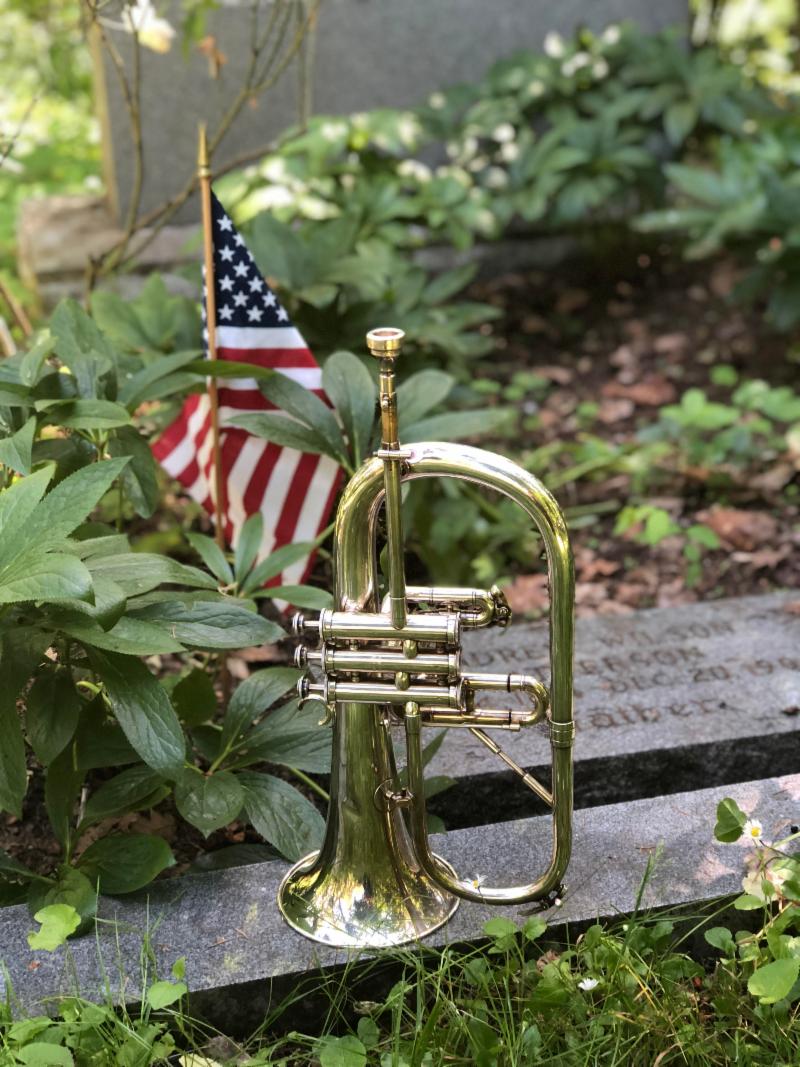
· Taps will be played at 12:15 on both Sunday and Monday. Take a moment of silence afterwards to reflect on the sacrifices by the fallen soldiers buried here.
· Two scheduled tours will be led by experienced guides, Diego Llewellyn-Jones on Sunday, and Caroline Forell on Monday. Caroline will lead a “Cemetery Highlights” tour and Diego’s tour will focus on “The Landscape” and our arboretum.
If you miss the tours, you can enjoy self-guided tours at any time using the graveside historic plaques and walking-tour brochures describing the site’s occupants. Brochures and other information are available at the Garden Cottage and in Hope Abbey Mausoleum.
· “History Hunts” is a fun activity for children and families on both days. Start your search in Hope Abbey where you will get a map and clipboard. Prizes are given to anyone who participates.
· On Sunday, May 26th at 6 PM, there will be a free concert at the public square. See more details below under Music On The Square.
Please park on city streets because there is no general public parking on the cemetery grounds. Hope Abbey is the large concrete structure at the end of E. 26th. For easier access to the public square for the 6 PM concert later in on the public square, refer to the information below.
| |
|
Memorial Day, originally called Decoration Day, is a day of remembrance for those who have died in service to the United States of America. It's difficult to prove the origins of this day, as over two dozen towns and cities lay claim to the birthplace. In May, 1966, President Lyndon Johnson officially declared Waterloo, N.Y. the birthplace of Memorial Day.
Regardless of the origins or the exact date, one thing is crystal clear—Memorial Day was born after the Civil War (which ended in 1865, six years after the Eugene Masonic Cemetery was created), with a desire to honor our dead. In 1868, General John Logan, who was the national commander of the Grand Army of the Republic, officially proclaimed it in his General Order No. 11.
In the Order, the General proclaimed,"The 30th of May, 1868, is designated for the purpose of strewing with flowers, or otherwise decorating the graves of comrades who died in defense of their county during the late rebellion, and those bodies now lie in almost every city, village and hamlet churchyard in the land." On the first Decoration Day, 5000 participants decorated the graves of 20,000 Union and Confederate soldiers buried at Arlington National Cemetery.
New York was the first state to officially recognize the holiday in 1873. It was recognized by all northern states by 1890. The South refused to acknowledge the day and honored their dead on separate days. This went on until after World War I when the holiday changed from honoring just those who died fighting in the Civil War to honoring Americans who died fighting in any war.
| |
|
In Flanders Fields
By John McCrae
| |
|
In Flanders fields the poppies blow
Between the crosses, row on row,
That mark our place; and in the sky
The larks, still bravely singing, fly
Scarce heard amid the guns below.
We are the Dead. Short days ago
We lived, felt dawn, saw sunset glow,
Loved and were loved, and now we lie, In Flanders fields.
Take up our quarrel with the foe:
To you from failing hands we throw
The torch; be yours to hold it high.
If ye break faith with us who die
We shall not sleep, though poppies grow In Flanders fields.
******************************
John McCrae, was a Canadian doctor and
teacher who is best known for his
memorial poem "In Flanders Fields."
As the first shots of World War I were
fired in the summer of 1914, Canada, as
a member of the British Empire, became
involved in the fight as well.
| |  |
|
McCrae was stationed in the trenches
near Ypres, Belgium, in an area known as
Flanders, during the bloody Second
Battle of Ypres.
In the midst of the tragic warfare,
McCrae’s friend, twenty-two-year-old
Lieutenant Alexis Helmer, was killed by
artillery fire and buried in a makeshift
grave.
The following day, McCrae, after seeing
the field of makeshift graves blooming
with wild poppies, wrote his famous
poem “In Flanders Fields,” which
became popular almost immediately
upon its publication. The poppy soon
became known as the flower of
remembrance for the men and women in
Britain, France, the United States, and
Canada who have died in service of their
country.
Today, McCrae’s poem continues to be an
important part of Remembrance Day
celebrations in Canada and Europe, as
well as Memorial Day and Veterans Day
celebrations in the United States
| |
|
Memorial Day: Red Poppies
Inspired by the poem “In Flanders Fields,” Moina Michael replied with her
own poem:
We cherish too, the Poppy red
That grows on fields where valor led,
It seems to signal to the skies
That blood of heroes never dies.
She then conceived of an idea to wear red poppies on Memorial Day in honor of those
who died serving the nation during war. She was the first to wear one. Later a Madam
Guerin from France was visiting the United States and learned of this new custom
started by Ms. Michael. When she returned to France she made artificial red poppies to
raise money for war-orphaned children and widowed women.
Shortly before Memorial Day in 1922, the VFW became the first Veterans organization to
nationally sell poppies. Two years later their “Buddy” Poppy program was selling
artificial poppies made by disabled veterans. In 1948 the US Post Office honored Ms.
Michael for her role in founding the National Poppy movement by issuing a red three cent postage stamp with her likeness on it.
| |
|
Music To Die For Concert Series 2024
June 9: Carleen & Mike McCornack with Dale Bradley
July 14: Sweet Winds Quintet
August 11: Wild Hog in the Woods
September 8: Violin Ensemble
October 13: Recorder Orchestra
The free concerts are in Hope Abbey mausoleum at 2 p.m. and finish about an hour later.
| |
|
Music on the Square Concert Series 2024
Yes, we are back for another season of great music in the gorgeous Masonic Cemetery Public Square! See at the bottom of this eNewsletter on how to get there.
May 26: Riverside Chamber Symphony
June 16: Oregon Brass Society
June 30: Blugene Brass Quintet with Jack McGaughey-piano
July 28: Springfield Community Band
August 4: Kef!
September 15: Oregon Tuba Association
Bring a folding chair or a blanket to sit on, and a picnic dinner if you wish.
| |
|
Riverside Chamber Symphony
Since 2000, the Riverside Chamber Symphony has presented concerts of music of the masters: Beethoven, Mozart, Haydn, Schubert and others, and has premiered new works by regional composers. The 30 piece ensemble is made up of advanced non-professional players from around the region, and has performed frequently in the Wildish Theater and other venues.
The all volunteer orchestra aims to provide a high quality experience in the study and performance of musical literature for players and audience alike.
For this concert on May 26th, the Riverside Chamber Symphony will present Joachim Raff’s Sinfonietta. In the spring of 1873, Raff coined the term Sinfonietta: a work in several movements, but shorter and lighter in content than a symphony. Written for pairs of flutes, oboes, clarinets, bassoons and French horns, the Sinfonietta has been popular from the start, and is one of the few works of his still performed today. The piece has unfailing wit, vivacity, good humor, and a relaxed sunny nature.
The group is led by conductor Philip Bayles who has been active in the region's musical life for many years. He was the founding conductor of the Eugene Opera and Eugene Concert Choir, and has appeared with the Eugene Symphony, the Eugene Ballet and the Oregon Mozart Players. Bayles is also Musical Director of the United Lutheran Church.
| |
|
Getting There
Note that there is no public parking in the cemetery, so please park on city streets and
walk to the Public Square, but be aware that there is a steep uphill walk on the road to
the Public Square. There is no transportation to get you there.
The easiest option for getting to the Public Square is to be dropped off at the Elinor
Street entrance on the south edge of the cemetery. Walk north towards the Public
Square on level ground. There is very little parking at the Elinor Street entrance.
Please take care not to block any driveways.
| |
John Bredesen, eNewsletter Editor
Eugene Masonic Cemetery Association
| |
|
Mission Statement
To restore, rehabilitate, maintain, interpret and operate the historic Eugene Masonic Cemetery and Hope Abbey Mausoleum as a cultural and natural resource for the community.
The cemetery is operated for the public benefit,
but it is private property.
(A 501(c)(3) non-profit organization)
| | | | |