Due to the ongoing effects of last year's state budget impasse, some legislators have expressed difficulties dealing with delayed paychecks. Loans from candidate committees have been used as a way to tide them over until they are compensated in a more timely manner.
While political committees in Illinois are able to give and receive loans at any time, this aspect of campaign finance law is rarely studied in detail in our state.
ICPR's research team examined this topic to better understand best practices for improving transparency in the process.
In June, Representative Chad Hays brought this topic to the forefront when taking out a loan from his own candidate committee.
Representative Hays (R-Catlin), in an abundance of caution, was very careful throughout the process to ensure no laws were broken.
He clearly stated that his loan's purpose was "to cover delayed legislative salary," and paid it back within one month at market interest rate.
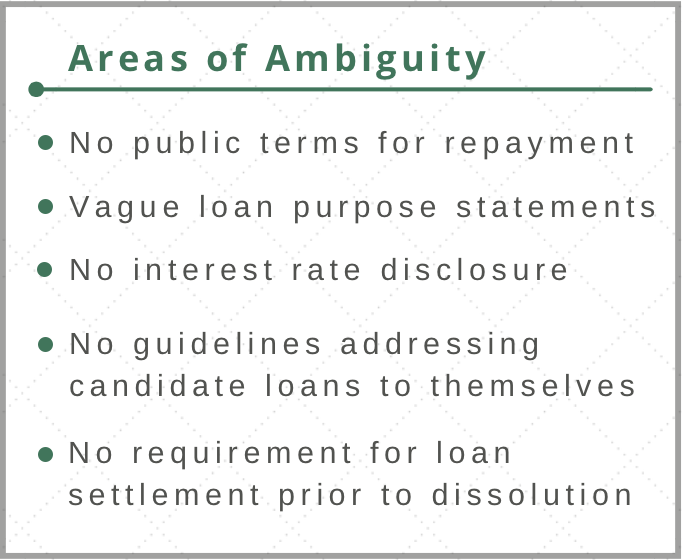
This type of interaction between a political committee and an individual, including between candidates and their own committees, is considered legal in Illinois. Loans are included in the definitions for contributions and expenditures, and are held to the same disclosure standards. However, current state law allows for areas of vagueness and confusion on terms for repayment, interest, and purpose.
The first ambiguity is in the purpose section of a loan. Every committee expenditure is required to state its purpose "in connection with the nomination for election, election, or retention of any person to or in public office or in connection with any question of public policy" (10 ILCS 5/9-1.5).
However, many loans given by committees simply state "loan" or "loan to" the recipient as their description.
This results in vague record-keeping and little explanation as to why the loan was connected to the candidate's election.
No extra information, such as a promissory note, repayment date, or interest rate is required to be publicly reported when giving or receiving a loan from a political committee. Hays paid interest and reported it separately, but was not required to do so by law. This means that there is no public accountability for when the loan needs to be repaid. This presents a more serious problem when the candidate is taking out a loan from his or her own committee, as candidates are essentially engaging in a legal contract with themselves.
Other states provide some insight into how to deal with these issues.
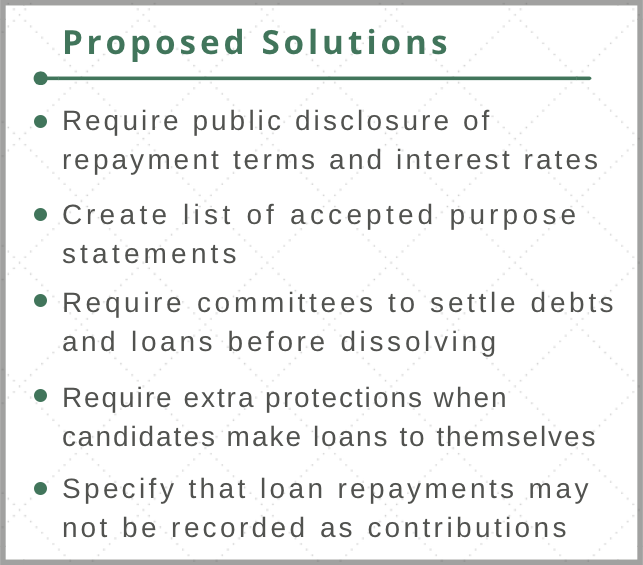
For example, New York requires public disclosure of a promissory note with a loan repayment date as part of a loan agreement. Texas goes further by requiring that a loan interest rate is provided for the public record. Texas also provides a helpful model for decreasing vagueness in the "purpose" section of loan reporting. The Texas Ethics Commission's rules include a list of acceptable categories for all campaign expenditures, including loans, resulting in more specific disclosure reports across the board.
Some states did not see loans from committees to candidates as an appropriate use of funds. California expressly prohibits committee loans to individuals, and explicitly states that loans must reasonably relate to a political, legislative, or governmental purpose. Officials from New York, Ohio, and Texas had not considered the possibility of a committee loaning money to its own candidate, but noted that it may violate clauses in their election codes prohibiting campaign funds for personal use.
Including Hays,
there have been a total of 12 cases over the past nine months where a candidate's committee has loaned money to its namesake.
Only Representative Hays paid interest or included a substantial statement of purpose.
Ten of the loans are still outstanding.
In fact, of the $49,729 that candidates have loaned themselves in the past nine months, $41,482 is still outstanding. There is no way of knowing when those funds will be paid back, because loan maturity dates are not publicly recorded. Furthermore, no interest payment is required.
In some instances, committees have even dissolved before loans could be paid back.
This is legal in Illinois, but is prohibited in other states like
Ohio, which requires that all loans are settled prior to a committee's dissolution.
There are relatively simple fixes that can increase transparency in the process of political committee loans. ICPR plans to provide language for potential legislative changes in the coming session. This issue, while easily overlooked, is important because loans made and taken by political committees must be held to the same transparency standards as other areas of the campaign finance system. Without those standards, an important part of our campaign finance system is left unregulated.
Contact: Sarah Brune at 312-436-1274 or sarah@ilcampaign.org
ICPR Data and Research Analysts Aaron Feldman and Jack Lockhart contributed to this report.
Data was sourced from the National Conference of State Legislatures and state compiled statutes.
|