|
LiveWell & Benefits
Retiree Newsletter
| |
Show Your Heart Some Love | |
You know that you should take heart disease seriously. And maybe you even know that you should eat better and move more; but did you know that according to the Centers for Disease Control and Prevention, heart disease is the leading cause of death for men, women, and people of most racial and ethnic groups in the United States.
| |
One person dies every 33 seconds
in the United States from cardiovascular disease.
| |
Here are 10 small, easy changes you can make to help increase your overall heart health.
-
Spend time with friends and family - Research has long suggested that regular social interaction and social connectedness play an important role in overall health, as well as heart health. One hypothesis explaining this effect is that spending time with friends and family can mitigate stress and fend off depression—both of which are risk factors for heart disease.
-
Share a laugh or two! – It turns out that laughter can be good for your heart as well. So, when you are spending time with those you care about. Have fun and laugh. You’ll love the time spent together as well as the heart-healthy laughs you’ll share!
-
Go to bed just a little earlier - Without enough sleep, your risk for heart disease and heart attack goes up—no matter your age, your weight, or how much you exercise or smoke.
-
Start your day with a great breakfast - Having whole grains like cereal or whole wheat toast and fruit can be a great way to start the day.
-
Eat one extra fruit or vegetable a day - Fruits and veggies, particularly those in season, taste great and are good for your whole body, including your heart. Try adding berries into your cereal in the morning, or a small salad at lunch, and you’ve met this goal already.
-
Stand-up - Sitting for long periods was associated with worse health outcomes including heart disease, Type 2 diabetes, and cancer.
-
Take a 10-minute walk – While you are up, adding a short walk to your day is a great way to start moving. Take a walk during your lunch break, or after dinner, and you’ll find it not only helps your heart but your mood as well.
-
Relax and take a breath - Try breathing slowly and deeply for a few minutes every day. It can help you relax and center yourself and can even help reduce blood pressure.
-
Hobbies help - Activities like knitting, sewing, quilting, woodworking, and more can be a great way to relieve stress and do your heart some good in the process.
-
Make a call - Schedule your annual preventive exam with your Primary Care Provider (PCP) so that you and your doctor can stay up-to-date on your heart risk and make a plan to protect your heart.
| |
Healthy Body, Healthy You | |
How Can I Be a Healthy Retiree? | |
|
Regardless of age, one thing we all have in common is just how impactful physical activity can be on our total wellbeing. Not only does it dramatically decrease our risk of heart disease, Type 2 diabetes, Alzheimer’s disease, depression, and osteoporosis, but it also helps prevent severe/fatal injuries, and improves confidence and capability in motor skills. This translates to being able to do more of the things we love.
| |
Getting 3-4 hours of moderate exercise per week reduces your risk of cancer by 10-20%. | |
|
$117 billion of US annual healthcare costs are attributed to low
physical activity.
| |
110,000 premature deaths could be prevented each year if adults were more physically active. | |
|
As we get older, our body naturally loses muscle mass and bone density. By adding in regular exercise, such as the suggestions below, you will be able to enjoy the benefits of less lower back and joint pain, stronger hips and knees, better coordination and balance, and overall improved quality of life.
Step-Ups
- Involves core stability and leg strength, a great way to improve your functional strength and balance.
Lunges
- Develops single leg strength and stability, but more importantly improve one’s ability to get up off the floor.
Squats
- Increase lower body strength while also stimulating the cardiovascular system.
Bent-Over Rows
- Help the body effectively deal with upper body loads and stress of everyday activities, while also improving spinal and hip mobility.
Planks
- The tried-and-true exercise designed to target your core strength and stability without straining the back.
Cardio
- Arguably the best way to strengthen your heart, The Center for Disease Control and Prevention recommends at least 150 minutes of brisk walking each week for older adults, or 75 minutes of vigorous activity like jogging, biking, hiking, and climbing stairs.
Need help on your fitness journey? Contact the Employee Fitness & Wellness Center at 703-324-5590 or join the Fairfax County Rec Centers.
| |
Medicare Annual Wellness Visit vs Annual Physical Exam? | |
|
We all know that it’s a good idea to see your primary care physician annually but once you are enrolled in Medicare, you are eligible to receive both a Medicare Annual Wellness Visit, and an Annual Physical Exam.
Check out the comparison between the two visit types below and talk with your doctor to discuss which visit, if not both, is best for you.
| |
|
What is a Medicare Annual Wellness Visit?
If you’ve had Medicare Part B for longer than 12 months, you can opt to have a Medicare Annual Wellness Visit. The purpose of these visits is to create a personalized prevention plan that can include the following:
- Review your medical and family history.
- Take routine measurements such as height, weight & blood pressure.
- Review and/or update your list of medical providers and current prescription drugs.
- Develop a schedule for screenings and other preventive services recommended for you.
- Test for cognitive wellness and look for signs of memory loss, dementia, or frailty.
- Discuss advance care planning.
- Offer personalized health advice.
| |
|
What is an Annual Physical Exam?
An Annual Physical Exam, also known as an Annual Preventative Exam, is much more extensive than a Medicare Annual Wellness Visit. An Annual Physical Exam can include the following:
- Review your medical and family history.
- Take routine measurements such as for height, weight & blood pressure.
- Assess risk factors for preventable diseases.
- Listen to your heart and lungs to detect irregular sounds.
- Test your motor function and reflexes.
- Take urine and blood samples and submit for lab testing.
- Perform pelvic and rectal exams.
- Look into your eyes, ears, nose and throat for potential problems.
| |
|
A simple way to remember the difference between these two types of provider visits is that a Medicare Annual Wellness Visit will include assessments and planning but won’t include tests where the doctor has to physically touch you, unless you have a specific diagnosis or symptoms.
Remember you should always talk to your physician about your specific needs and check with Medicare and/or your medical plan provider to understand how different health services may or may not be covered.
For plan specific questions regarding coverage and/or provider assistance, you should contact the carrier directly before contacting the Benefits team.
Contact information for our medical plan vendor partners can be found below.
| |
|
Kaiser Permanente HMO Plan
Kaiser Medicare Advantage Plan
| |
|
|
Cigna OAP Coinsurance Plans (80% & 90% Co-Insurance and MyChoice CDHP)
Cigna True Choice Core Medicare Advantage PPO Plan
Cigna RX Part D Prescription Plan (PDP)
UnitedHealthcare Medicare Advantage Group PPO Plan
Medicare (Non-County Contact)
| |
Have you visited the Retiree Benefits Page? | |
|
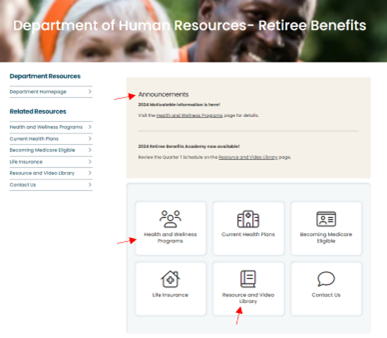
The Retiree Benefits Page provides Fairfax County Government retirees with up-to-date information and resources regarding their benefits. The Announcement section is regularly updated with upcoming programs, events, and other important dates.
Retirees can access the Retiree Benefit Academy Catalog and pre-recorded plan specific education sessions and information under the Resource and Video Library page. Click on the dedicated tabs for the full list of offerings.
The Health and Wellness Programs page houses the current years LiveWell and MotivateMe information, as well as fitness pass applications and webinar recordings.
| |
|
Airrosti Webcasts
Airrosti, a group of health providers who specialize in soft-tissue and musculoskeletal ailments. Join us in learning more about Carpal Tunnel (April), Plantar Fasciitis (May), Arthritis Pain (June), and Hip Pain (July)
Kaiser Webcasts
Kaiser's live webcasts are available to all Farifax County Government Retirees.
| |
|
Retiree Benefit Academy
Join Benefits and vendor partners for a variety of classes covering anything from your health plan options as a retiree, to financial planning, to understanding Social Security, and so much more!
LiveWell Webinars
Join LiveWell for a variety of wellness related classes covering fitness, nutrition, mental wellbeing, and more! Check out our flyer for class titles and registration links.
| | | | |