Idaho Magnified
by Nick Neely, Communications Associate
Last Thursday I ventured to
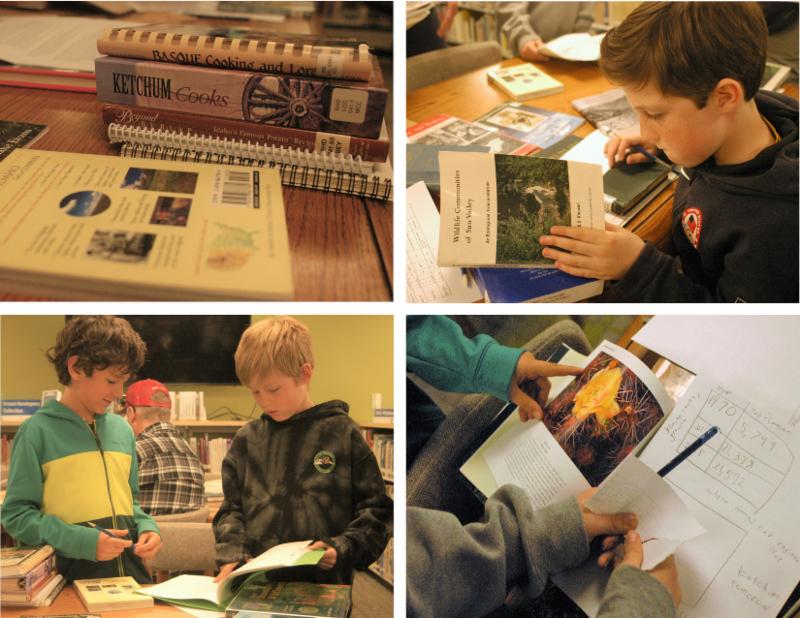
the Center for Regional History, for now housed in our new, beautifully remodeled space below the Children's Library. A fourth grade class from Hemingway Elementary was visiting for a special project, all boys. The work tables in the Center's lustrous reading room were strewn with books that held the story of this place, a riot of human and natural history:
Trees in Idaho, Idaho Discovered,
Early Idaho,
Idaho Mountain Flowers.
It was as if an Idaho-themed shelf had toppled over. Every subject and corner of the Gem State was in evidence. What exactly was going on? I asked. A boy named Caleo looked to his teacher and then piped up, softly: "We're, like, getting artifacts, and sending them to another school." He had a quiet lisp and wore a green and yellow Marmot hoodie. "And then they'll send us clues back, and we have to figure out where they're from."
His teacher, Pam Duquette, further explained: With the help of our Regional History Librarians, the class was researching their home in order to make and gather representative objects, and finally ship them, as a mystery, to another fourth-grade class somewhere unnamed in the country. Fittingly this swap is called
The Artifact Box Exchange. In past years, her classes had received Hershey's Kisses from a school in the eponymous Pennsylvania town, and salt shakers from--did you guess it?--Salt Lake City. Inside each box is a series of envelopes on various themes, labeled "hard" to "easy." The kids start with the tough (or downright impossible) clues and eventually move to the easier.
Caleo's research list was eclectic, somehow poetic: "Recipes, rivers, and immigration patterns." On a scrap he had scrawled a makeshift map of the Snake running through an imagined Hells Canyon, with a wavering note: "We live in the state that has the deepest gorge in North America." It was a sly, admirable clue, sure to throw off his counterparts. Those poor kids--they would think immediately of the Grand Canyon and lose themselves in Arizona. And what kind of recipes was Caleo discovering? Roberta McKercher's
From Roberta's Kitchen sat beside
Basque Cooking and Lore, but he opened yet another cookbook to a page 72, "Sheep Wagon Omelet":
1 cup prepared lamb fries
2 Tbsp. chopped green pepper
2 Tbsp. chopped onion
1 clove minced garlic
2 ½ Tbsp. Spanish olive oil
1 Tbsp. minced Italian parsley
4 eggs, beaten
Salt and freshly ground pepper to taste.
For some time, we debated about the nature of "lamb fries" and whether it was an appetizing ingredient. We could not agree. In any case, Caleo planned to copy out and staple his own little recipe book for inclusion in this year's artifact box.
It was beautiful to imagine fourth grade classes corresponding anonymously across the country, cross-pollinating like the local flowers that another student was leafing through in a book. Mrs. Duquette told me, "They're learning things that they don't know, and then sharing them. And the goal is to find things that aren't easily looked up on the internet." The only way to do that is to hit the books. The Artifact Box Exchange also was teaching these kids about artifacts. "An artifact is something you can touch," said Mrs. Duquette. "It's something can smell, something you can taste. We want to send three-dimensional things."
I asked another boy, Oscar, what categories he'd been assigned. "Pretty boring subjects," he flatly declared. "Typical clothing, a soil sample, the state bird, and postage stamps." He was not impressed when I told him that, at home, I happened to have an Idaho stamp with a mountain bluebird perched on it (maybe that was just rubbing salt in the wound). But later I saw Oscar looking very intently at
Wildlife Communities of Sun Valley. Seemed as if he didn't think his task was so boring after all. Oscar wore a United States Olympic Team hoodie, and it made me think about how he and all these other boys were wearing "typical clothing," or artifacts that told the story of this place: sporty, mountain-town garb. My hunch about his hobbies was confirmed when hopped between tables on one leg. He'd sprained his ankle skateboarding. He was going to get an X-ray today. He was so
of this place, and through this project he was becoming more self-aware.
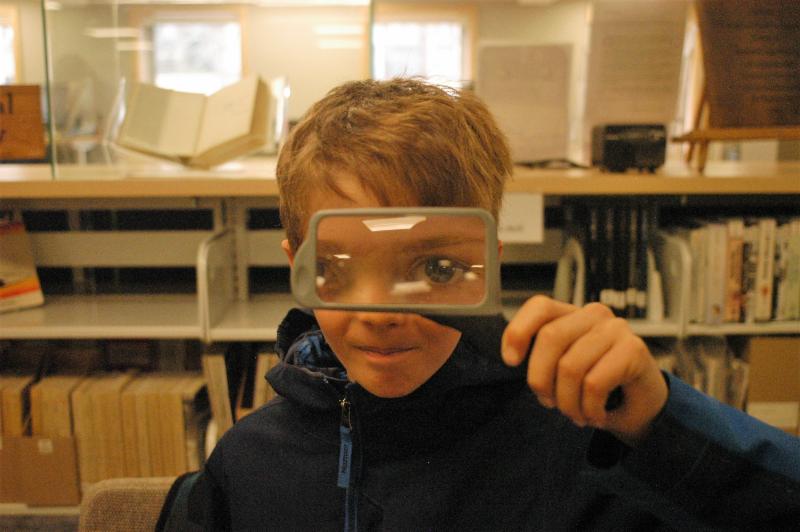
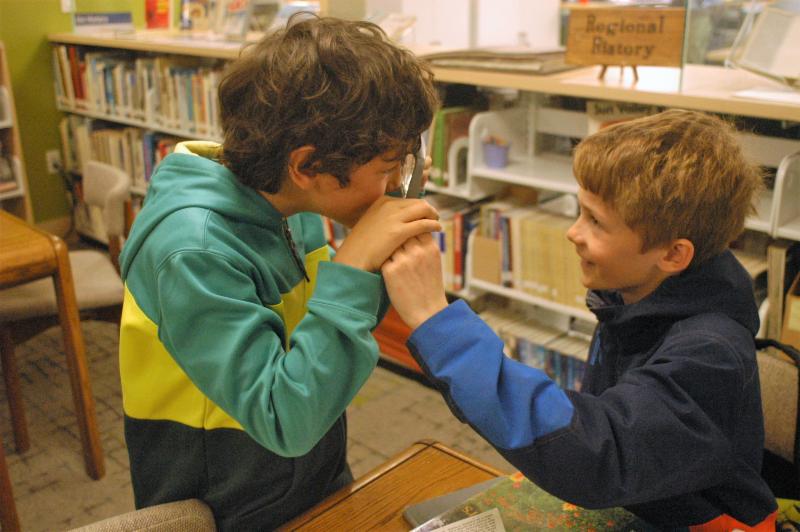
As lunch neared, the boys found a magnifying lens for enlarging print and started turning it on each other. One after the next they peered into each other's eyes, amazed by the distortion. "Your eyes were this big," said one kid. "You look like a baby!" cried another.
They clustered by the Center for Regional History's door, looking closely at each other, and I thought about how they really were magnifying their region and state, and so their own identities. "Gentleman, I don't think we're quite finished yet," said Mrs. Duquette, and they went back to work.