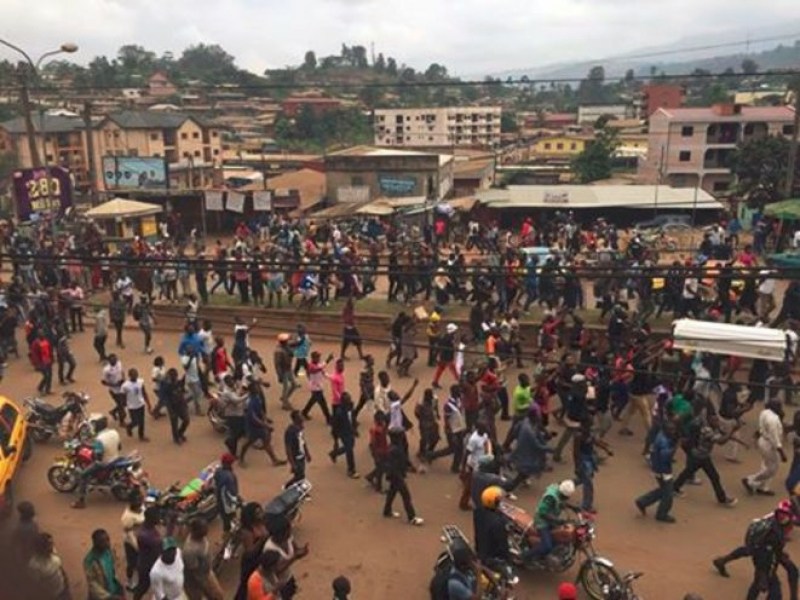
There are few times in life when one is faced with a fundamental issue that reaches to the very core of their being, challenges the essence of their existence and their role in community and the world. For myself and many others, this is exactly what the Anglophone problem in Cameroon represents.
It is interesting that, today, the vast majority of
Cameroonians seem to accept that there is actually an "Anglophone" problem in the country. Contrary to many attempts to label it as a quest for secession, this problem is centered on the systematic marginalization of English-speaking Cameroonians by the government, and the deliberate attempt to extinguish the core cultural, legal and administrative systems in these regions. The current manifestation of this problem, as presented by the teacher's trade union and Common Law lawyers and the autocratic responses from government have left me crying for my beloved country. A problem that could be easily acknowledged and addressed has, instead, escalated into a ticking time bomb because of serious government ineptitude and the blatant disregard for fundamental rights.
How Not to Manage
The Cameroon Anglophone Civil Society Consortium
(Consortium) that was created by English-speaking Cameroonians to table their concerns to government has pursued dialogue. When these leaders did not accept government bribes, an executive order from the State Minister for Territorial Administration and Decentralization, Rene SADI, banned the group and designated it a terrorist organization. Now, how does a government, my representatives, sit down and negotiate with a group and, when at an impasse, turn around and label it a terrorist group? This decision, unfortunately, will likely go down as one of the worst decisions in the 34-year of presidency of Paul Biya. If the government seriously thought that banning the Consortium and arresting its leaders would solve the problem, it is clear that they could not have been more wrong, as their actions have only hardened the determination of regular citizens in their quest for equality. For the very first time, I have seen English-speaking Cameroonians nearly 99.9999% united and speaking with one voice. The only people who are not openly in support of the Consortium are "Anglophones" in today's government, as well as many politicians. Groups like the SCNC which, previously, did not have the benefit of even 5% support, are now very popular. May be this was the government's plan all along ... to justify the arbitrary arrests and brutalization of law-abiding citizens. I would caution very strongly that this strategy will backfire.
The
current protests have "liberated" English-speaking Cameroonians in ways that many cannot begin to fathom. Of their own volition, parents have refused to send their children to school until the demands are addressed. In Buea, store owners have made plans to close shops on Mondays and Tuesdays as prescribed by the banned Consortium. In fact, people do not even seem remotely angry about closing up their shops, but instead are saying, "Enough is Enough." The sequence of events is eerily similar to the African National Congress (ANC) struggles in South Africa, a fact which has not gone unnoticed by many. ANC leaders were widely popular with Black South Africans. Consortium leaders today are extremely popular with English-speaking Cameroonians. We all know that ANC leaders were arrested and jailed. Consortium leaders have been arrested and are currently jailed. ANC leaders were tried in repressive courts and sentenced to life in prison. Likewise, Consortium leaders are being tried in special courts and will be sentenced to .... This may sound like déjà vu, but the reality is that most Consortium leaders have already accepted their fates. And that is a very scary thing. The English-speaking population, both in Cameroon and abroad, knows that they are fighting for something much bigger than themselves.
Read full article here... |