|
Take a look at your fingertips, at the loops, whorls, and arches that make up their intricate and unique ridge pattern. You might know something like the back of your hand, but do you know it like your own fingerprints?
Technically, the assorted lines on your fingers – and palms, toes, and the bottom of your feet – are called friction ridges. Prints are the impressions they leave behind. Whether you know it or not, no matter how many times you wash your hands, your skin is greasy and moist. The sweat and oils your skin naturally exudes make the impression of those friction ridges transfer to surfaces. Generally those prints are latent – prints that are invisible to the naked eye and have to be revealed by processing. A patent fingerprint is made by some other substance, such as when there is blood or grime on the ridges. A plastic fingerprint is made when the ridges are pressed into something such as wax or wet paint.
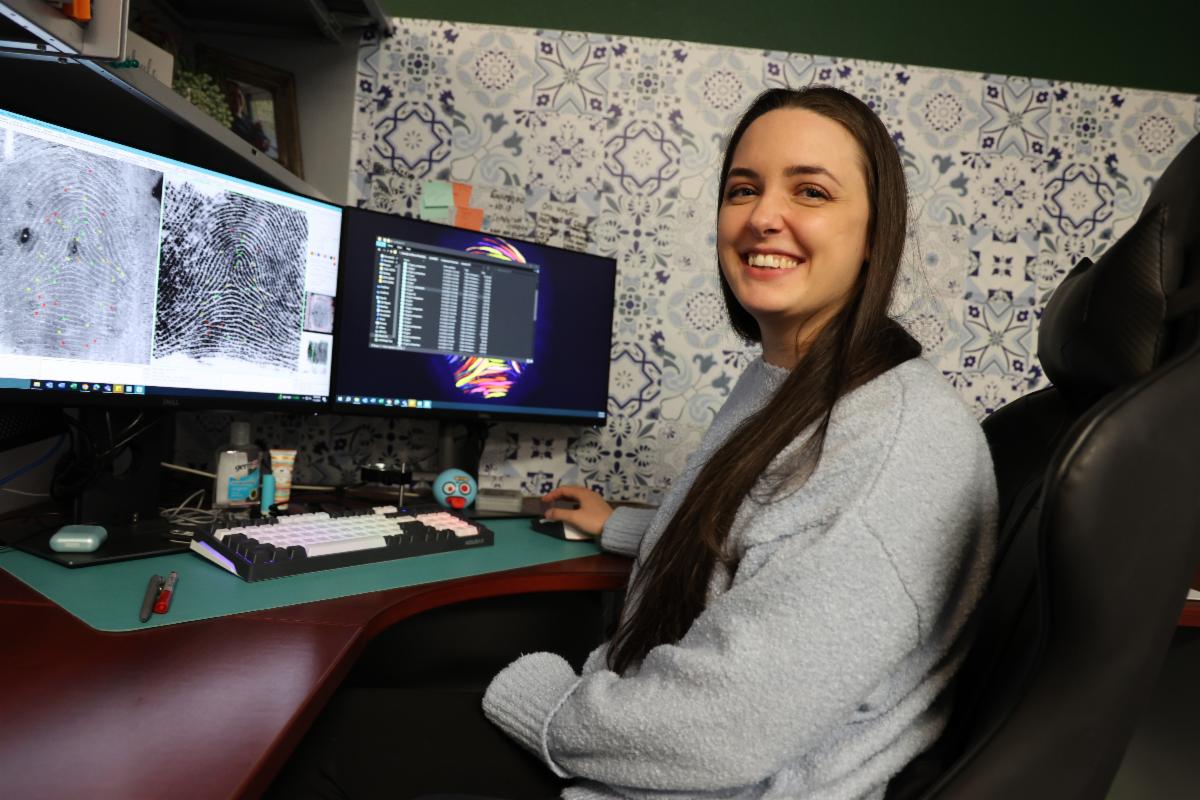
Latent Print Examiner Nikki Chiriboga can analyze all of these, but most of her work is done with latent prints. “My job is to analyze unknown fingerprints taken at crime scenes,” she said. Forensics Science Specialists may collect prints at the scene using powder, or they may take evidence back to process in a more complicated way. Prints can be revealed using chemical processes that involve substances ranging from superglue to gold. “We’re a whole team here. Their good work allows us to do our work.”
The print will then be photographed so that it can be better compared to other prints. They don’t get the actual piece of evidence such as a gun or shell casing, just the image of the print. “The only physical evidence we would have is a pawn slip – everyone who pawns something has to provide their right thumb print. If something is recovered stolen from a pawn shop they use that print to identify the person for the case.”
Except for priority or major cases, which a supervisor assigns, all cases go in a queue and the examiners pull them in the order they arrive. “One recent case had more than 100 items to analyze. The next one had only two.” She never knows what she will get. In fact, she rarely knows anything about the case at all. “We know what type of case it is – homicide, burglary – but that’s all. I don’t read anything about the case, I don’t know the names of any suspects. And when comparisons come back they are identified by numbers, not names. This avoids any possible bias.”
The first step is to decide if the print is viable for analysis. “We look for any types of distortion, movement, creases, scars – not just the ridge counts, or ‘points.’” There are three levels of detail they use to conduct their analysis. “The first is the pattern type, the ridge flow. What type of anatomical print are we looking at? Is it a fingerprint, a palm print, a footprint? Then we look at Level 2, which includes any ridge endings, bifurcations, or dots between main ridges. Level 3 addresses the structure of the ridges themselves – the edge marks, pores within the ridges.” How good it needs to be is subjective – there is no set standard. Every examiner has their own threshold. “We try to make sure there is at least Level 1 and Level 2.”
Next, Chiriboga will compare the latent print to any elimination prints. These are prints from people who are supposed to be at the scene. For example, in an auto burglary they would eliminate prints from the car’s owner or anyone who might legally have access to the vehicle. If not, the print may be from the suspect so it’s time to start the search. “I’ll enter the prints into the AFIS system, which allows us to compare it to all of the fingerprint records we have.” Fingerprint records may be local, state, or national. The Automated Fingerprint Identification System (AFIS) has algorithms that look at the different characteristics of the print, compare the latent with known prints, and try to find prints with the same or similar characteristics. It comes back with the best five different possibilities.
The program makes the suggestions, but it is always the human eye that makes the comparisons and determines whether there is an identification. “We have four different conclusions we could make. The first is Identification – the two prints came from the same source.” Exclusion means they originated from different sources. Incomplete means they lack a full set of known prints to be able to make a comparison -- for example if the latent print is just the tip of a finger, and the known print doesn’t include the tip. Inconclusive means there’s not enough information to make a conclusion, or the latent print doesn’t meet the exclusion criteria.
If there is an identification or exclusion, the print is then verified by a second examiner. After that, the supervisor uploads the results and they go to the detective who is the case agent.
Chiriboga’s work is extremely detailed and highly painstaking. She sits for hours focusing intently on the tiniest details that can establish an identification, and possibly lead to the arrest and conviction of a dangerous criminal. An elimination might prove a suspect’s innocence. Her work is of vital importance to every criminal case where the suspect leaves a fingerprint behind.
Chiriboga started off as a Fingerprint Technician, and was trained by Danny Mennel who was featured in the last story about the AFIS Division. “But this has always been my end goal. I went to school for forensics and got my degree in criminology with a minor in chemistry.” First, she volunteered with Pasco County Sheriff’s Office forensics. “When I went out to scenes I realized this isn’t what I thought it would be.” It wasn’t so much the dead bodies and smells as it was the heat. Forensics is a physically demanding job, working for hours in the sun or in houses without electricity. “Then they had an opening to volunteer with the latents.” It was an instant match. “That was a lot more fun, I’m a puzzle person. That’s what it feels like when you’re comparing prints – like a spot-the-difference puzzle. I realized that’s what I want to do.”
|