|
Larry Smith – Common name, uncommon depth
Don’t worry Saturday at Gold Cup
if you think ratings hurdler
Eye of Gunfighter has lost a shoe
(He hasn’t: He’s lost two.)
| |
Celebrating his 300th career winner as trainer (not counting a dozen or so point-to-points), Larry Smith saddles one of the morning-line favorites in the ratings race at International Gold Cup. Find out how he went from Tom Voss barn rat to army colonel scrambling to put on his battle rattle as enemy shells started pounding the U.S. base in Afghanistan. Hear the convincing methodology behind his curious – and slightly eccentric – horseshoeing theory, and for sure click and listen to his band, Release, play their own foot-tapping version of Prince’s “Kiss” with a mid-Atlantic party band funk interpretation. | |
|
Lawrence Madison Smith – Larry, saddled his 300th lifetime winner Oct. 14 at Glenwood Park.
It was a milestone for this sometime part-time trainer, retired army officer, combat veteran, one-time political candidate, front-man for one of the mid-Atlantic region’s most popular rock-and-roll bands, and lifelong horseman that’s not afraid to think outside the box.
As of press time, Smith had saddled 3,388 starters, winners of 300 races with almost $3.12 million in earnings.
At tomorrow’s International Gold Cup meet in Virginia, Smith hopes to add number 301.
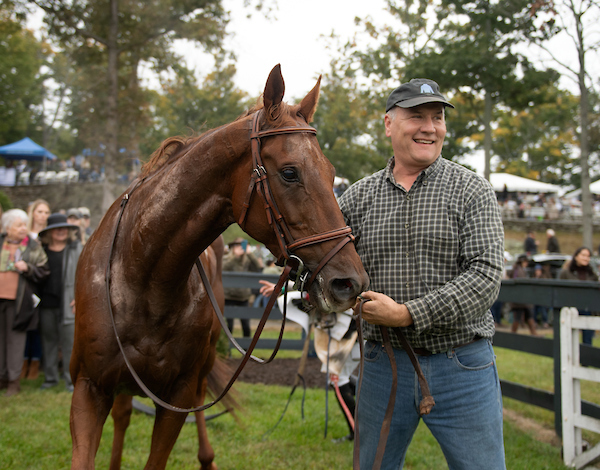
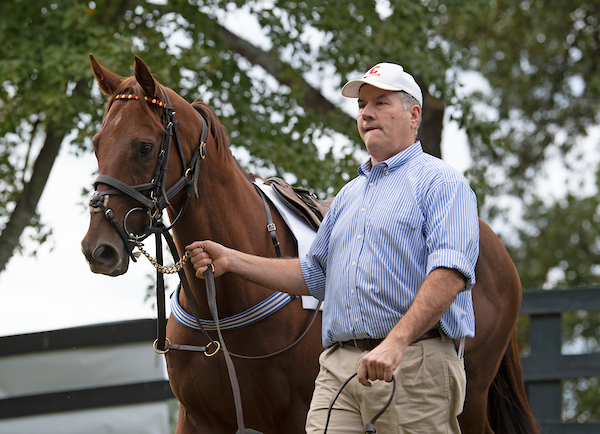
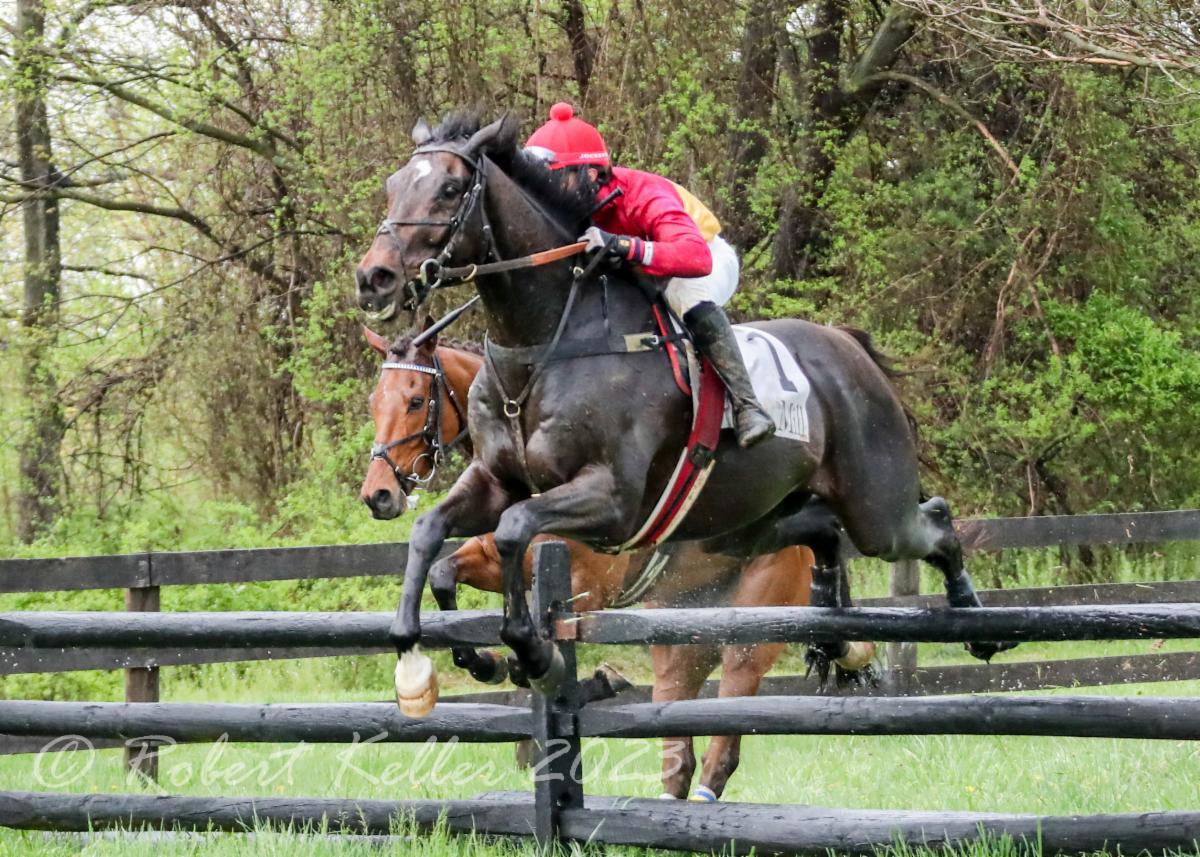
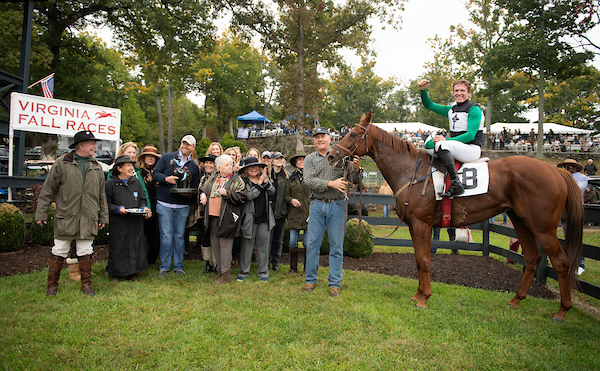
He sends out the formful Eye of Gunfighter in the 115 ratings hurdle. He’s co-highweight at 158, but Smith says the 6-year-old has “only gotten better and better” this season, with back-to-back wins Oct. 1 and Oct. 14. (Tod Marks photo, above, of Smith with Eye of Gunfighter after his win in the Magalen O. Bryant Memorial Hurdle Handicap at the Virginia Fall Races)
The casual railbird at first glance might do a double-take, thinking Eye of Gunfighter has lost a front shoe as he stalks past on his way to the paddock or on his way to post. Then you realize he’s lost both his front shoes.
That the trainer and the handler aren’t scurrying to grab the course blacksmith is your best clue: Eye of Gunfighter isn’t shod up front on purpose.
Like all of Smith’s other horses in training, Eye of Gunfighter doesn’t wear front shoes ever. Only hind shoes.
| |
|
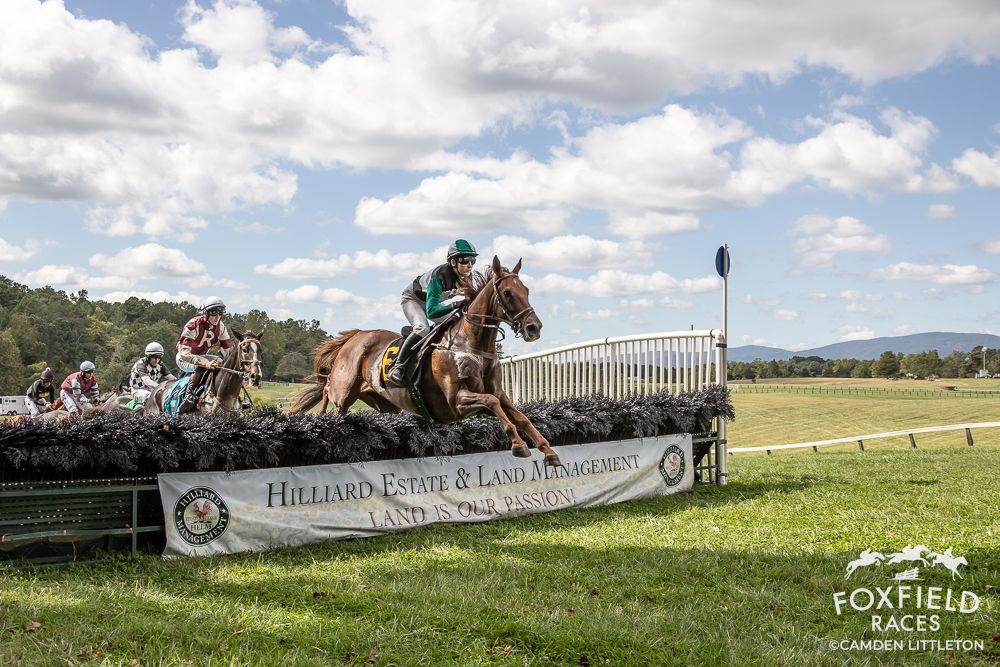
How Smith developed the quirky trademark is a long story. Briefly put, Smith came to believe that driving nails into the bottom of the equine athlete’s feet and weighting them down with U-shaped metal bars wasn’t adding to their capability. (Camden Littleton photo, left, of Eye of Gunfighter at Foxfield on October 1)
To ditch the shoes was extreme, but it is a unique training-racing and physiological model Smith developed from years of research, calling on his book-learning and lab time studying animal science from every angle at Cornell, reaching back into the decades of observation he’d logged working in the thoroughbred industry and – perhaps key - the hours he spent in solitary self-reflection. Like any working horseman, Smith had plenty of time to think and ponder, he says, driving a truck and trailer up and down the East Coast to catch a good spot for a horse.
He drove. He thought. He considered the issue from all angles.
And one day he went home and pulled all his horses’ shoes.
To fully understand where the Westminster, Maryland horseman has gotten to, you have to hear where he started.
| |
Smith, now 58, looks to his youth for the inspirations that pushed him down several of his career tracks. He credits his parents for piquing his interest in the military and the horse world, and a penchant for keeping things in order that made him a natural for Belts Logistics Services. | | |
|
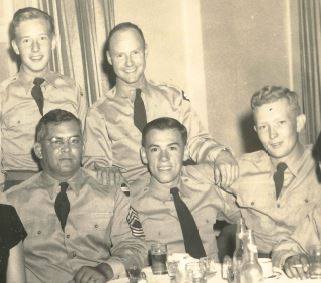
Larry Smith's father Hal Smith (middle) -- 1951, age 23.
Photo courtesy of Larry Smith
| |
|
|
Smith followed the army track of his father and grandfather, both combat vets. Horses came from his mother: she grew up in Lexington, Kentucky, and was instrumental in Smith’s early equine education, ferrying the young teen to Bruce Fenwick’s and Tom Voss’s to work and soak up as much knowledge as they’d share.
“Bruce Fenwick is the one who started me learning the horse and farm landscape,” Smith recalls.
“He’s the one that taught me how to throw haybales.
“He paid me $1.50 an hour.
“One of my favorite memories was getting to work all day on Belmont Farm on school snow days. This was a long time ago – 1979, and Bruce’s big green John Deere tractor was before its time – it had an FM radio! I remember one winter morning plowing snow off Bruce’s driveway, listening to Michael Jackson’s ‘Don’t Stop ‘Til You Get Enough’.
“It was surreal. I still remember that day, that feeling.
“I remember watching his riders. I was thinking, ‘people get paid to do this.'
“That was when I knew I’d be getting into horses.”
| | |
|
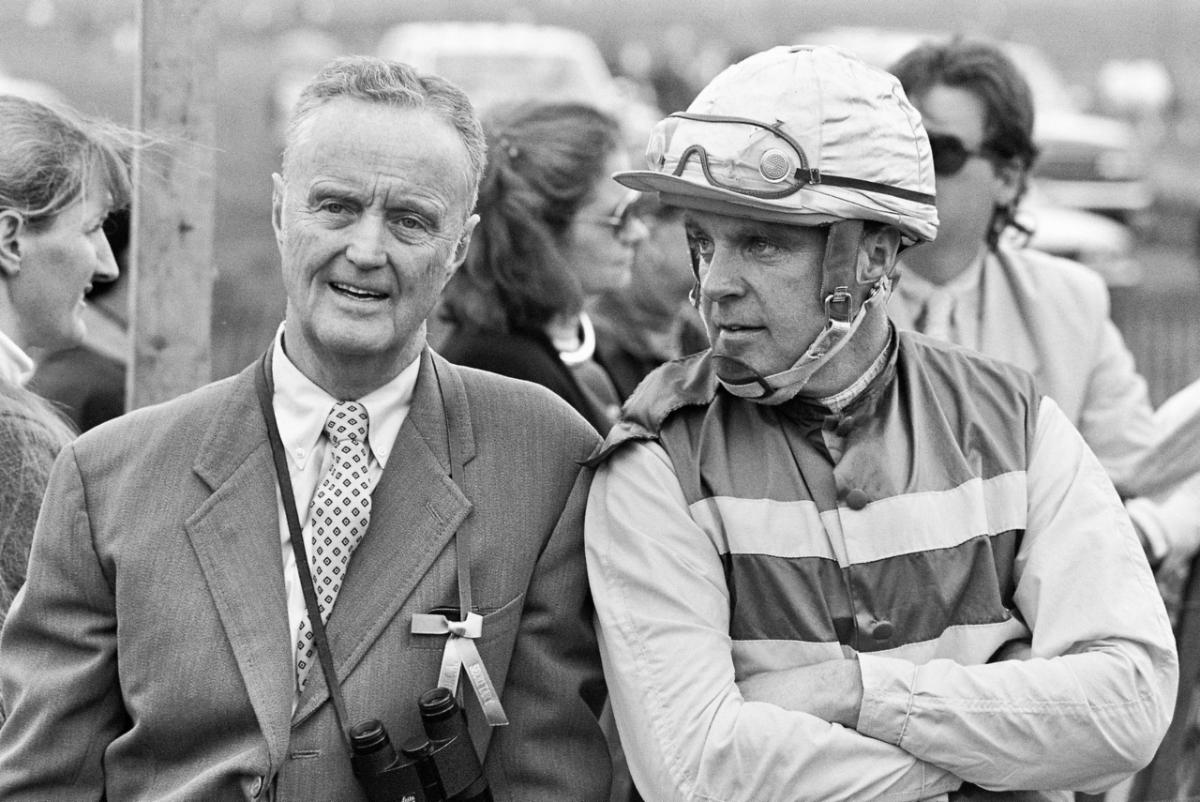
Bruce Fenwick, so influential on Larry Smith's career, in the Maryland Hunt Cup paddock with father, Cappy.
©Douglas Lees
| |
|
|
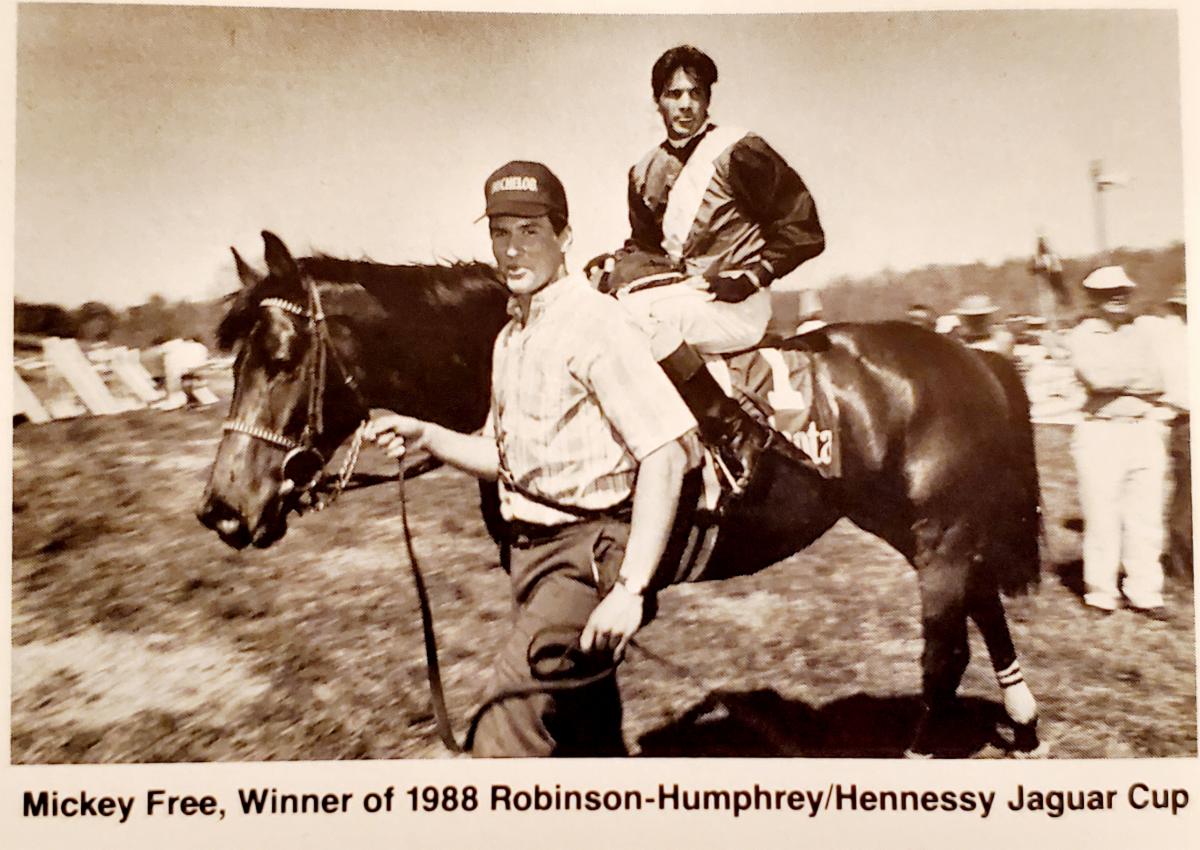
Smith recalls another moment frozen in time that put him on track: one April weekend in 1988 when he was working for Voss. “I took (multiple stakes winner and Voss homebred) Mickey Free down to Atlanta for the stake, all by myself because Tom had to run the Elkridge Harford Point-to-Point that day on his farm. Chuck Lawrence rode the horse, and the day before, we’d bought Mickey Free at the calcutta. And he won! Chuck and I split the winnings, and danced all Saturday night long.
“Remember it like it was yesterday.”
| | |
Mikey Free (Chuck Lawrence in the tack and Larry on the shank) in Atlanta in 1988. From the 1988 "American Steeplechasing" | |
|
|
Smith studied at the Friends School, graduated with a BS in animal science and agricultural economics from Cornell in 1987 and earned a masters of public policy management and international security from the University of Maryland in 2008. He played football – tight end, while at Cornell.
Smith may never catch up to fellow Cornell grad and four-time Eclipse Award-winning trainer Chad Brown – 10,000 starters, 2,500 winners of $271 million.
| |
|
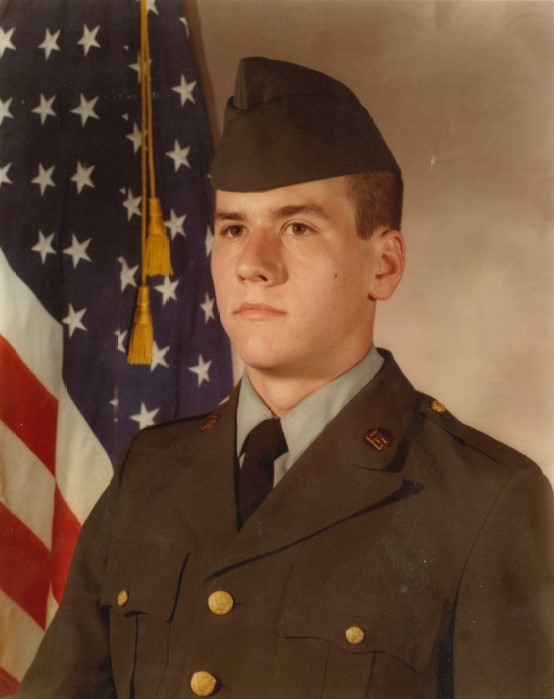
Smith rose to the rank of lieutenant colonel in the U.S. Army. He served active duty as intelligence officer in the Iraq war and Operation Enduring Freedom in Afghanistan. He was theater infrastructure master planner U.S. forces in Korea at Yongsan Army garrison in Seoul 2012 and ‘13. He later worked with the Joint Chiefs of Staff at the Pentagon. (An 18 year old PVI Smith in June 1983, courtesy of Larry Smith)
Smith felt it important to give back to the nation.
“Seeing Washington’s leadership deficit is abundantly clear to me,” Smith says. “Without a change in course, my son’s generation is destined to inherit a nation with fewer opportunities – not more.
“We owe it to our children to control the national debt, revive and re-shape the American economy and uphold our national security.”
While he was active duty, Smith says he just “gave up horses" and says he didn’t really even keep up with racing while he was away. It was the time before internet feeds and things.
“Horse racing is a form of entertainment. National security came ahead of that.
“It put it all in perspective.”
He did jump right back into racing when he returned stateside. “I had to relearn all the stallions when I came back.
“JB Secor said I was like a horse coming off a layoff. Freshened.”
| |
|
Smith ran for the Republican nomination for Maryland’s district 02 in 2012.
His platform: Leadership. Fairness. Candor. Courage.
| |
|
Wife Connie Smith helps run Hickory Made Stables, and handles the day-to-day farm operations.
She has two daughters and a granddaughter. His son Nathan is a student at West Virginia University.
It’s the name of their racing operation at their Pioneer Farm in Westminster, Maryland, but there’s a funny story behind Hickory Made Stables.
“I once ran a horse like five times in one month, and (fellow Maryland horseman) Ann Merryman was teasing me that the horse must be made of hickory, as tough as he was.”
The name stuck.
Hickory Made to date has had 278 starters with more than $365,000 in earnings. They partner with several clients, including Eye of Gunfighter co-owners Celtic Venture Stable.
| |
|
A 1970 grandson of Turn To, 🏇🏿Turn To Silver🏇🏿 was the first horse Smith trained, and was his only race mount as jockey.
It wasn’t so much the horse, Smith says, as the tactics of his fellow junior jockeys that derailed his “trainer-rider” career to just “trainer.”
“Old Dominion Hounds Point-to-Point in Virginia, 1981. We were running around that course. I think it was Woods Winants that was squeezing me over. (They were both also-rans in the junior horse race on the card.)
“We were pulling up and I was like, ‘wow, football is a lot safer than this. I think I’ll stick with that.’
“Racing that one horse scared me sufficiently into hanging up my jockey boots.
“But riding is what led me into training in the first place. The magic of being on your horse in the woods at dawn as the sun comes up through the trees. Riding along and seeing a doe and a fawn, or going around the next corner and seeing a fox through the fog.
“That left an impression.”
| |
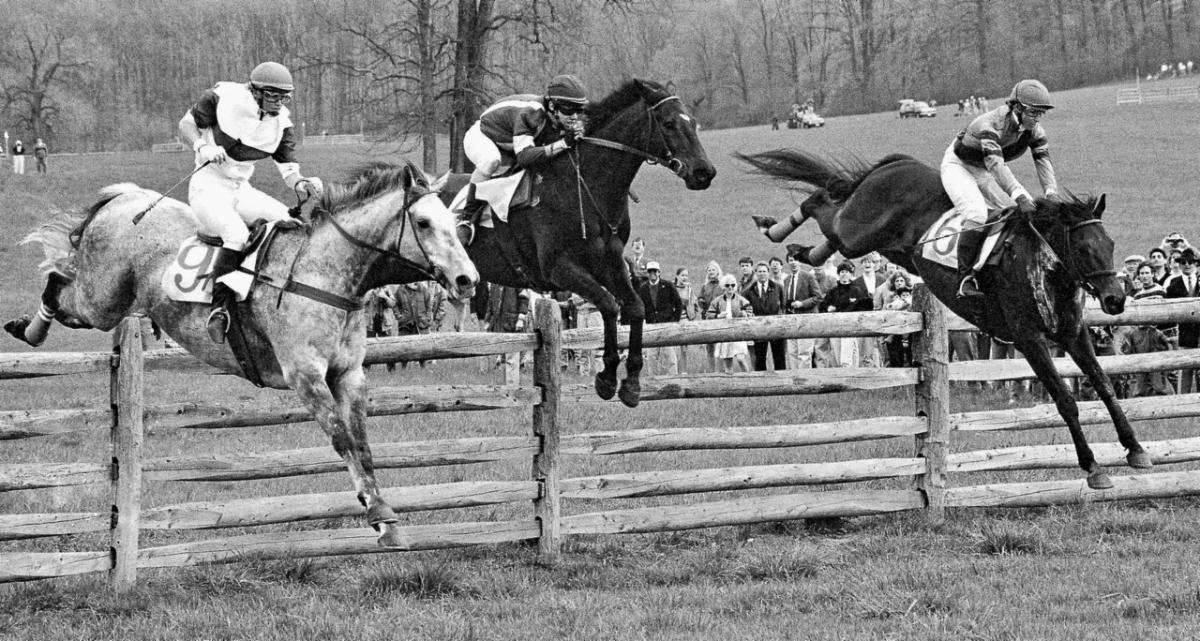
1993 Maryland Hunt Cup, 3rd fence: Ivory Poacher (Sanna Neilson) - 1st; Snow Maker (Joseph Delozier, up) - 4th; Pleasant Sea (Liz McKnight, up) - 5th. ©Douglas Lees | |
|
Ohio-bred 🏇🏿Snow Maker🏇🏿 literally launched the career of standout jockey (later, trainer) J.W. Delozier. Delozier rode Snow Maker in his first half-dozen races – junior races at point-to-points, then his first open point-to-point race, first timber race, first sanctioned start …. and first win at Winterthur in 1991.
In 1992, Smith, Delozier and Snow Maker posted an epic spring campaign – Snow Maker won at Howard County-Iron Bridge Point-to-Point, was second in the maiden at My Lady’s Manor and won the allowance at Grand National. They finished third in the Maryland Hunt Cup.
Snow Maker and Delozier finished fourth in the 1993 Hunt Cup.
| |
Smith and Eye of Gunfighter in the paddock at the 2022 Virginia Fall Races. Smith tends to run "Gunner" on the flat for most of the year, with hurdle starts at the hunt meets in Virginia in the fall. ©Tod Marks | |
Smith’s International Gold Cup entry for the Celtic Venture syndicate, 🏇🏿Eye of Gunfighter🏇🏿 just keeps getting better, according to Smith. The Pennsylvania-bred 6-year-old has has run 55 times total, with three wins on the flat and two over hurdles, both this fall. He has almost $115,000 in earnings.
He’s run 16 times so far this term.
| |
One of Smith’s best was turf mare 🏇🏿Big Big Affair🏇🏿, grade 3 placed for Smith in the 1990s who earned more than $230,000 in 77 starts for breeder Billy Christmas and for Smith and owner Michael Kirchenbauer. | |
|
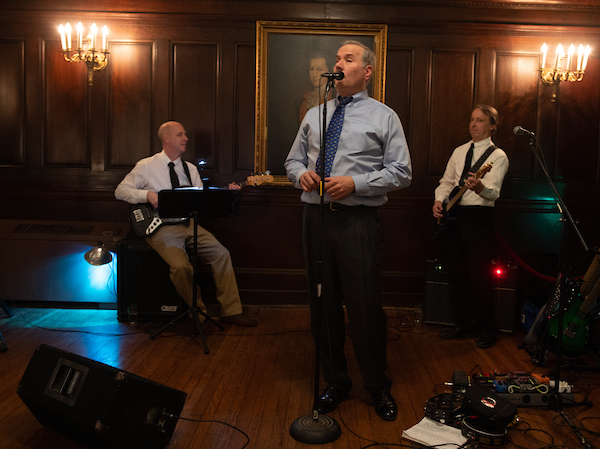
Like horses, his parents played a big role in creating his ardor for music: Smith’s mother took him to see Elvis Presley, live, when Smith was 11.
He played in college, and for the past 30 years, Smith has been lead singer and harmonica for the band, Release.
Smith calls Release “aggressively eclectic,” with playlists from REM to Van Morrison, Johnny Cash to U2. Find their toe-tapping rendition of Elvis Presley’s “Little Sister” on YouTube, and try not to jump up and dance when you play Smith’s version of Prince’s version of the funk classic, “Kiss.”
Release plays gigs a few times a month, Smith says, playing everything from the Maryland State Fair to the Maryland Million, dive bars to a Boniface wedding reception. (Tod Marks photo of Release playing at The Maryland Club in January for the NSA awards dinner)
| |
|
I’m lucky that training horses isn’t all what’s paying my bills. I work at Belts Logistics Services near Baltimore harbor, receiving, storing and distributing (the goods from) shipping containers delivered there from around the world.
Helping people get their stuff – mostly food and alcohol, everything from baby food to vodka.
The horses train in the evening in summer, late afternoon in winter.
I like it that, in the horse world, pretty much everybody helps everybody. The larger your network, the better you do.
| |
|
Like any trainer when I was doing it full time in the 1990s, 2000s, I was shipping around to find the right spot for a horse. Driving gave me long (stretches of time) to think.
I was thinking one day about bone chips, and started to realize it is the torque on the ankle causing it.
The further the distance between the (joints) and the ground, the more torque.
Same theory where you wouldn’t wear your running shoes on the basketball court – their soles are too thick. And women being careful wearing high heels because they might twist an ankle.
It was a eureka moment. If we can keep the ankle from dropping down so far on these horses, you solve a lot of soundness problems.
| |
In 2019, Smith co-authored an opinion piece for the Paulick Report on the question of ethics in racing. | |
In general, we do a bad job of defending our industry. Everyone on the inside knows, if we keep our horses happier and healthier, they’re capable of making more money – plus, they’re happier and healthier.
The racing industry, by and large, treats every single horse as well as possible.
Think about it – the trainer is always thinking about what kind of toy can I provide my horse to keep him happy. I’ll get a goat, cut a hole in the wall for him to see out, hang up a toy. Send him to the farm.
We often fail at getting this message out there when we’re attacked. We need to educate people, and that’s what we can do better.
| |
Eye of Gunfighter and connections will aim to add another win on Saturday at the International Gold Cup Races - he runs in the Ratings Handicap Hurdle with Gerard Galligan in the tack once again. ©Tod Marks from the Virginia Fall Races | | | | |