While close wildlife encounters are rare, a few nearby events have prompted us to refresh our knowledge of back country animal behaviors and what we can do to stay as safe as possible.
Although most animals will run when approached by a human, as a last resort or if surprised, they can attack. So as we strive to co-exist with our wildlife friends, please read through the following guidelines for what to do in the unlikely event of an encounter.
Please share this information with your families and guests and please report and incidents or sightings to Ranch Security: security@wolfcreekranch or 435-783-6140.
|
|
Take precautions while hiking
- Stay alert at dawn and dusk, when bears are more active
- Go with a group, if possible
- Make noise as you travel through dense cover
- Stay away from animal carcasses
- Store food, trash and scented items (such as sunscreen) in airtight plastic bags
- Keep kids in the center of the group
Protect your home and property
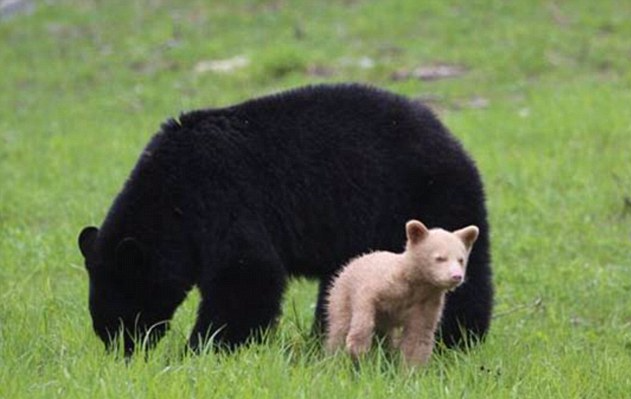
If a bear enters your yard, give it an obvious escape route - do not corner it. Black bears can quickly inflict thousands of dollars in property damage. You can reduce or eliminate visits from bears if you:
Dispose of trash carefully
- Store trash in a secure location or bear-safe container
- Put your trash out for pick-up in the morning, not the previous night
- Clean your trash container regularly
Use deterrents
- Put up electric fencing
- Place bear unwelcome mats (wood planks with nails or screws protruding) in front of doors or windows
- Install motion-activated lights or noisemakers
- Get one or more dogs
- Turn on garden hoses or sprinklers
- Spray the bear with bear spray
If you encounter a bear
- Stand your ground. Never back up, lie down or play dead. Stay calm and give the bear a chance to leave. Prepare to use your bear spray or another deterrent.
- Don't run away or climb a tree. Black bears are excellent climbers and can run up to 35 mph - you cannot out climb or out run them.
- Know bear behavior. If a bear stands up, grunts, moans or makes other sounds, it's not being aggressive. These are the ways a bear gets a better look or smell and expresses its interest.
If a bear attacks
- Use bear spray. Then leave the area. Studies have shown bear spray to be 92 percent successful in deterring bear attacks.
- Shoot to kill. If you use a firearm, never fire a warning shot - aim for the center of the bear and keep firing until it is dead. Notify the Division of Wildlife Resources immediately.
- Always fight back. And never give up! People have successfully defended themselves with almost anything: rocks, sticks, backpacks, water bottles and even their hands and feet.
Information provided by the Utah Division of Wildlife Resources:
|
|
Mountain Lion Behavior Around Humans
Seeing or hearing a wild mountain lion is rare as they tend toward avoidance around people. These mammals do not want to be seen or noticed, but have probably observed you whenever you hike through their habitat. Even amongst each other, mountain lions tend to be wary. They live solitary lives and the only time they are not alone is when a mother mountain lion is rearing her cubs. Mountain lion cubs are both deaf and blind at birth, making them incredibly vulnerable to prey. As a result, mother mountain lions are very protective of their cubs.
While encountering a mountain lion is rare, and a mountain lion attack is even rarer, the high mountain climate throughout Utah is mountain lion habitat. Consequently, you should be aware of mountain lion behavior to best stave one off in the event of encounter or attack.
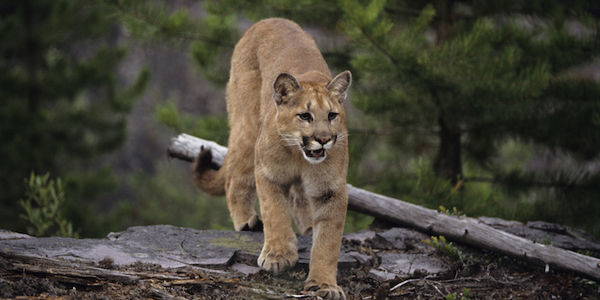
Aggressive Mountain Lion Behavior, which may indicate a potential mountain lion attack, includes:
- Stalking
- Closer than 50 yards away
- Hiding
- Creeping
- Crouching
Curious Mountain Lion Behavior is:
- Distance of 50 yards away or greater
- Following, but not trying to hide
- Frequently changes position, but never to a crouching position
- Simple observation
- A mountain lion displaying curious behavior is still a threat to young children
How to React to Aggressive Mountain Lion Behavior
- Do not run from a cougar. Running will provoke an instinctive prey response and the cougar may pursue you.
- Make yourself look intimidating. Make eye contact with the cougar, and make yourself look big by opening your jacket, raising your arms and waving them. Speak loud and firm to the cougar.
- If you have children, pick them up before they panic and run. When you are picking children up, keep eye contact with the cougar and try not to bend over too far or turn your back to the cougar.
- If a mountain lion does attack you, fight back. Use anything at your disposal and go for its neck. Stab, smash, punch--whatever you do, do not lay still and fake death.
Recreating in Cougar Country
- Hike with other people and make noise. Cougars usually will not bother groups of people.
- Keep a clean camp and store food and garbage in your vehicle or hang it between two trees where cougars (and bears) cannot reach it.
- When hiking with small children, keep the children in the group or in sight ahead of the group. Remember, cougars ambush from behind, so keeping a child in front of the main group will lessen the possibility of attack.
- Keep away from dead animals, especially deer or elk. This could be a kill that a cougar is guarding or will be returning to. A cougar will defend its food.
- If hiking with pets, keep them close to the group. Roaming pets will be open to cougar attacks or could irritate a cougar that is trying to avoid the group
Living in Cougar Country
- Do not feed wildlife. Feeding wildlife attracts animals to your yard that may be prey of cougars, thus attracting cougars to your yard.
- Do not feed pets outside. Cougars will eat pet food, and the food could attract cougars to your yard. Keep pets indoors at night as well, as pets make easy prey for cougars.
- Make your yard deer-proof. If your landscaping is attractive to deer, cougars will follow the deer and hang close to your property.
- Dense vegetation makes great hiding places for cougars. Remove vegetation that could be a hiding place, making your yard less friendly for cougars.
- Outdoor lighting and motion-sensitive lighting is a deterrent for the secretive cougar. Lights also make approaching cougars visible.
- Secure livestock in a barn or shed at night. If that is impossible, a small, well-lit pen close to a structure is the next-best option.
- Keep a close eye on your children when they are playing outside. Bring children in before dusk when cougars begin to hunt.
Mountain Lion Facts
- The cougar, Felis concolor, is also known as the mountain lion, puma or panther.
- The cougar is one of North America's largest cats and is recognized by its tawny color and long tail.
- Cougar kittens, or cubs, have blackish-brown spots on their body and dark rings on their tails that fade as they get older.
- Cougars are solitary animals, making them a rare sight for humans. They usually hunt alone and at night, ambushing their prey from behind. Typically, cougars kill their prey with a bite to the lower neck.
- After making a kill, a cougar often will take the carcass to the base of a tree and cover it with dirt, leaves or snow, saving it to eat later.
- Cougars live all across Utah, from high in the Uinta Mountains to the dry southern Utah deserts.
- Cougars' main prey is deer, so cougars are often found close to deer.
- Cougars live up to 12 years in the wild but have lived up to 25 years in captivity. In the wild they face death through accidents, disease and large predators (including humans).
Information provided by the Utah Division of Wildlife:
|
|
DON'T MESS WITH THE MOOSE
|
|
Preventing & Surviving a Moose Attack
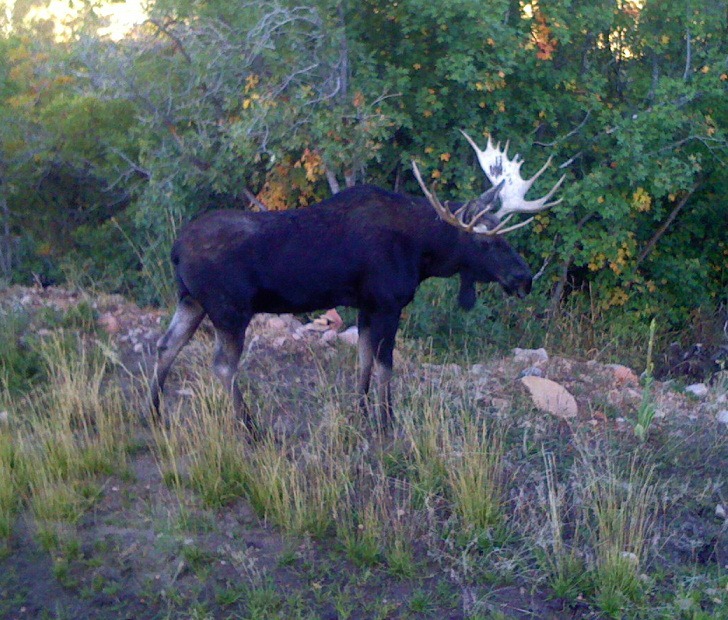
Although they appear gentle, wild moose can be unpredictably aggressive, occasionally attacking when they feel threatened. With moose weighing upwards of 1,500 pounds, this is like a car barreling toward you.
Why Wild Moose Attack
Moose attacks generally occur in two seasons and for two reasons:
- Early Summer with Calves - Moose mommas (or cow moose) are likely to have their calves alongside them during this time of year. If you come between a cow and it's calf, you are in trouble
- Fall and Mating - Bull moose are highly aggressive in the fall when courting cows. If you encounter a bull moose during mating season, it may perceive you as a mating threat and ward you off by attacking
Another reason a moose will attack is if the moose is provoked by man or canine. If you see a wild moose, do not provoke it with words or weapons, such as rocks or sticks. Moose may also associate your dog with a coyote or wolf, who are natural predators of their young.
How to Survive a Moose Attack
Signs of an aggressive moose include:
- Walking in your direction
- Stomping its feet
- Peeling its ears back
- Grunting
- Throwing its head back and forth
Should you encounter an aggressive, wild moose, here is how to prevent and survive an attack:
- Back away with your palms facing the moose
- Speak softly and reassuringly, like you would to a little child
- If the moose charges, get behind a large tree or rock in order to separate your body from the moose. Most moose charges are bluffs
- If the moose attacks you, feign death by curling up in a little ball. Protect your head and neck with your arms. If you are wearing a backpack, your pack will protect your back
Information provided by Glacier National Park:
|
|
|
|
|
|
|