Washington County Voters Bring Legal Action Challenging Board of Election's Decision to Conceal Information about Voters' Mail Ballot Disqualification | |
|
We're going to court to challenge a new policy in Washington County that left hundreds of voters with no opportunity to make their voice heard in April's primary election.
Under the new policy, Washington County officials deliberately concealed information about which voters had made disqualifying errors, such as missing dates or signatures, on their mail-in ballot envelopes, and in many cases misled voters into believing that their vote would be counted, when in fact it had been rejected. The county also instructed its election office staff to withhold any information about disqualifying errors, even if voters called to ask about them.
With no way to learn that their mail-in ballot had been rejected, Washington County voters had no opportunity to salvage their right to vote by voting a provisional ballot at their polling place, and 259 voters were disenfranchised in April's primary election.
Today, we filed a lawsuit challenging this policy on behalf of seven of these voters, the Center for Coalfield Justice, and the Washington Branch NAACP, arguing that Washington County’s policy, which will be implemented again in the November general election, violates the PA Constitution’s due process guarantee. We were joined by co-counsel from ACLU-PA and Dechert LLP. Read more and view case documents here.
"I thought I had done everything correctly when I voted by mail in this year's primary election, but I made a mistake. I had forgotten to sign and date the outer envelope," said Bruce Jacobs, a Washington County resident and longtime voter. "Washington County election officials knew I made a mistake when they received my ballot. They knew that they would reject my ballot because of this mistake. I wish county officials had respected me, as an American with a fundamental right to vote, and given me a chance to address my error." Pittsburgh's WESA covered the case.
| |
Every child, every community: The long-term plan for strong public schools in Pennsylvania | |
|
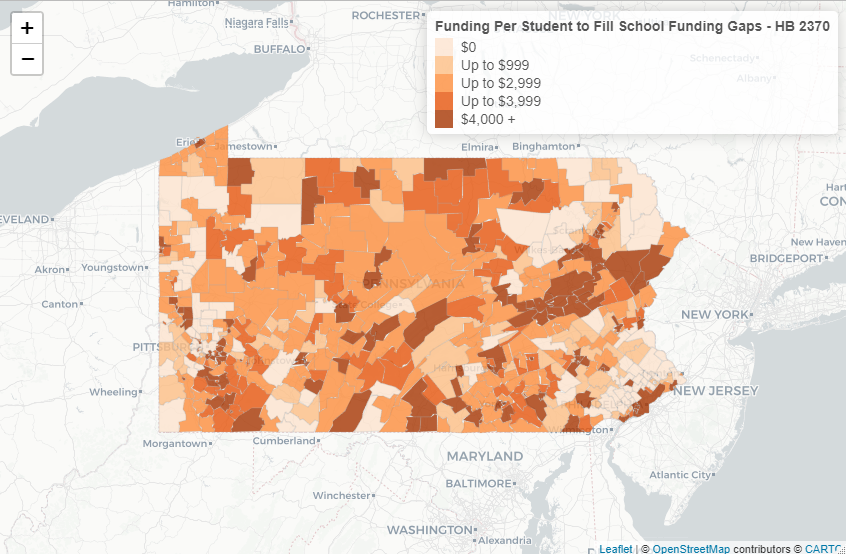
Above: A map showing the statewide impact of HB 2370, a long-term plan for transformative public school funding, in school districts across Pennsylvania.
Hundreds of thousands of Pennsylvania public school students in cities, small towns and suburbs are going without the basic resources they need to realize their potential.
Students in Johnstown are going without the support of reading specialists. Just 15% of Pennsylvania’s lowest wealth schools have librarians. While the American School Counselor Association recommends a school counselor ratio of one to 250 students, Pottstown School District has two counselors for 991 middle schoolers and two for 990 high school students.
Our students have a fundamental right to education, but for too long, that right has been thwarted by a public school funding system that relies on local wealth. In Feb. 2023, Pennsylvania’s Commonwealth Court ruled that this is unconstitutional and must change, following the school funding lawsuit we filed with Education Law Center-PA and O'Melveny.
Now, there’s a serious long-term plan to fix our commonwealth's unconstitutional underfunding of public schools: Pennsylvania House Bill 2370, which passed the House with bipartisan support on June 10, 2024. The plan would provide funding based on what students need to succeed, not what communities can afford.
If it becomes law, this plan would:
-
Boost current state funding to 367 underfunded school districts by $5.1 billion to fill constitutional adequacy gaps, through annual increases each year for seven years.
-
Provide $1 billion in property tax equity support for communities facing the highest local tax levels due to state underfunding
-
Ensure stability for all 500 school districts, particularly those with declining enrollments, by guaranteeing that they will continue to receive no less than their current level of state funding.
- Significantly reform cyber charter school funding.
Read more about this plan and check out an interactive map of what it would mean for school districts across Pennsylvania, and view a spreadsheet with details of the plan.
It’s up to all of us to tell the Pennsylvania Senate to finish the job for our students and pass this plan into law. Use this tool to find and tell your state senator to pass HB 2370 and transform the lives of hundreds of thousands of students across Pennsylvania.
“Today, members of the Pennsylvania House of Representatives showed that they take their constitutional duty to our students seriously,” said Dr. Eric Becoats, superintendent of William Penn School District, our client in the school funding lawsuit, after the bill passed the House. “For too long, William Penn educators and students have had to ‘do more with less:’ less counseling, less remedial support, and opportunities that are less than any child deserves. But kids shouldn’t have to ‘do more with less.’ They should have what they need. This plan would deliver it.”
The General Assembly did not meet its June 30 deadline to pass a state budget for 2024-25, and negotiations are still ongoing between House leaders, Senate leaders, and Gov. Shapiro. This is the year to live up to the promise of our state constitution--and there's only one plan on the table to do so. The House has passed it, and Gov. Shapiro has endorsed it. Now, it's up to the State Senate.
| |
Now is the time: take action for constitutional public school funding this budget season | |
|
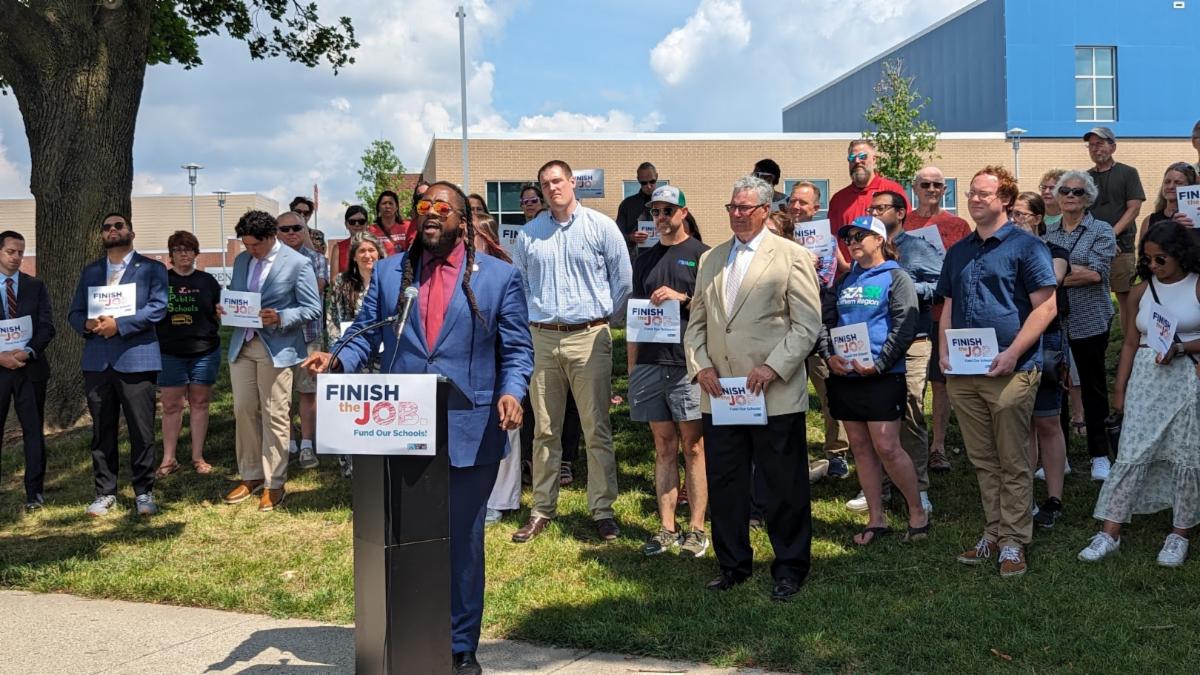
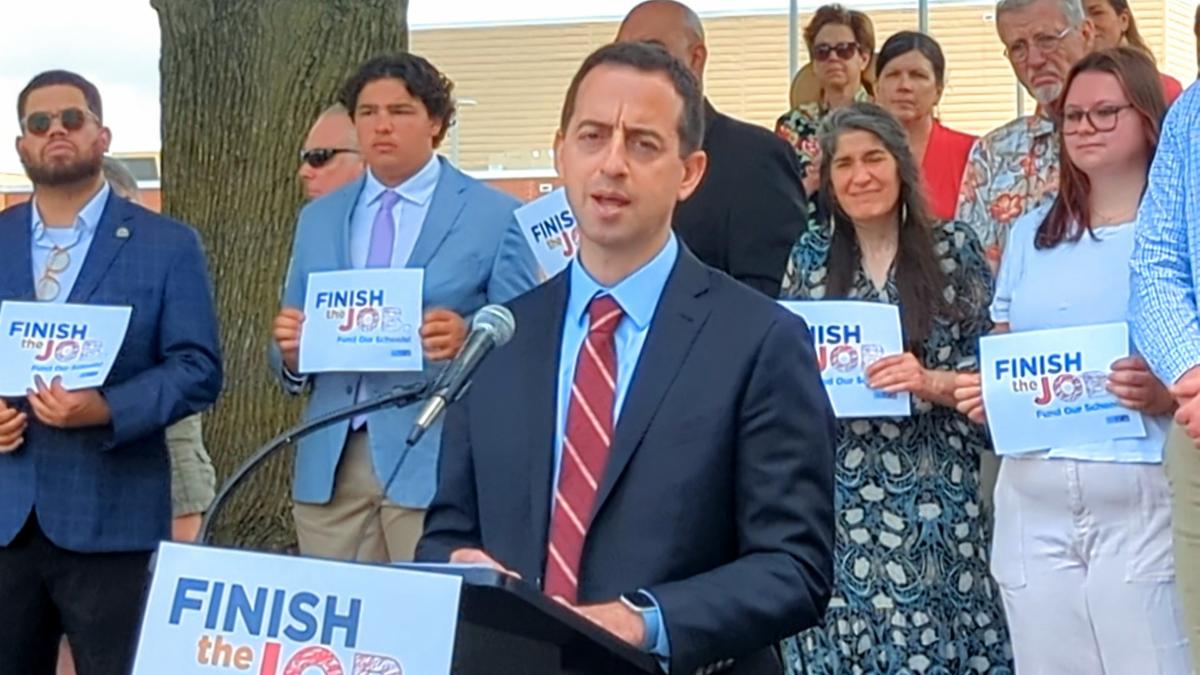
Above: State Representative Ismail Smith Wade-El (left) and our senior attorney Dan Urevick-Ackelsberg (right) address a group of educators, parents and students in Millersville on June 13, following the passage of HB 2370
More than a year after the historic win in our school funding lawsuit, it's time to tell our leaders in Harrisburg to finish the job and fund our public schools.
Use this online tool to send a letter to your representatives in the General Assembly, urging them to pass Governor Shapiro's game-changing budget proposal for public education.
Advocates can help mobilize school boards and community organizations to come out in public support of this game-changing plan by passing resolutions sent to lawmakers in Harrisburg. Learn more and view a sample resolution from our friends at Education Voters PA.
| |
Tenants sue Columbus Properties, one of Philadelphia's largest providers of supportive and low-income housing, for neglect and disrepair | |
|
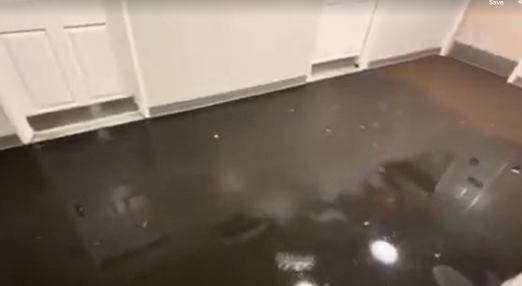
Left: Flooding on the first flood of Columbus apartment building Freedom Village in January 2023. The stagnant water was unaddressed for at least seven days.
The nonprofit Columbus Property Management, part of the larger housing nonprofit Mission First Housing Group, manages 34 apartment complexes in Philadelphia, serving low-income tenants and tenants with disabilities. Supported by public subsidies, Columbus plays a critical role in a city with a dearth of affordable housing--but tenants find that Columbus falls far short of their responsibility to provide decent and safe places to live for Philadelphia’s vulnerable residents.
Residents face security failures, leaks that persist for months and turn to mold, rampant pest infestations, useless appliances, and many other serious habitability issues. These issues routinely go unaddressed for months or years, despite repeated complaints.
On June 7, our clients, nine tenants in three Columbus apartment complexes, sued their landlord in the Philadelphia Court of Common Pleas. The widespread unsafe, uninhabitable and unfit conditions of their apartments and buildings—and Columbus’s failure to respond to repeated requests to repair them, all while continuing to collect rent—violate the terms of their leases, tenants say, along with Pennsylvania laws protecting tenants and consumers. We were joined by pro bono co-counsel from Holland & Knight.
Read the complaint here, including photos of housing conditions faced by residents. The Philadelphia Inquirer covered the case on June 10.
“Columbus claims to provide decent housing for vulnerable Philadelphians, but that’s not the reality for the people who live there,” said our staff attorney Caroline Ramsey. “Philadelphia needs Columbus to do its job, and do it well. But it is clear that they will continue to fail to perform their basic responsibilities until they are compelled to do so."
| |
Law Center in the News: Jay Z and the latest push for school vouchers in PA | |
|
As the Pennsylvania General Assembly considers a plan to finally address our commonwealth's unconstitutional underfunding of public schools, there are renewed efforts to convince legislators to ignore this responsibility and instead enact private school vouchers. These vouchers would not bring us a dollar closer to constitutional compliance and facilitate taxpayer funded discrimination against students.
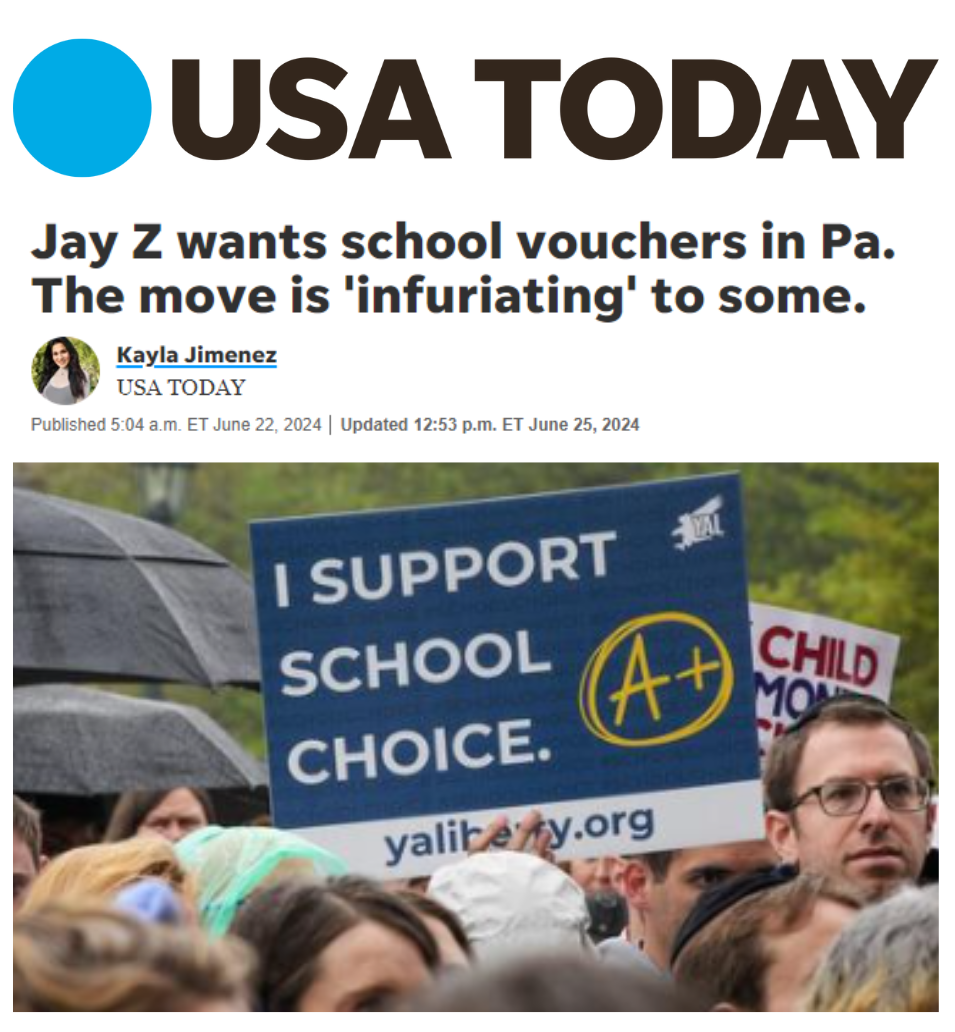
On June 22, USA Today covered the efforts of Jay Z's company, Roc Nation, to lobby for Pennsylvania to spend $300 million on a new voucher program. As our senior attorney Dan Urevick-Ackelsberg told a reporter, it is "infuriating" to be on the verge of enacting fair and full funding for public schools "when an out-of-state billionaire comes in and says, instead 'Let's enact school vouchers.'"
Kevin Welner, a professor of educational policy and law at University of Colorado, cited studies showing that students participating in voucher programs did worse academically compared to their peers in public schools. "From my perspective as a researcher, it's incomprehensible that we’re still pursuing these policies that are showing to be so harmful," he said.
| |
Key investor in Brith Sholom House apartments pleads guilty to mortgage fraud conspiracy | |
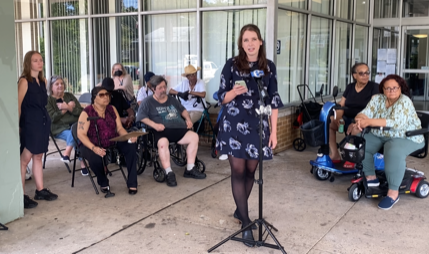
Right: Our Independence Foundation attorney fellow Madison Gray speaks at a press conference following the guilty plea.
On June 17, Aron Puretz, an employee of real estate investment firm Apex Equity Group, pleaded guilty to engaging in a conspiracy to fraudulently obtain over $50 million in mortgage loans. Puretz is listed as a responsible party for dozens of Department of Licenses and Inspections code violations at Brith Sholom House apartment complex, where more than 150 Philadelphia seniors are facing potential displacement after years of neglect and disrespect.
As part of this scheme, Puretz and his co-conspirators provided fraudulent documents to lenders across the country. They also created a nonprofit, JPC Charities, so that the properties acquired through the scheme could be tax-exempt. Though Brith Sholom was not part of the mortgage fraud conspiracy, the entities involved in the scam profited off of the building while residents endured dismal conditions. On its most recent tax filing, JPC Charities claims that Brith Sholom House generated over $2.4 million in revenue for the entity in 2022.
“This investor let buildings crumble and utilities go unpaid, all while ripping off taxpayers and treating senior citizens in places like Brith Sholom as collateral damage” said our Independence Foundation attorney fellow Madison Gray. “Guilty pleas will bring some justice and they are welcome. But those pleas won’t ensure seniors can live in safe, affordable housing. The City of Philadelphia and its partners need to step in and preserve that housing now.”
“The residents are fed up with the way we are being treated,” said Marguerite Byrd, a resident and spokesperson of the Brith Sholom Tenants’ Council. “Something needs to be done so we can have a pleasant place to call home again.” We represent the Council in its efforts to secure safe housing and preserve their homes.
Tenants are demanding action from the City of Philadelphia to preserve their community. They are calling for sufficient resources to ensure that the Philadelphia Housing Authority—which has expressed interest in acquiring the property—or another new owner who can be held accountable is able to acquire the property and maintain it as affordable senior housing. Read more here.
| |
Meet some of the pro bono partners who make our work possible in our 2023-2024 Pro Bono Report | |
|
We could not do what we do without close collaboration with pro bono partners in the Philadelphia legal community and beyond. Read more about how these dedicated attorneys have helped advance civil, social and economic rights for marginalized communities in our 2023-2024 Pro Bono Report, featuring interviews with lawyers advocating for gun safety, strong public schools, and the preservation of valued community institutions.
If you are an attorney or firm who would like to collaborate with the Law Center in a future case, learn more here or contact our legal director, Mimi McKenzie, at mmckenzie@pubintlaw.org.
| |
The official registration and financial information of the Public Interest Law Center may be obtained from the Pennsylvania Department of State by calling toll-free, within Pennsylvania, 1-800-732-0999. Registration does not imply endorsement. | | | | |