|
|  | |
NICOA Supports Legislation to Improve Elder Aging Services |
 |  | Senators Lisa Murkowski (R-AK) and Tina Smith (D-MN) introduced the Native ELDER Act to enhance federal programs for the healthy aging and independence of Alaska Native, American Indian, and Native Hawaiian elders. NICOA's Executive Director supports this legislation which addresses caregiver support, home modifications, and training for tribes to provide in-home care. It proposes establishing an Older Americans Tribal Advisory Committee, prioritizing accessible home modifications, and improving technical assistance for tribes. This act is part of the 2024 Older American Act reauthorization and builds on previous efforts to enhance services for Native elders. “The OAA is the key legislative framework for developing, coordinating, and delivering home and community-based services to allow American Indian and Alaska Native elders to maintain their independence and dignity,” Billie Tohee, Executive Director of the National Indian Council on Aging. “NICOA appreciates Senator Murkowski's leadership in introducing legislation that emphasizes Tribal priorities and increases coordination across agencies that serve our elders.”
| | | |
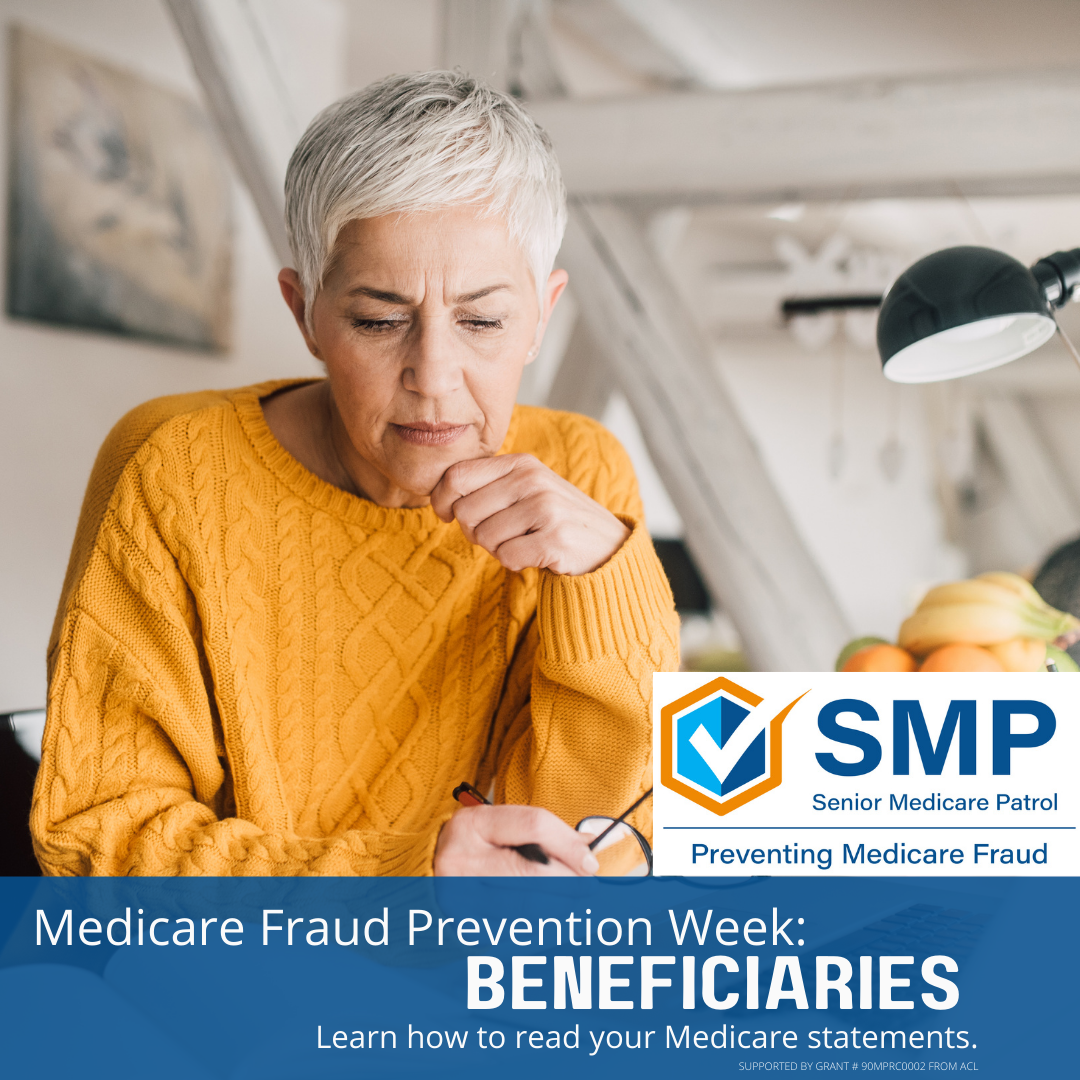
Medicare Fraud Prevention Week | |
If you are a Medicare beneficiary, start the week by learning how to read your Medicare statements! Read your Medicare Summary Notice (MSN) or Explanation of Benefits (EOB) in the paper form that is mailed to you or go online to Medicare.gov and review them digitally. Remember the three steps from the SMP: Prevent, Detect, Report!
-
Prevent: Learn how to read your MSN by watching this video, How to Read Your Medicare Summary Notice (MSN). You can also call your SMP or go to their website to learn how to best protect yourself and your loved ones from health care fraud, errors, or abuse. Find your SMP by using the state locator.
-
Detect: When reviewing your MSN or EOB, look for services, products, or equipment you didn’t receive, double charges, or items your doctor didn’t order. Request and use a My Health Care Tracker from your SMP to compare appointment information you recorded with what is printed in your MSNs and/or EOBs. If you find items of concern, call the doctor or company in question and ask them about potential mistakes. Call your insurance company if you still have questions.
-
Report: Call or email your local SMP if you believe that you have experienced health care fraud, errors, or abuse, or if you would like to request a My Health Care Tracker.
| | | |
June is Alzheimer’s & Brain Awareness Month | |
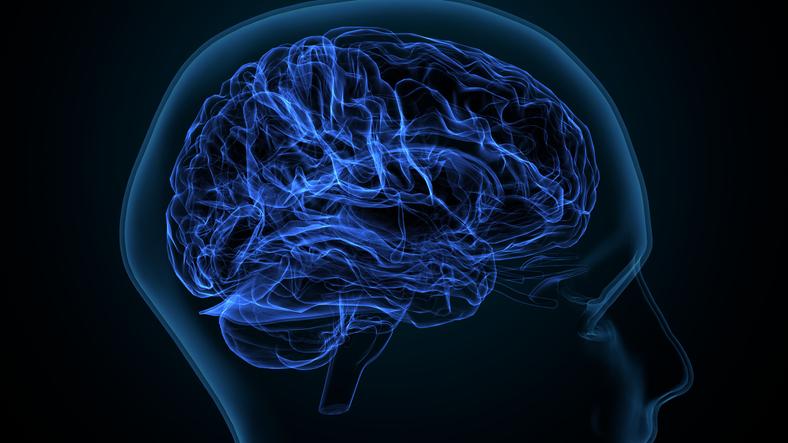
This June during Alzheimer’s & Brain Awareness Month, the Alzheimer’s Association® is encouraging all Americans to take charge of their brain health.
Today, there are nearly 7 million Americans living with Alzheimer’s. The lifetime risk for the disease at age 45 is 1 in 5 for women and 1 in 10 for men. The brain changes that cause Alzheimer’s are thought to begin 20 years or more before symptoms start, which suggests that there may be a substantial window of time in which we can intervene in the progression of the disease.
Experts believe there isn’t a single cause of Alzheimer’s. It’s likely the disease develops as a result of multiple factors. While not a direct cause of Alzheimer’s, the greatest known risk factor is advancing age. Although some risk factors like age cannot be changed, others — including physical activity, not smoking, education, challenging your mind, blood pressure and diet — may be modified to reduce a person’s risk.
As many as 40% of dementia cases worldwide may be attributable to modifiable risk factors. Based on mounting scientific evidence, the Alzheimer’s Association encourages individuals to incorporate these 10 healthy habits to reduce the risk of cognitive decline and possibly dementia.
| | | |
New Research Highlights Severe Cognitive Health Disparities in Older American Indians | |
A recent study revealed that 54% of older American Indians have cognitive impairment and 10% have dementia, significantly higher than the general American population. This research, conducted by scientists from the Huntington Medical Research Institutes and the University of Washington School of Medicine using data from the NIH-funded Strong Heart Study, found that these rates are much higher than previously thought, highlighting significant health disparities. The study suggests that modifiable vascular risk factors like hypertension and diabetes, which are more common than Alzheimer’s in cases of mild cognitive impairment, could be targeted to help reduce cognitive decline among American Indians.
| | | |
Become a NICOA Member:
2023-2024 Membership Available
| |
|
Do you want to improve aging services for American Indian and Alaska Native elders?
If so, become an advocate and learn more about supporting Native elders! NICOA is the premier organization on Native aging, and we invite you to become a member. Anyone can become a member, regardless of their age.
All elders are encouraged to join and have their voices heard. Be an important part of a national membership network and become a NICOA member by applying today. Memberships are for two calendar years.
| | | |
Ted Wright Appointed as New Executive Director of Native American Food Sovereignty Alliance | |
The Native American Food Sovereignty Alliance (NAFSA) has appointed Ted Wright as its new Executive Director. With over 25 years of experience in tribal governance and education, Wright has been a strong advocate for economic development, natural resource management, and social justice, having previously led several tribes, including the Native Village of Eyak and the Sitka Tribe of Alaska. Under his leadership, NAFSA aims to enhance its food sovereignty efforts and support for tribal nations by stabilizing operations and expanding its impact through strategic initiatives. Wright's extensive background in complex policy environments positions him to guide NAFSA in restoring indigenous food systems that promote health, economy, and self-determination among tribal communities.
| | | |
Ho-Chunk Nation Decriminalizes Cannabis on Tribal Lands, While Navigating Legal and Regulatory Challenges | |
The Ho-Chunk Nation has announced the decriminalization of cannabis on tribal lands, indicating that Ho-Chunk police will not issue citations for possession, though legal experts caution that the drug remains illegal under state and federal law. Despite being celebrated as a step toward legalization by advocates, tribal law experts suggest that broader regulatory changes may take time. Challenges emerge due to Wisconsin's criminal jurisdiction over Native Americans on reservation land and potential obstacles in establishing cannabis businesses. However, recent federal recommendations to reclassify marijuana signal a potential policy shift, although state Republicans remain divided on legalization efforts. Supporters view the Ho-Chunk Nation's decision as a proactive move toward seizing opportunities in the cannabis industry and enhancing community well-being.
| | | |
Recent Tribal Newsletters/Websites | | | |
ACL Releases 2023 Profile of Older Americans | |
The "Profile of Older Americans" summarizes statistics about older adults in the U.S., sourced from the U.S. Census Bureau, the National Center for Health Statistics, and the Bureau of Labor Statistics. This report highlights demographic changes among Americans aged 65 and older, covering topics like population growth, marital status, living arrangements, income, employment, and health. In 2022, there were 31.9 million women and 25.9 million men aged 65 and older, comprising 17.3% of the population, a figure expected to grow to 22% by 2040. In 2023, 59% of older adults lived with a spouse or partner, while 28% lived alone. States with the highest percentages of older adults in 2022 were Maine, Florida, Vermont, and West Virginia. The median income for older adults in 2022 was $29,740 ($37,430 for men and $24,630 for women), and 11.2 million Americans aged 65 and older were in the labor force in 2023.
| | | |
|
Indian Health Service (IHS) Expansion Letter
The Indian Health Service (IHS), the Tribal Self-Governance Advisory Committee (TSGAC), and the Community Health Aide Program Tribal Advisory Group (CHAP TAG) are expanding the Community Health Aide Program (CHAP) across Indian Country. This program, which has been highly successful in Alaska, provides quality healthcare through community, dental, and behavioral health aides in rural and remote Tribal communities. President Biden's Executive Order 14112 supports this initiative by promoting Tribal self-determination in healthcare. The expansion aims to address health inequities and improve access to care for American Indian and Alaska Native people in the lower 48 states. Strong Tribal-Federal partnerships will be crucial for this effort, respecting Tribal sovereignty and drawing on Tribal expertise. For more information and to get involved, visit the CHAP Website or contact Dr. Loretta Christensen at ihschap@ihs.gov.
| | | |
100th Anniversary of the Indian Citizenship Act | |
Ronnie Jo Horse, a second-generation voter in her Oglala Lakota and Northern Cheyenne family, highlights the ongoing struggle for Native American voting rights. Despite the Indian Citizenship Act of 1924 granting U.S. citizenship to Indigenous people, barriers to voting persist, including inadequate polling locations and restrictive ID laws. Indigenous leaders, particularly women, are at the forefront of advocating for improved voting access and civic engagement through initiatives like the Native American Voting Rights Act. These efforts aim to ensure equitable representation and empower Native communities in the political process. To learn more read 100 Years Later as well as the Native American Voting Rights Project.
| | | | | | |
|
We are committed to providing services for Native elders, but the power to provide starts with you.
Your support brings attention, education, and improved services to elders and people with disabilities across Indian Country. Every elder deserves access to the services and resources necessary to age independently, with dignity, and in their chosen community.
Consider donating to us directly to help us with our mission to improve the lives of American Indian and Alaska Native elders. Your financial support will go directly to supporting our mission to improve health, social services and economic well-being for all Native elders.
| |
The National Indian Council on Aging | 8500 Menaul Blvd. NE, Suite B-470, Albuquerque, NM 87112 | 505-292-2001 | www.nicoa.org
| | | | |