Your Monthly News & Updates | |
|
|
As May has drawn to a close and June is upon us, I am once again left to reflect on our good fortune.
We started May full of positive energy due to the incredible success of History Weekend. Although Norma and I were tied up at the Historical Society Museum both days for a special art exhibit by John Austin Sands Monks, feedback was overwhelmingly positive and continues to roll in. Chris McCue Potts did an incredible job organizing the weekend and bringing all the different history-minded organizations together. The money raised was shared between all the different organizations who participated.
Monday nights continue to buzz with volunteers who come for a wide range of projects. Yumi Jones and Laurie Kearney have been quite busy trying to make sense of the two basement rooms where countless artifacts have accumulated over the years. We have a long way to go but it is all starting to make a bit more sense down there. Soon we will be able to start investing in some additional new archival boxes to better protect our historical documents and treasured artifacts.
It is hard to make the need for fireproof cabinets sound sexy, so unfortunately, we were not awarded a grant from the Medfield Foundation for that purpose. However, we are super excited that both the Dwight-Derby House and Peak House received funding for special exhibits, and I can't wait to share more about the results in the future. We did leave with a promise of support for our Magazine effort. (We are starting to gain commitment from folks to support the printing of our next edition which is scheduled for September in time for Medfield Day.)
This week has been extra fun with the annual visit of the third grade class organized by Nancy Temple Horan. Nine separate groups of students made their way around town to visit many of the historic sites. I had the pleasure of giving them a very abridged tour of some of the key items from the Historical Society's collection. In addition, it was my deepest honor to co-present the Medfield Historical Society scholarship award to MHS Senior Morgan Kim. This scholarship is funded by Joe and Nancy Opiela in honor of their son Adam Opiela who died from cancer in 2021. Adam had a deep love for history and this scholarship is a loving tribute.
Well, it is late in the evening so it is time for me to say goodbye. But before I go, there is one more thank you that cannot be missed and it is for our dear Jo Ellen Heck, without whom this newsletter would not exist because she patiently herds the cats that make it possible. Jo Ellen is another one of the "quiet giants" of the Medfield Historical Society that make everything we do possible.
Thank you to our members and donors – your support means the world to us. Maintaining the archives means that as the warm weather starts to arrive, we are switching over to air conditioning. So, if you find yourself home on a warm Monday night, don't forget we are always looking for new volunteers. You can stay cool while hanging out with cool people!
| |
|
PeggySue Werthessen
President
| |
Historical Happenings Around Town | |
Third Graders Tour the Town | |
|
by Chris McCue Potts
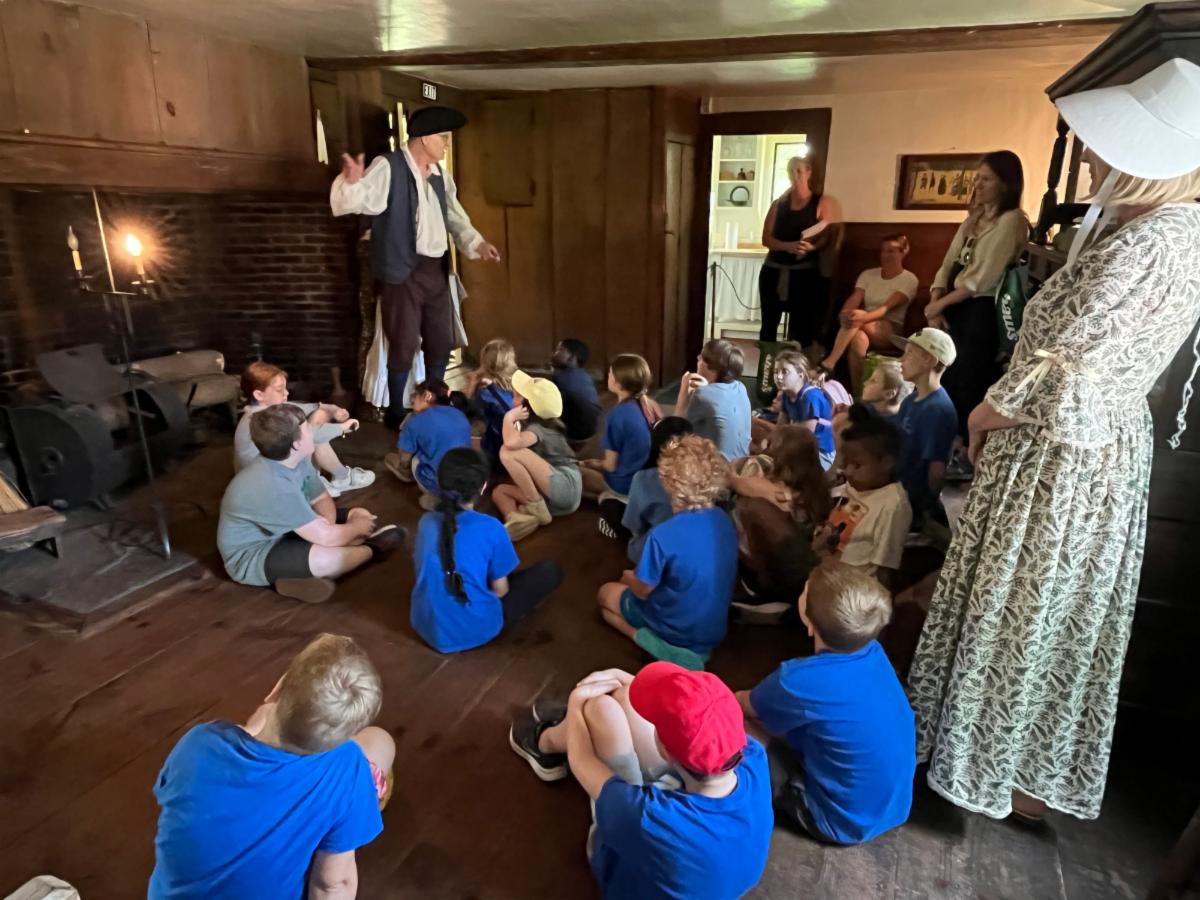
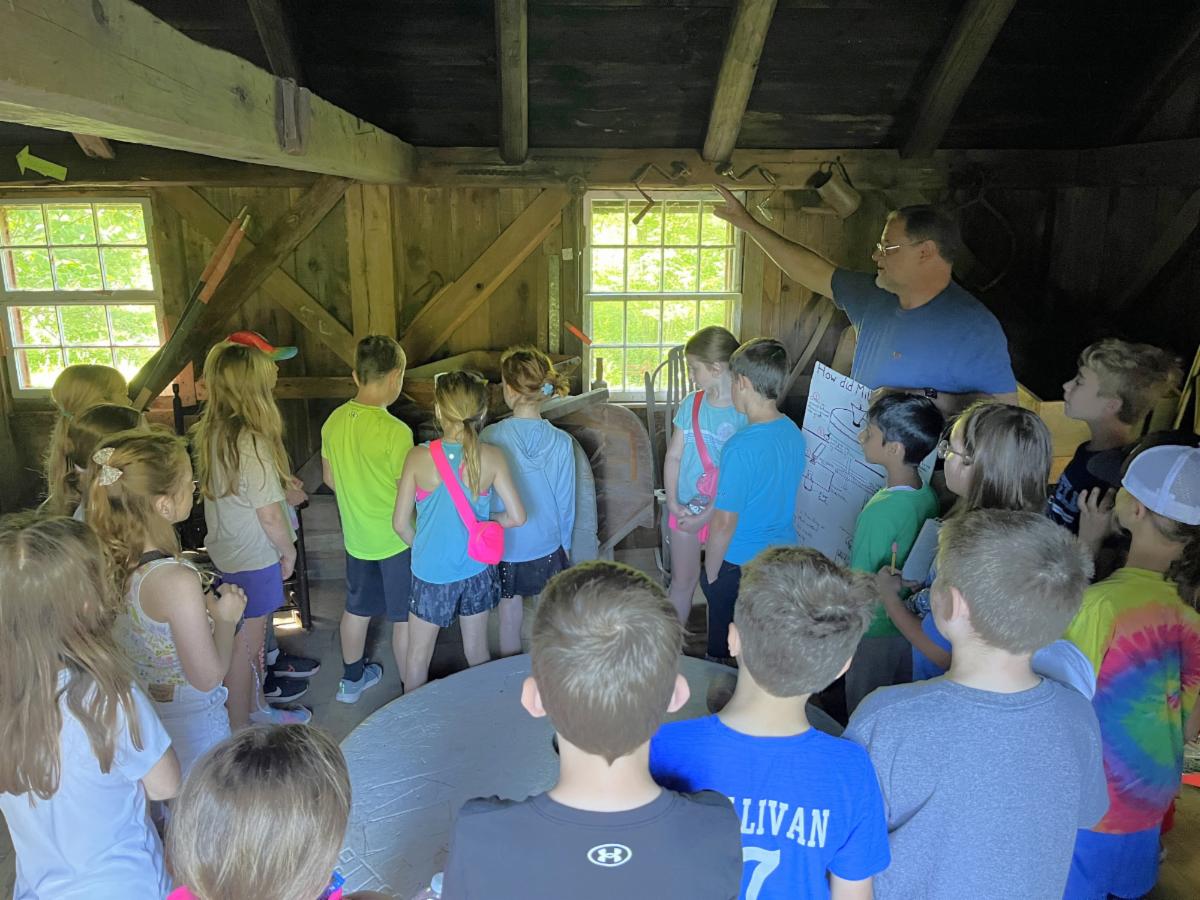
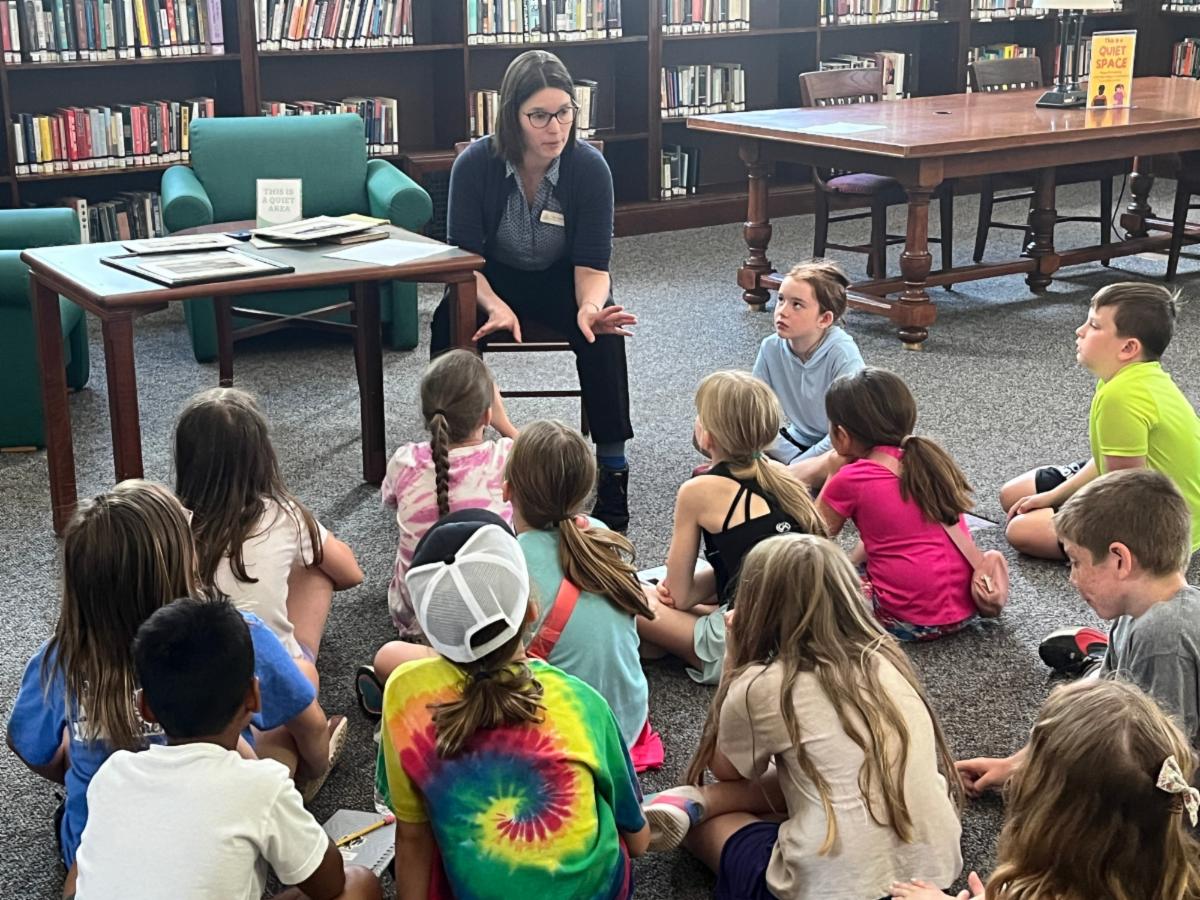
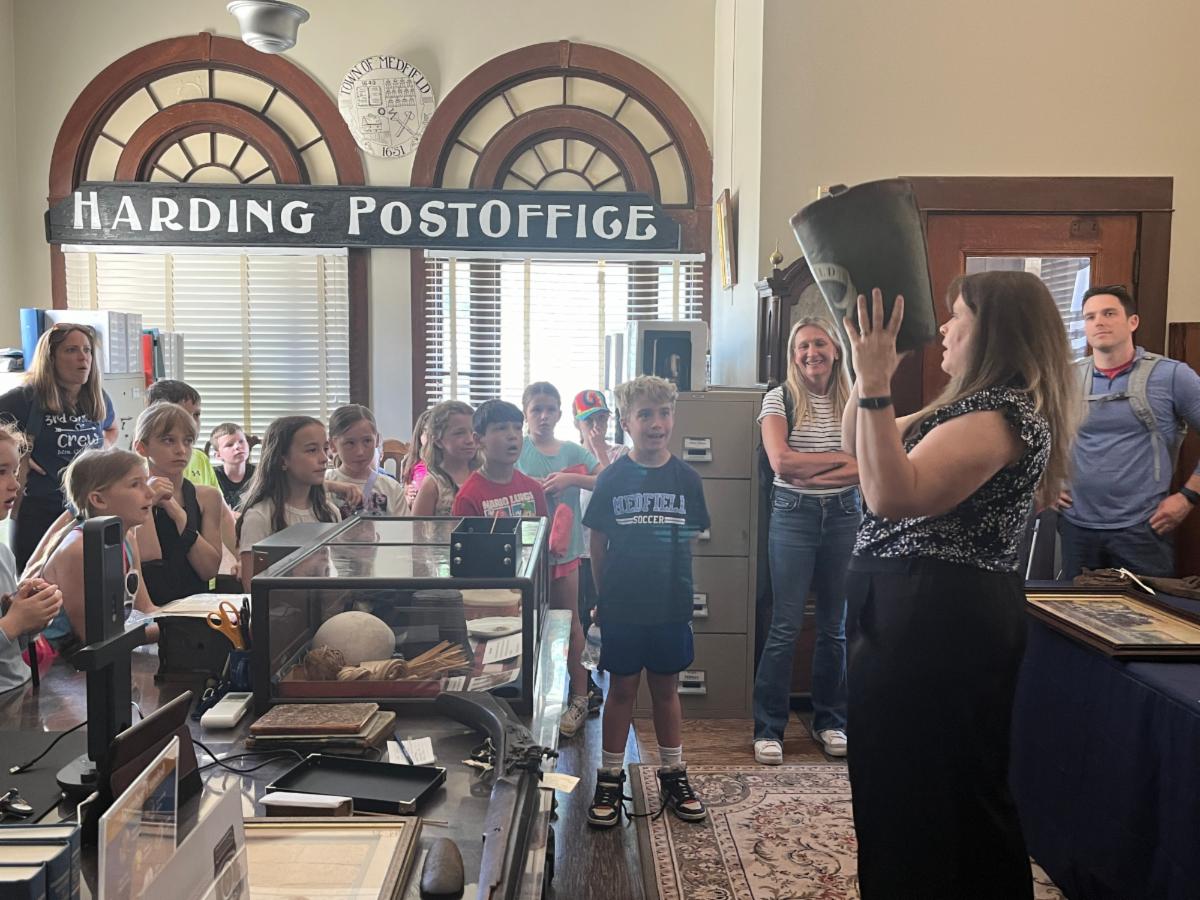
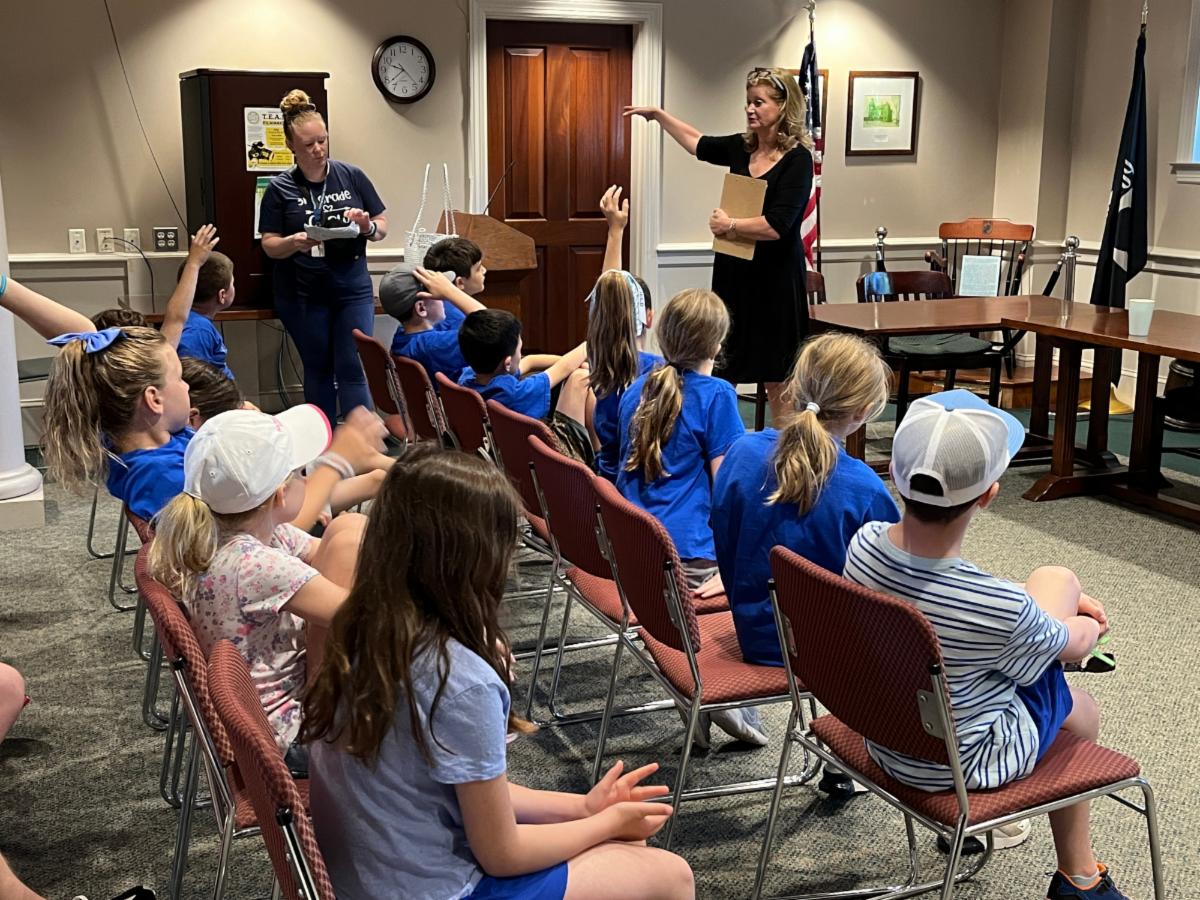
Once again, Medfield Wheelock School third graders got the chance to tour various historical sites in their town as part of the social studies curriculum. The annual field trip, spread across multiple days to accommodate nine classes, was organized by Medfield Historical Society board member Nancy Horan in collaboration with Wheelock School staff, and with the help of town officials and volunteers. This year's tours took place on May 28 and 29; the May 30 tour was rescheduled to June 11 due to rain.
| |
Geoff Sauter, president of Friends of Dwight-Derby House, shared stories about the daily lives of colonists who lived in the 1651 home. | |
At the Kingsbury Grist Mill, students learned how the water wheel, stone grinder and threshing machine work from volunteer Jerry Potts (other volunteers included Dick and Sharon Judge). | |
Pam Gardner, director of Medfield Public Library, explained the evolving role of the library and shared its legacy of more than 100 years in the center of town. | |
Medfield Historical Society President PeggySue Werthessen shared how water buckets were once used to battle blazes long before modern firefighting equipment was invented. | |
Whether managing elections, keeping town records, or helping residents in countless ways, Town Clerk Marion Bonoldi explained her multi-faceted role as an elected official. | |
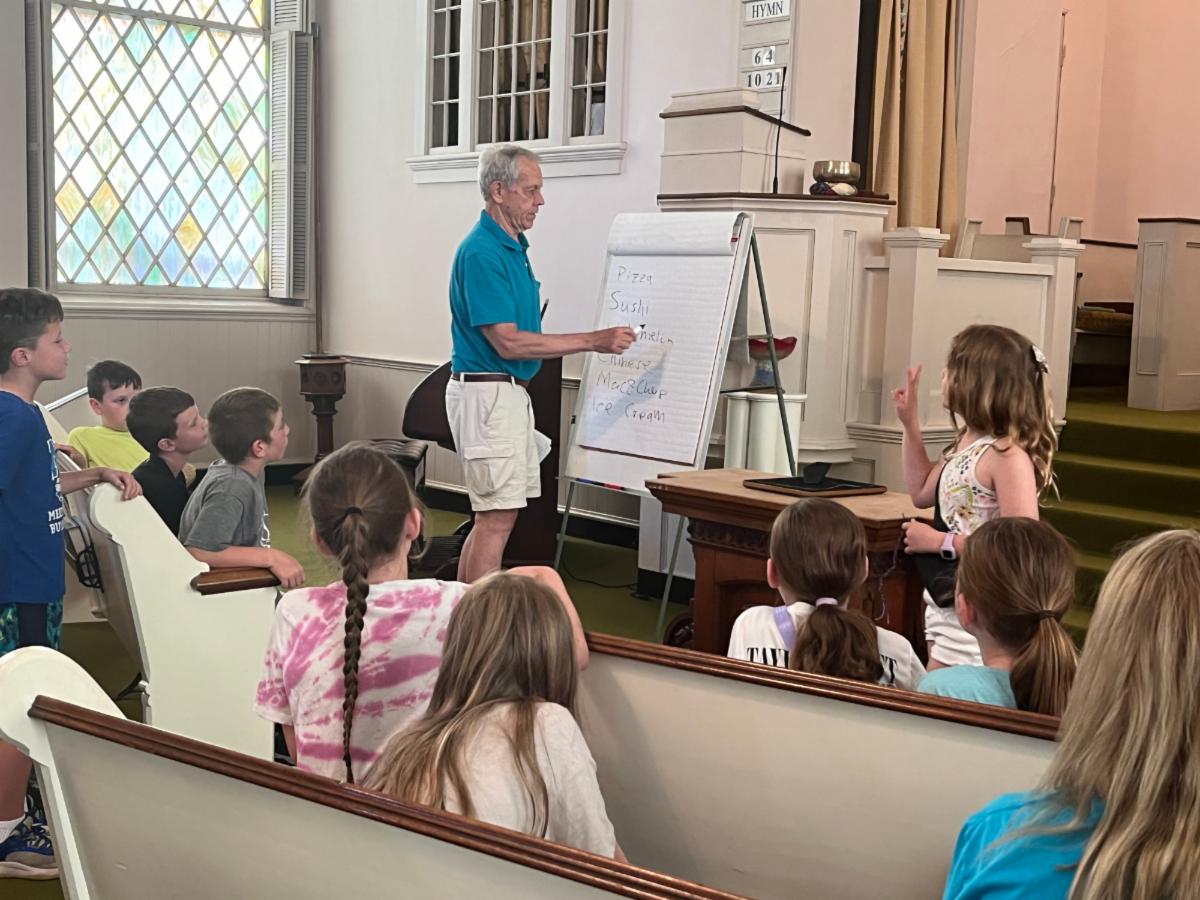
David Temple, immediate past president of Medfield Historical Society and member of First Parish UU, engaged students in a mock election at the historic Meetinghouse. | |
Morgan Kim Awarded Scholarship | |
|
Morgan Kim was awarded the Medfield Historical Society Scholarship in Memory of Adam Opiela for 2024 at the Medfield High School Senior Recognition Night on May 29. The award is given to a student who exhibits distinction in the study of, interest in, and passion for the subject of history, and who also demonstrates community involvement. Society President, PeggySue Werthessen, and Adam’s father, Joe Opiela, made the presentation.
Adam was the first winner of the Historical Society scholarship given to a Medfield High School senior in 2009. He majored in history at Trinity College and earned a Master’s degree in Education from the University of Texas. He was teaching middle school social studies in the Austin, Texas school district when he was diagnosed with young-onset colorectal cancer in 2021, and passed less than four months later.
| 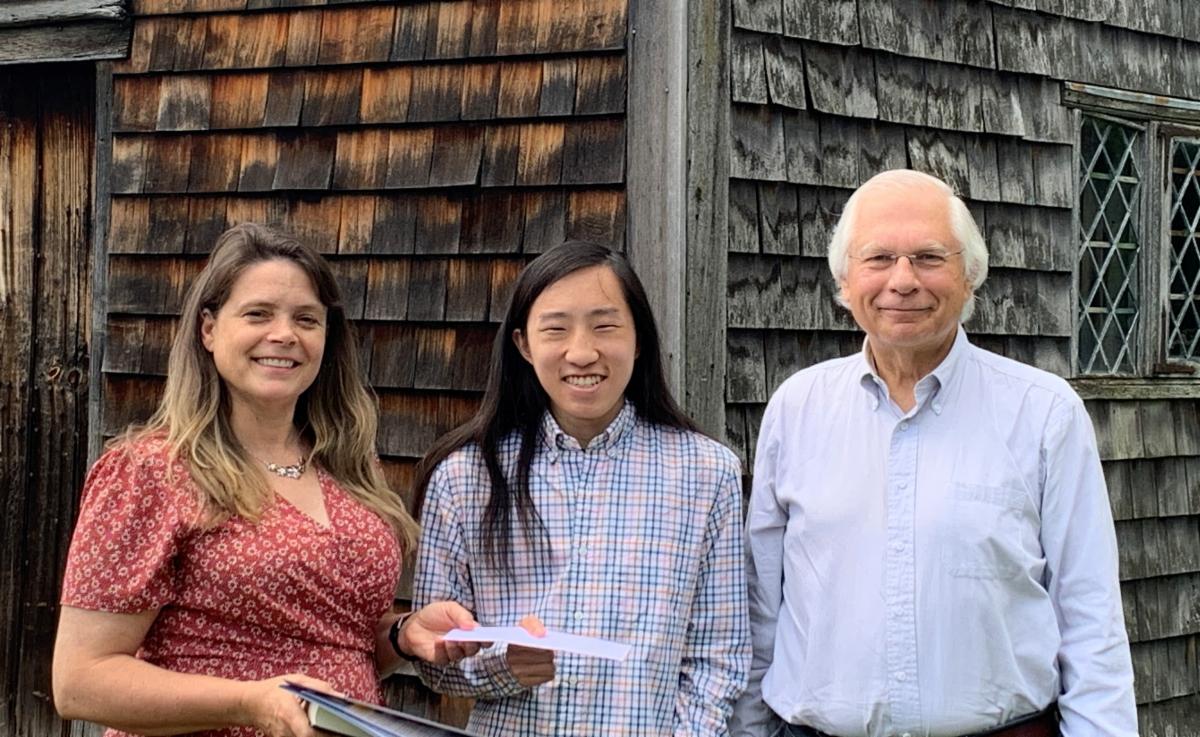 | Morgan Kim receives Medfield Historical Society Scholarship Award in Memory of Adam Opiela from Society volunteer Joe Opiela and Society President PeggySue Werthessen. | |
Morgan was chosen for the scholarship by the high school history faculty. He earned high grades in all his history courses, and showed a love of learning and a willingness to engage with the community by volunteering at the Medfield Public Library, where he coordinated the library’s annual Haunted House event, and the Bellforge Arts Center.
He has been awarded “Above and Beyond” recognition for work in Social Studies courses. In the senior AP History project, Morgan demonstrated significant creativity, diligence, and skill in creating a video in which he rewrote the lyrics to Billy Joel’s “We Didn’t Start the Fire” coordinating it with visuals of historical events from the 20th century.
Morgan is “very passionate” about history according to one of his teachers. Another teacher said “he is the rare student driven by a love of learning. This quality is an asset to his teachers as well as his classmates. He readily draws connections across topics and brings outside knowledge to bear in class discussions.” He will be attending UMass-Amherst in fall.
| Historical Sites Inspire Zullo Artists | |
by Chris McCue Potts
When the Zullo Gallery augmented reality exhibit was first taking shape months ago, the Medfield Historical Society became an inaugural partner in the innovative undertaking, especially given the historically inspired theme, “Evolution of a Small Town.”
As artists considered the work they might create to reflect the theme, a variety of Medfield sites became natural subjects for augmented reality – a way of seeing invisible art through a cell phone or iPad, in this case, using a free app developed by Acton-based company, Hoverlay. To date, the exhibit has had nearly 1,400 visitor views, with the Society museum and “Jack the Dog,” often earning the top ranking on any given day.
Among the other historic sites chosen by artists for augmented reality experiences include:
- Town House (abstract art outside the front door)
- Peak House Heritage Center garden (kitchen garden painting)
- Medfield Public Library and gazebo area (various experiences, including a party, hidden forest and secret agent)
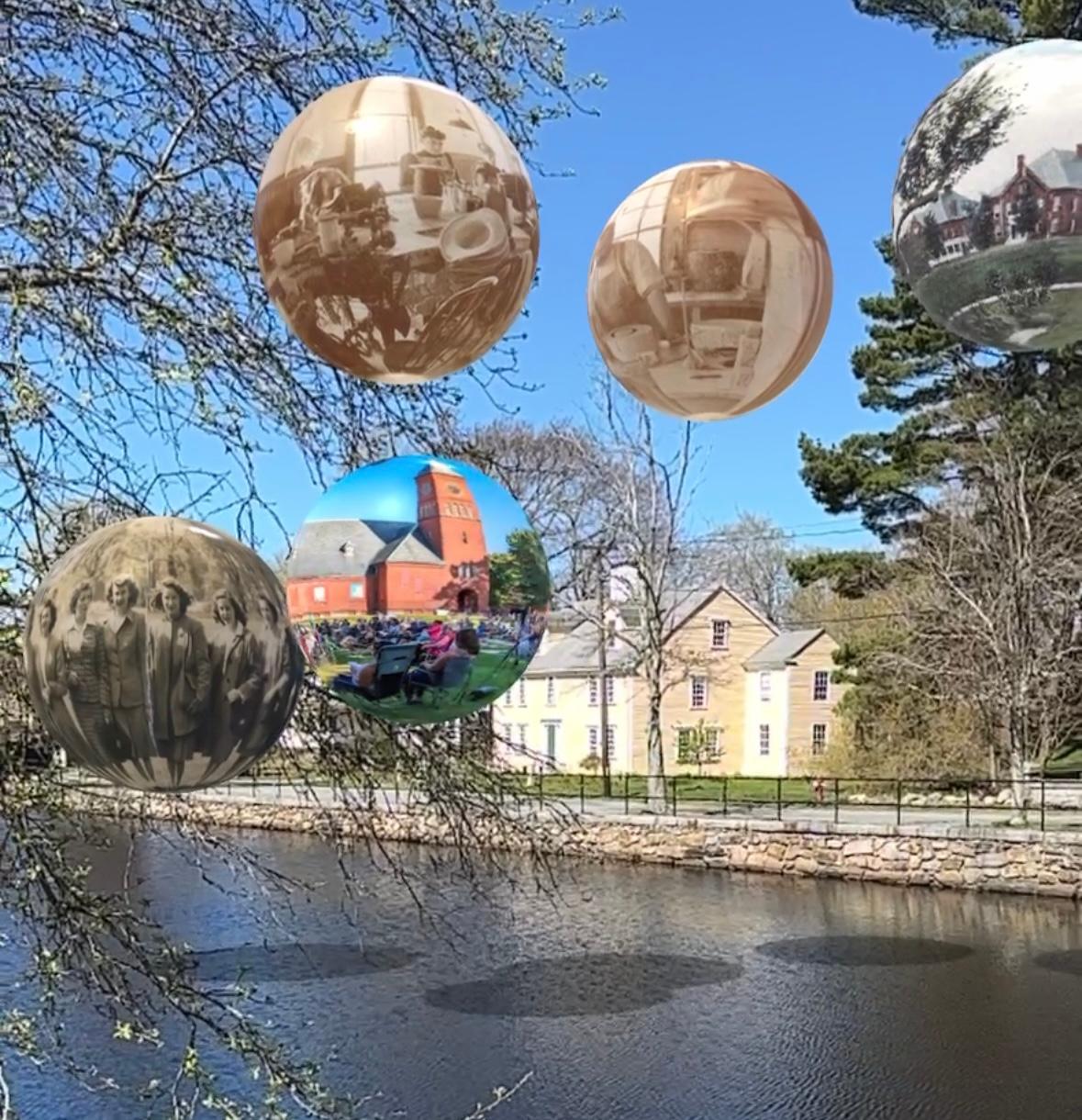
- Meetinghouse/Baker’s Pond (floating spheres with historical images inside each; a ghostly cartoon that floats near the front doors)
- Former Medfield State Hospital and MSH Cemetery (various experiences, including life-size butterflies at the sledding hill)
- Medfield Rail Trail (a phantom train station at Farm Street)
- Main Street (#406) home and studio of 19th century landscape painter George Inness (a giant painting viewed via sidewalk)
- Zullo Gallery (multiple pieces, including “Welcome to Medfield” with narration by Town Historian Richard DeSorgher)
|  | |
The Society’s painting, “Jack the Dog,” by John Austin Sands Monks, served as the inaugural augmented reality experience for both the Society and Zullo. Together they used the canine for a dual purpose: to launch Medfield History Weekend in April, and promote the exhibit. With his slow-moving head, Jack has captured the attention of children and adults alike. A reproduction of the original painting can be viewed outside the museum door at 6 Pleasant St., even when the building is closed.
Tapping into the exhibit
So how does one actually “see” the exhibit? Here are easy steps to follow:
- Go to the Hoverlay site to download the free app, tap “search for channels, and then tap onto ZulloARCanvas;
- Using the ZulloARCanvas map, locate, visit and experience various sites; and
- Alternatively (with the exception of Jack), look for a small white sign with a QR code at each site which might make it easier to get started.
The Zullo Gallery augmented reality exhibit officially ends on June 23, but the outdoor experiences around town can be viewed for almost a year. More information at Zullogallery.org.
|
|
Uncovering Medfield's Anti-Slavery Activities | |
|
by Norma Vogel
Medfield is in full bloom once again, as we welcome the month of June. Along with my usual time-travel musings, I’ve been thinking about Juneteenth, wondering about Medfield’s involvement in the antislavery movement. Evidence shows that Medfielders were active in the movement, which gained strength in the northern states during the 1830s. In bits and pieces, the story is here in our archives, waiting to be told. So far, I have uncovered antislavery connections among the Medfield Library and the Medfield Lyceum.
Anti-slavery Activity Proposed in 1832 by Medfield Lyceum
As I wrote in March, the Medfield Lyceum’s “editresses” published the Lyceum Gazette newspaper in 1861-1862. Since then, I have learned (without surprise) that the Medfield Lyceum was originally established by prominent Medfield men whose names are familiar to those who study the town’s history (Onion, Allen, Leland, etc.) in 1832. The men met in the space over Noah Fiske’s store.
In 1831, the New England Antislavery Society (NEAS) “the first antislavery association among white activists to demand immediate, unconditional abolition of slavery and equal rights for black Americans, without compensation to the slave-owners and without colonization (forced expatriation) of the freed slaves” (Roberts) had been founded in Massachusetts by William Lloyd Garrison.
By 1835, branches of the NEAS had begun in every New England state, so the NEAS itself became known as the Massachusetts Antislavery Society. Medfield shared the growing antislavery passion among the northern states, although I still need to find more information on the specific activities of Medfield’s antislavery movement. The “Secretary’s Book” of the Medfield Lyceum, which we possess, recorded the topics of the group’s lectures and discussions. Among the first questions debated were “Were our ancestors justified in taking possession of Indian lands?,” “Whether Death ought ever to be inflicted as a punishment?” and on April 6, 1832, “Ought the Northern States to interfere with the subject of slavery, so far as it relates to its existence in the original southern states?”
| 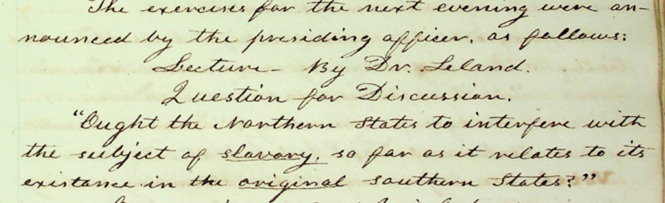 | Figure 1: First Mention of Slavery in Medfield Lyceum, 1832. | |
|
The discussion itself, unfortunately, was not recorded.
Read more >>
| |
|
Hat manufacturing, especially the E.V. Mitchell Company, was the dominant business in Medfield in the last half of the 19th and first half of the 20th century. But there were several smaller manufacturing operations which made products to be used in making hats.
There were two companies that made wire; both were at 57 Frairy Street. The Moses Clark Bonnet Wire Factory operated from 1873 until a lightning strike and fire in 1893. Another factory, built on the site by William Marshall, made wire until 1909. Both employed around 20 people.
| 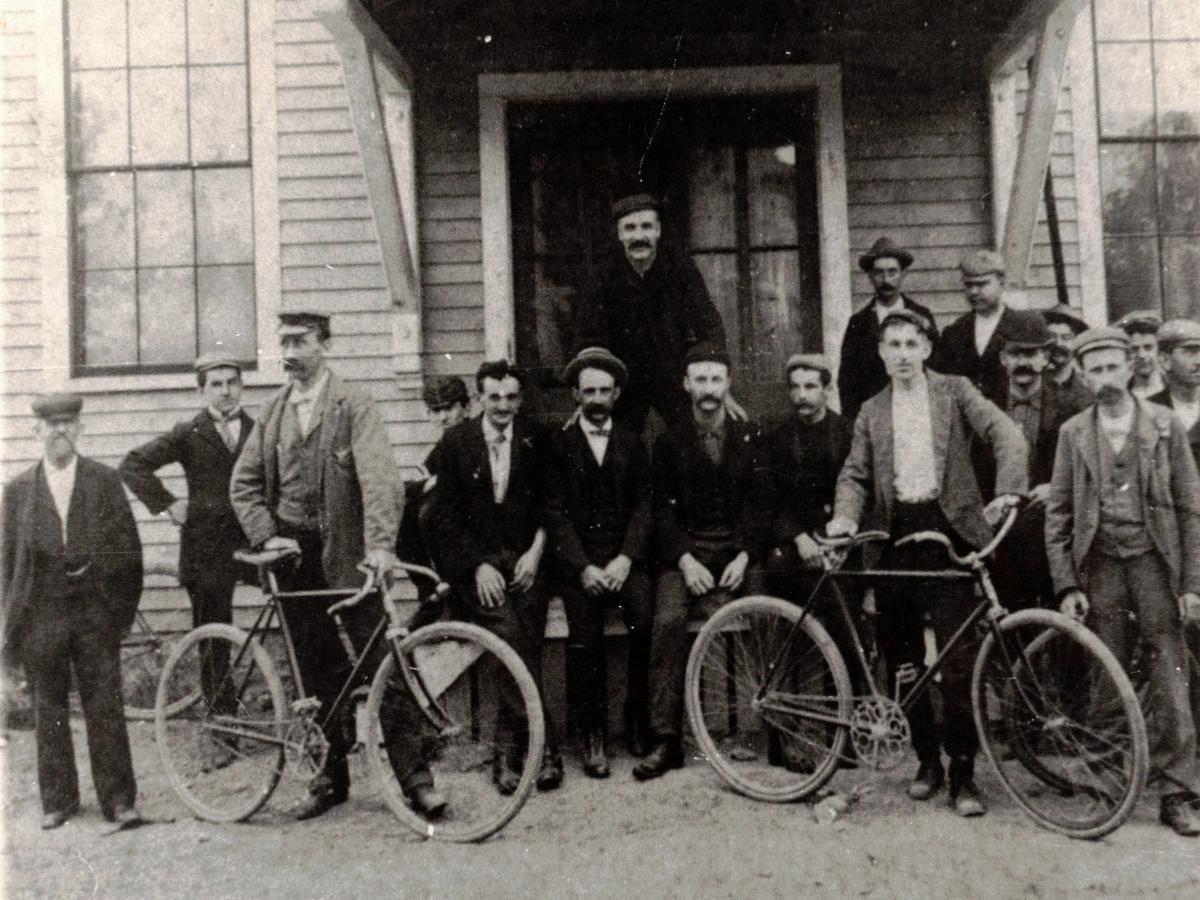 | |
This photo, above, was probably taken around 1900. Two men are proudly showing off their bicycles, early examples of today’s products.
The British Rover bicycle, introduced in 1886, was the breakthrough. Previous bicycles had a big front wheel and a small rear wheel; they were hard to mount and dismount, and dangerous because riders were often thrown forward over the handlebars. The bikes were nicknamed “headers.”
The Rover had 26-inch tires front and rear like the ones in the photo. In the next few years refinements in metalworking resulted in stronger frames with less weight, and balloon tires replaced solid rubber or wooden tires.
By the mid-1890s Americans were buying 1 million bikes a year at an average price of $80, which was still a lot of money for the time. But for the first time in history, a horseless person could go door-to-door two or three times as fast as before.
In Medfield, on Patriots’s Day, 1900, over 5,000 people watched a 10-mile bicycle race with about 100 competitors. The winner was Albert Hoyle of Lowell, with a time of 27:33.
| |
People and Places of the Past | |
by Claire Shaw/ Tim Flaherty | |
|
While searching for a way to tie in two related stories – Claire Shaw’s history of Medfield’s animal shelter and Tim Flaherty’s remembrances of the some of its former denizens – we learned that June is National Cat Adoption Month, June 4 is National Hug Your Cat Day, and June 2-8 is National Pet Appreciation Week. Later this month are National Take Your Cat (June 17) or Dog (June 21) to Work Day.
Dogs were domesticated about 12,000 years ago, and cats a few millennia later. There is archaeological evidence that ancient Greeks and Romans mourned the loss of their pets. Two thirds of the 131 million U.S. households have pets: about 90 million cats and 80 million dogs. Americans’ total expenditure on their pets is almost $140 billion per year. Much more information is here.
| |
|
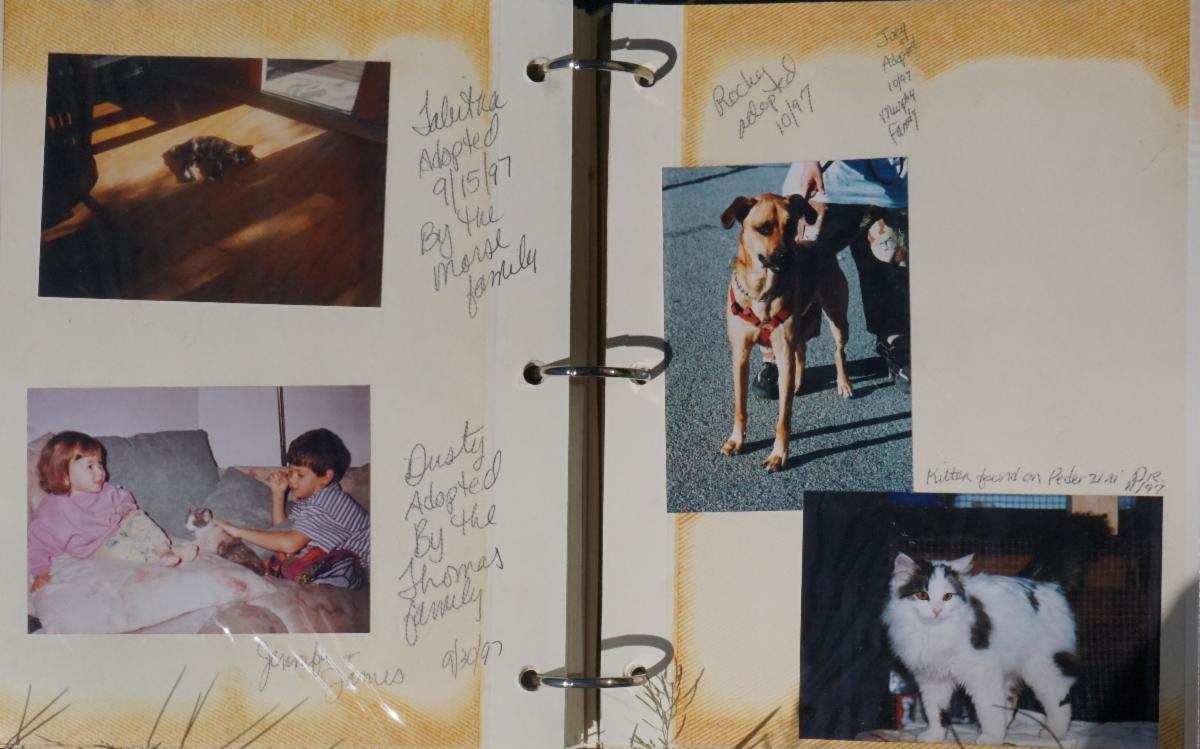
How Medfield’s Animal Shelter Came to Be
by Claire Shaw
Once upon a time, Medfield had no animal shelter, so some strays were taken to Heritage Hill, a veterinary practice on Farm Street. The situation wasn’t ideal, and did not last long, because it was in a neighborhood, and dogs will bark.
Around 1985, ACO Karen McGregor had a friend who donated a shed to offer some sort of shelter for stray animals. The shed had no electricity, no heat, no running water and was made entirely of wood. The only available lighting after dark was from two lights at the Treatment Plant. Over time, holes were cut in the back of the shed and someone donated runs for the dogs to have some exercise. This arrangement was in place for twenty years: 1984 to 2004.
Read more >>
| | | | |