SOCAL CONNECTED Continues KCET's "Summer of the Environment"
Green Wish produced film on climate change, "Is There Hope For Planet Earth?", gets it telecast date on KCET-TV in Los Angeles, as part of the the highly awarded SoCal Connected news magazine series! July 18th at 8pm!
Burbank, Calif. - June 14, 2017 - KCET,
the nation's largest independent public television station
, announced today the return of SOCAL CONNECTED with three new environmental specials highlighting environmental progress, environmental justice and the challenge of balancing nature and humans.
The summer lineup will air over the course of three weeks on KCET, in support of the station's "Summer of the Environment" initiative. The event kicks off on Tuesday, July 11, at 8 p.m. on KCET in Southern California with "Balancing Act," featuring a trip to Joshua Tree National Park. "On the Cutting Edge," debuting Tuesday, July 18, at 8p.m. on KCET includes "Is There Hope for Planet Earth?" In the film directed by Raphael Sbarge (Once Upon a Time, Murder in the First), Caltech climate scientist Dr. Jess Adkins
reveals what other climatologists are thinking, and offers inspiring advice on what can be done to help. The series concludes on July 25 with "Environmental Justice" and a look at the
Chiquita Canyon Landfill.
|
|
 |
SOCAL CONNECTED Reporter
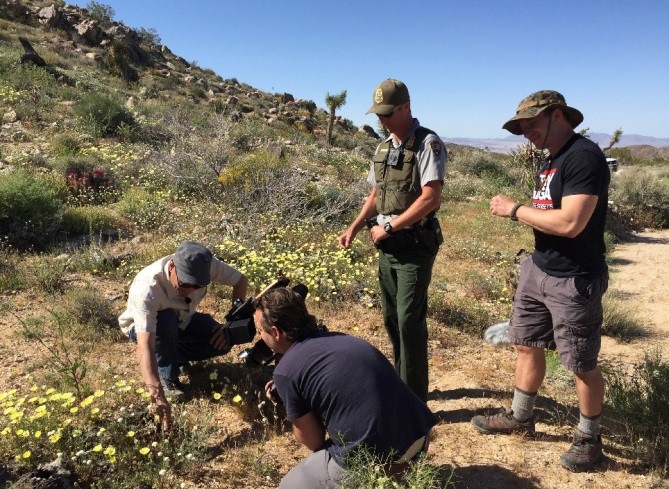
Nic Cha Kim at Joshua Tree National Park surrounded by crew and staff.
Image Courtesy of KCET
|
|
SOCAL CONNECTED
is an acclaimed weekly half-hour local news magazine series that offers Southern California viewers substantive, in-depth reporting on vital issues that impact the region including race relations, civil rights, technology, transportation and in this case, environmental issues.
The programs will also be available online along with additional resources at
kcet.org/socalconnected
including editorial news posts on organic farming and more.
"Summer of the Environment" is a three-month initiative (June-August) on KCET and Link TV offering audiences a robust library of content on multiple platforms intended to ignite compassion and action for helping to save and heal the planet.
Join the conversation on social media using #SoCalConnected
and #KCETgreen
ABOUT SOCAL CONNECTED
SOCAL CONNECTED
, winner of a Peabody® two duPont Awards, 23 Emmy® Awards, 22 Golden Mikes, 48 LA Press Club Awards, two Gracie Awards, as well as four regional and one national Edward R. Murrow Awards, including Best News Documentary and Los Angeles Magazine's "Best New Local TV Program" of 2009, airs exclusively on KCET. For more information, to view episodes online or to leave comments, please visit http://www.socalconnected.org. SOCAL CONNECTED is made possible through the generous support of The Ahmanson Foundation, Chapman University and the Maddocks-Brown Foundation.
|
THE TRUTH ABOUT CLIMATE CHANGE AND WHAT YOU CAN DO TO FIGHT IT AT HOME
by Neil Stawski
info@climatewise.co
Climate change is one of the most hotly contested political issues of our time, but when it comes to the science, there really isn't any debate. The scientific consensus is that climate change is real, it's negatively affecting life on Earth, and humans are causing it. That's the bad news. The good news is that we, as a society, as well as individuals at home, can take action to help slow its effects. Here are some commons questions about climate change, answered.
What is climate change and is it the same as global warming?
Climate change is the long-term change in the Earth's climate. It is overall change in global and regional climates, which affect average temperatures, rainfall, snow, and other weather patterns. Weather changes over a relatively short period of time, while climate is how the atmosphere behaves over a long period of time.
Climate change is not the same as global warming, though you might hear the two phrases used interchangeably. Global warming, or the average rise in global temperatures, is one aspect of climate change. As the Washington State Department of Ecology
puts it, "warmer global temperatures in the atmosphere and oceans leads to climate changes affecting rainfall patterns, arctic ice (and the northern jet stream that drives our weather), frequency and intensity of storms and droughts, growing seasons, humidity, melting polar and glacial ice, and sea level."
Why is climate change a problem?
The overall global warming trend is already leading to effects that we can see with our own eyes. If climate change continues at its present rate, just some of the effects will include sea level rise, more droughts and heat waves, ocean acidification, the melting of the arctic ice, more severe weather, and the destruction of many of the plant and animal species on Earth. Low-lying cities could be swallowed up as sea levels rise 1-4 feet over the next 100 years.
In some climates, "sea level rise, erosion, inundation, risks to infrastructure and increasing ocean acidity pose major threats. Increasing wildfire, insect outbreaks and tree diseases are causing widespread tree die-off,"
says NASA. In others, "extreme heat, heavy downpours and flooding will affect infrastructure, health, agriculture, forestry, transportation, air and water quality, and more."
What can I do about it?
There are plenty of ways that you, a homegrown activist, can help bring awareness to and help combat climate change. If you get involved in a climate change activism group, you can spread your message through merchandise, such as
t-shirt sales, and fundraising. Help organize 5Ks, bar crawls, raffles, and anything that can raise money for organizations that help fight climate change.
Write your congresspeople and let them know that climate change is an important issue to you. Vote your issues. Participate in political rallies, science marches, and town hall meetings. Getting involved is the best way to make sure the issue stays at the forefront of people's minds.
To reduce your own carbon footprint, you can think about the car you drive and how much you use it. Opt for more eco-friendly forms of transportation as often as you can. Also, "food accounts for a sizable portion of our emissions. If you want to make cuts here, your best option is to reduce your consumption of meat, especially beef,"
notes the US Union of Concerned Scientists. Buy energy-efficient light bulbs. Save water in a rain barrel and use that for all your plant watering needs. The list goes on and on.
Climate change is real. Scientists agree. Humans are causing it. And humans can do something about it. As a concerned citizen of Earth, you can help by knowing the facts, helping to educate those who don't, rallying for your cause, and attempting to enact political change. At home, you can take small steps to reduce your own carbon footprint. We all need this planet. It's ours, and there's no other home for us. We should all do what we can to protect it.
|
|
|
|
|
| Pin created by Lisa Colver. |
|
DONATE to Green Wish!
|
|