|
The Corresponder
The Newsletter of the Committees of Correspondence for Democracy and Socisalism
| |
|
A Look at Progressive Democrats of America (PDA) and the Local Election Experience
July 22nd 8pm
sponsored by CCDS Socialist Education Project
4th Monday series
With Bourgeois Democracy vs Fascism on the ballot this year, it is all hands-on deck! Hear from experienced activists from Progressive Democrats of America
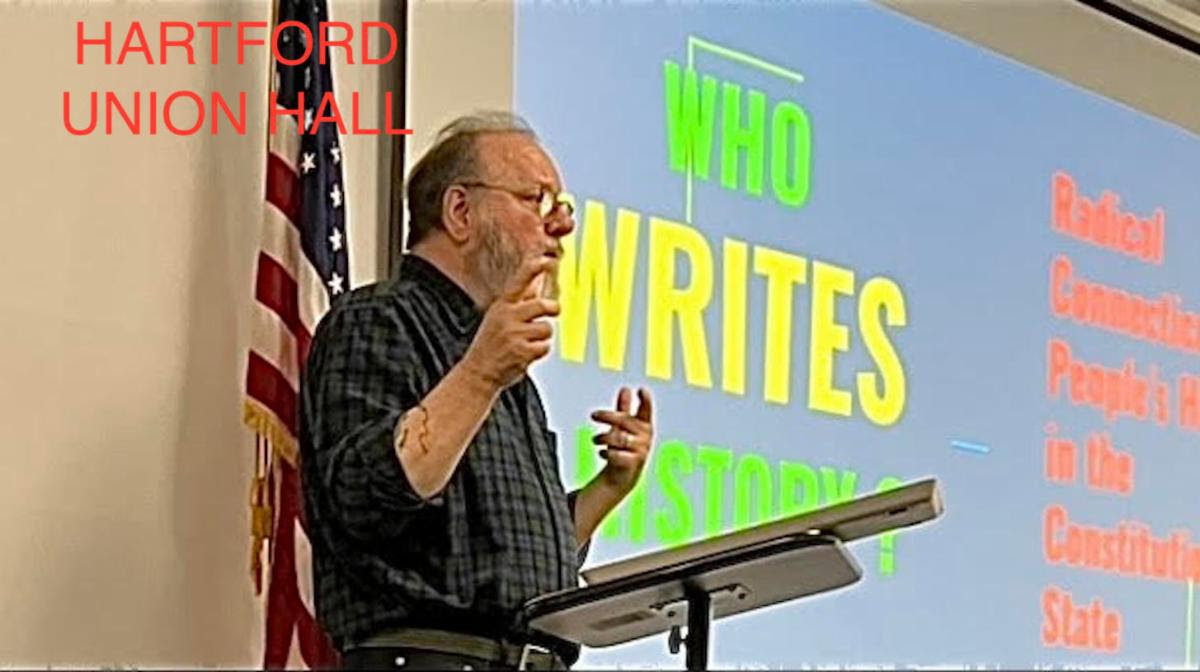
Peter Deutsch, CCDS member, worked locally with the Jamaal Bowman campaign
Randy Shannon, CCDS member and PDA National Secretary
Tina Shannon, CCDS member and local election activist
Register https://us02web.zoom.us/meeting/register/tZ0tfuGvqTkvHtVddBTstuWahEVTU5XFWvzy
| |
|
Convention Report:
“CCDS Thirty Years Later: Where Have We Gone, What Next?”
The Committees of Correspondence for Democracy and Socialism held its every third-year national convention online Saturday, June 1 and Sunday June 2, 2024.
On Saturday, the session opened at 8:30 AM PDT with short commemorations by founding members.
This was followed by a presentation from a Southern Workers Assembly representative Ashaki Binta. Ashaki Binta is a life long organizer and political activist in the Black freedom movement experienced in labor, trade union, women’s rights, and electoral organizing. She was a founding member and organizer of the Southern Workers Assembly (SWA) in 2012. Ashaki is a veteran member of the Black Workers for Justice, serving in a number of posts in over 40 years including Director of Organization and International Representative.
At mid-morning Jerry Harris gave the keynote address that highlighted the current political situation within the global context.
Next were several workshops on CCDS committees that included Elections (Carl Davidson), Class Race and Gender (Erica Carter and Paul Krehbiel), and Peace & Solidarity: International Relations, part 1 (Harry Targ, Duncan McFarland, Peter Deutsch).
After lunch, workshops resumed, with sessions on Labor (Paul Krehbiel and Sandy Eaton), the Environment and Climate (David Schwartzman), the Socialist Education Project (Jay Jurie), and Peace & Solidarity Part 2: Boycott, Divestment, and Sanctions (Stephen David, Rod Such & Harry Targ).
At 3:30 PM “The Future of CCDS” Plenary was held.
Resolutions by Marilyn Albert, “Idea for CCDS – Let’s Progress Using Our Strengths,” Carl Davidson and Janet Tucker, “Transforming CCDS Into a Political Center,” Paul Krehbiel “CCDS Increase coalition building to bring greater unity to the Movement,” Paul Krehbiel and Harry Targ, “Building for 2024 and Beyond,” and Harry Targ, “On the Future of CCDS” were introduced.
A new slate of members for the National Coordinating Committee (NCC) were introduced, and two candidates for national co-chairs were elected (Jay Jurie and Meta Van Sickle).
On Sunday, the plenary opened at 10:00 AM PDT with confirmation of those who agreed to serve on the NCC and ratification of the two co-chairs and Janet Tucker continuing in the role of National Organizer.
The resolutions introduced at yesterday afternoon’s plenary were briefly discussed, and it was decided to turn them over to the new co-chairs to amalgamate and provide a unified draft for the first post-convention meeting of the NCC.
| |
Meta Van Sickle, CCDS Co-Chair | |
The NCC Resolutions as Amalgamated
By Meta Van Sickle and Jay Jurie
Incoming co-chairs Meta and Jay were tasked by the CCDS national convention on Sunday, June 2, 2024, with combining the resolutions presented at the convention into one hopefully suitable draft. To do this, we used each of the proposals and searched across the documents to find threads of agreement. We also took an inventory of activities we are currently involved with and can implement. This compilation was to be submitted for discussion and consideration at the NCC meeting of Wednesday, June 26, 2024.
What follows is a somewhat revised and abbreviated version of that draft.
CCDS has recast itself as largely research-oriented, analytical, and predominantly educational in nature and purpose. Activity and output by CCDS largely seek to expand possibilities, widen opportunities, and better inform practice. Particularly addressed are fresh perspectives and insights CCDS can develop and contribute, whether those be new proposed initiatives, or enhancements to ongoing efforts. As Paul Krehbiel put it in his resolution, “CCDS [should] embark on an ongoing research and organizing program to facilitate greater outreach to a broad array of organizations and campaigns from the left to the Progressive Majority, to find common ground wherever it exists.” And as Meta has expressed it, people with specific background and interests should cover the topics in committee meetings and then bring the content back to the NCC meetings for further discussion.
CCDS should scan the horizon to interrelate various forms of existing, or potential practice thereby using the associations and expertise of the membership more fully. Paul gave as an example an effort by SEIU Local 600 in Los Angeles that protested the closure of a county hospital. The Local invited peace activists to join in, building an alliance that showed the cost of one B-2 bomber would cover the county budget shortfall. This sort of action is illustrative of the effort the existing CCDS Move the Money Task Force (MTM) seeks to advance, linking destructive military-industrial complex to deficiencies in meeting community-level human needs. Further, developing a better understanding the destructiveness of the military-industrial complex would benefit from the new international realities studies of the CCDS Peace and Solidarity committee.
While such work at times may be ideological or theoretical, for the most part intellectual labor is not intended to be nor divorced from action. As Carl Davidson and Janet Tucker put it, “We need to strengthen our analysis of real [work] going on and assist in giving a voice to those who feel voiceless and make our education work as interactive as possible.” Wherever practicable, given our small size and demographics, we encourage and promote selected outreach activities. We might be able to model new forms of outreach and practice, especially, if we use the dialectic and dialogic practice of “yes and” while building the larger model.
In their joint resolution Paul and Harry Targ recommended the establishment of a “committee to pursue ‘building Democratic Socialism in the Coming Period’.” In line with their resolution Paul and Harry are invited to co-chair such a committee and oversee its formation and work, with the stipulation there be regular reports at forthcoming NCC meetings until such time as the committee finishes its work. Other elements of their resolution should be taken up and implemented by this committee, again, to be presented regularly to the NCC.
They recommended the formation of a three-person committee to ensure the Mobilizer (now the Corresponder) “is produced monthly for mass distribution.” It is presently understood Janet, Harry, and Jay have volunteered to be that committee for the immediate future. Meta has graciously volunteered to assist with proofreading.
As Paul and Harry further recommended, “we would ask that each [CCDS] member join one of the committees…” of the organization. This is a valuable suggestion. We seek to encourage groups such as the Corvallis chapter to continue their work. Such groups will continue to be welcome in the organization. Likewise we seek to encourage those participating as individuals in progressive movements and campaigns to continue that work. They should consider ways of better interrelating that work with the mission and purposes of CCDS.
As CCDS moves in a new direction, if we are to be effective, it is imperative that we enhance our outreach and communication proficiency. As Marilyn Albert proposed in her convention resolution, we should look at upgrading our web site. If we need to hire outside assistance to do that, then that’s what we must consider.
While continuing our Zoom webinars, we must professionalize them while expanding the number of people they reach. We must take more stringent measures to prevent embarrassing “Zoom-bombing” or unmuted speaker interruptions from occurring. We must have more people who are skilled in navigating the Zoom system and can serve as hosts.
We must strengthen our announcements for events, such as the webinars, and for our publications. Such announcements must all have embedded links so they can be posted on web browsers. Our CCDS membership needs to be recruited to post our publication and event announcements on e-mail listservs or other networks with which they are affiliated to help spread the word. On a regular, consistent basis we must look at placing announcements and advertisements where they may do us the most good.
We must further develop our skill levels. We can generate new and appropriate words to use when members are with other groups such as WILPF, PopEd, and so on, or in general society. This is a new task for CCDS, it is essential whether we are an education, activist, or political center group. To fail to do this task is to fail to help the collective Left.
Remember to discuss salient ideas during your time in the meetings and to stay focused on your topic. Our practice of dialog then needs to: agreement to disagree without stopping forward motion and momentum. We can send position statements to various organizations when they arise. We can encourage our membership to participate.
We can learn to “yes and” instead of “but”, yes and means we see connections to our point and are envisioning a larger construct. “But” means we are refuting what was said.
We are no longer under the pressure it takes to grow and sustain a mass organization. Instead CCDS needs to "right-size" itself. That means attracting and retaining members who are in accord with our redefined mission and purposes. They will have an interest in joining us to explore and propose “new roads to freedom.” While still open to all comers who agree with democratic socialism, it is to be anticipated those we attract, and seek to attract, will likely be of middle-age. That is, of beyond the age of the most action-oriented youth but not yet of senior status.
**********************************************************
Activities in place that we should continue and in various forms are in all the proposals:
Written works:
New Studies on the Left
Left Links
Mobilizer / Corresponder
OUL
Social Media
Changemaker Press
The CCDS Facebook page
Position statements
Verbal activity:
Saturday Morning Coffee
Committee Meetings as follows --
Peace & Solidarity (including New International Relations subcommittee, and Move the Money, currently inactive),
Socialist Education Project (including 4th Monday webinars, see separate publications list above), inclusive of Latin America, Mexico Solidarity, and China Study subcommittees
Medicare for All (currently inactive)
Zoom NEC and NCC meetings
All effort should address our strength as a(n):
· Research, analysis, and education organization.
· Development of specific content for each of the written and verbal activities we are currently involved in.
· A group of committed comrades who enjoy the repartee of the interactions
· Involvement of all the membership.
| |
|
Lurching Toward Democratic Socialism
by Jay Jurie
“Under [T]rump my gas and groceries were cheaper,” wrote one New York woman in her 20s.
“Under Biden I can'ty afford to live.” –from Ariel Edwards-Levy, 9 out of 10 voters say there are
important differences between Biden and Trump, CNN, July 4, 2024
Even when compared with other Western nations the US has a limited, less-democratic
form of republican government. As many commentators have observed, the US
“winner take all” system has effectively limited the range of public discussion and
decision-making. Functionally speaking, most political participation along with a much
broader range of possible alternatives has been channeled into this two-party system.
Whether one likes it or not, there are only two electorally-viable options, the Republican
and Democratic Parties.
While at the local level it is possible at times for independent candidates or third parties
to break through this deadlock, and at times even at the state or national level, these
are by far the exception rather than the rule. When and where those break-throughs
occur since WWII has usually been a result of factors such as long-term, patient base-
building or in localities that have long histories as liberal and progressive enclaves, such
as college towns and certain urban centers. A predominant effect of this constriction is
that the oligarchy that rules this country sets the terms of debate and decision-making.
Borrowing from mainstream economist Herbert Simon in a somewhat different context
this can be described “bounded rationality,” in this instance the way in which parameters
are set around social discourse. In a more modern construction, the Overton Window
described a range of political ideas that are deemed politically acceptable. Edward
Herman and Noam Chomsky, among others, take such analysis further in the
construction of a “propaganda model” in which certain beliefs and concepts are
advanced while others are ignored or excluded.
Within the political system only dialog that subscribes to the constructs and values of
the prevalent for-profit market economy and which upholds the primacy of US pre-
eminence, such as the doctrine of “exceptionalism” are viewed as acceptable. Within
those parameters, as Herman and Chomsky have stated, debate may be free-ranging,
even passionate. When it comes to political choices and decision-making, such debate
is then shunted into one or the other of only two allowable options, those amenable to
either the Republicans or the Democrats. This is what it means to say that elections in
the US are inherently binary in nature.
Conceived as “conceptual stretching,” new or different items may sometimes reach the
platform of either party or their candidates, but is typically the result of a process
wherein perspectives are hammered into conformity with existing concepts,
approaches, or policy. Regardless, when presented to the voters at the ballot box, it all
boils down to one choice or another.
This extremely limited range of options and choices helps explain why voters often
switch from one candidate or party to the other. Like the woman quoted by Edwards-
Levy, above, the only way in which they can express their dissatisfaction is to vote for
one preference over another, or to put it a different way, to register their disgust by
voting for the “lesser of two evils.” Or as some wag once put it, voting for the “evil of
two lessers.” This crashing from one side to the other can be defined as the “Lurch
Factor,” whereby a majority of the electorate, or a sizable portion thereof, may switch
voting allegiance from election to election. All else in the electoral arena beyond such
framing, like voting for third parties, amounts to nothing more than political theater.
Sometimes the US system is described as pluralistic. As has already been discussed,
such pluralism is limited to a binary choice between what in recent history have been
two generally compatible political parties. This conceptualization may be undergoing
metamorphosis with the conversion of the Republicans into a neo-fascist party, which
has involved more than normal conceptual stretching, but that is a topic that must await
further developments and exploration.
The remainder to be advocated at present is that those who believe in expanded
democracy and socialism once the electoral season is concluded, are advised to focus
more time and attention on grass roots non-electoral organizing and the mobilization of
campaigns outside the electoral arena, in other words, an “outside strategy.” This would
have a dialectical relation relation with “inside” politics in helping set electoral terms. An
eventual goal would be to foster a greater presence within the base of the Democratic
Party, such as present epitomized by the Squad and the Justice Democrats. As has
been seen, that opens the path to progressive advances, paths at the local level that
have already led to expansion within the binary straight jacket.
An even farther-reaching goal is the replacement of the present two-party binary system
with socialist pluralism. That would be a parliamentary approach, but one with multiple
socialist parties all vying on terrain that has been liberated from the ownership and
control of the capitalist system. It is understood such an approach is not supported by
many advocating for a socialist society.
It is proposed here partly for discussion purposes as well as suggesting a path forward
to the advancement of 21 st Century Socialism, wherein a pluralist socialist democracy
would wither away in favor of a more traditional goal, like that of communes.
For more on Herman and Chomsky and their Propaganda Model, see:
https://chomsky.info/consent01/#:~:text=The%20essential%20ingredients%20of%20our
%20propaganda%20model%2C%20or,%22anticommunism%22%20as%20a%20nation
al%20religion%20and%20control%20mechanism.
For more on the Venezuelan experience with communes, see:
https://canadiandimension.com/articles/view/what-is-the-future-of-venezuelas-
| |
|
CCDS Peace and Solidarity Committee: Workshop 1
“International Relations: New Realities”
Harry Targ
The New International Relations Realities, a sub committee of the Peace and Solidarity
Committee formed to discuss and assess new developments in international relations. Key
concepts that animate thw work of this committee include the “rise of the Global South,” the shifttowards “multipolarity” in the worlds distribution of power, and the emerging commitment to a new global order based on “multilateralism.”
This workshop elaborated on these themes. Harry Targ described the transformation of
international relations from a global system driven by powerful, mostly Western capitalist state,
to a system based upon challenges from the Global South to the old neo-colonial system of
hegemony. Duncan McFarland described these changes in greater detail, reporting on his
recent research on the expansion of membership and function of the BRICS (originally
collaboration between Brazil, Russia, India, China, and South Africa). Particularly he reported
on the burgeoning request by many nations to join BRICS and the rising interest in nations
shifting their commerce awazy from reliance on the dollar. Peter Deutsch reported on his
research on scientific and cultural developments oover many years from countries and cultures
of the Global South. His point is that part of our understanding of new world realities is a
realization that many of the developments in science and culture that are enjoyed by the
developed countries have their roots in the Global South
CCDS Peace and Solidarity Committee: Workship 2
A Boycott, Divestment, and Sanctions Campaign
Harry Targ
Rod Such reported on the campaign initiated by Palestinian activists in 2005 to encourage
peace and solidarity activists to boycott products, investments, and military production that
assists the state of Israel in its efforts to repress Palestinians in the West Bank and Gaza. There
are a variety of BDS campaigns today and the workshop discussed how CCDS might engage in
some of these programs. Stephen David elaborated on BDS and compared the current efforts
with the sanctions campaigns against apartheid South Africa. Along with their material impacts,
he said, the campaigns demonstrated to South Africans that their was global support for their
struggle. Tom Gogan,a longtime Move the Money activist, pointed out that US dollars flowing to
Israel, Ukraine, and elsewhere are dollars that are not spent on human needs at home. MTM
and BDS campaigns arecompatible and overlapping.
| |
CHALLENGING MISPERCEPTIONS
OF U.S. POLICY IN ISRAEL/PALESTINE
Talk given by Libby Frank to W. Palm Beach branch
of the Women's International League for Peace and Freedom
November 15, 2008
As you know, this issue is often difficult to discuss among those who have emotional ties to Israel or to Palestine. I believe it is especially difficult for those, Jewish or not, who were alive during the Nazi onslaught and World War 2. Israel was seen as a haven for Jewish victims of fascism, and indeed it was.
Many good people condemn the evils of assassinations, occupation of land, violation of UN treaties and IMF policies elsewhere in the world, but they make an exception in the case of Israel.
They are afraid for the security of Israel and afraid of anti-Semitism. But those fears, whether real or manufactured, are used to keep Jews and non-Jews from criticizing Israeli policy,
To be part of the solution, we must understand the propaganda exerted by a variety of powerful lobby groups and corporate media which feed the fears of so many.
My interest in the Middle East started when I was a young Zionist in Cleveland. My first political act was organizing a demonstration in the 1940s in front of the British Consulate - demonstrating because Britain wouldn't allow Jewish refugees into what was then Palestine, to escape being killed in Europe.
Who lived in British controlled Palestine? I had a picture in my mind of young, white, open shirted Chalutzim, Jewish pioneers, taming the land and populating it. Along with many others, I was taught it was a "Land without people for a people without a land." Obviously, there were no Palestinians in such a picture. This vision took a long time to disappear from my mind. I just couldn't believe that Jewish young people could do what I learned about later.
It is exciting to see the changes over the years in how WILPF addresses Middle East issues. Some of the statements we made in the 1970s were controversial then but have become much more acceptable. When we advocated the acceptance of the PLO as a negotiating partner, we were almost alone in the U.S. peace movement. Thirty years ago, we were the only group saying that the U.S. is a major player in the region. We weren't always popular, but we were pioneers.
And WILPF now has a national section in Palestine, in addition to sections in Israel and Lebanon - something we used to just dream of.
Thirty years ago, there was only one weak but inspiring U.S. Jewish peace group. Today there is Brit Tzedek v'Shalom (which is interested in forming a group in this area;) Jewish Voice for Peace, the Shalom Center and lots of local groups. And U.S. Arab voices were much quieter than now. Today we have the civil rights group, Council on American-Islamic Relations, Arab American Institute, American Arab Anti-Discrimination Committee and more. In addition, the major peace coalition, United for Peace and Justice includes the Middle East in its actions.
As a long-time peace activist, I've been angry for years at how my country had me fooled into thinking it was a true friend of Israel. But I've since learned that U.S. policy is no different vis a vis Israel as it was in Vietnam, or in Iraq or elsewhere.
Will the new President make a difference? As you know, it largely depends on the pressure we put on him.
The Democratic Party Platform endorses the recent unconditional $30 billion in U.S. military aid to Israel. It calls on the U.S. to "ensure that Israel retains a qualitative edge in military capabilities." The Platform does not call for a reduction in the large-scale U.S. arms transfers to Arab governments historically hostile to Israel. The Platform supports the creation of a Palestinian State alongside Israel. But it calls only for compromises from the Palestinian side to order to make such a two-state solution possible.
Like the Republicans, the Democratic Platform pledges to "continue to isolate Hamas until it renounces terrorism, recognizes Israel's right to exist, and abides by past agreements. However, it doesn't call for isolating Likud and other extremist Israeli parties that similarly fail to renounce attacks against civilians, recognize Palestine's right to exist, and abide by past agreements.
The Platform says that "Jerusalem is and will remain the capital of Israel" without mentioning the possibility of it also becoming a shared capital, with East Jerusalem becoming the capital of an independent Palestinian State and West Jerusalem remaining Israeli. Obama has in the past shown warmth and concern for the Palestinians as well as for Israelis and has been attacked for calling on the U.S. to have a more-evenhanded approach to the region.
I will discuss today:
" U.S. policy in that region and who makes it;
" Some little-known information about the goings on in Israel and Palestine;
" obstacles to the struggle for peace and justice in the region;
" and resistance.
Some Americans criticize Israeli policy, and many more criticize Hamas in Gaza and Hezbollah in Lebanon, as well as Iran, Syria and others.
But, we are U.S. activists and our primary responsibility is to look at our own government's actions.
Peace and justice in the M.E. is probably the most difficult foreign policy issue there is. And we live in the U.S., one of the most difficult places to challenge it.
WHAT IS U.S. POLICY AND HOW IS IT DETERMINED?
First of all, Israel's security does not determine U.S. policy. Jews do not determine U.S. policy. Some neocons are Jewish which leads some people to assert that Jews do control U.S. policy.
No, U.S. strategy is dictated by its perceived interests, just as elsewhere: that is, cheap and ready access to natural resources, in this case, oil, not in Israel, but in countries in the region; privatization of major institutions in the region to guarantee access to the oil; and the curbing of revolutionary or nationalist movements which would likely threaten that access.
Paul Wolfowitz, a well-known neocon, explained that "anyone who controls those resources has enormous capability to build up military forces.... The more oil one controls, the more it can be used both to secure alliances and to weaken enemies."
Why the strong support by the U.S., not of the Israeli people, but of its right-wing policies? There have been many official agreements between Israel and the U.S. which build on the mutual security relationship that exists between the two nations.
As a result, Israeli anti-terrorist experts help the U.S. in its attacks on Iraq. An Israeli official told reporter Seymour Hersh: "No one wants to talk about this, it's incendiary. Both governments have decided at the highest level that it is in their interests to keep a low profile on U.S.-Israeli cooperation."
A true friend helps someone who is down and needy, but U.S. military and financial aid to Israel increased, as Israel grew more powerful and therefore more helpful to the U.S. Israel was the victor in the 1967 war. After Israel's victory, U.S. aid kept increasing until it reached over three billion dollars in 2003. This is in addition to $11 billion dollars in loan guarantees that same year, which are not considered foreign aid.
In June of this year, Congress passed the 2009 spending bill that included a $17 million increase in security assistance to Israel as part of its new 10-year, 30 billion dollar defense aid commitment to Israel. It is part of the U.S. new 10-year defense commitment to Israel. Both Rep. Hastings and Wexler voted for it.
And this past September, the U.S. sent to Israel a high-powered radar system and the supporting people and equipment needed to defend against an Iranian missile attack. An attack which most military experts claim as highly unlikely. It is the first permanent U.S. military presence on Israeli soil.
It isn't just Israel which receives such aid. The pact includes a $20 billion weapons package for Saudi Arabia, a $123 billion package for Egypt and reportedly arms deals worth at least $20 billion for other Gulf States. You will note that what they all have in common is a conservative or right-wing government that will cooperate with the U.S. in keeping the region safe from nationalization of resources.
What does the U.S. get from Israel in return?
Several years ago, Douglas Feith, then Under Secretary of Defense for Policy, explained "...Israel has formidable military forces, intelligence capabilities, militarily relevant R&D skills, strategically located ports and airfields, training facilities..." and more. Israel willingly allows the U.S. to benefit from all this. Without Israel, the U.S. couldn't duplicate these benefits in the Middle East, even if we spent many billions of dollars."
But that's not all the U.S. gets from Israel.
Israel has advanced U.S. interests not just in the Middle East, but in other areas, as well.
For example, Israel served as a conduit for U.S. arms to places the U.S. couldn't be seen as helping, such as apartheid South Africa and the Nicaraguan Contras.
SOME LITTLE-KNOWN FACTS ABOUT HAMAS, GAZA AND ISRAELI OPINION.
You are all aware that there is great hostility between the Palestinian group Hamas and Israeli policies. Hamas is the major political party in Gaza. It is referred to in the West as "the terrorist" organization which kidnaps and commits suicide missions. We all have read that.
But you may not be aware that Israel, with the quiet support of the U.S., aided the formation of Hamas in the 1970s. It gave direct and indirect financial aid to Hamas. The Israelis wanted to use it as a counterbalance to the PLO. It was a direct attempt to divide and dilute support for a strong, secular PLO by using a competing religious alternative, that is, Hamas. According to U.S. officials, it was to serve as a counterweight to the PLO and communists. There is evidence that the United States helped unleash fundamentalist Islam in such places as Jordan, as well.
However, right before the January 2006 Palestinian election, the U.S. was worried about Hamas, after supporting it in the past. So it sent funds for humanitarian relief to Fatah, the primary Palestinian opposition to Hamas. The U.S. hoped the funds would give enough support so that Fatah would get elected. This was 30 years after it had done just the opposite. Congress passed a resolution right before the elections that conditioned future financial aid to the Palestinian Authority on the actual exclusion of Hamas from the Palestinian elections. Yet Hamas won the election.
Why did the Palestinians vote for Hamas?
Hamas provides social services as the PLO did many years ago. I didn't know about the PLO support of clinics, schools, care for the elderly, etc. until I went on a WILPF trip in the 70s and saw for myself. Today, most people in the U.S. don't know that's what Hamas in Gaza and Hezbollah in Lebanon provide.
Fatah is the major party within the PLO. Its leaders had talked to Israel, recognized Israel and still didn't get a state. And, it was accused of serious corruption. Hamas is seen as corruption proof.
Palestinians were ready for a change. A top Hamas leader in the West Bank, said Hamas would accept a Palestinian independent state with the 1967 borders with a long-term truce. "For us a truce means that two warring parties live side by side in peace and security for a certain period and this period is eligible for renewal."
Gila Sverski, an Israeli peace activist said, "Fatah failed in the election because Israel refused to offer any reward for moderation, refusing to sit down and negotiate with them."
How should our government respond? The Israeli peace movement, Gush Shalom, says: "We must talk with Hamas; they also can be partners."
If the U.S. agrees it needs to talk to the "enemy," that is, Hamas, what a strong effect that could have on how Israel acts and how Hamas might react. Instead, what we got was an hysterical anti-Palestinian bill in Congress which calls for restricting humanitarian aid with punishment for helping supply such aid; and calls for how Hamas should act. But no calls for Israel to curb illegal settlements or lift the siege on Gaza. (It is HR 4681.) The Senate passed a similar bill (S.2370) which became law at the end of Dec. 2006. Both Alcee Hastings and Robert Wexler [Representatives from Florida] were co-sponsors. McCain and Obama were co-sponsors of the Senate version.
Let's be clear. Israel didn't withdraw from Gaza. The Israeli occupation changed form. Yes, the Israeli settlers had to leave. But after Hamas won the Palestinian election in January 2006, international donors led by the U.S. cut off aid to the Palestinian Authority. Israel periodically stops its monthly transfer of the tax revenue it collects for the Palestinians.
Gaza is under siege. Israel doesn't allow goods to leave Gaza and allows only limited food supplies to enter. Industry has shut down. There is only intermittent electricity and water services, since Israel bombed the main power station. Checkpoints out of Gaza are closed or open only for short periods of time, which are set arbitrarily. Fruit and flowers that are grown in Gaza spoil, as they can't be exported. Every transaction at terminals is videoed and beamed to a site where Israeli officials watch.
Increasing poverty in Gaza is leading to a desperate, radicalized population, which may resort to desperate measures. Neither Israel nor Palestine is made secure by these policies.
The whole world knows the name of the Israeli soldier captured by Hamas in Gaza in 2006, Corporal Gilad Shalit. But the corporate media have not told us that the day before, on June 24, Israeli soldiers kidnapped two Palestinian civilians in Gaza. And to this day I don't know their names. But they join 10,000 Palestinians in Israeli jails. And that includes many members of the Palestinian Parliament.
Regarding Israeli attacks on Gaza, the Israeli media presented a very different picture than that in the U.S.
A survey of politically diverse Israeli Hebrew language papers (by BBC) showed there was strong condemnation of Israel's action in Gaza, ostensibly seeking the missing Israeli solder. Israel's top circulation paper says, "What we have here is not an attempt to rescue Cpl. Shalit ... and not an attempt to stop the firing of the rockets but a move aimed at destroying the Hamas government that will negotiate with Israel."
On the other hand, the Jerusalem Post, an English language paper, portrays a severe right-wing position on Israeli/Palestine issues. No negotiations. While many are Israeli readers, its hard copy and online newspapers are read by hundreds of thousands of readers in the U.S. It helps us understand where many Jewish Americans, as well as others, get their information and opinions.
The Israeli public had a different opinion of Israeli military attacks in Lebanon than in Gaza. When the Israeli government portrayed its attacks on Lebanon as a war of Israeli survival, Israeli opinion favored the Israeli military solution. This was unlike what they thought regarding Gaza.
It's important to understand what's different. Ze'ev Sternhell, professor at Hebrew University of Jerusalem, put things unsparingly painfully. "...When it was clear that Israel was not achieving its aims in Lebanon,... a war of survival was invented."
(By the way, Professor Sternhell's home was recently bombed by Israeli right-wingers and he was lightly injured. And Hebrew language flyers were distributed by Israeli right-wingers offering the equivalent of $300,000 to anyone killing a member of the Israeli organization, Peace Now).
THERE IS A VARIETY OF OBSTACLES IN THE STRUGGLE FOR PEACE AND JUSTICE IN THE REGION.
I'll start with Islamophobia. It refers to hostility toward Islam and Muslims that tends to dehumanize an entire faith, portraying it as fundamentally alien and attributing to it a variety of negative traits.
It is led by right-wing ideologues, including our past President. They refer to that world as "Islamofascism."
To get the U.S. public willing to support the U.S. wars in Iraq and elsewhere, Bush and his cronies have painted the entire Muslim world with that term. It presents the very diverse Muslim world as "them," and we're against "them." The McCain-Palin campaign fed it, emphasizing Obama's middle name, Hussein, for instance.
About a month before the election, 28 million copies of an awful DVD were included as freebies in major newspapers in swing states across the country. It's called "Obsession, Radical Islam's War Against the West." Given the attack on Obama as a Muslim, the clear intent was to tap into the "Islamophobia" among many voters. The sponsor is "The Clarion Fund." It is based at the same N.Y. address as Aish Hatorah, an Israeli right-wing group affiliated with U.S. neocons.
This has frightened many, Muslim or not. Mosques have been attacked in many places across the country; an Irvine, CA Muslim candidate for office received a death threat; women wearing head scarves have been discriminated against in jobs and schools; people looking like Arabs are stopped and searched at U.S. airports and worse.
The organization, FAIR, Fairness & Accuracy in Reporting, has produced a fine report called "Smearcasting: How Islamophobes spread fear, bigotry and misinformation."
Regarding Obstacles, what about the infamous "Jewish" Lobby?
Congress is besieged with lobbyists creatively pushing for all kinds of military aid to Israel and other nations friendly to U.S. noncons and putting impossible conditions on aid to the Palestinians.
It's important to realize that the groups lobby on other issues in addition to relations with Israel.
The lobbyists may differ in the make-up of their basic constituencies. But they are inter-related by their support of right-wing Israeli government and its strategic cooperation with the corporate right-wing power of the U.S.
There are several kinds of lobby groups. I will touch on four of them:
The Jewish Lobby; the Christian Zionist fundamentalists; Big Oil and the Aerospace Industry.
1. Regarding the Jewish Lobby, we all think of AIPAC, the American-Israeli Public Affairs Committee. What I want to emphasize is that AIPAC's interests go beyond support for Israeli policy. They touch on broader aspects of U.S. policy as the interests of the leadership of both countries coincide.
One example: In 1995, AIPAC co-founded the Campaign for U.S. Global Leadership. It includes over 250 "leaders from the aerospace,, telecommunications, chemical and financial industries and others." The Campaign's mission is to educate Congress about foreign aid as a tool to enhance U.S. global interests."
Less known but also effective are some other Jewish right-wing groups: the Jewish Institute for National Security (JINSA) and Toward Tradition being two of them.
JINSA was founded in 1976 to "put the U.S.-Israel strategic relationship first...." JINSA's focus includes U.S. defense and foreign policy, in general. It calls for regime change in Iraq, Iran, Syria, Saudi Arabia and the Palestinian Authority.
Toward Tradition was formed in 1991. In its own words, "It is a non-profit educational organization working to advance our nation toward the traditional Judeo-Christian values that defined America's creation…" These values include "free markets; a strong military; and, a moral public culture."
Regarding Israel, founder Rabbi Lapin says: "One message of Genesis 1:1 is that 'All the earth belongs to the Holy One, Blessed Be He. He created [Israel] and bestows it upon whoever he chooses.'" God has become a real estate agent.
2. The second major category of organized lobby groups is the Christian Right or "Christian Zionism."
There are several groups involved in this movement. In 2002, a group called "Stand for Israel" was formed which aims to be a Christian counterpart of "AIPAC". It claims it can mobilize 100,000 affiliated churches and 250,000 donors to call into Washington at crucial times.
Another is "Christians United for Israel." It intends to establish a 50-state rapid-response network that aims to reach every senator and Congressmember in the U.S. It is also concerned with "protecting marriage, family and faith."
A few years ago, the N.Y. Times magazine section had an article titled, "The Rabbi who Loved Evangelicals. My favorite quote is from a supporter of the Rabbi, who said, "I support Israel in every way possible. For example, I make it a point to buy my clothes from Jews."
3. The third lobbying force is the Arms Industry. It has a powerful lobbying arm, The Aerospace Industry Association (AIA). How powerful?
There had been a long-standing U.S. policy of limiting sales of sophisticated weapons to the region. But this was changed in 1992 when McDonnell Douglas wanted to sell advanced fighter planes to Saudi Arabia. The Association helped create the "U.S. Jobs Now" coalition, arguing that exporting its F-15E fighter planes to Saudi Arabia would save 40,000 jobs. Working with the AIA, McDonnell Douglas was successful, but still laid off 14,000 workers over the next three years. As an aside, let me say that the U.S. has sold the same planes to Israel for decades.
Unlike in any other case, the U.S. requires Israel to use 75% of all the U.S. government military aid it receives to buy US-made arms.
4. To be frank, I've just learned about the Big Oil lobbyists, although I should have figured it out myself. I worked with a fascinating book, "The Tyranny of Oil. The World's Most Powerful Industry-And what we must do to stop it." by Antonia Juhasz.
She writes, "Lobbying firms and groups such as the API, the American Petroleum Institute and the U.S. Chamber of Commerce represent the oil companies. Many of the lobbyists are former members of Congress, cabinet secretaries, and ex-White House, congressional, or agency staff people."
The API's primary job on behalf of its 400 corporate members is to eliminate barriers to oil production, and to keep their activities private. So they favor digging in public land in the U.S. and off-shore drilling wherever they can.
Big Oil spent millions of dollars lobbying the Federal government and giving campaign funds to Congress members. And we know how Congress caved on the off-shore drilling issue.
"The day before he launched the U.S. attack against Iraq, President Bush signed a National Security Directive.. The first line states, "Access to Persian Gulf oil and the security of key friendly states in the area are vital to U.S. national security." Evidently, Israel is one of the key friendly states along with Saudi Arabia, Egypt and others.
RESISTANCE TO U.S. AND ISRAELI POLICIES:
Is there resistance to what's happening? Yes there is. I mentioned some U.S. groups early in my talk.
Some of you may be aware of resistance in Israel to Israeli policies: Rabbis for Human Rights, Gush Shalom, Coalition of Israeli Women, Women in Black, Machsom Watch, New Profile and the Shminitsim. If you are aware of any of them, I dare say you didn't learn about them from the mainstream media.
The Shminitsim are Israeli 12th graders who resist military service, which is compulsory except for the Orthodox youth. Let me read you an excerpt from a statement from 250 high-school "refusniks."
"We, boys and girls, citizens of Israel, who believe in the values of democracy, humanism and pluralism, hereby declare that we will refuse to take part in the policy of occupation and repression for which the Israeli government has opted.... Every person is entitled to basic rights: the right to life, equality, dignity and freedom. It is our conscientious and civic duty to act in defence of these rights by refusing to take part in the policy of occupation and repression....
"We want to see the society in which we live pursuing justice, upholding equality for every person and citizen. The policy of occupation and repression is an obstacle to realisation of that vision, and we shall refuse to take part therein. We wish to contribute to society in an alternative way, which does not involve harm to human beings.
"We call upon all young people awaiting induction, and all the soldiers of the Israeli army, to reconsider whether to risk their lives in taking part in the policy of repression and destruction. We believe there is a different way."
And, something just a few years old: 120 former Israeli combat soldiers and Palestinian militants unveiled a unique peace group. It's called "Combatants for Peace." It was started jointly by Palestinians and Israelis, who have taken an active part in the cycle of violence; Israelis as soldiers in the Israeli army (IDF) and Palestinians as part of the violent struggle for Palestinian freedom. Their statements say, "After brandishing weapons for so many years, and having seen one another only through weapon sights, we have decided to put down our guns, and to fight for peace."
One might ask about peace groups among the Palestinians. It's almost like asking about peace groups among the Vietnamese while the U.S. was bombing. They cannot be equated. Yet, there is non-violent resistance among Palestinians.
There is a network of 54 popular committees throughout the West Bank. Palestinians have engaged in sit-ins and protests, and have literally put their bodies in front of the bulldozers used to build the Wall. It's not just members of the International Solidarity Movement or Americans like Rachel Corrie, but courageous Palestinians, as well who faced the bulldozers. Although these communities have consistently used only nonviolent tactics, in many cases openly declaring they will not use force in their protests, they have been met with tear gas, rubber bullets and sometimes live ammunition by Israeli forces.
One example is the village of Nilin, in the West Bank. In May, its 4,700 inhabitants began a campaign of mainly nonviolent demonstrations to halt the building of Israel's separation wall across their land. The wall will cut off the village from 40 percent of its remaining farmland, effectively annexing it to half a dozen large Jewish settlements that encircle Nilin. Those settlements are all illegal under international law.
Several times a week the villagers, joined by small numbers of Israeli and international supporters, congregate in olive fields where bulldozers are tearing up their land to make way for the wall. They have tried various nonviolent forms of protest, including praying in the path of the heavy machinery, using mirrors to reflect sunlight at the construction workers, banging pots and pans, and placing rocks in the way of the bulldozers during the night.
The Israeli army has responded with tear gas and stun grenades. And on occasion, with rubber-coated steel bullets and live ammunition. While preparing this talk, I saw a video of just that. Awful.
The Middle East remains a major pillar of U.S. imperialism. It is also a major area of division and miseducation for the U.S. anti-war and anti-imperialist movement. The most important distinctions in the Middle East, as elsewhere, are between the oppressors and the oppressed. This distinction cuts across all national, language and religious boundaries. Unless we in the U.S. come to grips with the forces at play and come to a unified position on the Middle East, our movement in the U.S. will be weak.
The highest form of solidarity with resistance movements across the Middle East, including Israel, is to expose and work to change U.S. policy, despite the many obstacles along the way.
And, with the new President and a large population of activists, we just might succeed in helping bring about peace and justice in the region.
| |
 | |
MOVE THE MONEY UPDATE -
submitted by Tom Gogan
This past February, Detroit’s City Council passed a superlative Move the Money
resolution, which included some strong Gaza ceasefire language. Detroit City
Council members, all Democrats and mostly Afro-American, saw fit to follow the
lead of their small neighbor Hamtranck in challenging the USA’s ever-growing war
machine, which just a week earlier passed its own “move the money” resolution.
Detroit activists, having been in touch with some of us in New York City who are
fighting for in- depth hearings into the military budget’s many harms inflicted on
our communities, included that language in its path-breaking resolution. Last
year’s official Pentagon budget reached nearly $900 billion, and this year’s will be
close to ONE TRILLION dollars for the coming fiscal year. And like every year’s
massive military budgets, a bilateral US Congress is only too happy to direct over
half the tax dollars it allocates to war, weaponry and military bases girdling the
planet.
Meanwhile in New York City, a newly-seated City Council – following our well-
attended public hearing on ”Move the Money” Resolution 423, which had
achieved majority support in the Council – turned its attention to the massive
cutbacks our ever-shortchanged Citby budget has been facing this year.
Members of Move the Money-NYC, in solidarity with the Peoples Budget
Coalition, demonstrated repeatedly at City Hall this Spring in what became a fairly
successful effort at clawing back most of Mayor Adams’s proposed cutbacks, thus
recovering several billion dollars’ worth of public investments in services and new
housing.
But a far deeper problem continues to plague New York and cities and towns
across the country: military spending, which currently absorbs some 60% of
available tax dollars, means there’s far too little for schools, healthcare, public
transit, environmental care and so forth in virtually every city and town in the
USA, while too many of our children head off to military training and incursions
on several continents. CCDSers in NYC have played an active role in this fight
and we won’t back down!
Our hope is that CCDSers elsewhere will pick up on this effort and organize their
own-broadbased coalitions to keep building this needed grassroots fightback so
crucial to workers both here and abroad.
| |
People gathered in the Republique Plaza in Paris react as election results are released on Sunday, July 7. The left-wing New Popular Front alliance defied the polls and came in first, pushing the neo-fascist National Rally party into third place and beating President Emmanuel Macron's center-right forces, as well. The victory showed that the popular front strategy, from which the left coalition took its name, is the way to block fascism. | Christophe Ena / AP |
France proved the popular front strategy is
the way to beat fascism
July 8, 2024 11:46 AM CDT BY C.J. ATKINS
reprinted from the Peoples World
Georgi Dimitrov would be smiling this morning in Marxist heaven, if such a thing existed. The Bulgarian Communist is credited with introducing the “people’s front” (or popular front) strategy of uniting labor, left, progressive, and centrist forces to block fascism back in 1935, and France – the first country to elect a popular front government almost 90 years ago, has just done it again, maybe.
The left-wing “New Popular Front” coalition defied the polls and knocked the neo-fascist National Rally (Rassemblement National) party of Marine Le Pen and Jordan Bardella out of first place in the final round of parliamentary elections.
The left bloc’s victory is a win not just for democracy and the working class in France; it is also proof for those of us fighting similar battles against the extreme right that broad unity, organization, and mass mobilization are the way ahead. With less than four months to go before the U.S. elections and the “Biden question” diverting attention away from the effort needed to block Trump, the popular front strategy is more relevant than ever.
France’s example
The New Popular Front is an alliance of the French Communist Party (PCF), France Insoumise (France Unbowed, the party of Jean-Luc Mélenchon), the center-left Socialist Party (PS), and Les Écologistes (a green environmentalist party).
The coalition won 182 seats in France’s 577-member National Assembly, the most seats but not an outright majority. In second place was President Emmanuel Macron’s center-right Ensemble group, with 163. National Rally captured only 143 seats, despite media predictions it was going to win.
Coming in first should give the New Popular Front the right to form a government and propose a new prime minister. But Macron, with the support of big business, continues to stoke fears of the left, just as he did in the elections. He’s looking for a way to keep New Popular Front out of power and has asked his current prime minister, Gabriel Attal, to stay on “temporarily,” even though the latter offered his resignation.
The president’s maneuvering to block the left and working class-backed parties is no surprise, however. Macron is a former investment banker who worked for Rothschild & Cie Banque before being plucked by former President François Hollande to become finance minister ten years ago.
In that role and later as president, he pursued policies that privatized or deregulated major sections of the French economy, made lay-offs easier, raised the retirement age for workers, and pursued other capitalist class priorities.
He faced brutal criticism from all sides throughout the election campaign; most people think he essentially helped the fascists nearly take over the country by calling for the vote in the first place. Even Attal criticized his boss.
Macron plunged the country into the snap election following the National Rally’s runaway win in EU parliamentary elections in early June. He gambled that fear of the right would help him steal voters away from the left and strengthen his control of parliament.
National Rally—formerly known as the National Front—was founded in 1972 by anti-Semite and Holocaust denier Jean-Marie Le Pen to unite the extreme nationalist right. Among its founders were veterans of the French division of Hitler’s Waffen-SS and supporters of the collaborationist Vichy regime of World War II, which helped the Nazis rule France after they invaded the country.
Now led by Jean-Marie Le Pen’s daughter, Marine Le Pen, the party has tried to paper over its fascist roots, but it maintains the same toxic anti-immigrant positions, and members are frequently outed as racists in the press. But like many neo-fascist parties, National Rally has also taken steps to make itself amenable to the neoliberal ideology of the capitalist ruling class, accepting the euro currency and promising to follow the budget demands of the big banks.
The Communist Party (PCF) warned that “the noose is tightening” on democracy in France following the National Rally’s string of advances. To block the descent into far-right rule, it took the lead in initiating the New Popular Front.
Rather than competing and splitting the votes of the left, the parties of the New Popular Front ran a block of common candidates in France’s 577 constituencies, dividing the seats among themselves. After the first round on June 30, in any constituency where it looked like National Rally might win, the coalition stuck to its united front tactics and backed whomever had the best chance of beating the right, whether they were a New Popular Front candidate or not.
Macron’s forces cooperated in several districts, but in others, they clung on, even if it meant fracturing the anti-fascist vote and handing the seat to National Rally. If he had ordered his party to cooperate more closely with the left and pro-republican forces, the scale of the National Rally’s defeat might have been even greater.
Trade unions, mass organizations, environmental advocates, and other citizen groups, however, did rally to the New Popular Front’s message of unity. The Confédération Générale du Travail (CGT, France’s largest union federation) gave the bloc its “full support.” The situation was reminiscent of the original Popular Front victory in the 1936 elections, which saw the Communist Party, the Socialist Party, and the CGT all unite to stop fascism.
People’s Front USA
Donald Trump and Marine Le Pen are expressions of the same far-right, racist, corporate-backed trend. In France’s 2017 presidential election, Trump gave her a strong endorsement, calling her the “strongest candidate,” while his now-imprisoned adviser Steve Bannon offered his services to her party.
It took broad unity to block Le Pen and the National Rally this weekend in France. Though the political institutions and voting systems in the U.S. are very different, a similar strategic approach is required to block Trump and the MAGA Republicans here.
The U.S. doesn’t have a multiparty system, a proportional representation electoral arrangement, or a historical memory of what direct fascist rule looks like. That means the tactics and messaging will be different here and the alliances less formal, but it’s worth remembering that the popular front strategy has strong roots in our country, too.
In the 1930s, in the midst of the Great Depression and with World War II looming, communists, labor activists, liberals, Democrats, and other progressives came together to block the road to fascism in America. (Along the way, they also organized unions in the major industries and won Social Security and unemployment insurance.)
In the U.S., the strategy was called “the People’s Front.” Drawing on the experiences witnessed in places like France, the U.S., Germany, Britain, and others, Dimitrov pulled together the lessons learned from both victories and losses in the struggle against fascism to craft the popular front strategy, which he presented at the 7th World Congress of the Communist International in 1935. U.S. Communists helped craft the global left’s turn that Dimitrov put into writing.
The Popular Front: Read the original strategy in Dimitrov’s classic 1935 text, Against Fascism and War, available from International Publishers.
At the core of the popular front strategy is the idea of broad-based coalition politics, and it’s formulated around a couple of key strategic questions. First, it asks what goal, if won, can change the relationship of forces and open up the possibility for advance. Second, it sets out who are the main opponents and possible allies in the struggle to achieve that goal. This means determining who has the self-interest to fight for the goal and assessing their organization, consciousness, and capacity to join in the fight.
For the People’s Front of the 1930s, the goal was the containment of fascism and the defeat of the anti-New Deal section of capital and the Republican Party. As delegates to a convention of the Communist Party heard in June 1936, “There are two chief and opposite directions of possible development in political life…. All parties and groups must be judged by their relation to these two fundamental political tendencies.”
To win a people’s recovery program in the Great Depression, this meant lining up all the forces of progress on one side to take on the forces of reaction on the other.
A December 1936 document followed up: “Our country, in common with the rest of the capitalist world, is threatened with reaction, fascism, and war…. Everything that organizes and activates the working class and its allies is progress toward socialism; likewise, everything that weakens and discourages the forces of reaction goes in the same direction.”
There were two main camps, and those who cared about stopping the worst assaults of the reactionary right and opening a way forward had to pick sides. The CPUSA has followed some variation of the People’s Front strategy ever since, making adjustments as circumstances demanded – right up to the present day.
Today, in 2024, we face a challenge similar to that of the 1930s. Whatever may happen within the Democratic Party when it comes to the question of Biden’s candidacy, the task for the labor, left, and people’s movements is still to stop Trump and MAGA fascism. If the latter win, all bets are off when it comes to the question of whether any democratic space will remain for us to organize, mobilize, and resist going forward.
A major part of building the unity that’s needed, of course, is also fighting for the Biden administration to dump its own reactionary policies, like backing Israel’s genocide in Gaza and its Trump-like immigration policies. The White House’s approach on these issues puts unity in peril.
Black voters and their organizations, by and large, understand the threat facing the country and serve as an example to follow. Surveying the recent string of reactionary Supreme Court rulings, the NAACP, for instance, blasted out the warning: “Elections have consequences. This is what Trump was able to do in the last term, what would the next look like?”
What is to be done next?
For the left and democratic forces in France, they now move on to the next step: figuring out how to govern and implement a pro-working class policy agenda, starting with picking a prime minister. They’ll have to cooperate with Macron and his center forces while also contending with a larger far-right bloc in parliament.
But because they followed a popular front approach, they have preserved and expanded the space for progressive advance and democratic struggle. The fascists were beaten back for now, and there are real opportunities to make new gains for workers, women, people of color, immigrants, and youth in France.
Here in the U.S., we’ve still got to a lot of work to do in the months ahead. We have to fight to preserve and further build unity among the anti-MAGA majority. We have to resist the media’s temptations to sink into a contest of personalities that the Biden “replacement debate” has sparked. Instead of getting too caught up in the speculation of who might replace the president at the top of the ticket, what we need to fight for right now are replacement policies on issues like Gaza and the border.
And above all, we need to keep highlighting the threat posed by MAGA fascism; the dictatorial desires of Trump and his enablers in the courts, Congress, and right-wing-controlled state legislatures; and the Project 2025 schemes being drafted on behalf of the capitalist class by outfits like the Heritage Foundation.
French workers showed us what can be done: The popular front strategy is still our best hope to block fascism and open the road to new victories.
As with all op-ed and news analytical articles published by People’s World, this article reflects the opinions of its author.
| |
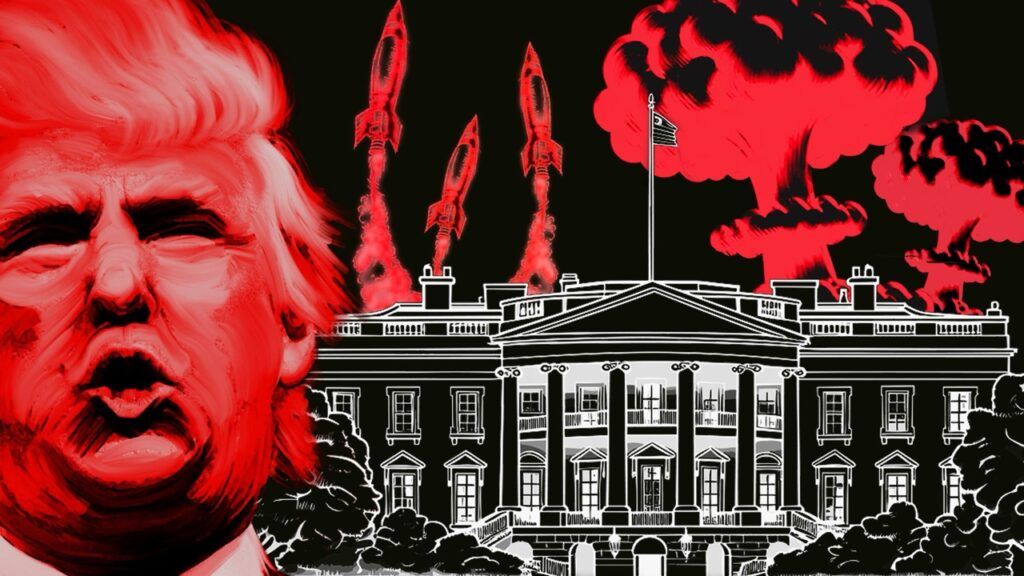
Trump has a strategic plan for the country: Gearing up for nuclear war
By Joe Cirincione | July 2, 2024
| |
|
President Joe Biden has a terrible nuclear policy. A re-elected President Donald Trump’s would be much worse.
Biden has authorized the largest nuclear weapons budgets since the Cold War, delayed then squandered his chance to contain Iran’s nuclear program, and apparently has no policy for containing North Korea’s missiles and weapons. But a re-elected Trump would put nuclear weapons programs on steroids, trash what remains of the global arms control regime, and likely trigger new nuclear weapons programs in more other nations than we have seen at any time since the early 1960s.
Trump’s nuclear policy is all spelled out in a new conservative manifesto by Project 2025, a coalition of over 100 far-right groups led by the Heritage Foundation, which is widely seen as the template for a possible Trump 2.0 administration. If readers of the Bulletin have heard of Project 2025, chances are that they did not go through its 900-page book “Mandate for Leadership.” They should. This policy agenda, dubbed the “Conservative Promise,” is a blueprint for the most dramatic take-over and transformation of the US democracy in history.
The Project 2025 coalition members are staffed by over 200 former officials of the first Trump administration. These sophisticated Trump-movement MAGA operatives now know how to work the levers of government and have learned from what they see as their main mistake during Trump’s first term: leaving the “deep state” intact. These conservatives proudly served Donald Trump through his administration and attempted insurrection. They are now ready to help him complete the job and their plan is here for everyone willing to see.
Our goal is to assemble an army of aligned, vetted, trained and prepared conservatives to work on Day One to deconstruct the Administrative State,” writes Paul Dans, a former chief of staff of the Office of Personnel Management during the Trump administration and now the director of Project 2025, in his foreword to the report. Russ Vought, the chief of staff of the Office of Management and Budget under Trump and now the president of the conservative think tank Center for Renewing America, agrees: “We have to be thinking mechanically about how to take these institutions over.” Vought vows to be “ready on Day One of the next transition,” adding, “Whatever is necessary to seize control of the administrative state is really our task.”
In the nuclear realm, “seizing control” would mean implementing the most dramatic build up of nuclear weapons since the start of the Reagan administration, some four decades ago. If this hawkish political coalition gets its way in November, the scope, pace, and cost of US nuclear weapons programs would increase all at once. Their plan, which seeks to significantly increase budgets and deployments of nuclear weapons and related programs and destroy the remaining arms control agreements, would dramatically increase the risks of nuclear confrontation as a result.
Nuclear proposals. The nuclear proposals are a key part of the Project 2025 coalition’s recommendations to reshape the Defense Department. This chapter is led by Christopher Miller, a former US Army special forces colonel who served as Trump’s last defense secretary. As Michael Hirsch reports in Politico, the agenda “is far more ambitious than anything Ronald Reagan dreamed up.” (In 1980, President Reagan ordered a massive nuclear buildup, which scholars now consider to have greatly escalated the Cold War.)
In condensed and translated form, Project 2025 proposes that a second Trump administration:
- Prioritize nuclear weapons programs over other security programs.
- Accelerate the development and production of all nuclear weapons programs.
- Reject any congressional efforts to find more cost-effective alternatives to current plans.
- Increase funding for the development and production of new and modernized nuclear warheads, including the B61-12, W80-4, W87-1 Mod, and W88 Alt 370.
- Develop a new nuclear-armed, sea-launched cruise missile, even though neither the administration nor the Navy has requested such a weapon, and the Navy has not fielded this type of weapon since they were retired by President George H.W. Bush in 1991.
- Increase the number of nuclear weapons above current treaty limits and program goals, including buying more intercontinental ballistic missiles (ICBMs) than currently planned.
-
Expand the capabilities of the National Nuclear Security Administration’s weapons production complex, including vastly increasing budgets, shedding non-nuclear weapons programs at the national laboratories (such as those devoted to the climate crisis) and accelerating production of the plutonium pits that are the cores of nuclear weapons.
- Prepare to test new nuclear weapons, even though the United States has signed the Comprehensive Nuclear Test Ban Treaty that prohibits such tests and has not tested a full-scale nuclear device since 1992.
- Reject current arms control treaties that the coalition considers being “contrary to the goal of bolstering nuclear deterrence” and “prepare to compete in order to secure US interests should arms control efforts continue to fail.”
- Dramatically expand the current national missile defense programs, including deploying as-yet-unproven directed energy and space-based weapons, or as the report puts it: “Abandon the existing policy of not defending the homeland against Russian and Chinese ballistic missiles.”
- Invest in a sweeping, untested “cruise missile defense of the homeland.”
- Accelerate all missile defense programs, national and regional.
:
These proposals would add unnecessary new weapons to an already expansive nuclear arsenal. If implemented, these new and expanded programs would accelerate the nuclear arms race the United States is already engaged in and encourage the expansion—or initiation—of new nuclear weapons programs in other nations around the globe.
It is not as if the United States needs to spend more on nuclear weapons.
At $70 billion, President Joe Biden’s Fiscal Year 2025 budget request is already the most the country will have spent on nuclear weapons since the Cold War. Under Trump and now Biden, the United States has engaged in a sweeping replacement of nearly all existing nuclear weapons systems, including a new generation of strategic bombers (the B-21), strategic missile submarines (the Columbia class), intercontinental ballistic missiles (the Sentinel), several new warhead programs, and the development of new nuclear weapons, including smaller, “more usable” nuclear warheads and air-launched cruise missiles.
The Congressional Budget Office estimates that the currently planned nuclear weapons programs will cost $750 billion over the next decade (2023-2032). And the costs will rise every year: Biden’s requested $70 billion for the next budget is a 22 percent increase from last year. The total cost of the programs will approach $2 trillion. And there is more. The Biden administration also requested $30 billion for Fiscal Year 2025 for missile defense programs, much of which will be devoted to weapons designed to intercept long-range, nuclear-armed missiles.
The policy recommendations made by the Project 2025 coalition would substantially increase these costs. Unlike other generalized calls for more weapons, these conservative authors have developed a detailed plan for how to implement their apocalyptic vision and minimize any opposition. It is a far more specific plan than any before it, and more developed than anything groups trying to save what remains of the global arms control regime have even attempted.
Implementation plan. In March, the Heritage Foundation detailed the steps necessary to implement these proposals in asking the president to “revitalize the US strategic arsenal.” The authors propose that the next US president—meaning Donald Trump, but never mentioning him—immediately upon assuming office:
- Make a major speech soon after inauguration to “make the case to the American people that nuclear weapons are the ultimate guarantor of their freedom and prosperity.”
- Direct the National Nuclear Security Administration (NNSA), which is charged with producing all nuclear weapons fissile materials and the manufacture of all warheads, to provide monthly briefings in the Oval Office and to submit its budgets separately from the Energy Department, within which department the agency resides.
- Direct the Office of Management and Budget to submit to Congress a supplemental budget request to accelerate key NNSA projects and Defense Department nuclear weapons delivery systems (missiles, bombers, and submarines).
- Increase the number of deployed nuclear warheads by directing the placement of multiple warheads on each of the currently deployed Minuteman III intercontinental ballistic missiles. (Each missile in the current fleet of 400 ICBMs holds one warhead. Under this plan, the next president would order each missile to deploy multiple warheads by 2026. The new, replacement ICBM, the Sentinel, would also be fielded with multiple warheads.)
- Direct the production and deployment of new nuclear weapon types, including the sea-launched cruise missile (SLCM-N) and putting nuclear warheads on Army ground-launched missiles. (Both capabilities were eliminated by President George H.W. Bush in 1991.)
- Add nuclear capabilities to several hypersonic systems currently under development as non-nuclear missiles.
- Direct the Air Force to examine a road-mobile version of the Sentinel ICBM. (President Reagan investigated such a program in the early 1980s and found it to be highly controversial, expensive, and impractical.)
- Direct the expansion and enhancement of US nuclear weapons capability across the globe, including by pre-positioning nuclear bombs and aircraft in Europe and Asia. (The United States currently deploys 100 nuclear bombs abroad at five bases in NATO Europe.)
- Direct the NNSA to “transition to a wartime footing,” including the expansion and construction of facilities to produce plutonium and plutonium cores for nuclear weapons.
What’s fueling the commercial fusion hype?
Implications for national security. Should these recommendations be implemented, they will result in a sharp decline in the security of Americans and a dramatic increase in the risk of regional and global conflicts. At the very least, the proposed programs will explode the national debt. With the defense budget already at $850 billion for Fiscal Year 2025 and the budget for nuclear weapons and related programs at over $100 billion, these new projects could add hundreds of billions of dollars to weapons development, production, and deployment costs. The Heritage Foundation estimates that these additional programs will cost “tens of billions,” but this is a gross underestimate.
The existing US strategic arsenal already exceeds what is required for any conceivable nuclear mission. The United States currently maintains a stockpile of some 3,708 nuclear warheads for delivery by missiles and aircraft. Of those, approximately 1,770 warheads are deployed, ready for use within minutes of an order to launch. The rest of the operational stockpile (1,938 warheads) is held in reserve for potential use. In addition, the United States has approximately 1,336 retired, intact warheads in storage awaiting dismantlement. The explosive yields of most of these weapons are 10 to 30 times greater than the bombs that destroyed Hiroshima and Nagasaki.
To put the power of this arsenal in perspective, one city destroyed by just one nuclear weapon would be a level of destruction not seen since World War II. Ten weapons burning 10 cities would be a catastrophe unprecedented in human history. One hundred such weapons would destroy not only the targeted nation but likely unleash a nuclear winter and subsequent famine that could destroy virtually all human civilizations—even those far from the conflict.
Increasing the US arsenal at the scale recommended by the Project 2025 would likely compel rival nations—including Russia, China, Iran, and North Korea—to increase their defense budgets, warfighting plans, and nuclear weapons developments and deployments to match what they will see as an increasing threat from the United States. Allied nations will also be caught up in the competition, fueling an already existing nuclear arms race: Japan, South Korea, and even Germany could be pushed over the nuclear line.
This would be the unintended consequence of an unleashed nuclear modernization. While each nuclear-armed state sees its programs as defensive, their adversaries see them as offensive programs striving for a military advantage. Each move engenders a countermove; each nation believes it is responding to the other. That’s how the security dilemma has spiraled since World War II. But the Project 2025’s recommendations go one step further: They are based on the belief that the United States would win any arms contest through superior technology, resources, and political will.
In 2019, former President Trump’s arms control negotiator Marshall Billingslea said: “We know how to win these races and we know how to spend the adversary into oblivion. If we have to, we will.”
But such programs would further weaken nuclear guardrails that are already gutted by the withdrawals from major arms control agreements—including most significantly, Trump’s withdrawal from the Joint Comprehensive Plan of Action that reduced, contained, and controlled the Iranian nuclear program and his withdrawal again from Reagan’s Intermediate Nuclear Forces agreement that eliminated most nuclear weapons deployed by the United States and Russia in Europe.
The erosion of the arms control and non-proliferation regime is not a defect of the proposals; it is one of its central goals. The Project 2025 authors believe that arms control has failed, and that treaties negotiated with both allies and rivals weaken Americans, rather than are protecting them. These views are not shared by most US allies. Those allied nations committed to restraining or eliminating nuclear risks will, therefore, increasingly doubt US leadership in international relations, weakening the alliance system so essential to US national security since the end of World War II.
Importantly, these proposed programs and activities will almost certainly have the United States abandon its commitment not to test nuclear weapons under the 1996 Comprehensive Test Ban Treaty. Should the United States conduct new nuclear tests, other nations will almost immediately follow suit, adding more fuel to the nuclear fire.
Taken together, the policies and programs advocated by the Project 2025’s self-proclaimed “mandate for leadership” would push the United States onto the precipice of an expensive, dangerous, and destabilizing nuclear confrontation—something not seen since the darkest days of the Cold War.
| |
PEOPLE DON’T TRUST THE GOVERNMENT: MAYBE BECAUSE IT USUALLY SERVES THE INTERESTS OF THE CAPITALIST CLASS?
Harry Targ
“As of April 2024, 22% of Americans say they trust the government in Washington to do what is right “just about always” (2%) or “most of the time” (21%). Last year, 16% said they trusted the government just about always or most of the time, which was among the lowest measures in nearly seven decades of polling.”
https://www.pewresearch.org/politics/2024/06/24/public-trust-in-government-1958-2024/
What is a Legitimacy Crisis?
Theorists as varied as Karl Marx, Antonio Gramsci, and a variety of American political scientists have written in their own ways about “legitimacy” of political institutions and how degrees of it affect stability and change. We can say that a “legitimacy crisis” exists when there is a substantial decline in the level of support for particular regimes, governmental institutions and/or the political leadership of a country.
Polling data from 1964 (when Lyndon Johnson won a huge election victory over conservative opponent Senator Barry Goldwater) until 1976 (at the end of the eight-year period of the Nixon/Ford administration) indicated a dramatic decline in the trust that the American people had in the government. In 1964 seventy-five percent of the people said they trusted their government “always or most of the time.” That declined to thirty percent in 1976. The slide continued until 1980. By 1984 President Reagan’s popularity boosted trust to over forty percent. Then a decline followed bottoming out at twenty percent during the mid-1990s. Trust in government increased after 9/11 in 2002 but by 2007 had declined again to 26 percent. Now, as the Pew Research Center reports (see the link above), 22 percent of those surveyed trust their government at least some of the time. While we can quibble over the meaning of numbers, methodologies, and questions asked, the general thrust of the data indicates a substantial decline in support for government and its leaders since the 1960s; spurred by Vietnam, Watergate, and economic crisis at home. As popular as Ronald Reagan was, he never reached the level of support held by Presidents Eisenhower and Johnson. One can only assume that the rise of Trump, the bizarre rulings by the US Supreme Court, and the lackluster and ill-defined policies of the Biden Administration have solidified the basic legitimacy crises of our own day.
The Vietnam Syndrome
As to foreign policy, polling data, protest activity, and pressure from influential and grassroots lobbying groups led politicians “inside the beltway” to conclude that the American people did not want their country to engage in another long, unwinnable, and controversial war again, such as Vietnam. Thus every presidential administration from Jimmy Carter on regarded with scorn the constraint that the “Vietnam Syndrome” placed on their capacity to act in an overt and massive military way overseas. President George Herbert Walker Bush confirmed this perceived constraint when he announced at the press conference ending the first Gulf War: “At last we have licked the Vietnam Syndrome!” He probably was premature in his exuberance.
More recently, political scientist John Mueller refined the idea of the “Vietnam Syndrome” by studying polling data from U.S. participation in three wars, Korea, Vietnam, and Iraq. He found a common trend in declining support for these wars. Namely duration and casualties (particularly number killed) are correlated with the systematic decline in support for the wars in question. When a president sends troops into combat, temporarily, the people “rally round the flag.” But as wars continue support declines. And today, historically high military expenditures at home and huge transfers of US military aid to support wars in Ukraine, Izrael/Gaza, and “threats” in the South China Sea, can only reinforce the skepticism that used to be called “the Vietnam Syndrome.”
Meanings of the Past
What is relevant about all this for today? Are there enough similarities between now and the 1970s to learn from the past? What is different today from the 1970s? Is there anything to be gleaned about the “consciousness of the American people” at various points in time that bear on the question of how to build a progressive majority and against more war and for social justice?
The 1976 candidate for president, Jimmy Carter, ran on a program, he hoped, to bring the disenchanted anti-war activists back into the mainstream political process. He said he would “learn the lessons of Vietnam,” cut military spending, and most importantly use human rights as the primary criteria for foreign policy. He also pledged to continue the policies of “détente” that his predecessor had initiated with the Soviet Union.
The anti-war movements and social justice movements of the mid-1970s, never well-organized or interconnected continued to disintegrate. After two years of modest efforts as promised, the Carter Administration tilted back toward the Cold War policies of its predecessors, spurred on by the trauma the collapse of the Shah of Iran created in the foreign policy establishment. The Iranian revolution was followed by revolutionary change in Grenada, Nicaragua, and reformism on the horizon in El Salvador. In the summer, 1979, Carter signed a secret directive authorizing covert assistance to anti-Soviet rebels who were launching a war against the secular, Marxist regime that had come to power in Afghanistan.
In other words, as the social movements of the 1960s and 70s dissolved, American foreign policy returned to its historic struggle against revolutionary ferment, albeit in a more covert way. It was candidate Reagan who took the struggle for legitimacy further by promising a more aggressive foreign policy that would lead to victory against the Soviet Union, “the evil empire.” Even so, Reagan had to gradually bring the American people along to military intervention by invading and winning a one-week war in Grenada, and developing a covert strategy to fight communism in Central America, Southern Africa, the Horn of Africa, and Southeast and South Asia called “low intensity conflict.” U.S. military intervention was “low intensity” for Americans while it was “high intensity” for peoples of the Global South.
Relevance for Today
Where is the consciousness of the American people in 2024? First, the wars against Afghanistan and Iraq, the illegal and immoral incarcerations and torture of suspected “terrorists,” egregious shifting of government funds to contractors tied to the administration, media manipulation and an host of other unethical and criminal acts stimulated a substantial decline in legitimacy of government in the years of the Bush presidency. The campaign of Barack Obama, by contrast, mobilized masses of people to the political process in the hope that government could be made to work for the American people. His first six months in office, however, raised some questions about the new administration's ability to deliver on the hope. Today, the citizenry is told that the US must lead the way in supporting “democracy” over “autocracy.”
In general, I believe we can conclude that despite ups and downs in levels of support for government since the end of World War II, there has been a substantial downward trajectory in support for government institutions and personnel. The American people are suspicious of their government and distrust their leaders. Many believe that government has been an impediment to the health and happiness of the people. Episodes of scandal, from Watergate to Iran Contra, to Monicagate, to the Trump and Biden legal hurdles reinforce the skepticism about government. And poll after poll indicate that vast majorities of Americans support Medicare for All, good schools, livable wages, reductions in the grotesque gaps between the rich and poor, and the right for workers to join unions.
In the 1970s, mass movements were dissipating. Today such movements, initiated over the last eight years, continue to grow. They are reinforced by the most significant economic crises for about forty percent of the population since the 1930s. Without mass movements, the twin consciousnesses of the America people as to legitimacy and foreign policy provide little hope for building a progressive majority. In fact, the legitimacy crisis, if not addressed with a progressive alternative vision of what government can be, can lead to massive alienation, right-wing populism, and violence.
Building a progressive majority, at this time, should include making our peace and justice organizations strong, presenting compelling images of what government can and should do, and strategizing about how the mass movements can demand participation in government. As to foreign policy, our campaigns should emphasize the length of our wars and the casualties resulting to Americans and victims in host countries, along with our arguments about the imperial underpinnings of such wars.
Even though the present and the future do not merely repeat the past, the past can inform what we do today.
| |
Letter to the New York Times
Doug Morrison | harrisburg, pa
Too often lost in the world of activism is the lesson from the Industrial Workers of the World more than 115 years ago: educate, agitate, organize (for system change). They grasped the need to build an informed and energized organization grounded in a common identity: the working class, that invited in all other self-identified cultural or ethnic groups: one big union (OBU). The goal? Challenge and overcome the concentrated forms of power in the economic and political system so as to build substantively democratic structures through which the voice of working people (the vast majority of the population) could meaningfully and effectively participate in and contribute to shaping the decisions and conditions that impact life - and no more boss class. The key problem facing activists, especially those on "the real left" is the authoritarian nature of every dominant institution in the U.S. The absence of meaningful forms of democracy is captured in the point that 82% of people in the U.S. opposed bump stocks. It mattered little. The same is true across the board. 90% of the people could prefer a universal non-profit based health care system, but, as the NYT put it back in the 1990s "it would be politically impossible" in the U.S., because of the way in which power is distributed, i.e., concentrated in the hands of the ownership class and the political and court system that serves and services that class, at the expense of the well-being and safety for the rest of us.
|  |
Who Is Keir Starmer, British Labour Party Leader on the Road to Downing Street?
A Review of “The Starmer Project: A Journey to the Right” by Oliver Eagleton, Verso Books 2022
June 24, 2024 Marilyn Albert PORTSIDE
The widely expected Labour Party victory over the British Conservatives (Tories) will be an important and positive development. 14 years of austerity under the Tories has done terrible damage to the British working class. Now it is important to understand who the new Prime Minister of the UK – Sir Keir Starmer – really is, because his politics and way of operating will present another important arena of struggle.
While spending a month in England recently, I snatched up the last copy for sale of “The Starmer Project – a Journey to the Right” at Oxford’s famous Blackwell’s Books. It was written by Oliver Eagleton, and published by Verso Books in 2022. Eagleton is an editor at New Left Review and writes for The Guardian and other publications.
Eagleton’s account of Starmer’s career has 25 pages of end notes, so readers are free to delve more deeply into the often shocking facts that he documents about Starmer.
Americans are most familiar with Starmer’s campaign against the previous Labour Leader Jeremy Corbyn and prominent Labour MP Diane Abbott.
But Starmer’s campaign has been not only to marginalize and purge Corbyn, Abbott, and other Left elected officials of the Labour Party – it has been to transform the party into a Center-Right organization whose “number one mission is wealth creation” (Starmer interview in May 2024). What is Starmer’s backstory?
He grew up working class. He attended Oxford and developed an interest in human rights law. Dabbling in the socialist movement on the Left of the Labour Party, he was a member of the editorial collective of a publication called “Socialist Alternatives” and became secretary of a socialist lawyers’ society.
But in the early 1990s, some of his colleagues perceived Starmer to be “mutating”, as Eagleton puts it. He advocated for changes in the socialist lawyers’ group that would end its more militant character. He overhauled the group in a way that forecast his make-over of Labour 30 years later.
During this period Starmer worked in apparently contradictory ways – endorsing British police violence against Northern Irish Republicans, but also working against the death penalty in Britain’s former Caribbean and African colonies, while taking pains to say he was not opposed to the death penalty “per se”.
At this point Starmer achieved the position for which he would later be knighted: he became head of the Crown Prosecution Service – similar to the US Attorney General, and held the job for 5 years. By the end of his term of office, his achievements had put him on the road to Parliament.
(One summary e-mail a day, you can change anytime, and Portside is always free.)
What were these achievements in a hugely important job in the British government? He made a major mission of his office to work closely with the British security agencies and their international partners in the “war on terrorism”, getting deployed to work with the Obama Administration and developing a relationship with Attorney General Eric Holder to the point that Holder actually asked Starmer to write a comprehensive critique of the US Justice Department!
Starmer’s Crown Prosecution Service was in charge of the Julian Assange case, when Sweden requested Assange’s extradition, which Assange feared would then lead to his extradition to the United States. During these years, Starmer traveled to the US to meet with Eric Holder about Assange multiple times. The documents from those meetings have been destroyed.
In another case, Starmer worked “doggedly” to extradite to the US an autistic computer expert who breached US security. During his imprisonment the young man became suicidal. But Starmer persisted in trying to get the extradition, until Conservative Home Secretary Theresa May ultimately intervened, based on the young man’s mental illness.
Starmer refused to prosecute police officers who killed three innocent migrants. The author of the book estimates that there could be dozens of cases of police violence which Starmer refused to prosecute. Instead, Starmer turned his attention to prosecuting victims of crime, as well as social justice demonstrators. In particular, during years when rape cases were rising, he prosecuted several women whom he claimed had lied about being sexually assaulted.
He wrote new guidelines making it easier for police to charge political activists, as well as re-writing guidelines for charging welfare claimants who had misclaimed small amounts of benefits.
Accompanying the Tories’ “welfare reform”, Starmer advocated a “superdatabase” for government access to the public’s personal data. This type of “law and order” is now reflected in the Labour Party’s advocacy of eliminating “anti-social behaviour”. Starmer’s stint as Crown Prosecutor includes many more shocking details. Following his 5 year term of office, he was ready to run for Parliament in 2015.
In 2016, there was an attempted “Labour Right” coup against Leader Jeremy Corbyn. During this failed effort, Starmer backed a pharmaceutical lobbyist who wanted to privatize the National Health Service.
In Corbyn’s Shadow Cabinet, Starmer was Shadow Brexit Secretary. The book includes a lengthy description of the whole Brexit episode, which most Brits now believe has been a huge disaster for the country.
Corbyn-led Labour lost very badly in the General Election of 2019, leading to ultra-rich businessmen coming together to rid the Party of Corbyn and uniting around Starmer as the next Party leader. In April 2020, Starmer won with 56% of the vote, becoming the next leader of Labour and possible next Prime Minister.
At the high point of Covid19, Starmer largely went along with the Tories’ program around the pandemic, offering little in the way of a better plan of action.
In a section of the book entitled “Throttling the Left”, Eagleton documents Starmer’s systematic crushing of the Left wing of the Party.
A major component of the campaign to purge the Left was to end Corbyn’s influence in the Party, using a smear campaign of false claims of anti-Semitism in which others who criticized Israel were also charged with anti-Semitism. The British news media took a major role in this attack. In October of 2020 Starmer used a government report on the alleged anti-Semitism to suspend Corbyn from the Party.
A struggle in the Party ensued in which Starmer backtracked his accusations, and then reversed the backtrack. In November 2020 Corbyn was readmitted to the Party but removed from his powerful role in what is called the Parliamentary Party. In early 2024 Corbyn was barred from
running for his Parliamentary Seat and he announced he would run as an Independent. He was expelled from the Labour Party, to which he had belonged for 40 years.Others got similar treatment to Corbyn, including the first Black woman to be elected to Parliament, Diane Abbott. But Abbott received high levels of support which Starmer could not withstand and she was returned to the 2024 candidates’ list.
All of this was the culmination of action against the Left which began as soon as Starmer became Leader. Anytime a Labour official voted against what the Tories did in Parliament, they were reprimanded by Labour officialdom. In the Fall of 2021 the leadership sent letters to socialist MPs and activists threatening to put them under investigation for unspecified things. Labour MPs were warned not to walk union picket lines.
Between 2021 and 2022 the Labour Party prohibited membership in seven Leftwing organizations, expelling, as of September 2023, 363 members, though not all for Leftwing affiliations.
As of today, less than two weeks before the election, polls show the Tories will be badly trounced by Labour. Keir Starmer will then become Prime Minister of Great Britain.
Each Party’s campaign Manifesto can be viewed on the Party websites or in publications such as The Guardian. Jeremy Corbyn’s website is https://jeremycorbyn.org.uk
| |
|
Below are education materials that you can use!
Share with friends. invite peope opver for a video night, etc!
| | |
|  |
|
New Studies
on the Left
Paperback $19.95
...is a journal of socialist theory and practice. It is the successor to ‘Dialogue and Initiative, published as an annual journal of the Committees of Correspondence for Democracy and Socialism in book form from 2012 to 2022. It will continue the CCDS policy of left unity, including articles with a variety of left perspectives, including debates.
This issue contains over 30 articles grouped under the headings of Analysis and Global Reach, Debate and Controversy, Labor, Socialism, and Book Reviews. Some are reprinted from other sources, but many appear here for the first time.
Among the authors are David Bacon, Joan Braune, Carl Davidson, Bill Fletcher, Jr., Jerry Harris, Jay Jurie, Paul Krehbiel, Sun Liping, Adewale A. Maye, Duncan McFarland, Jasmine Payne-Patterson, Vijay Prashad, Nikhil Pal Singh, Harry Targ, and Janet Tucker.
Table of Contents
Click HERE to purchase
| | |
|
Hard Ball Press author says: “Seek the past to prepare for the future.”
A quick survey of our political landscape tells us all we need to know about the national crises we currently face. It seems to many Americans that this is the worst of times.
That’s where a new Hard Ball Press book comes in. Radical Connecticut: People’s History in the Constitution State by Andy Piascik and Steve Thornton is designed to inspire ordinary people by illuminating past struggles. They introduce us to stories of union workers, peace activists, civil rights campaigners and many more. Their “history from below” comes to life with almost 100 stories that span decades.
While the book’s focus is Connecticut, the lessons are universal. “This isn't local nostalgia. The people and events we chronicle are linked in many ways to national and international conflicts,” Thornton explains. “Our stories provide a broader perspective to help activists everywhere better understand the big picture, the wider movements.”
He continues: “We tend to think anything important that progressives have achieved only took place in the big cities. That’s a significant blind spot. We can all learn from each other.”
The authors have given talks at a dozen venues including union halls, libraries and pubs. At recent Gaza encampments on local college campuses, students were introduced to past “tent cities” set up by war veterans in 1932 and welfare mothers in 1970. Union rank and filers heard about a Bridgeport factory sit-down strike in 1937. Young tenant organizers learned eviction tactics from a 1976 Hartford housing protest.
“People's history can be told by others besides academics,” Andy Piascik says. “Their accumulated wealth and experience is of the utmost value. We encourage people to tell the stories which have not been told.”
RADICAL CONNECTICUT is available from Hard Ball Press and your favorite independent bookstore.
Unsubscribe | Update Profile | Constant Contact Data Notice
Timothy Sheard | 415 Argyle Rd. 6A | Brooklyn, NY 11218 US
ng!"
|  | |
|
Discussion in April "On the Immigration Problem'
Http://ouleft.org/wp-content/uploads/4thmonda-immigration-bacon-lewis.mp4
David Bacon
writer, photographer, labor organizer.
http://dbacon.igc.org/
""David Bacon is the conscience of American journalism: an extraordinary social documentarist in the
rugged humanist tradition of Dorothea Lange, Carey McWilliams,
| |
|
Anne Lewis
Anne comes out of a movement to make media that helps create opportunity for social change. She has made documentary films (always with limited resources) since the 1970¹s and was associate director and assistant camerawoman for HARLAN COUNTY, USA.
| |
Libby was a founding member of CCDS, along with her husband Mort, who proceded her in death, They are both greatly missed. | |
|
Campaigns, Movements, and Organzing Strategies
with Bill Fletcher Jr.
and Carl Davidson
| |
|
`Buy this book in honor of incredible woman!
click HERE to purchase
| |
Understanding and Countering Fascist Movements
From Void to Hope
By Joan Braune
This book is based on the premise that understanding fascism is crucial for defeating it.
Understanding and Countering Fascist Movements suggests fascism must be understood according to two “dimensions.” First, fascism is a social movement seeking power, always already connected to sources of power. Hence, fascism cannot be defeated by policing it as a crime problem, nor therapeutically treating it as a pathology of mental health. Second, fascists have cognitive and emotional needs they are seeking to fulfill through their participation in the movement, but the presence of these motivations must be held in tension with the fact that fascists are responsible for their choices and that these individual motivations also exist in a wider social context of capitalism and systems of supremacy.
The book opens by examining some psychological elements of recruitment and disengagement from fascist movements, before addressing broader social narratives, concluding with the limitations of an approach that is grounded in the national security state that relies on individualized, perpetrator-centered interventions. Rejecting centrist paradigms that see fascism as “extremism” or “accelerationism,” Braune argues that fascism must be addressed in its specificity and uniqueness as an ideology and movement. Ultimately, she argues, fascism can only be defeated by countervailing social movements that not only demand radical social change but offer alternative spaces of belonging, community care, and the search for meaning.
Understanding and Countering Fascist Movements is a philosophical contribution to antifascist theory and practice that will be appreciated by academics, students, and activists concerned about fascism today. https://www.routledge.com/
| |
|
HARD BALL PRESS & THE MAYA BOOK PROJECT PROMOTE INDIGENOUS MAYA LANGUAGES IN GUATEMALA
Catarina Chay, director of the K'iche' department of Quetzaltenango.
Timothy Sheard | 415 Argyle Rd. 6A | Brooklyn, NY 11218 US
The Bilingual Education department of the Guatemala Ministry of Education in Quetzaltenango has printed 3,000 copies of Margarito’s Forest - 1,500 in Spanish- K'iche' version and 1,500 in Spanish-Mam version. The books will be given to Maya schools across the country as part of the movement to preserve and nurture indigenous Maya languages.
Hard Ball & Little Heroes Press is proud to support the Maya Book Project in also producing Margarito’s Forest in Spanish-K’iche’ and Spanish-Mam versions. We have also published Margarito's Forest
in English-K’iche’ and English-Mam for Maya children in North American schools as part of this campaign.
Hector Guzman, is Director of the Mam department, Guatemala Dept. of Education.
| |
|
The last few years I have been composing songs about peace, justice, climate renewal and our Covid heroes.
A wonderful company of musical theater actors and musicians have joined my Mighty Rivers Music Company and performed these songs.
Please have a listen and click on A CHILD OF MINE, a song about a woman and daughter caught in a city ravaged by war. It was inspired by the terrible events in Gaza, but could easily be sung for a mother and child in Ukraine, or in Viet Nam during the 60’s.
(Click on closed captioning for the lyrics)
More songs coming to my Youtube channel every Monday morning, 8:00 am, so check them out!
Listen to more songs and check out performance dates at my Mighty Rivers Music web site.
Out-of-towners will be able to watch shows streaming from my Facebook page, so be sure to “friend me” on Facebook.
Thank you, Tim Sheard.
| |
|
RADICAL CONNECTICUT – PEOPLES HISTORY IN THE.CONSTITUTION STATE - Andy Piascik and Steve Thornton
Who really makes history?
Radical Connecticut: People’s History in the Constitution State tells the stories ofeveryday people and well-known figures whose work has often been obscured, denigrated, or dismissed.
There are narratives of movements, strikes, popular organizations and people in Connecticut who changed the state and the country for the better.
Unlike a traditional history that focuses on the actions of politicians, generals,
business moguls and other elites, Radical Connecticut is about workers, the poor,people of color, women, artists and others who engaged in the never-endingstruggle for justice and freedom. It offers a fresh look at history that should especially inspire young people engaged in social justice work in an increasinglydangerous world.
| | |
 | |
PRESENTE, A DOCKWORKER STORY
Herb Mills
What would you do if ordered to load military weapons on a ship that was bound for a government that was brutally killing the people?
In December 1980, a union steward with the longshoremen’s union in San
Francisco learned that a shipment of arms on the docks was soon to be loaded onto a ship bound for the fascist government of El Salvador. While the
Salvadoran regime murdered thousands of its citizens, in the United States,
Ronald Reagan was an elected president on a conservative, anti-union platform.
Herb Mills, an officer in the ILWU (International Longshore and Warehouse
Union), led his union’s campaign to refuse to load the weapons. But such a direct
violation of their union contract could lead the government to jailing the officers
and putting the union into receivership.
How could the union stop the shipment and keep out of jail? Would the public
support them and, if so, how? Would the press vilify or praise them?
Based on his personal archives and historical union records, Mills fashions a
gripping fictional account of that campaign. The names have been changed, but
the courage and the daring of the union men and women are not made up, they
are all real, and now their story is told.
| | |
|
Children, did you know that you have real superpowers?
It’s true! Even if you are young, even if you are small, you and
your friends and schoolmates have the power to make the world a
better place.
Want to know how to release your powers? Read Little Meena and the
Big Swim/ La Pequeña Meena Y El Gran Nado and you will see that
when many little people all get together and speak in one voice, big
people have to listen. And change.
It is called Solidarity/ Solidaridad!
Release: June, 2024
_ _ _ _
Hard Ball Press is helping preserve indigenous languages through
partnering with the Maya Book Project. Little Heroes author Andy
Carter has released his wonderful children's book Margarito's Forest
in English-Mam and English-K'iche, the two most common indigenous
languages spoken by the Maya.
In Guatemala, the Ministry of Education, in partnership with the
Maya Book Project, is including the Spanish/K’iche and the
Spanish/Mam editions in their indigenous bilingual curriculum.
Children in schools across the country will be able to practice
their native language.
In addition, Little Heroes Press has released two new editions: Mam/
English and K’iche’/English. We published these versions for
children in North America to help Maya children (and parents!)
practice their indigenous language.
| |
|
The Man Who Changed Colors
By Bill Fletcher, Jr.
When a dockworker falls to his death under strange circumstances, investigative journalist David Gomes is on the case. His dogged pursuit of the truth puts his life in danger and upends the scrappy Cape Cod newspaper he works for.
Spend a season on the Cape with this gripping, provocative tale that delves into the
complicated relationships between Cape Verdean Americans and African Americans, Portuguese fascist gangs, and abusive shipyard working conditions. From the author of The Man Who Fell From The Sky.
“Bill Fletcher is a truth seeker and a truth teller – even when he’s writing fiction. Not unlike Bill, his character David Gomes is willing to put his life and career in peril to expose the truth. A thrilling read!” − Tavis Smiley, Broadcaster & NY TIMES Bestselling Author
Review by John Bachtell
Click HERE to purchase
| | |
|
From Upton Sinclair's 'Goose Step' to the Neoliberal University
Essays on the Ongoing Transformation of Higher Education
By Daniel Morris
and Harry Targ
Paperback USD 17.00
This is a unique collection of 15 essays by two Purdue University professors who use their institution as a case-in-point study of the changing nature of the American 'multiversity.' They take a book from an earlier time, Upton Sinclair's 'The Goose-Step A Study of American Education' from 1923, which exposed the capitalist corruption of the ivory tower back then and brought it up to date with more far-reaching changes today. time. They also include, as an appendix, a 1967 essay by SDS leader Carl Davidson, who broke some of the original ground on the subject.
Click HERE to Purchase
| | |
From the CCDS Socialist Education Project... | |
A China Reader
Edited by Duncan McFarland
A project of the CCDS Socialist Education Project and Online University of the Left
244 pages, $20 (discounts available for quantity), order at :
The book is a selection of essays offering keen insight into the nature of China and its social system, its internal debates, and its history. It includes several articles on the US and China and the growing efforts of friendship between the Chinese and American peoples.
| | |
|
Taking Down White Supremacy
A Reader on Multiracial and Multinational Unity
Edited by the CCDS
Socialist Education Project
166 pages, $12.50 (discounts available for quantity), order at :
https://www.lulu.com/spotlight/changemaker
This collection of 20 essays brings together a variety of articles-theoretical, historical, and experiential-that address multi-racial, multi-national unity. The book provides examples theoretically and historically, of efforts to build multi-racial unity in the twentieth century.
Click here for the Table of contents
| | |
CHANGEMAKER PUBLICATIONS: Recent works on new paths to socialism and the solidarity economy
Remember Us for Gift Giving and Study Groups
We are a small publisher of books with big ideas. We specialize in works that show us how a better world is possible and needed. Click Gramsci below for our list.
| |
522 Valencia St.
San Francisco, CA 94110
415 863-6637
| | | | | |