Q1 Carpet Recycling Rate Hits Stunning 41.6% | |
|
Q1 2024 results for the California Carpet Stewardship Program include:
-
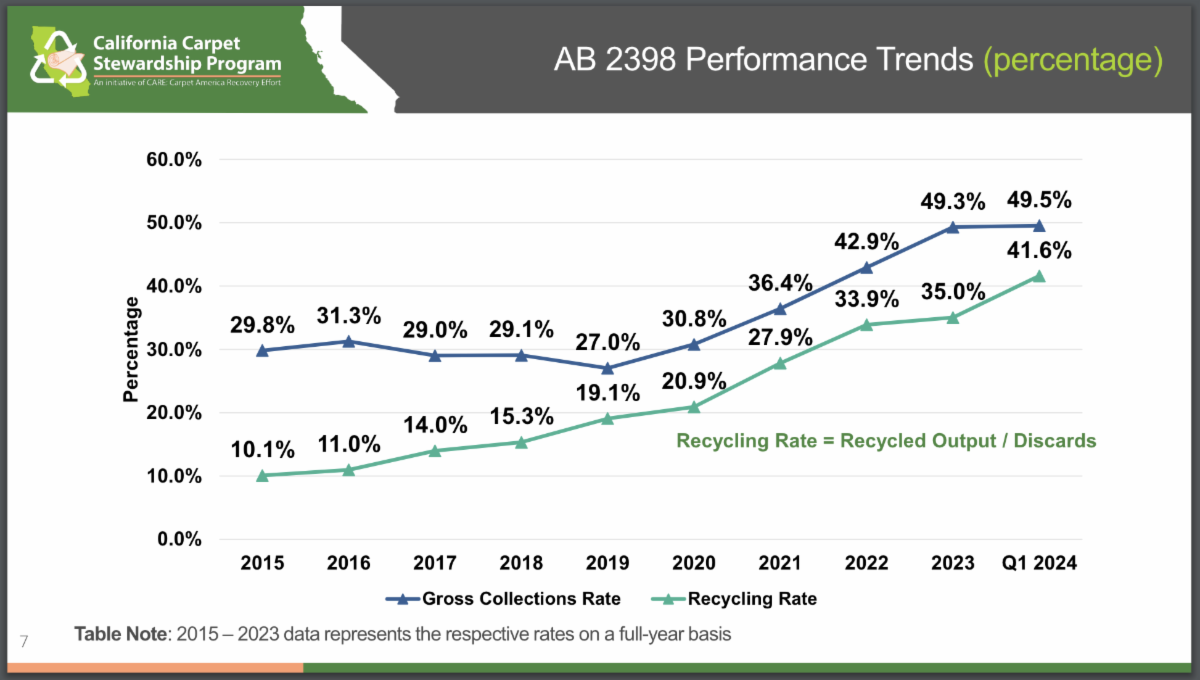
49.5% of discarded carpet was collected (gross collection rate) and the recycling rate reached 41.6%. The 2024 recycling rate target is 34%. The recycling rate for all materials in California is 41%.
- Q1 carpet sales were on budget, but sales are expected to continue their decline year over year. Q1 sales were 3 percentage points below Q1 of 2023.
- 56% of carpet sold comprised PET face fiber and 31% was nylon.
- The assessment paid on carpet sales support the California Carpet Stewardship Plan. 82% of total Program expenses were paid out in the form of subsidies; 74% of all subsidies were paid to California-based recyclers.
See the Q1 presentation here.
| |
Innovation & Design Grants Awarded | |
|
The CARE California Carpet Stewardship Program has awarded $200,000 under round two of its Innovation & Design (I&D) cycle, which is intended to provide funding for testing and development activities that create:
- A more recyclable and environmentally sustainable carpet design and/or
- Post-consumer carpet (PCC) products that are more reusable, recyclable and/or have a decreased environmental footprint.
The University of California Davis was awarded $100,000 to explore the reformulation of Visions Recycling’s PCC-content lightweight aggregate in construction applications while completing a business case and lifecycle analysis of the material versus traditional cement. The project lead is Sabbie Miller, Associate Professor in the Department of Civil and Environmental Engineering. She is also a Faculty Scientist at the Lawrence Berkeley National Laboratory. Visions Recycling is based in Sacramento and is a CARE Capital Improvements and Product Testing grantee.
Arizona State University was awarded $100,000 to research the inclusion of PET fiber in concrete applications; this project originally began under a CARE Product Testing Grant to CMJ Systems, Inc. The work will include any remaining preparations to create a market-ready product. The project lead is Narayanan Neithalath, Fulton Professor of Structural Materials in the School of Sustainable Engineering and the Built Environment.
Both projects will run through the 2024-25 academic year.
CARE plans to release another round of Innovation & Design grant funding this fall and the Micro Grants for Collection/Reuse program remains open on a first-come, first-served basis. For more information, please visit the CARE grants webpage or email Abbie Beane, CARE grants manager, at ABeane@CarpetRecovery.org.
| |
CARE Welcomes New Public Drop-off Site | |
|
CARE welcomes one new public drop-off site this month:
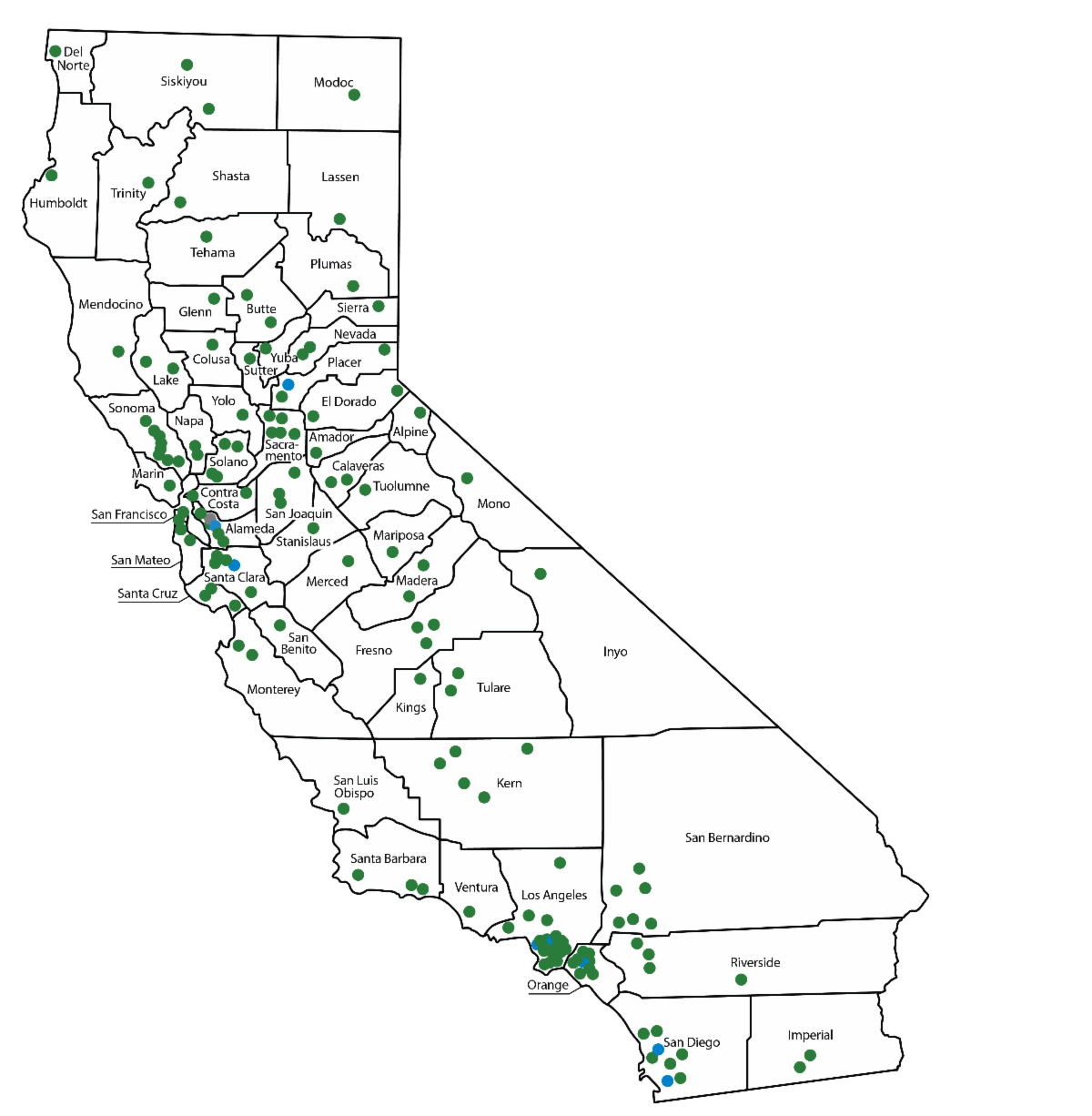
There are currently 149 CARE public drop-off sites servicing all 58 California counties.
CARE supports drop-off sites by providing at no cost:
- A container for collection
- Third-party hauling to transport carpet material to recyclers
- Promotional materials for local government and the hosting facility
- Technical assistance from CARE staff
- Ready access to micro grants that support site set-up and collection equipment/infrastructure.
To find the CARE-sponsored drop-off site closest to you, visit the drop-off site map. If there is a location, such as a supply house, landfill, transfer station or recycling facility that you feel would work well as a drop-off site for you and other flooring professionals near you, please email CARE with the facility's name, location and business phone number. A CARE staff person will call you to discuss your volume, learn more about flooring professionals’ needs in your area and work toward finding a solution.
In addition to public drop-off sites, CARE works with the recyclers who operate some 196 private collection sites around the state.
An updated print map booklet listing all CARE public Drop-off sites as of June 2024 is now available. Download here or request copies at CA@CarpetRecovery.org.
| |
CARE Provides Waste Wizard Toolkit to Local Governments | |
|
CARE equips local governments with a Waste Wizard Toolkit to effectively educate the public on proper waste sorting. Through online interactive waste sorting tools like Waste Wizard, people can learn how to dispose of various items responsibly. Despite carpet being included in these tools, misinformation often leads people to dispose of used carpet incorrectly.
Local governments can update their search tools with CARE resources to include educational material about recycling carpet and nearby drop-off locations. CARE proactively contacts local governments, offering a Waste Wizard toolkit to streamline the dissemination of information about carpet recycling and resources provided by the California Carpet Stewardship Program. If your agency could benefit from this toolkit, please get in touch with Thomas Coates at TCoates@CarpetRecovery.org, who will ensure prompt delivery.
| |
2023 Program Highlights Mailed to Retailers and Installers | |
|
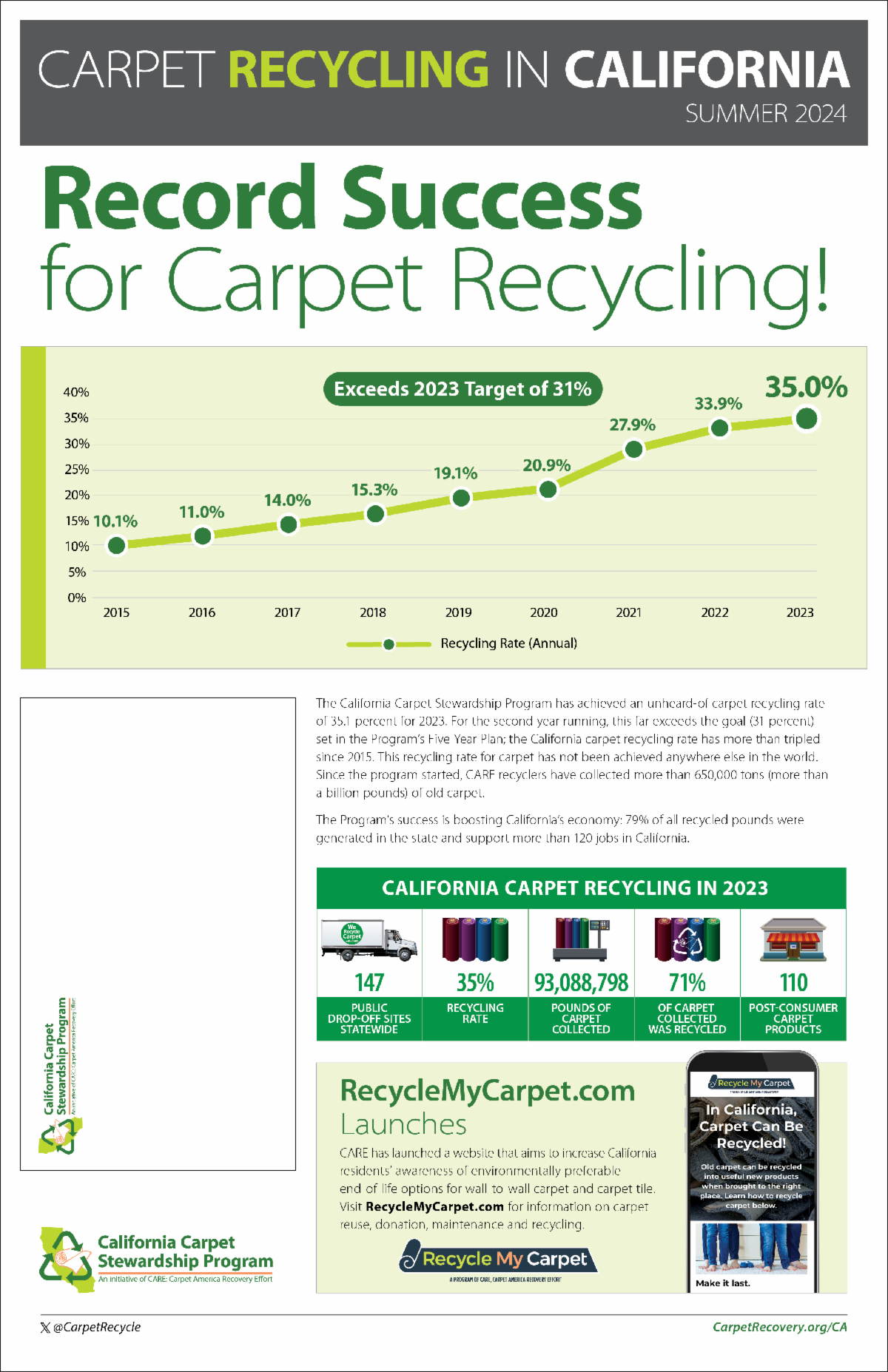
CARE’s annual Program Highlights newsletter was mailed last month to all retailers and licensed flooring contractors in the state. The newsletter details the California Carpet Stewardship Program’s progress in 2023, including achieving an unprecedented 35% recycling rate. Other articles describe the carpet assessment, carpet collection opportunities, grants, products made from post-consumer carpet material, and installer resources.
The goal of the newsletter is to raise stakeholder awareness of the Program’s advancements and challenges so that more retailers and flooring contractors are encouraged to recycle tear-out carpet and carpet tile.
See the Highlights here.
| |
Recyclability Report Published | |
|
CARE has published a new report, “CARE Assessment of Post-Consumer Carpet Recyclability-2023.” The report presents the results of a survey conducted among California-based Collector-Sorter-Entrepreneurs (CSEs) and post-consumer carpet (PCC) recyclers, highlighting the percentage of non-recyclable PCC types and identifying factors contributing to their lack of recyclability. The report also discusses the efficacy of backstamping processes (designed to inform recyclers about carpet’s fiber type) and outlines CARE’s commitment to enhancing carpet recyclability and its plans for future action.
Among the key findings:
- Given the current technology and end markets available to California-based recyclers and CSEs, approximately 93% of post-consumer carpet may be recyclable or reusable.
- Recyclers and CSEs identified various factors contributing to the lack of recyclability, such as the lack of markets for certain PCC types, heavy glue or cement used for installation, technology availability, cost, equipment compatibility issues, limited market demand, unavoidable contamination, shipping costs related to reuse markets and carpet scraps.
- The efficacy of back-stamping processes varied among recyclers and CSEs. Some reported a readable and accurate rate of 20-25% for PCC back stamps, while others found back stamping to be somewhat effective or ineffective due to the absence or inaccuracy of PCC stamps.
See the report on the CARE website.
| |
Carpet Industry Opposes AB 863 | |
|
In June, California bill AB 863, “Carpet and flooring recycling: producer responsibility organizations: fines: succession: training” (Aguiar-Curry) was re-referred from the Judiciary Committee to the Appropriations Committee, which will meet on August 5th. The bill proposes the establishment of a producer responsibility program for flooring, to include carpet, carpet pad, resilient flooring, and LVT (luxury vinyl tile); the new Producer Responsibility Organization (PRO) would replace the current California Carpet Stewardship Program likely after the current plan expires at the end of 2027. There are numerous requirements around convenience, fees, funding and more that will have enormous implications for all flooring industry stakeholders in the state. The bill received considerable negative comments from opposition noting the last-minute notice and lack of adequate stakeholder engagement.
CARE and the Carpet & Rug Institute are opposed to the bill in its current form. Read more in Floor Covering News. CARE encourages all stakeholders to familiarize themselves with the updated bill and to communicate with their representatives. This bill will cost homeowners and retailers a lot of money.
| |
New York To Launch Carpet EPR Law | |
|
An Extended Producer Responsibility (EPR) law for carpet in the state of New York goes into effect on December 28, 2024. The law requires carpet producers to fund a convenient carpet collection program at no cost to New York state consumers, with program launch set for July 1, 2026. Read more here.
| |
|
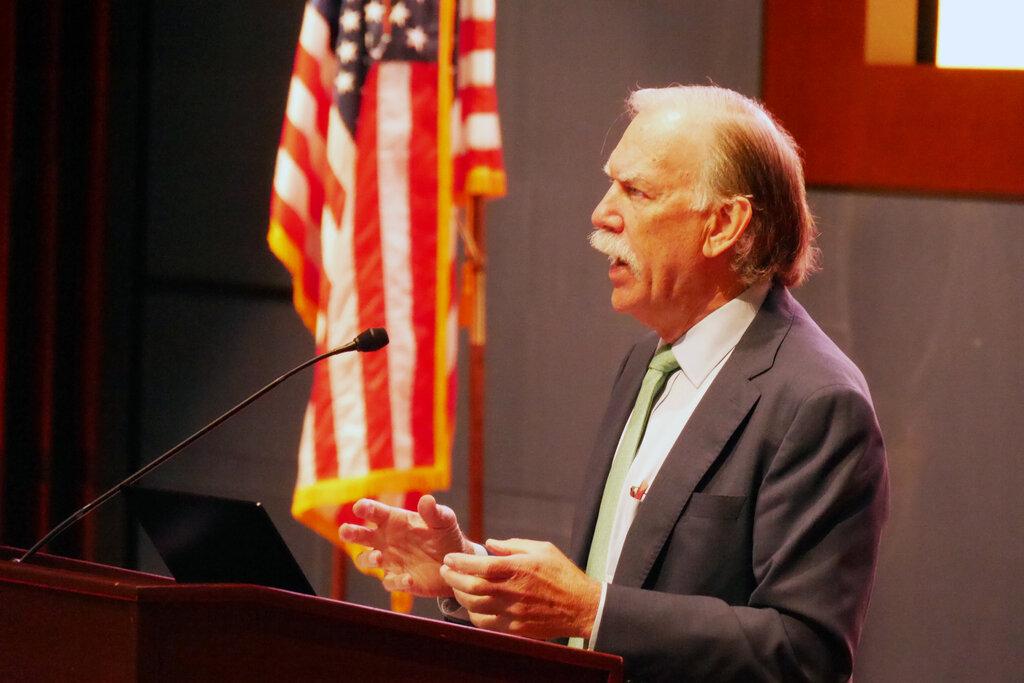
CARE Executive Director Bob Peoples addressed the inaugural Flooring Sustainability Summit on July 18 in Washington, DC. Peoples updated the audience of government agency and Capitol Hill staff and flooring industry experts on lessons learned on what it takes to build a circular economy and deal with plastic waste as well as progress of the California Carpet Stewardship Program and developments with the New York state carpet EPR law.
CARE will be tabling at the California Resource Recovery Association Conference, August 17-19 in Anaheim, California. California staff look forward to speaking with local government waste and recycling staff from across the state about the California Carpet Stewardship Program’s progress and how local agencies can become more involved with diverting carpet from landfill. Come join us to learn more about this successful program!
| |
Carpet Recycling Questions? We’ve Got Answers! | |
CARE frequently fields questions from members of the public about what to do with carpet tear-out. We respond promptly with the most complete information possible… every square yard counts! Retailers and members of the public are encouraged to email us at CA@CarpetRecovery.org with questions about carpet recycling in California. | | | | |