|
This article originally appeared in Post Alley.
Look up low-income housing and you’ll likely find yourself looking at a picture of Sharon Lee. The founder and executive director of the Low-Income Housing Institute (LIHI) is laser focused on one thing: getting a roof over the heads of homeless and low-income individuals.
In an interview with her, it’s easy to become dizzy talking about one and another of her developments. LIHI, one of the largest nonprofit housing organizations, now owns and manages 3,400 housing units at 75 sites located in six Puget Sound counties. Or maybe it’s even more, since it’s hard to keep track given LIHI’s latest developments. Those are impressive statistics for the Seattle-based nonprofit that was founded by Lee in 1991. The housing provider got its start partnering with a church and opening a residence for teen-aged mothers.
The low-key Lee doesn’t dress the part of big-time developer. Most days she could easily be mistaken for one of her less-provident tenants. Explanation for her advocacy may lie in her interesting biography. That journey started with her birth in New York City, daughter of immigrants. When her parents divorced, she and her sister spent four years in Hong Kong with grandparents before returning to the U.S., this time to Philadelphia where she and her family sometimes experienced hardship and homelessness.
Lee attended the University of Pennsylvania, obtaining a bachelors in urban studies while working as a student intern for the Tenants Action Group. From there, she travelled to M.I.T. where she earned a dual master’s in architecture and urban planning. It wasn’t until a visit to her sister, by then living in Seattle, that Lee fell in hopelessly in love with the Emerald City. She found it “so beautiful” that she ended up staying. Ironically, her sister afterwards moved away.
In Seattle, one of Lee’s first jobs was with Bob Santos at Interim Community Development Association. She cites “Uncle Bob” and City Councilmember Paul Kraabel as her early mentors. She served on Kraabel’s staff and helped lobby the Legislature to set up the State Trust Housing Fund. It was during her time working with eventual House Speaker Frank Chopp at the Fremont Public Association that she founded LIHI.
The new nonprofit emerged during the years when Seattle Mayor Norm Rice was dealing with numbers of homeless living on city streets. The city’s mission to end homelessness faced many challenges. Although the affordable housing levy had passed in 1986, it took many months to obtain building permits and even more time to construct needed housing.
By 2015, those lengthy delays led Lee to entertain the idea of tiny house villages — temporary housing in very small houses that serves to get people off the streets while offering privacy, warmth, security, and a path to permanent housing. Ideally the homeless would spend six months in tiny houses before moving on to permanent housing. But as Lee ruefully noted, “Some take a little longer.”
In addition to management of the tiny house villages and other projects, LIHI also gets credit for Urban Rest Stops, hygiene centers that provide access to restrooms, showers, and laundry facilities at no cost to the unsheltered. There are locations in Ballard and downtown.
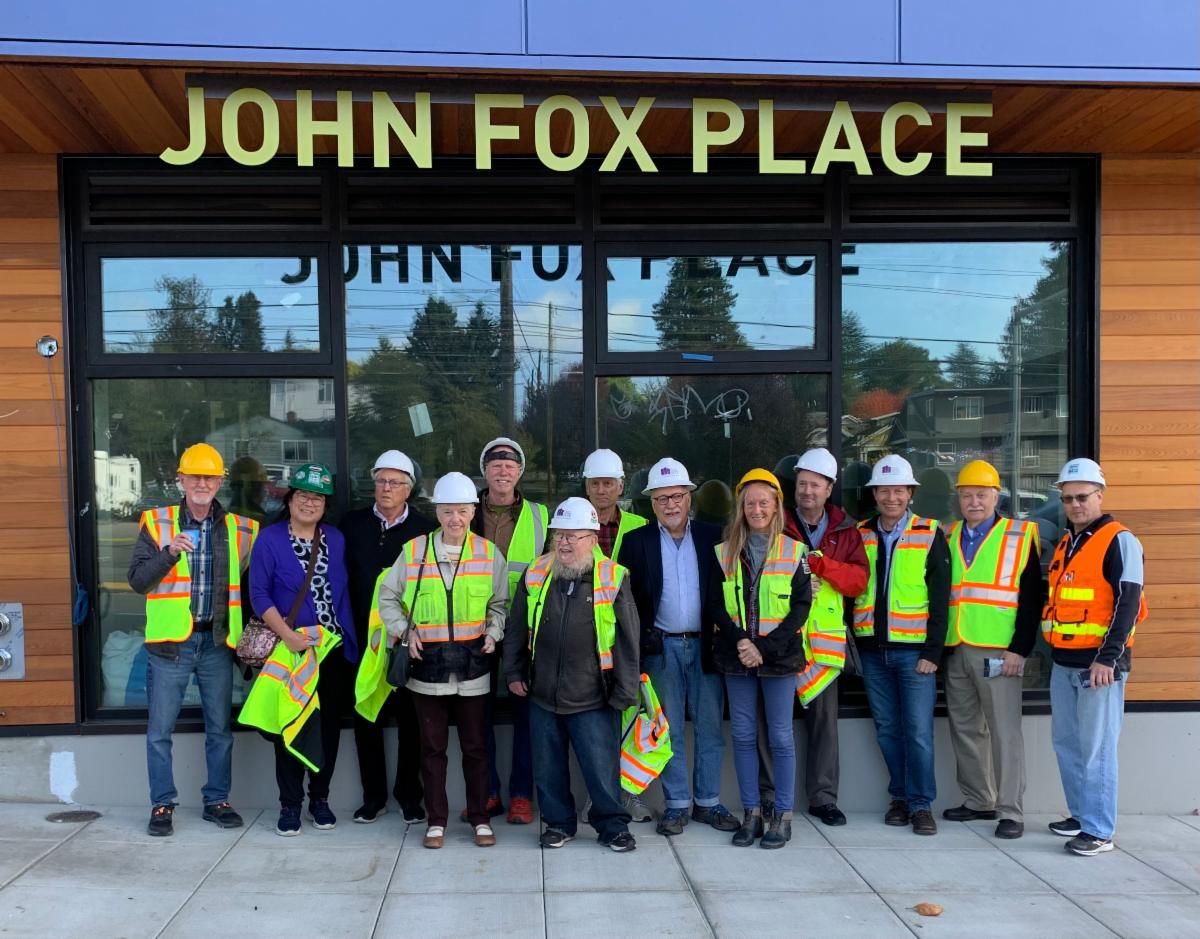
LIHI under Lee has developed dozens of housing projects throughout the city and the Puget Sound region. To name just a few: the Dockside Apartments, Denny Park Apartments, Aki Kurose Village, Tony Lee Apartments, and John Fox Place. A University District development, The Marion West, brought together Youth Care, the University District Foodbank, and LIHI under one roof. Named for a woman who long rented to students of color, the Marion West offers 20 studios for young adults and 28 for low-income workers. Besides a spacious roof-top garden, it features a food bank and a public café that offers barista training.
Lee’s most recent project, Sand Point Cottages, opened in May. It has 22 compact homes, all now leased to formerly homeless families, the elderly, disabled, and low-income workers. She tells how the pandemic altered the Sand Point plans: “The original idea was to have the cottages built by students. But then Covid hit and we had to pivot. We got a grant from the state and hired a contractor. We were helped along by a major donor and obtaining leased land from the city.” Asked about the cost of renting a cottage, Sharon would only say there is “a sliding scale,” based on percentage of the resident’s income.
One of Lee’s other plans — to open an RV safe lot on leased property in Interbay — has run into a snag. Now the property on 15th Ave. NW is destined to become a pickleball complex, home to 20 courts and facilities. Once again, Lee is ready to pivot. She points out it should take at least two years for the pickleball project to complete architectural work and get permits and financing. She likes working with “developers who have land that LIHI can use on an interim basis.” The site can temporarily accommodate 26 RVs and nine tiny houses.
Although she’s amassed much praise for LIHI and her leadership, Sharon sometimes has been the target of critics. Some years ago she found herself the target of a scurrilous news story she discovered plastered to local phone poles. That she’s experienced a modicum of censure is not surprising given her forthright, sometimes abrasive, take-no-prisoners approach. There were times during the 2008-12 recession when Lee raised hackles insisting the cash-strapped city expend dwindling rainy-day funds, reserved for emergencies, to beef up low-income housing projects.
More recently, Lee has sparred with the King County Regional Housing Authority over her championing tiny house villages for transitional housing, which the Authority didn’t like. She brushes the controversy aside saying, “that was just Marc Dones,” referring to the CEO who since has left the agency. Dones criticized tiny homes for failing to move people on to jobs and better housing conditions.
Sharon Lee’s fierce advocacy for the underserved has earned national respect for her work with homelessness. She’s a frequent panelist and speaker, valued for her talent at assembling financing and delivering projects. Most recently she was in Boston consulting with the mayor’s staff. It’s a credit to her leadership and her belief that “there must be a roof over everyone’s head.”
|