|
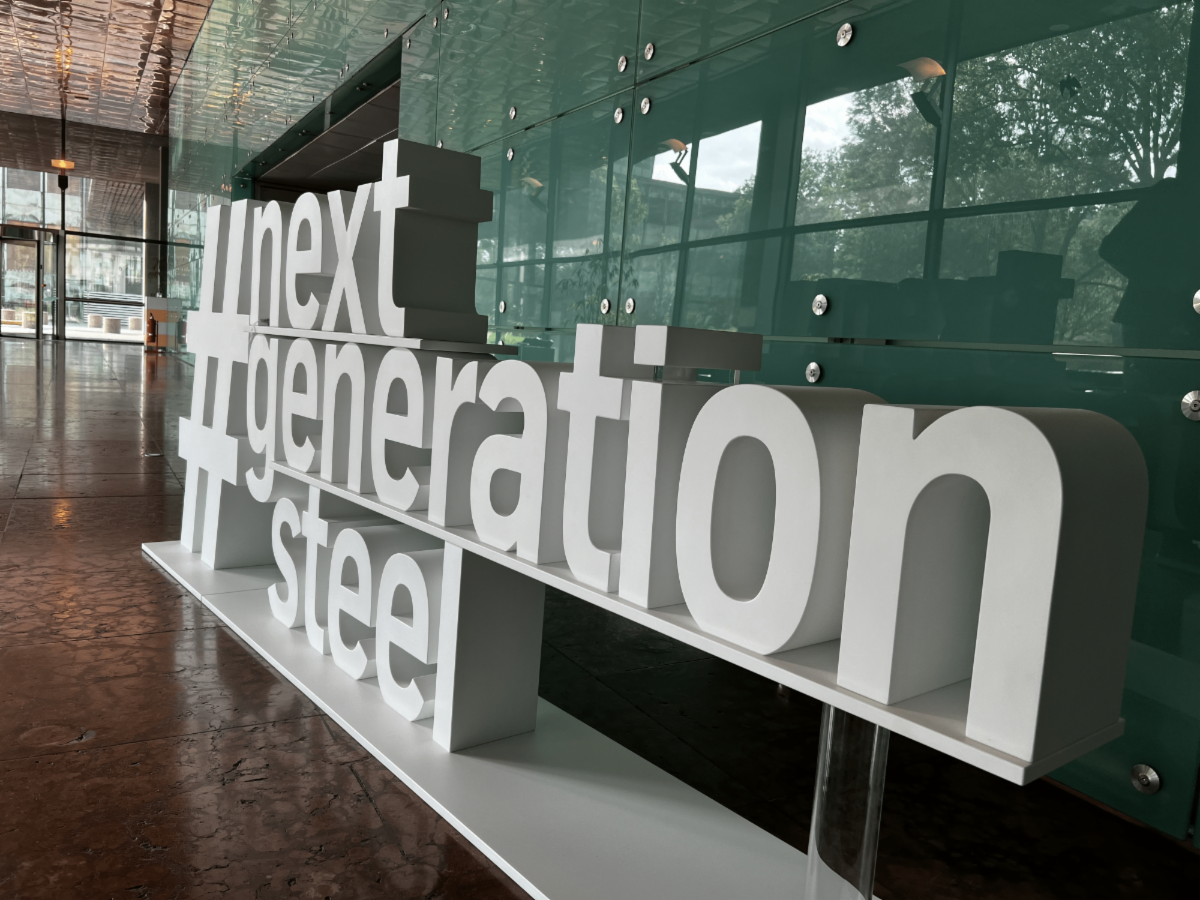
Thyssenkrupp's efforts spelled out in the lobby of the ground floor proclaiming: #NextGenerationSteel
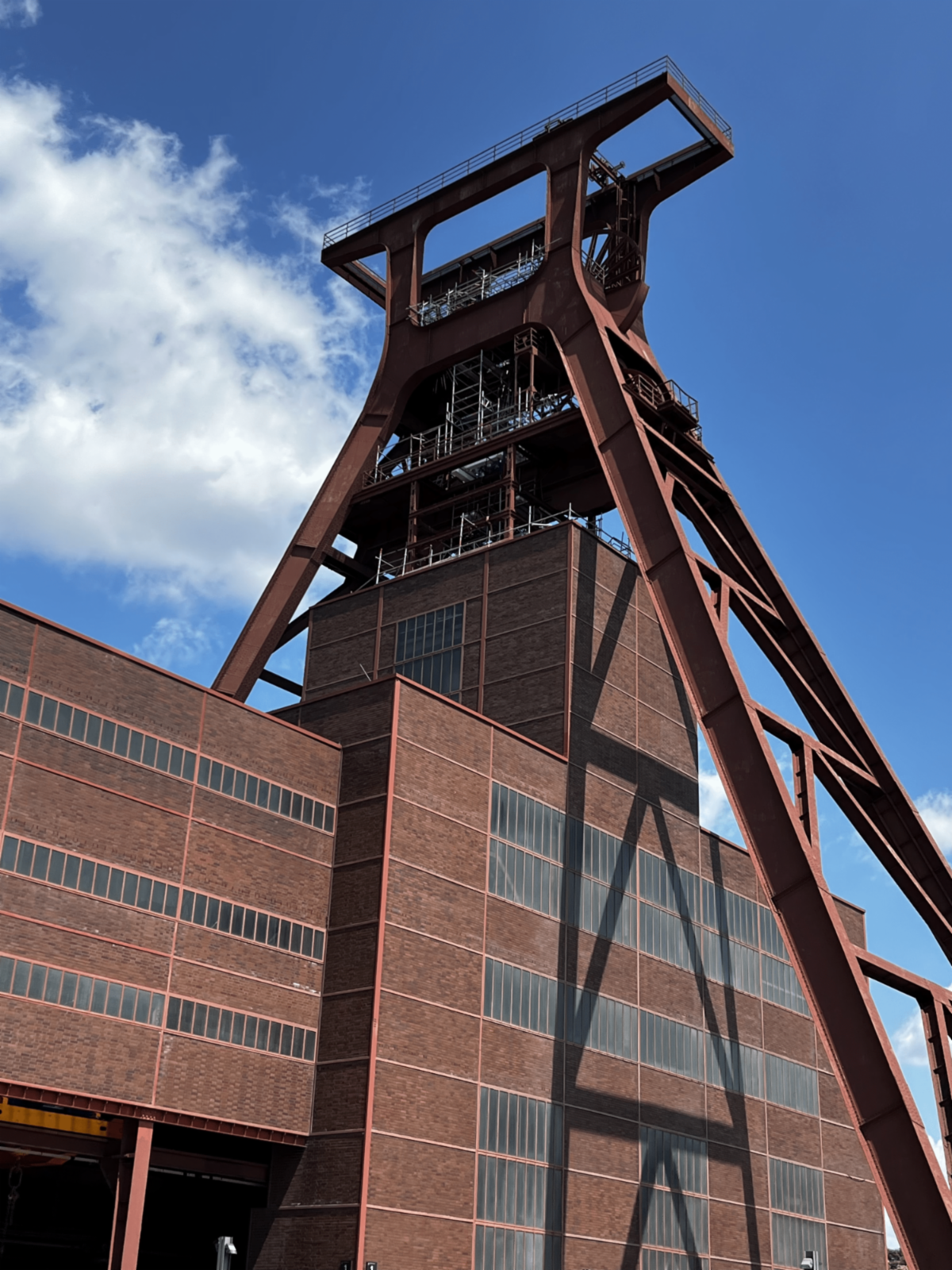
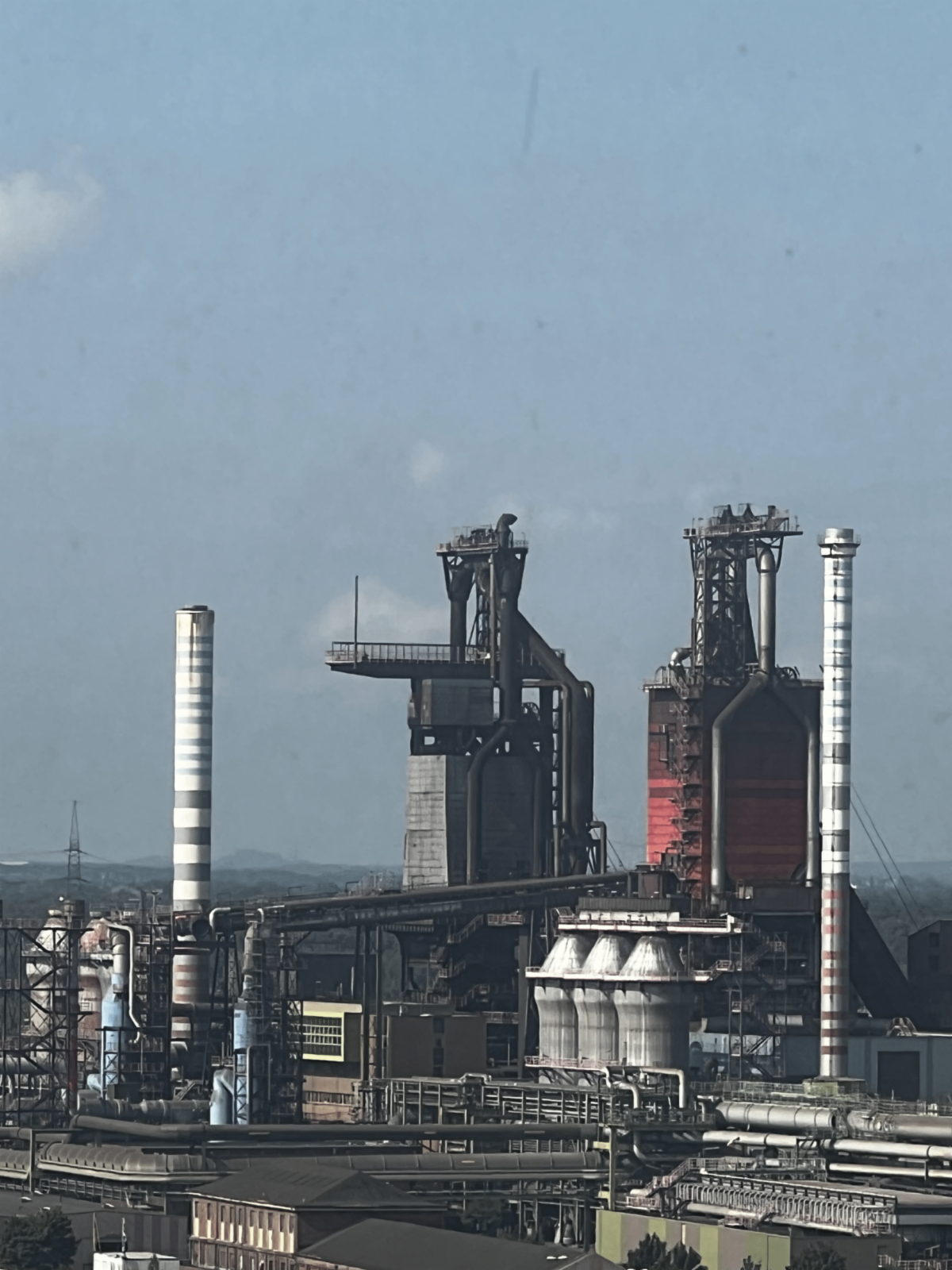
I was in Germany participating in a week-long international study tour at the invitation of Germany’s Federal Foreign Office, focused on structural economic change that carries cultural and political implications. Our cohort – with 14 participants representing 14 countries – met with various ministries and experts, and toured sites beginning in Berlin and the state of Brandenburg in the east and concluding with Essen and the Ruhr region in the west.
Across the Atlantic, there is a shared concern of how best to manage legacy industries that have lifted significant economic weight yet bore great cost to the environment, while also working to manufacture new ones. It’s in the spirit of reducing carbon emissions, keeping pace with global production, and replenishing and filling a pool of jobs readily available to the skilled workforce. The cross-continental contrasts in approach between the U.S. and Germany stand to serve as blueprints to inform each other – and others – to widen the overlapping middle of the Venn diagram of transitioning industrial economies.
Laboratories of Democracy and Unprecedented Investments
The key difference between points of approach is the U.S.’s ground-up model compared to Germany’s top-down. Well understood through the centuries-old cultural mythos of the spirit of American rugged individualism and through the popularization of the phrase “states are the laboratories of democracy,” the genesis progress in the U.S. has long since been placed at the individual, or local, levels. The quote refers to Chief Justice Louis Brandeis’s opining in the 1931 U.S. Supreme Court case of New State Ice Co. v. Liebmann that “a single courageous State may, if its citizens choose, serve as a laboratory; and try novel social and economic experiments without risk to the rest of the country.”
Yet, with the passing of the American Rescue Plan Act (ARPA), Infrastructure Investment and Jobs Act (IIJA), CHIPS and Science Act, and Inflation Reduction Act (IRA), and the $3.8-trillion-worth of spending that comes with them, the U.S. government is making historic, large-scale investments aimed at rebuilding regions through place-based industrial policy.
But if not for the ravaging of the Covid-19 pandemic, would we have seen these unprecedented federal investments? Regardless, the U.S. is making those investments and would stand to look to Germany for lessons.
Bottom-up, meet Top-down
The German Constitution, adopted in 1949 and known as Basic Law, calls for “equivalent living conditions” for all Germans, which leads to greater, intentionally planned and evaluated support of structurally weak regions. This weighted approach to regional aid results in areas in greater need receiving greater support with investments in commerce-related infrastructure, such as industrial parks, business incubators, and tourism infrastructure, as well as other measures to raise the competitiveness of disadvantaged regions.
A divide in Germany, like the U.S., can be seen between urban and rural areas. As is the case with U.S. residents, a majority of Germans live in, or near, larger metro centers. But this increased support to residents in rural, industrial areas – for example, Brandenburg in the east, and spread throughout the Ruhr region in the west, two regions historically known as centers of coal and steel production along with other heavy industries – is the German path toward an equitable, just society through a whole-of-country effort executed at the regional levels. The nation has been steadily narrowing that gap since reunification in 1990.
Disparities in innovation funding in the U.S. have been seen both at the national and state levels, like in the case of Pennsylvania, where an overwhelming majority of investment goes to large metro areas and research universities. This created a “winner-take-most” climate in which legacy, industrial regions like Erie, and other rural parts of the state, were left to compete for minimal federal- and state-level scraps and, in turn, turned to local solutions.
The passage of the CHIPS and Science Act arguably introduced a new era of industrial innovation policy in the U.S., giving hope that both funding and innovation largely regulated along the country’s coastlines would be more evenly advanced nationwide. In May, the U.S. Economic Development Administration announced a Notice for Funding Opportunity (NOFO) for Regional Technology and Innovation Hubs as a $500 million part of the U.S.’s $10 billion initiative to transform place-based industrial economic growth. As the U.S. embarks on this unprecedented level of investment, it would be wise to observe Germany’s weighted model and measure regional impact accordingly.
Economic Impact, Political Implications at the Local, National, and Global Levels
More than three decades since German reunification, economic gaps remain, largely between west and east as a whole and in Berlin specifically. This has led to divisions along cultural and political lines, as it has in the U.S.
Similar to the rise of the far-right faction in the U.S.’s conservative political party fomenting from feelings of being left-behind and unheard, German’s AfD, the far-ring-wing Alternative for Germany party, is on the rise, as indicated by its increase from 10% support in 2022 to 18% this year. Most pronounced in rural areas to the east, the party plays to concerns of economic and industrial lag and immigration. Looking at Germany’s regional aid policy, a greater focus and deployment of resources to these areas in the east is a clear attempt at economic stabilization that may also curb political cleaving.
The intertwined nature of economies and politics goes beyond national borders. Endeavoring to phase out coal production ahead of European Union standards and serve as a continental leader, Germany turned to other energy resources. This included natural gas and oil from Russia, which thus amounted to nearly half and one-third, respectively, of Germany’s energy supply. When Russia invaded Ukraine, Germany cut off the Russian supply and pivoted its imports elsewhere.
Both the short-term and long-range impacts of a dramatic shift in energy supplies remain to be seen, but the warning signs and lessons are clear: Depending on autocratic regimes is risky at best, and economically and politically destabilizing at worst. As the U.S. acknowledges its increasing dependence on China for minerals needed for modern technologies and makes billions of dollars of investments in places like Columbus, Ohio to produce new semiconductors to create blue collar and “new collar” jobs, it would be wise to both learn from Germany’s over-dependence on Russian energy, and, when considering foreign investments, look to ally-shore with other democracies and rely more sustainably on democratic partners.
The Evolving Role of University-Led Ecosystems Leading Innovation
The leaps in innovation made on research-driven college campuses in the U.S. is well known and documented. Less known is the experimentation taking place on other campuses, like the consortium of colleges, along with a public library, in Erie, Pennsylvania. Known as the Northwest Pennsylvania Innovation Beehive Network, it sparks a level of increased innovation in regions without R1 universities. It also offers different, greater-than-the-sum-of-their-parts solutions with regional impact.
Brandenburg University of Technology Cottbus–Senftenberg (BTU), 80 miles south of Berlin, reminded me of that when we visited the campus. With a mission to drive progressive and sustainable development in the region, it is playing an integral role in increasing research and development. With the launch of the on-campus Lausitz Science Park, with a 420-hectare footprint and over 100 partners, it is attracting more cooperation and collaboration in the region and outperforming what would be expected of a 6,800-student enrollment.
Big Geographic Place Focused Investments
Across the country in Essen, we met with leaders and doers of the Initiativkreis Ruhr, a regional economic alliance of some 70 companies and institutions. The breadth, scope, and diversity of initiatives underway reminded me of American start-up innovation culture and America’s entrepreneurial ecosystem. Among the successes they shared was the bottom-up approach to climate change in the city of Bottrop, which cut carbon emissions by 50% in 10 years through its Innovation City initiative, a model Bottrop’s mayor, Bernd Tischler, presented in March 2021 to an Erie audience.
At city hall in Essen, a city of some 590,000 in the Ruhr region with more than 5 million residents, we learned about regional efforts to build up both green and blue infrastructure. The transition earned Essen the title of European Capital of Culture (on behalf of the whole Ruhr area in 2010) and the city was named the European Green Capital in 2017.
|