|
STRATEGY LESSONS TO HELP YOUR
PENTATHLETES PREPARE FOR TOURNAMENT
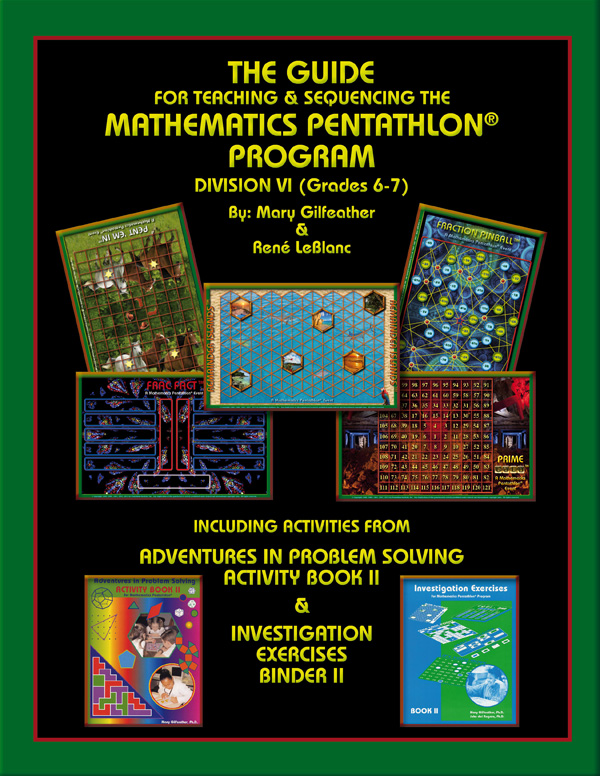
Adventures in Problem Solving Books 1 & 2, as well as Investigation Exercises Books 1 & 2, provide critical activities and exercises for students to be successful with the MP Games. Some of these have been highlighted for each Division Level.
DIVISION 1
SHAPE-UP
Adventures in PS Bk 1: Activity III (pp. 14, 16-19) - MATCH MY SHAPE WORKSHEETS: These sheets help students identify either small-to-large OR large-to-small versions of the same-shape, different size that relate to the goal of Shape-Up.
NOTE: For each shape on the Shape-Up Gameboard make sure that students discover ALL winning positions.
Investigation Exercises Bk 1: IT'S YOUR MOVE - ROLL A WIN, ROLL A WIN 2, & ROLL A WIN 3 (pp. 9-11): For each portion of the Shape-Up Gameboard, students analyze how to land on the Target Shapes.
HEX-A-GONE
These lessons help students deal with End-of Game scenarios.
Adventures in PS Bk 1: Activity X (pp. 178, 186-188) - TRIPLE HEX and TETRAHEX: Using the same rules, but fewer blocks, students use these smaller boards to explore End-of Game strategies.
Investigation Exercises Bk 1: GO FOR A WIN AND CAN YOU WIN? (pp. 9-10): Students investigate 2-Hexagon regions to analyze better choices.
DIVISION 2
RAMROD
Adventures in PS Bk 1: Activity 7 (p. 154) - COMPLEMENTS OF VALUES IN THE PURPLE-PLAYING AREA OF GAMEBOARD: After learning the numeric values of the rods (Act. 3) as well as the rectangular values in the purple-playing area (Act. 5), students explore and learn the various combinations of exactly 2 rods that form Captures to significantly enhance strategic thinking about Ramrod.
Investigation Exercises Bk 1: RAMROD COMBOS (pp. 3-6): Students experience algebraic thinking using the missing addend form of subtraction while reinforcing Ramrod Capture combinations.
FIAR
Adventures in PS Bk 1: Activity V (p. 120-121) - 4 CHIP LINE GAME: This game helps students with
horizontal and vertical movement, an essential skill in FIAR.
NOTE: Make sure that when teaching the game of FIAR that you first play the game WITHOUT the
Blocking-Chip feature, i.e. you still use the chips but ignore the stickers on chips as blockers.
Investigation Exercises Bk 1: IT'S YOUR MOVE 1, 2, 3, 4 & 5 (pp. 3-7): Use these sheets to analyze the best moves in mid-game scenarios.
DIVISION 3
STARS & BARS
Adventures in PS Bk 2: Activity XI-XIV (pp. 207-212) - PROGRESSIVE LEAD-INS TO STARS & BARS: After learning how the cards differ from one another according to the 4 critical attributes (Activities II, IV, and V), students play these essential games that incrementally teach the game of Stars & Bars. These simpler versions of Stars and Bars teach how to both score and maximize the game's scoring system.
Investigation Exercises Bk 2: MAX A SCORE 1 and 2 (pp. 19-20): These exercises simulate mid-game scenarios of Stars & Bars and help students practice maximizing their scores.
FAB-A-DIFFY
Investigation Exercises Bk 2: HOW THE BARS WERE MADE? (pp. 3-6): These worksheets investigate equivalence among the fraction strips. This critical skill is essential since the game does not allow for paper/pencil calculations and students must understand how to conceptually convert from non-equivalent to equivalent terms.
DIVISION 4
FRACTION PINBALL
Adventures in PS Bk 2: Activity IV (pp. 191 and 193-195) - FRACTION PINBALL WIZARD 1, 2, and 3: To practice an important Fraction Pinball skill, students investigate these worksheets to find connected fraction pathways that are converted to decimal form for the greatest and least sums.
NOTE: Do this Activity in conjunction with the Know Your Machine Worksheet (see pp. 13-14) of the Division 4 Teaching Guide.
Investigation Exercises Bk 2: 4 Tilt (pp. 3-4): Both of these worksheets represent mid-game scenarios on the Fraction Pinball Gameboard where students investigate the best pathway to arrive at a winning score.
PRIME GOLD
Investigation Exercises Bk 2: CONJECTURING FOR GOLD (pp. 19-22): Pentathletes sometimes do not take advantage of an important Prime Gold Rule referred to as Goldbach's Conjecture. While using this game rule, students can form a number sentence that results in an even value greater than 6. Rather than just placing 1 chip on the board per turn, this rule allows players to place 2 chips to cover 2 prime number values. These exercises provide many examples of game scenarios to help Pentathletes implement this critical game rule.
|