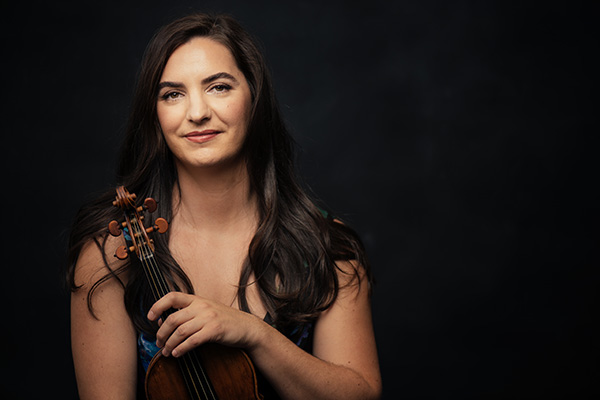
Interview with ABS Instrumentalist Tekla Cunningham
|
|
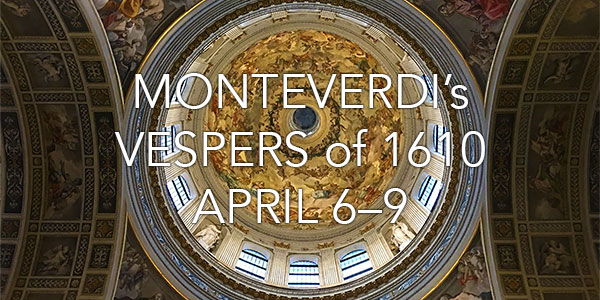
What are your thoughts on the Monteverdi Vespers?
- Monteverdi’s Vespers of 1610 is such a seminal work in Western music. People who don't usually go to concerts often attend performances of this work. Every time I play it, I am struck by the vibrancy and modernity of this music that is now well over 400 years old. You can feel Monteverdi's surging, creative force at every turn, as he moves away from the polyphony of past generations to the completely new way of writing in the seconda pratica. This past year I finished my personal "trilogy" of the Monteverdi operas when Pacific MusicWorks presented Orfeo. We've done Il ritorno d'Ulisse in patria as well as Poppea and the Vespers several times in Seattle. As an instrumentalist it's quite different to play Monteverdi in comparison with Bach. In Bach’s music you are often playing with singers; in Monteverdi, while there is that aspect at times, the instrumentalists often play interludes, between the vocal passages, that reflect on, elaborate, and connect the story being told by the singers. So, it's pretty interesting in that you have to be a little bit more of an actor and think about the psychological aspect of what is going on in the text. That's something that Jeffrey is always developing and listening for, so I'm really looking forward to this production.
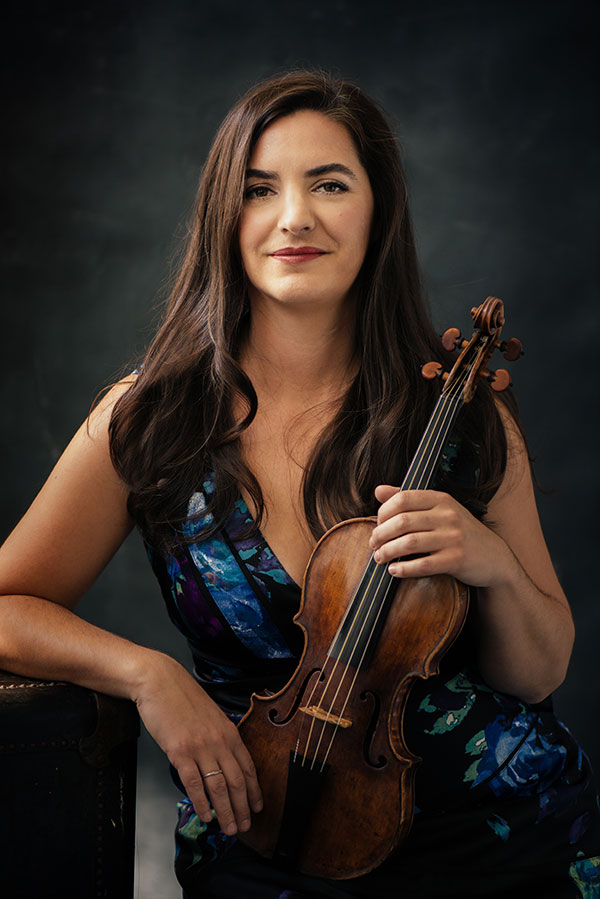
What's the story behind your 1746 Venetian violin built by Sanctus Seraphin?
- My violin came to me through my teacher from high school, Irv Eisenberg, who also introduced me to the joys of string quartet playing, especially music of Haydn and Mozart. Irv played the Seraphin in Eugene Ormandy's Philadelphia Orchestra for many years. I have the paperwork from the loan the orchestra extended to him to purchase the instrument in the 1960s. His ensemble, the Philadelphia String Quartet, moved to Seattle (where I grew up) in the 1980s. When Irv was in his late eighties and couldn't play anymore, we made a deal that I would borrow the violin and then have first dibs to purchase the instrument from his estate. I had some work done to return the violin to a “Baroque” set up—changes to the bridge, sound post, tailpiece, and more. It's a typical, high-Baroque, Venetian instrument with a fairly flat belly. It projects amazingly well when I need a lot of power, but it also can make very soft and subtle sounds. It's completely at home at A=415 but rings like crazy at A=440, so I'm looking forward to playing Monteverdi’s Vespers. I'm very grateful to get to play such a wonderful instrument and to have this connection to the past—to my teacher from my high school days and to the previous generations of violinists that played this instrument. For this performance Elizabeth Blumenstock and I will be using the very short model bows that were typical in 17th-century Italy. They are very articulate and great at executing the rapid, bowed ornaments of this period.
|
|
In addition to violin and viola, you play
viola d'amore
. Tells us about it.
- The viola d'amore is a six- or seven-stringed instrument with an additional set of sympathetic strings that resonate when you bow the upper strings. Like the instruments in the viol family, it is tuned in thirds and fourths, and it's customary to use different tunings for different key areas, which makes for quite a challenge! I had a chance to learn the d'amore about ten years ago when a friend in Denver loaned me an instrument, so I could prepare for a concerto performance there. A few years ago, I ordered my own instrument from Martin Biller in Chicago. While the viola d'amore does not project as well as the violin, it is incredibly resonant because of the sympathetic strings; it creates a silvery cocoon of sound that is quite mesmerizing. There are some wonderful pieces written for this instrument. I've played a gorgeous Telemann triple concerto, the d'amore arias in Bach's St. John Passion, and a few solo concertos as well as a double concerto by Vivaldi. There is also a very unusual and dramatic piece by Biber, written for two violas d'amore, that I've had a chance to play a few times. One piece I have on my “musical bucket” list is the Bach Cantata, Tritt auf due Glaubensbahn (BWV 152), which has a spectacular solo for the d'amore.
|
|
What has been your experience with American Bach Soloists?
- One of my first concerts with ABS was Handel's Esther in 2002. I had just finished my master's degree at the San Francisco Conservatory of Music and was thrilled to be a part of such a fantastic group of musicians. I've learned so much from Jeffrey Thomas about delivering text as an instrumentalist and finding ways to support and enhance the vocal lines. Jeffrey is so specific with the wonderful American Bach Choir, and it has been endlessly fascinating, over the years, to contribute and experiment with ways of matching and complementing vocal articulations, particularly in the music of Bach. As a musician, there are few things more satisfying than playing the Bach masterworks that are at the heart of ABS's repertoire. It is a special thing to be able to join a group of singers and instrumentalists for a week and work together to create something of ephemeral beauty to send out into the world.
|
|
|
Monteverdi:
Vespro della Beata Vergine
Gabrieli:
In ecclesiis
& Magnificat à 14
|
|
Friday April 6 2018 at 8:00 pm
St. Stephen’s Episcopal Church
3 Bay View Avenue, Belvedere, CA 94920
Saturday April 7 2018 at 8:00 pm
First Congregational Church of Berkeley
2345 Channing Way, Berkeley, CA 94704
Sunday April 8 2018 at 4:00 pm
St. Mark’s Lutheran Church
1111 O'Farrell St, San Francisco, CA 94109
Monday April 9 2018 at 7:00 pm
Davis Community Church
412 C Street, Davis, CA 95616
|
|
TICKETS:
$25–$89; $10 student tickets for ages 25 and under with valid student ID, at the door or reserve at 415-621-7900
Phone: 800-595-4TIX (-4849)
FREE PRE-CONCERT “INSIGHTS”:
One hour prior to each performance, ticket holders can enjoy a free and informative lecture given by musicologist and conductor Victor Gavenda, an accomplished scholar who will share his insights about the repertoire, the composers, and the experience of hearing great music from the Baroque era performed to the highest standards.
|
|
NO SERVICE CHARGES FOR ONLINE ORDERS
Phone Orders: 800-595-4TIX (-4849)
INFORMATION: 415-621-7900
STAY CONNECTED
|
|
We Thank our Sponsors
The American Bach Soloists are grateful for the support of these and other Foundations, Corporations, Government Agencies, and Individual Sponsors
|
|
|
|
|
|
|