Illinois is One of Six States Filling Legislative Vacancies by Party Appointment
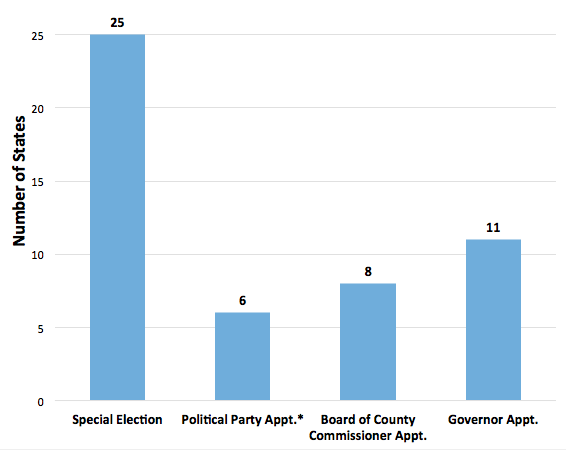
State Legislative Vacancies are Filled by Special Election in 25 States
Illinois has seen the departure of some high-profile members of the General Assembly over the past year. When a legislator leaves office for any reason, the voters in their district are often left wondering how a replacement will be chosen. ICPR compared Illinois' procedures for filling legislative vacancies to other states to provide a clearer picture of how this process is handled across the country.
Eleven members of the current General Assembly, totaling 6% of all state legislators, are appointees who have not yet faced a General Election. Of the eleven, seven are House Members (2 Democrats and 5 Republicans) and four are Senators (2 Democrats and 2 Republicans). All of them are up for election in November, and four of the eleven are running unopposed.
Illinois law states that party leaders within the departing incumbent's district should vote to appoint a replacement from the same party. Illinois is one of six states that uses political party appointment to fill vacancies. Each state sets its own methods for filling vacant state legislative positions.
Colorado, Indiana, New Jersey, and North Dakota also permit local party leaders to fill legislative vacancies. North Dakota allows voters to petition for a Special Election if the replacement would be in office for over 828 days.
Only Colorado requires the vote for a replacement to occur at a meeting that is open to the public. Ohio, the sixth state to use party appointment, is unique in that it allows the party caucus in the relevant legislative chamber to vote on a replacement.
Eight states allow Boards of County Commissioners to select a replacement, and eleven states give this power to the Governor. 25 states, the vast majority, use Special Elections to fill any vacancy created by a departing legislator. The exact rules vary widely by state, but all Special Election provisions require a district-wide vote by residents to choose a replacement.
Contact: Sarah Brune at 312-436-1274 or sarah@ilcampaign.org
ICPR Data and Research Analysts Aaron Feldman and Jack Lockhart contributed to this report.
Data was sourced from the National Conference of State Legislatures and state compiled statutes.