PRODUCT STEWARDSHIP UPDATES |
|
Our New Year's Resolution is to help enact as many EPR laws as we can. Oh wait, that was last year's resolution — it's the same one we've had for 22 years. And thanks to you, it's working: Our tally is now 131 laws across 16 product categories in 33 states! We are grateful to everyone who stepped up and supported our end-of-year fundraising drive, and especially to Christine and Paul Carr and our two anonymous donors who jumped in early to build our matching fund. Together, we raised more than $12,000 to continue our efforts in 2023. Thank you! |
|
Introducing Our Brand-New Website!
|
|
How much do you know about EPR? Our new website has all the details - from the "ripple effect" to its role in the circular economy. Last year, seven new EPR laws were enacted, including a first-in-the-nation law for gas cylinders in Connecticut, as well as new laws for mattresses in Oregon, carpet in New York, batteries in California, pharmaceuticals in Illinois, and packaging in Colorado and California. What's in store for 2023? Take a look and find out!
|
|
New York Enacts Carpet EPR |
|
After Governor Hochul signed the legislation last week, New York became the second state after California to enact a carpet EPR law - and the first in the nation to include artificial turf. “The enactment of New York’s carpet bill benefited from two decades of advocacy from experts across the country, including those from state and local governments, environmental groups, and carpet recyclers” said Scott Cassel, our CEO and founder. “This next-generation carpet EPR law is yet another indication that the overwhelming public sentiment is for producers to take responsibility to prevent negative impacts from their products and packaging all through their lifecycle.” Click here for our assessment on how this legislation will impact New York – and the nation.
|
|
2022 Impact: Gearing Up for 2023 |
|
In December, we celebrated our 22nd anniversary by representing the United States at conferences and events that furthered the international conversation about EPR. We welcomed the opportunities to celebrate with our national and international colleagues at these recent events. Learn more.
When this organization was founded by Scott Cassel in 2000, producer responsibility was in place in Europe and Canada, but had barely made a mark in the United States. Now, U.S. EPR is snowballing. As the 2023 legislative sessions begin, we would like to reflect on the accomplishments of those across the country who have, together with PSI, moved EPR forward in 2022 and increased the momentum for additional producer responsibility legislation in 2023 and beyond.
In 2022, 65 EPR bills were active across 20 states and Washington, D.C. These bills covered 14 product areas and included 58 bills to establish new programs as well as seven bills to amend existing programs. These bills included EPR programs for emerging product areas such as smoke detectors, solar panels, and wind turbine blades. Most significantly, a total of seven new laws establishing programs were enacted in 2022, including packaging EPR in California (SB 54) and Colorado (HB 22-1355), gas cylinders EPR in Connecticut (HB 5142), batteries EPR in California (AB 2440), pharmaceuticals EPR in Illinois (HB 1780), carpet EPR in New York (A 9279), and mattress EPR in Oregon (SB 1576). These laws bring the U.S. national total to 131 EPR laws across 16 different products in 33 states and Washington, D.C. In the coming year, PSI expects EPR legislation to be introduced in over a dozen states for several different product areas, including batteries, electronics, household hazardous waste, mattresses, packaging, paint, pharmaceuticals, and tires. We look forward to working with many of you on these bills!
|
|
Packaging EPR Laws: How Do They Compare? |
|
We continue analysis of the four EPR packaging laws in the United States in our multi-part blog series. Part two looks at covered entities, and collection and convenience standards in each state. Part three focuses on whether or not there are unique provisions and/or exemptions in the legislation related to the “producer” responsible for funding and managing the EPR program; it also lays out each state’s criteria for determining the governance roles: program operations, administration, multi-stakeholder input, oversight, and enforcement. And part one, which we shared in last month’s PSU, provided analysis of covered materials and products. Read more on the blog.
|
|
Members and Partners receive regular legislative updates and can track EPR bills and laws in our Legislation Library.
|
|
In a blog, NRDC recognized PSI’s role in advancing the carpet EPR legislation that was recently enacted in New York, calling us a “leading force in advancing producer-responsibility legislation.”
Politico’s recent deep dive into chemical recycling cites PSI’s CEO and founder, Scott Cassel, who commented on how the technologies come into play as state legislators move faster than the federal government in setting recycling targets, and links to our recently published paper on chemical recycling.
Waste Today shared information on the sharps take-back program that PSI partnered on with the Choctaw Nation, Indian Health Services, and Covina Environmental Solutions in Oklahoma.
PSI’s research on medical sharps and EPR was cited in a new study published on PubMed, “Unsafe Sharps Disposal Among Insulin-Using Patients With Diabetes Mellitus: An Emerging Global Crisis.”
|
|
On March 10th Scott Cassel will join a fireside chat on “Challenges and Frustrations with Implementing EPR” at the Sustainability in Packaging conference in Chicago.
|
|
Stericycle, a leading provider of medical waste management, secure information destruction, and patient engagement solutions, helps customers protect the communities they serve with a variety of disposal solutions for household-generated medications and sharps waste. They partner with pharmacies, hospitals, law enforcement, employers, government agencies and non-profit organizations to deliver services to communities across the United States. Through their MedDropTM consumer pharmaceutical kiosks, SafeDropTM sharps containers, and Seal&SendTM envelopes, Stericycle protects homes, workplaces, communities, and the environment from the damaging impacts of the opioid crisis, infectious disease, and contamination of waterways and drinking water systems. To learn more about Stericycle’s Safe Community Solutions, visit www.stericycle.com.
|
|
Because CalRecycle disapproved CARE’s Five Year Plan 2023-27, which was submitted in September, the Carpet Differential Assessment increase, scheduled for January 1, 2023, will not take place and current assessment levels will remain in effect until further notice. CARE is working on a revised plan to resubmit to CalRecycle in mid-January.
New report pegs the global vehicle recycling market at $67 billion in 2021 and anticipates it will reach a value of nearly $140 billion by 2027.
Sims Municipal Recycling installed four EverestLabs sorting robots to their New York City MRF, the largest commingled facility in the U.S., and plans to add as many as four more in 2023.
PepsiCo announced plans to double the percentage of reusable beverage servings from 10% to 20% by 2030, through expanding their SodaStream business, building out refillable PET and glass bottles, and adding reusable cups to fountain drinks, among other measures.
A long-term supply agreement inked with ACE Green Recycling will provide recycled lead and other key battery metal-based end products from recycled lithium-ion batteries to global commodities supplier Glencore plc. ACE is planning four lead-acid and lithium-ion battery recycling parks in the United States, India, and Thailand through 2023, which will produce 1.6 million tons of recycled metals including lead, lithium, nickel, and cobalt.
|
|
The Senate recently passed the Strategic EV Management Act, a bill introduced by Mitt Romney to improve recycling for end-of-life batteries used in federal fleet vehicles, which calls for the Department of Defense to create a policy that would increase battery recycling.
The European Parliament and the EU Council have reached a provisional agreement on a proposal to create a circular economy for batteries by better managing their design, use, and disposal, replacing a directive that was established in 2006. The deposit scheme requested by recyclers was not included in the draft.
A new Ireland EPA report showed that the country is in danger of missing EU’s waste-recycling targets, citing an 11% increase in per capita municipal waste generation from 2016 to 2020.
We regularly share information like this on LinkedIn, Twitter, and Facebook. If you'd like to get these updates in real time, please follow our accounts. Thanks!
|
|
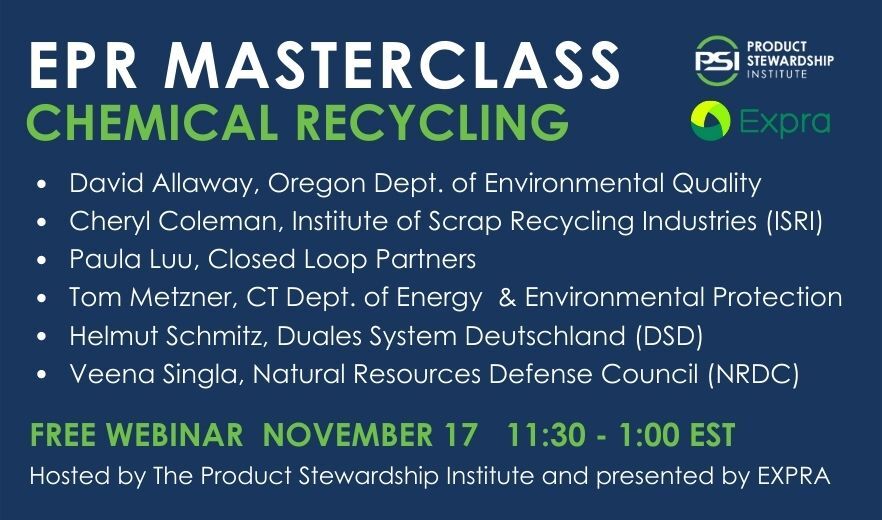
We gathered a group of experts to discuss the wide range of technologies that fall under the chemical recycling umbrella and consider criteria to determine which, if any, can support a sustainable economy, prevent waste and pollution, and curb greenhouse gas emissions. The recording and associated report are available to our full community.
|
|
The Product Stewardship Institute is a policy advocate and consulting 501(c)(3) nonprofit that powers the emerging circular economy. We rely on the generosity of our members, partners, and supporters to convene diverse stakeholders to build extended producer responsibility (EPR) policies, programs, and laws. Thank you!
|
|
The Product Stewardship Institute, Inc. is an equal opportunity employer and provider. Persons with disabilities who require alternatively formatted materials to ensure effective communication should contact Amanda Nicholson at amanda@productstewardship.us or 617.236.4855, TTY: use 711 or 800-439-2730; MassRelay.
|
|
|
|
|
|
|