|
Mundelein Historical Commission
Quarterly E-Newsletter
| |
| |
From the Commission Chairman | |
The Heritage Museum is open Wednesdays from 4pm to 7pm and Saturdays from 1pm to 4pm. We are always in need of docents. If you have an interest in local history, please stop by the museum and check us out.
Attendance has been very good. We have been getting a lot of visitors from throughout Lake County. If you are curious, please stop in. Remember, if you would like to schedule a group tour for your family, friends, business or organization, contact us at 847-566-8122. Leave a message and we will get back to you. You can also email mflynn@email.mundelein.org.
The Commission meets at the Mundelein Village Hall at 7 p.m. on the first Wednesday of the month. The meetings are open to the public.
Please feel free to join us!
Mike Flynn, Historical Commission Chairman
|
A Look Back in Time -
Uncovering the Past During Construction
|  | |
Occasionally, the past reveals itself to the present during a new construction project. That is just what happened in early May of this year on the west side of Prospect Street during the grading phase for the new apartment building at the SW corner of Prospect and Hawley Streets. One day a long narrow foundation (shown above) was uncovered! The discovery was first brought to the Historical Commission's attention by a visitor to the Heritage Museum.
It was puzzling. We knew this area was previously the right-of-way of the Chicago North Shore and Milwaukee Electric Railroad, but we did not know there were structures on this section of the line. We knew the original North Shore RR station was located on Morris Street near Rt. 176. It crossed Hawley Street near the post office. The original station was closed in 1929 when a new station opened on McKinley Street (where the McKinley apartments are now located). The North Shore RR stopped service in January 1963. The tracks were subsequently removed and the property sold. Much of the right-of-way was developed over the years, but the segment between Prospect and the Post Office remained undisturbed until this year.
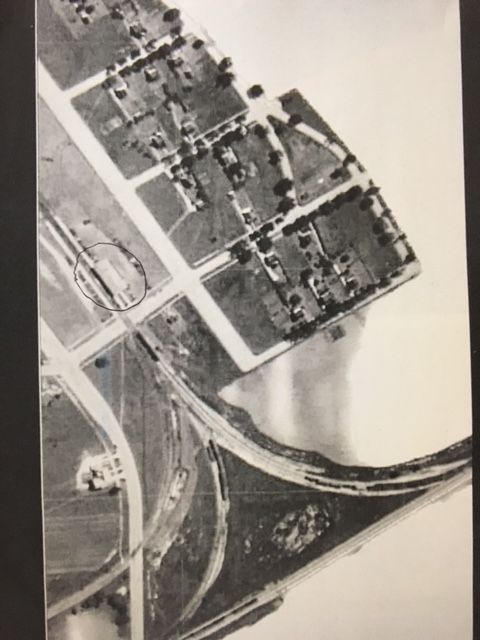
Commission member Gary Gunther began an investigation as soon as the old foundation was brought to our attention. He learned that the foundation was part of a maintenance pit used to access the underside of railroad cars for inspections and servicing. It was 67 feet long, and lighted, with a stairway at the east end. The area around the maintenance pit was used to store railroad cars that needed repairs. From the map below, you get an idea of the station location, the maintenance pit location, and car storage area. It was a busy place!
|  |
Did You Know?
The Model Farm (1928)
| 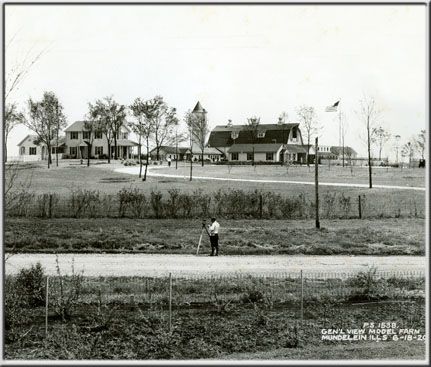 | |
Did you know the Village of Mundelein once had a "tourist" attraction that was visited by up to 50,000 people annually from throughout Illinois, Wisconsin and around the country? The attraction was not Diamond Lake --- it was the Model Farm, opened by the Public Service Company of Northern Illinois (PSC) in 1928.
The Model Farm was the vision of industrialist Samuel Insull, the founder of the PSC. The Farm was located on what is now the Tullamore subdivision. Its purpose was different from the "research" farms that were common in rural America in the early 20th Century. The Mundelein Model farm was not an experimental facility that developed and taught modern farming techniques to enhance crop and livestock production. The focus of the Mundelein Model Farm was to demonstrate to farmers and their rural communities how electric and gas appliances could minimize labor in the home and on the farm. Its purpose was to expand the market for the gas and electricity delivered by the Public Service Company. The concept was to show that a rural home could be made as attractive and comfortable as a city home.
The 80-acre Model Farm contained a six-room farmhouse, a stock barn, dairy, poultry house, swine barn, offices, and exhibit hall. In 1930 a play field was added for picnicking. In its first two years, over 100,000 people visited the Model Farm. The original house still stands on Kings Way.
The Model Farm operated until 1940 when it was sold to cattle breeder, Ed Manning. By the late 1950's the farm totaled 299 acres. Then, the farmland was gradually sold for non-agricultural uses -- Mundelein High School, Kirk of the Lakes Presbyterian Church (now part of MHS), and Faith Evangelical Lutheran Church (now The Chapel) -- all once part of Manning farm. In 1965, Jack Reddy, a local developer, bought the remaining farmland to build what is now the Tullamore residential subdivision.
| Preserve the Past, Support the Heritage Museum! | You can help support the Mundelein Heritage Museum by donating to the Mundelein Parks Foundation (MPF), a non-profit 501 C(3) charitable organization. The Heritage Museum is one of the Foundation's four "Areas of Focus". (The other are: All-Inclusive Playground Construction, Park Improvement, and Capital Projects). Donating is simple. Visit Mundelein Parks Foundation website, click "donate", and select an amount and the area of focus you would like to support. Donations to the Museum will be used for educational programs, local history preservation and museum enhancements. Thanks for your support! | |
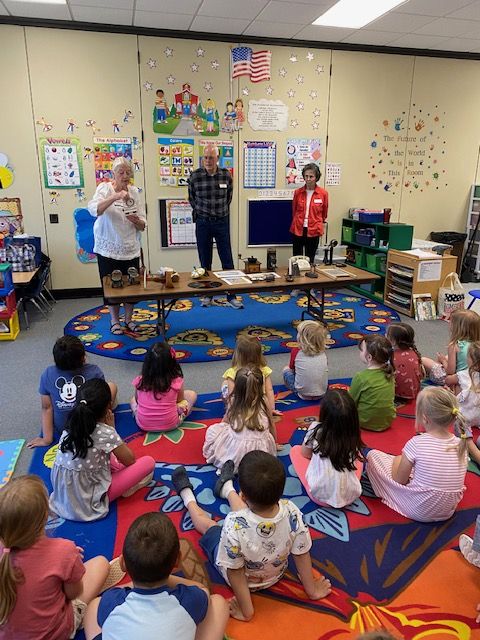
Diamond Lake Preschool Presentation | On June 7th, three members of the Historical Commission gave a presenttion of "old-time" household items to Debbie Chin's class of 30 students at the Diamond Lake Preschool summer camp. Gary Gunther, Wendy Frasier, and Anne Walker showed the class a variety of things that used to be common in most homes, but today are obsolete. The items included toys, tools, and kitchen ware. The students, ages 4-6 years old, were attentive and asked great questions! |
Mundelein Roots:
Senator George McGovern
| 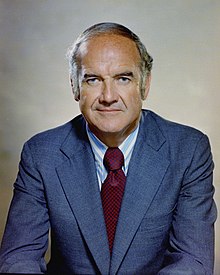 | |
Yes, George McGovern, the decorated WWII, B-24 bomber pilot, the US Senator from South Dakota, and the 1972 Democratic Presidential nominee, lived and worked in Mundelein for one year. McGovern came to town in the summer of 1947 where he served as a "student minister" at Diamond Lake Methodist Church.
McGovern was studying to be a minister at the Garret Seminary of Northwestern University in Evanston, Illinois. The Diamond Lake Church needed a minister, but was too small to afford a full-time clergyman, so McGovern was hired as a student minister. He served the Diamond Lake Church for about one year. He first lived with the Wallace Riedel family at 220 Oakdale Ave. in Mundelein. In the fall of 1947 he brought his family to Mundelein from his hometown of Mitchell, South Dakota.
While in Mundelein, McGovern grew dissatisfied with the minutiae of pastoral duties. In late 1947 he left the ministry and enrolled in the Northwestern graduate school to study history. He graduated from Northwestern in 1953 with a PhD. He returned to Mitchell, SD and worked as a professor of history and political science at Dakota Wesleyan University. He was elected to the US House of Representatives in 1956, and then to the US Senate in 1962 where he served until 1981. Senator McGovern died in 2012.
We are proud to recognize
George McGovern's
Mundelein connection!
| Mundelein History Day: August 26, 2023 | |
Saturday, August 26th is Mundelein History Day at the Heritage Museum. History Day this year will commemorate the 40th anniversary of moving the train depot from its original location on Seymour Street, to Lion's Park where it is today, and will feature several special exhibits focusing on Mundelein's extensive Railway History.
Railroads were important in Mundelein's history, and shaping its development over the decades. Our railroad history includes the Soo Line (now Canadian National), which came to town in 1885; the North Shore Electric Line which operated here from 1905 until 1963; Metra commuter service, added in 1996; railroad access to Diamond Lake for tourists and the ice industry in the early decades of the 20th century; the EJ and E on the south end of town, known as "the J"; and the Transportation Miracle of 1929.
History Day activities will include telegraph demonstrations, movies, and train whistle signaling. Learn about the important role of the caboose in railroad operations; how the North Shore electric line and Metra changed public transportation in Lake County, and how rail service fostered industrial development in central Mundelein.
The museum will be open for self-guided tours. There will be an introduction to the nationally renowned Story Corps program, and more! Mark your calendar and watch for further information on the Historical Commission webpage and in the Village E-newsletter.
| |
Museum Hours:
Wednesdays 4 p.m. - 7 p.m.
Saturdays 1 p.m. - 4 p.m.
601 E. Noel Drive
Mundelein, IL 60060
| | |
Donations
If you would like to donate an artifact to the Heritage Museum, please contact us by phone (leave a message) at 847-566-8122 or email mflynn@email.mundelein.org, or stop by the museum during open times. All proposed donations are reviewed by the Museum acquisition committee, but not all items are accepted.
The Collecting Objectives for the Museum are in part: To display objects and photographs that depict daily life of the inhabitants of the Mundelein area throughout history; and, preserve the natural, native and historical culture of the Mundelein area. For more details on our mission and objectives, see the Museum Management Policy on our website:
Museum Management Policy.
| |
Our Company | Contact Us | FAQs | Privacy Policy |
| | | |