Should auld acquaintance be forgot...
Annually sung around the world this very night, New Year's celebrations for many include belting out “Auld Lang Syne.” Join us on a deep dive into the song and its Scottish roots.
|
Nearly everyone you know has probably attempted singing this classic New Year’s Eve traditional song. A few lyrics, or maybe the chorus will be sung by a few during a celebration, and that counts for most! Rarely do the people singing it even understand what they’re saying. This is why historians often consider “Auld Lang Syne” the most famous ‘song that nobody knows’. This title is actually fitting, as its origins and life have altered it so much that even creator Robert Burns himself would not recognize the song as we know it today.
‘Twas once a folk song
Robert Burns is considered the creator of the poem/ song, and is likely the reason it has remained known to the masses. However, Burns himself never claimed it as his own…he only believed himself to be the “first person to write it down.” It was originally a Scottish folk song of unknown origin, although it bears more than a passing resemblance to “Old Long Syne,” a ballad printed in 1711 and written by Sir Robert Ayton before his death in 1638. Robert Burns lauded the piece and set about writing it down with the help from an (unknown today) older man. It’s not known if Burns transcribed exactly what the man said, or if they co-authored it. Burns flourished it with a few verses of his own, mostly adding lines about drinking, such as “we’ll take a cup of kindness yet” and “we’ll take a right good-will draught.”
In 1788 Burns sent a copy of his poem with a friend to share the words he admired. In 1793 he sent it to James Johnson, who was assembling a book of old Scottish songs ("Vol. 5 of James Johnson’s Scots Musical Museum"). Burns wrote him, “The following song, an old song, of the olden times, and which has never been in print, nor even in manuscript until I took it down from an old man.” It’s unclear whether Johnson linked Burns to the song in his credits, but by the time the book was published in 1796 the poet was dead. He’d never know that those words would eventually help secure his own cultural immortality.
|
A fluctuating tune
The original melody was used for a few different songs, including English composer William Shield's comic opera “Rosina.” It was a traditional folk sound to match the era, which still exists but it rarely used (or sped up). The tune known best today was formed in 1801 by Scottish music publisher George Thomson, who knew and worked with Burns in the last years of his life. In the 19th century the song was reprinted many times, and eventually became part of the Scottish Hogmanay (New Year’s celebration). Hogmanay celebrants traditionally sing the song while they stand in a circle holding hands.
In 1929 bandleader Guy Lombardo and his band, The Royal Canadians, performed “Auld Lang Syne” at the turn of the new year while performing a jazzier version at New York City’s Roosevelt Hotel during a New Year’s Eve radio broadcast. This tradition remained on the radio broadcast for 30 years – cementing it in people’s memories as the song to say farewell to the departing year.
|
|
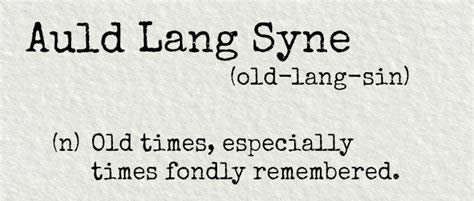
The lyrics of “Auld Lang Syne” are in the Scots language, as it was a nostalgic phrase as early as 1588. The title, translated literally into standard English, is ‘Old Long Since.’ The words can be interpreted as ‘days gone by’, ‘since long ago’, ‘long long times ago’ or ‘for old times’ sake. The lyrics are about old friends having a drink and recalling adventures they had long ago. There is no specific reference to the new year.
|
|
A most unique version and use |
In Japan, the tune is known as "Hotaru no Hikari" (The Light of the Fireflies), and the sentiments expressed in the Japanese version are similar to those in the original Scottish lyrics. You can hear supermarkets and department stores throughout the country play this song daily to indicate that it is almost closing time. |
|
Many variations of wording can be found in “Auld Lang Syne” as they have been written many times over the years. Even the surviving manuscript copies in Burns’ own hand are not identically worded. So the version you know may vary from these! |
|
Scots Version
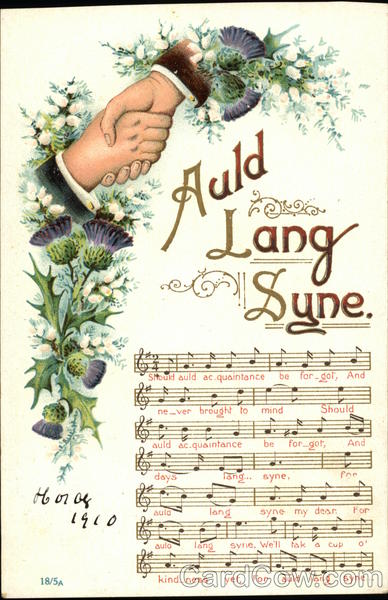
Should auld acquaintance be forgot,
And never brought to mind?
Should auld acquaintance be forgot,
And auld lang syne?
(Chorus)
For auld lang syne, my jo,
For auld lang syne,
We’ll tak a cup o’ kindness yet,
For auld lang syne.
And surely ye’ll be your pint-stowp!
And surely I’ll be mine!
And we’ll tak a cup o’ kindness yet,
For auld lang syne.
We twa hae run about the braes
And pu’d the gowans fine;
But we’ve wander’d mony a weary foot
Sin auld lang syne.
We twa hae paidl’d i’ the burn,
Frae mornin’ sun till dine;
But seas between us braid hae roar’d
Sin auld lang syne.
And there’s a hand, my trusty fiere!
And gie’s a hand o’ thine!
And we’ll tak a right guid willy waught,
For auld lang syne.
|
|
English Version
Should old acquaintance be forgot,
And never brought to mind?
Should old acquaintance be forgot,
And old lang syne?
(Chorus)
For auld lang syne, my dear,
For auld lang syne,
We’ll take a cup of kindness yet,
For auld lang syne.
And surely you’ll buy your pint cup!
And surely I’ll buy mine!
And we’ll take a cup o’ kindness yet,
For auld lang syne.
We two have run about the slopes,
And picked the daisies fine;
But we’ve wandered many a weary foot,
Since auld lang syne.
We two have paddled in the stream,
From morning sun till dine;
But seas between us broad have roared
Since auld lang syne.
And there’s a hand my trusty friend!
And give me a hand o’ thine!
And we’ll take a right good-will draught,
For auld lang syne.
|
|
 |
Saturday, January 21, 6pm
Ravenwood Golf Club
929 Lynaugh Rd, Victor, NY 14564
cash bar 6pm; dinner 7pm. Enjoy a special evening of traditional Burns Supper ceremonies and dinner, plus a silent auction and raffle. $55pp, order at rocscots.org/events
|
|
|
|
Robert Burns Dinner
Saturday, January 21, 6pm
Southminster United Church
6801 Hagar Ave, Niagara Falls, ON L2G 5M5, CA
Hosted by the Niagara Highland Dance Parent Association. doors 6pm; dinner 7pm. Ages 19+, $35pp (limited seats available). Enjoy their annual 3-course traditional Scottish dinner, a dram to toast the Haggis, door prizes, DJ and dance. Reserve a table or purchase tickets by calling (905) 295-6115 or email jgouck1@cogeco.ca.
|
|
|
|
|
Saturday, January 28, 6 – 10pm
GDI Countryside Inn
2049 Sandridge Rd, Alden, NY 14004
Hosted by The Alden Bagpipe Club. Join the club for a night with Scottish dinner, ceremonies, music & Bagpipes, Tongue 'N Cheek Poetry, food and beverages. $45pp - only 85 tickets available. Raffles & door prizes; Guinness on Tap; Dress is kilted Highland or semi-formal
|
|
|
|
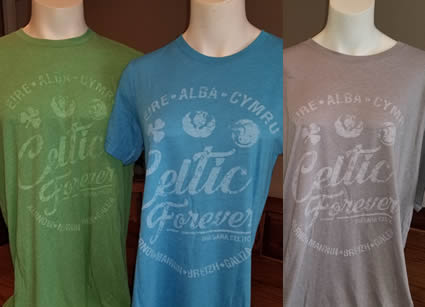
Support Niagara Celtic by purchasing souvenirs at our online store. All proceeds go towards the 2023 Niagara Celtic Heritage Festival.
Once they're gone, they're gone! Order shirts, hoodies and cookbooks today before they are gone forever. Take a peak & order now
|
|
|
|
Held at the Niagara County Fairgrounds, Route 78 in Lockport, NY 14094
|
|
|
|
|
|
|