Celebrate! The UN Nuclear Ban Treaty
Entered into Force on January 22, 2021
|
|
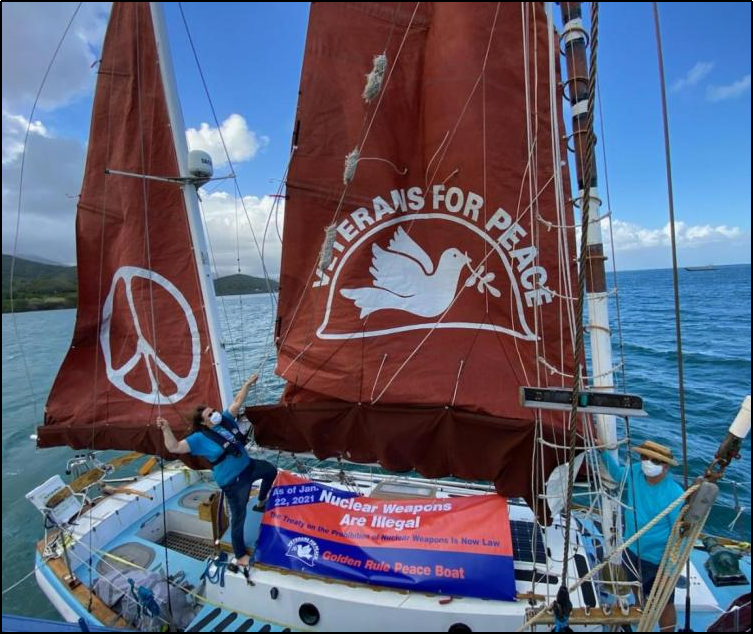
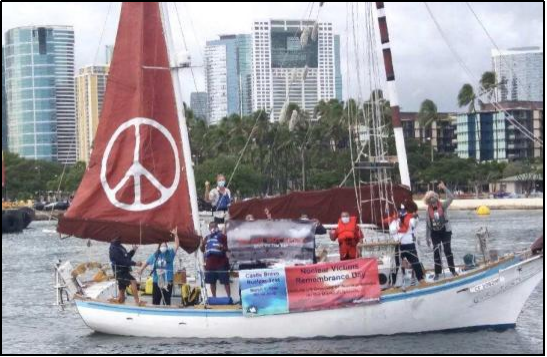
Activists in Hawai’i celebrated the day that nuclear weapons became illegal under international law, January 22, 2021. Golden Rule was in Kane’ohe Bay, where Connie Durant photographed Golden Rule with Project Manager Helen Jaccard and Captain Kiko Johnston-Kitazawa.
|
|
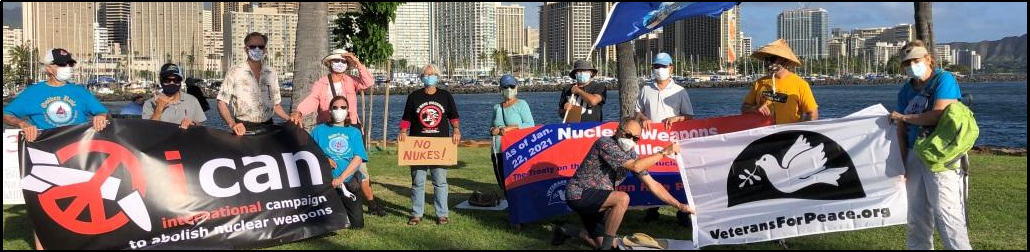
Dedicated members of Veterans For Peace, Hawaii Peace & Justice, Refuse Fascism and others gathered on Magic Island in Honolulu to commemorate the Nuclear Ban Treaty Entry into Force. |
|
What’s Next for the Golden Rule?
|
|
Due to Covid-19 restrictions on entering other countries and limitations on gatherings, we have decided to bring Golden Rule back to California. We’ll sail out of Hawaii in early May and arrive in San Francisco Bay in early June. You can follow the progress on our tracking system, share.garmin.com/goldenrule
Golden Rule will remain in the Bay Area through October where presentations, boat tours, and sailing are being planned (as Covid restrictions permit).
|
The Great Loop
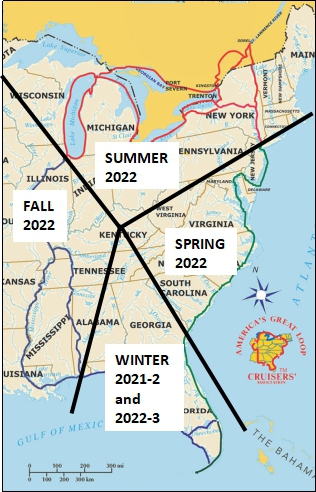
Veterans For Peace, Quakers and other volunteers who rebuilt Golden Rule envisioned sailing her in all of the navigable waterways of the U.S. Now we can make that dream come true by sailing “The Great Loop”. Our Great Loop voyage covers the Gulf of Mexico in the winter, up the eastern seaboard in the spring, into and around the Great Lakes in the summer, and down interior rivers in the fall, arriving back in the Gulf of Mexico after hurricane season ends (December 1).
We’ll visit all of the big cities along the way, including Houston, New Orleans, Mobile, Tampa, Miami, Jacksonville, Savannah, Washington DC, Philadelphia, New York, Cleveland, Detroit, Milwaukee, Chicago and St. Louis.
We will need crew and supporters for the Great Loop voyage. Please email us at vfpgoldenruleproject@gmail.com to volunteer.In November, Golden Rule will travel by truck to Corpus Christi, Texas. If we can borrow a 3-axle boat trailer and a volunteer with a pickup truck, we will stop in along the way to show off the boat and talk with landlocked communities, some of which are affected by the health effects of uranium mining.
|
|
Help Return Golden Rule to California |
|
It’s time for the Golden Rule to return home to California! We plan to set sail in early May and arrive in San Francisco Bay in early June.
Preparing for an ocean crossing is a big deal and the safety of the boat and crew are dependent on doing everything right.
We realize that many of you cannot donate right now due to Covid, which means it’s all the more important for those of you who can support us financially to be extra generous right now.
Thank you, donors and volunteers, for keeping this historic boat and project “Sailing for a Nuclear-Free World and a Peaceful, Sustainable Future”!
You can donate in these ways:
VFP Golden Rule Project
PO Box 87
Samoa, CA 95564
- Call Helen Jaccard at 206-992-6364 to give her your credit card information
- Click the button below to make a donation via Paypal
|
|
Nuclear Ban Treaty is a Game Changer |
|
by Gerry Condon
The Golden Rule Project is happy to celebrate the UN Treaty on the Prohibition of Nuclear Weapons (TPNW), the important new international peace initiative. The “Nuclear Ban Treaty,” as it is also known, was approved 122-1 by the UN General Assembly in July 2017, a clear expression of the will of the world’s people. On October 24, 2020, Honduras became the 50th nation to ratify the TPNW, triggering a 90-day period before it goes into force, on January 22.
None of the nine nuclear-armed nations have yet signed onto the Treaty. These nuclear powers are in violation of the 50-year-old Nuclear Non-Proliferation Treaty, which requires them to negotiate in good faith to reduce and eventually eliminate all nuclear weapons. Instead, the U.S. and other nuclear powers are developing new generations of nuclear weapons, alarming many experts who believe the threat of nuclear war is greater than ever.
The U.S. is spending $494 billion over the next ten years, and over $1.7 billion in the next 30 years to “upgrade” its arsenal of nuclear weapons. Powerful and influential corporations will be making billions of dollars from the nuclear programs over the next decade and will be contributing to members of Congress who will vote to continue their nuclear weapons arsenal and their profits.
These political leaders need to hear from everyday people who are rightfully concerned about the very survival of human civilization. We must demand that the U.S. and all the nuclear powers sign the Treaty and begin the de-nuclearization of the planet.
The Nuclear Ban Treaty goes into force four days after the national holiday honoring Martin Luther King, who passionately called for ending the nuclear arms race. In his Nobel Peace Prize acceptance speech in December 1964, Reverend King implored,
“Somehow we must transform the dynamics of the world power struggle from the negative nuclear arms race which no one can win to a positive contest to harness man’s creative genius for the purpose of making peace and prosperity a reality for all of the nations of the world. In short, we must shift the arms race into a “peace race.”
The United States can be a leader in the peace race, but only if our leaders hear a loud message from the people: nuclear weapons are an unacceptable threat to all of humanity, and they will now also be illegal. The U.S. must take immediate actions to step back from the brink of nuclear war, and to show leadership in the worldwide effort to eliminate all nuclear weapons. The future of humanity hangs in the balance.
Gerry Condon is a Vietnam-era veteran, former president of Veterans For Peace and President of the Golden Rule Committee.
|
|
Lessons from Hawaiian Past
Support the Value of Peace Treaties
|
|
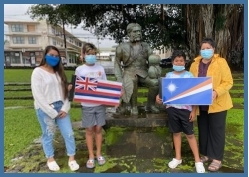
Captain Kiko Johnston-Kitazawa holds flags of the Marshall Islands and Hawaii at Wailoa Harbor in Hilo to commemorate Castle Bravo Remembrance Day |
by Kiko Johnston-Kitazawa
In ancient Hawai’i, warfare was often fierce, yet Pu’uhonua, places of refuge, existed where the defeated and non-combatants could flee and be spared from harm. Also, during the Makahiki season, about a third of the year, warfare was outlawed. In the 19th century, Hawai’i’s rulers and diplomats, aware of being a small nation in a world of mighty ones, negotiated treaties with the world powers. One feature of these treaties was agreeing to respect Hawai’i’s neutral status, thus making Hawai’i, in effect, a Pu’uhonua in the North Pacific for belligerent nations in the event of war. Most nations respected these treaties.
Often, when modern people learn of these things, they may think: well, if you can ban warfare a third of the year, why not get rid of it all the time? Or: why only those who reach Pu’uhonua, why not treat all defeated humanely? Or: what good are those treaties when one country failed to honor them?
The goal and achievement of all of these is to reduce suffering and put limits on the violence and barbarism of war. Not only Hawai’i attempts these measures; conventions against attacking and killing civilians, and treating captured soldiers humanely. exist now and have existed in many places at many times. World War I saw many poisoned by gas. The world recoiled in horror, and treaties barring use of chemical and germ warfare were implemented and have mostly been honored.
I think we should be happy the treaty banning nuclear weapons went into effect January 22, and look forward with hope, while being aware of the reality that as long as the nine nuclear powers aren’t signed up, our work still lies ahead. People cherishing and respecting one another is the key; treaties, though imperfect, are valuable tools along the way.
Kiko Johnston-Kitazawa lives in the Ka’u District of Hawai’i Island, and is the current Captain of Golden Rule.
|
|
Solidarity with Marshall Islanders |
|
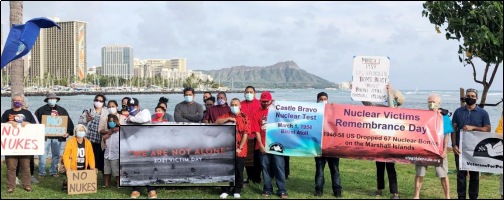
Marshall Islanders joined members of Veterans For Peace, Hawai’i Peace & Justice and Refuse Fascism on March 1st in Honolulu to remember the 1954 U.S. detonation of the “Castle Bravo” nuclear bomb on Bikini Atoll.
The Bikini Atoll exiles shared a mournful song, written by a 33-year old Bikinian after being evacuated, and now the Bikinian Anthem. Here are the words, in English:
No longer can I stay; it’s true.
No longer can I live in peace and harmony.
No longer can I rest on my sleeping mat and pillow
because of my island and the life I once knew there.
The thought is overwhelming
rendering me helpless and in deep despair.
My spirit leaves, drifting around and far away
where it becomes caught in a current of immense power –
And only then do I find tranquility.
|
|
After sharing words and song, five Bikinians went sailing on the Golden Rule. |
At 15 megatons, 1,000 times the magnitude of the Hiroshima and Nagasaki nuclear weapons, the Castle Bravo bomb vaporized three islands and contaminated many others. Despite a stern warning from the weather forecaster, Castle Bravo was blast on a day when the wind was blowing over the Marshall Islands population. Fine white radioactive fallout rained down on the islanders, with children playing in the “snow” and even eating it. The radioactive fallout from this weapon has forever devastated the lives of the Marshallese people, who continue to suffer from deadly cancers and other health problems. Many Marshallese have been forced to leave their beloved islands.
At the Honolulu commemoration, Nixon Jibas, an elected Council member representing all Bikinians exiled to Kili and Ejit Islands, read a statement from his brother, Bikini Mayor Anderson Jibas.
Mayor Jibas said, “When I say that the U.S. tricked the Bikinians into moving from Bikini, I mean they really were tricked. There were no lawyers representing Bikini when the U.S. came and asked Bikinians to move in 1946. No one told the Bikinians that there would be 23 nuclear bombs exploded on their islands. For the past 20 years, the current Changed Circumstances Petition in Washington, DC has been tossed around like a beach ball between Congress, the Administration and the Courts.
“Today only 4 workers live on Bikini Atoll. Of the 167 people who were on Bikini on March 1, 1954, only 11 are still alive. The U.S. can clean up Bikini Atoll. America spent $142 million dollars every single day in the war in Afghanistan in 2018. Just 3 days of that budget would clean up Bikini and make right what is wrong and would bring recognition to the huge contribution Bikini has made to the U.S. defense capabilities. Can we get some justice?"
On Hawai'i Island
|
|
Captain Kiko Johnson- Kitazawa was joined by four Marshallese descendants of people who were downwind of the Castle Bravo test. Camilla Nanilei Alik, left, is a college student whose grandmother, Ruth Charlie was from Jejit, Maloelap and Utrok - one of the atolls affected by the nuclear fallout in the 1950s. Gary Tileo and Renzo Kabua’s father is from Majuro, Ailinglaplap, and Bikini Atoll. On the right is Carmina Alik, President of the Hilo Marshallese Community and a Director of Micronesians United - Big Island.
|
|
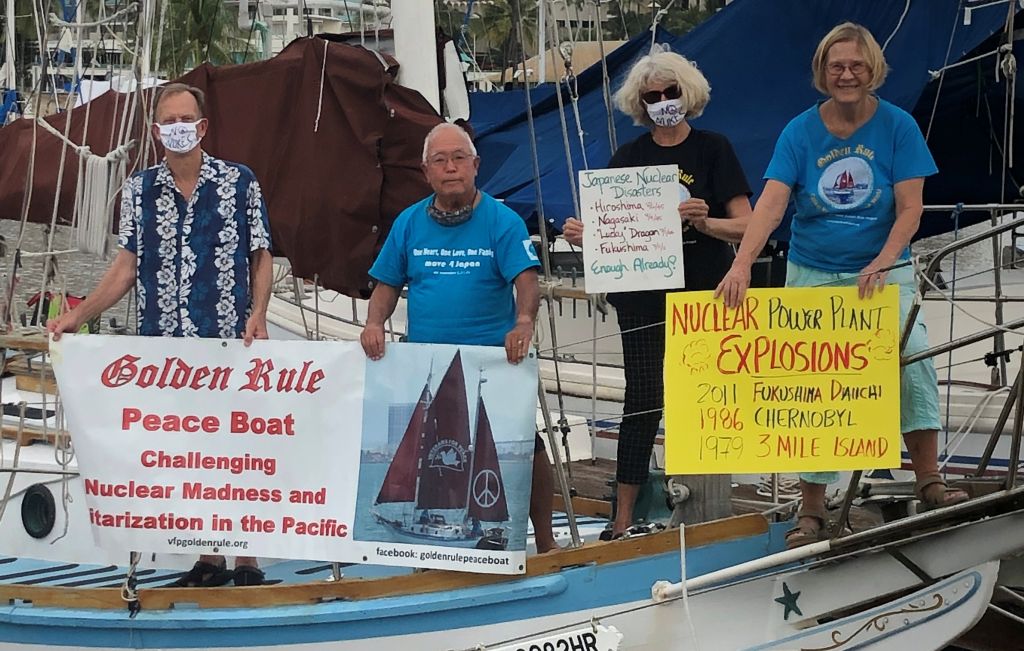
On March 11, Keith Oney, Ray Tabata, Barbara Leigh Cooney and Ann Wright gathered on Golden Rule to commemorate ten years since the earthquake, tsunami and nuclear plant meltdown in Fukushima, Japan.
Ray Tabata, a member of the Japan America Society of Hawaii and volunteer in the Fukushima area said, “On one trip, my friend drove us by the Daiichi power plant on the national highway. He had a Geiger counter in his car. As we approached the nuclear plant, the Geiger counter went crazy, like gggggggggggg! It is not allowed to stop on the highway—for good reason.”
On March 11, 2011, one of the worst nuclear accidents on the planet was caused by an earthquake and tsunami. Three of the nuclear reactors at the Fukushima Daiichi nuclear power plant melted down. Massive radiation from the reactors caused over 160,000 people to evacuate and over 50,000 are still unable to return home. Here’s what is going on at the site today.
2021 Earthquake - New Damage
Following the magnitude 7.1 earthquake on February 13 near Fukushima Prefecture, cooling water levels dropped in reactors 1 and 3. This indicates possible additional damage to the containment vessels. Cooling water flow has been increased to compensate for the new leaks.
Japan plans about to dump radioactive water into the ocean
Tokyo Electric Power Company (TEPCO) says its radioactive water storage capacity of 1.37 million tons will soon be full.
Japan’s plan to release the radioactive water into the sea faces fierce opposition from fishers and environmentalists, who call for building more storage tanks to hold the radioactive water while better solutions are found.
Marketing local fish would be more difficult if the water is released into the ocean.
Greenpeace, whose founding was inspired by the Golden Rule’s 1958 voyage, reports that the stored water can harm human DNA. Despite treatment systems, the water contains strontium-90, carbon-14 and tritium (heavy water) - all radioactive.
Olympics in Fukushima
Some of the Olympic games will be held in Fukushima Prefecture.
Author Yu Miri has said that disaster-hit areas have not recovered enough and preparations for the Olympics are part of the reconstruction delay. “Organizers should have seen the level of progress of the reconstruction before deciding to host the Games," she said. She says that the situation for homeless people has gotten so bad that many are committing suicide.
Sealing plugs on reactors are fatally hot
The underside of 39 feet diameter concrete sealing plugs on the No. 2 and 3 reactor containment vessels are highly contaminated by radioactive Cesium-137. They are as fatally contaminated as nuclear fuel debris that had melted. This will seriously impact Japan’s cleanup efforts.
Robotic arm development delayed
Over 900 tons of melted fuel need to be removed from three reactors. Development work on the necessary robotic arms has stopped due to Covid-19. Complete cleanup will take decades, or perhaps hundreds of years.
Japan court orders government, TEPCO to pay more for Fukushima disaster damage
A Japanese court has found negligence by both the government and TEPCO in failing to take measures to prevent the 2011 nuclear disaster, ordering them to jointly pay some $9.5 million in damages to thousands of residents for their lost livelihoods.
The court also ordered the government and TEPCO to pay damages to the plaintiffs, doubling the amount that a lower court had ordered only TEPCO to pay in 2017.
|
|
by Helen Jaccard
Two sides of the same coin: Nuclear power and weapons share important processes - uranium mining, milling, and enrichment. The 15,000 abandoned uranium mines in the US are causing cancer and birth defects in mostly indigenous areas. Radiation and chemicals used for manufacturing is harming health of nearby residents.
Used to produce plutonium: Plutonium doesn’t exist in nature - it is extracted from “spent” nuclear fuel rods. Until the 1970s, “clean, unlimited, cheap” nuclear power was only an excuse for reactors to produce plutonium for bombs.
Used for “depleted” uranium weapons: When uranium is enriched, the depleted uranium (DU) left over is used to coat bullets, missiles and armored tanks. So much DU was used in Fallujah, Iraq, that from 2010-13 at least 14% of babies born had defects.
No place for waste: There’s no place for long-term storage of “spent” fuel rods and other high-level radioactive waste.
Not carbon-free: Tons of carbon is burned to build and decommission a nuclear power plant and for processing uranium into fuel.
Expensive: Nuclear power is more expensive than other power sources, especially when considering the cost of decommissioning and the cleanup after meltdowns (paid for by taxpayers).
Keep the old? Concrete in old power plants is cracking from being exposed to radiation for so long. Many are the same design as the Fukushima Daiichi plants. Dangers of meltdown are increased by bigger storms and sea level rise.
Build new ones? They will be less prone to meltdown, but the other problems remain. For the time and expense involved, we could advance wind, solar and battery technology and learn how to use less power.
|
|
Please click the donate button or send a check to:
VFP Golden Rule Project
PO Box 87
Samoa, CA 95564
or call Helen Jaccard, 206-992-6364 with credit card information
|
|
|
|
|
|
|