|
Geography/Habitat:
The Roseate Spoonbill, Platalea ajaja, is a member of the order Threskionthidae with other spoonbills and ibises. It is usually placed in the genus Platalea with 5 other spoonbill species, but is placed by some in its own genus, Ajaja. First described by Linnaeus in 1758, and the Roseate Spoonbill is monotypic in the sense that is has no subspecies.
Found along the southern US costs, from Florida to Texas, and California, through both the Atlantic and Pacific coasts of Mexico and Central America, and extensively East of the Andes through northeast South America to Argentina. There is also a small population west of the Andes in Ecuador and Peru. Mostly resident, but some populations do migrate south in the winter.
Roseate Spoonbills frequent tidal pools, brackish lakes, ponds, and swamps. They are typically coastal but can stray further inland during short range migration. These habitats provide the spoonbills their food source of typically minnows, small crustaceans, small plants, and insects. It feeds by sweeping the bill from side to side gathering these items from shallow muddy water.
Life expectancy in the wild is around seven years, but have been known to live for at least 18 years.
Identification:
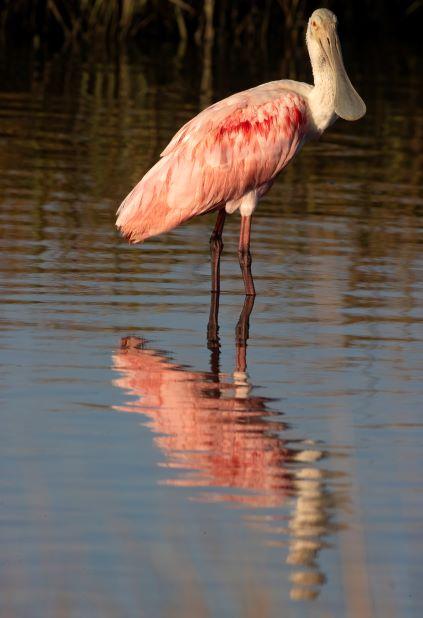
Pretty unmistakable, the Spoonbill is a large ibis with a yellowy-gray spoon-shaped bill, a pinkish body with some deeper red on wings, and a whiteish neck. The head is bare with greenish skin, and a prominent red eye. The skin at the back of the head darkens to blackish.
The call is an “ibis like” “huh-huh-huh” or “rek-rek-rek-ek-ek” but at a much lower pitch.
Interesting Facts:
· The Roseate Spoonbill was almost hunted to extinction for its feathers, which were used for fans and hats, but has since recovered although pesticides to control mosquitoes are having a detrimental effect on numbers.
· The pink coloration is due to the carotenoid pigment in the crustaceans it feeds on, who in turn get their piment from the algae they feed on. It is the only spoonbill with pink plumage.
· The spoonbills nostrils are very close to the base of the bill to allow it to submerge its bill while feeding.
· A group of Roseate Spoonbills is called a bowl.
|