|
Restaurants:
The Kosher Dill
The Jewish Encyclopedia:
Morris Rosenthal
Neighborhoods:
Homewood-Brushton
Calendar:
through Aug. 13: Green Book
Aug. 20: JGS Pittsburgh: Tyler Stump
Community:
Squirrel Hill Historical Society archives
"How We Got Here"
JCBA "Road-Trip"
Mystery portraits
Research Tools:
Newspapers, Cemeteries,
Memorial Plaques, Books,
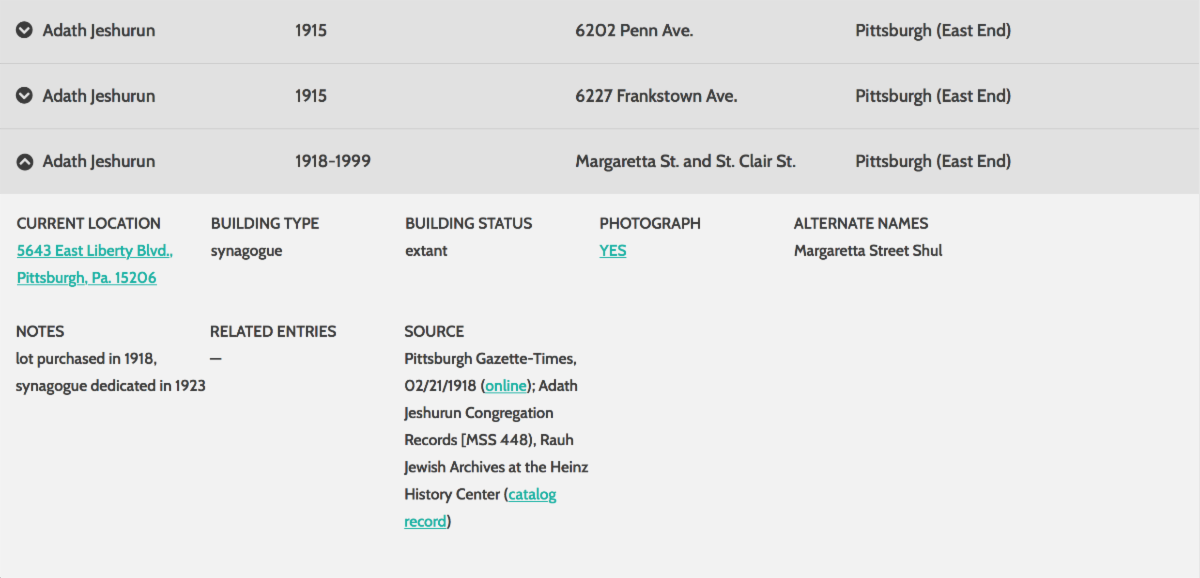
Population Figures, Synagogues, Newsletter Archive
| |
|
|
Restaurants:
The Kosher Dill
| |
|
Advertisement for the Kosher Dill restaurant at 206 N. Highland Ave. Promotes trays for catering. Includes photographs of building and of Kushner family, Nov. 21, 1974.
—from Jewish Criterion
Pittsburgh Jewish Newspaper Project
| |
|
All year we’ve been profiling local Jewish-owned restaurants.
What’s a restaurant?
We had to draw boundaries. We decided to look at dining establishments—places where you could order a meal and eat it on site.
That meant no grocery stores, no butcher shops, no bakers, and no caterers. Those stories are just as fascinating as restaurants, and we hope to tell them in the future.
In some cases, the boundaries are fuzzy. It was once common for restaurants to also have a delicatessen, and many restaurants have run catering services.
Reva Kushner was a well-known caterer in the local Jewish community.
Over the course of her career, she was chef and caterer at B’nai Israel Congregation in East Liberty, manager of the kitchen at the B’nai B’rith Hillel in Oakland (now Hillel-Jewish University Center), and manager of food services at the Jewish Community Center’s Henry Kaufmann Family Park in Monroeville.
| |
|
In August 1974, Reva and Fred Kushner opened the Kosher Dill on N. Highland Ave. in Oakland, in a storefront famous for having previously been the home of Gammon’s. The restaurant lasted at least into 1975, according to advertisements in the Jewish Chronicle. Aside from these advertisements, the archive contains no documentation of the restaurant and only indirect documentation of Kushner's catering career through organizational records.
If you have any information about the Kosher Dill, please contact the archives.
| |
All year, the Rauh Jewish Archives is highlighting Jewish restaurants in Western Pennsylvania. If you would like to donate a material from a Jewish restaurant, or just reminisce, contact the archive or call 412-454-6406. | |
|
Jewish Encyclopedia of Western Pennsylvania:
Morris Rosenthal
| |
|
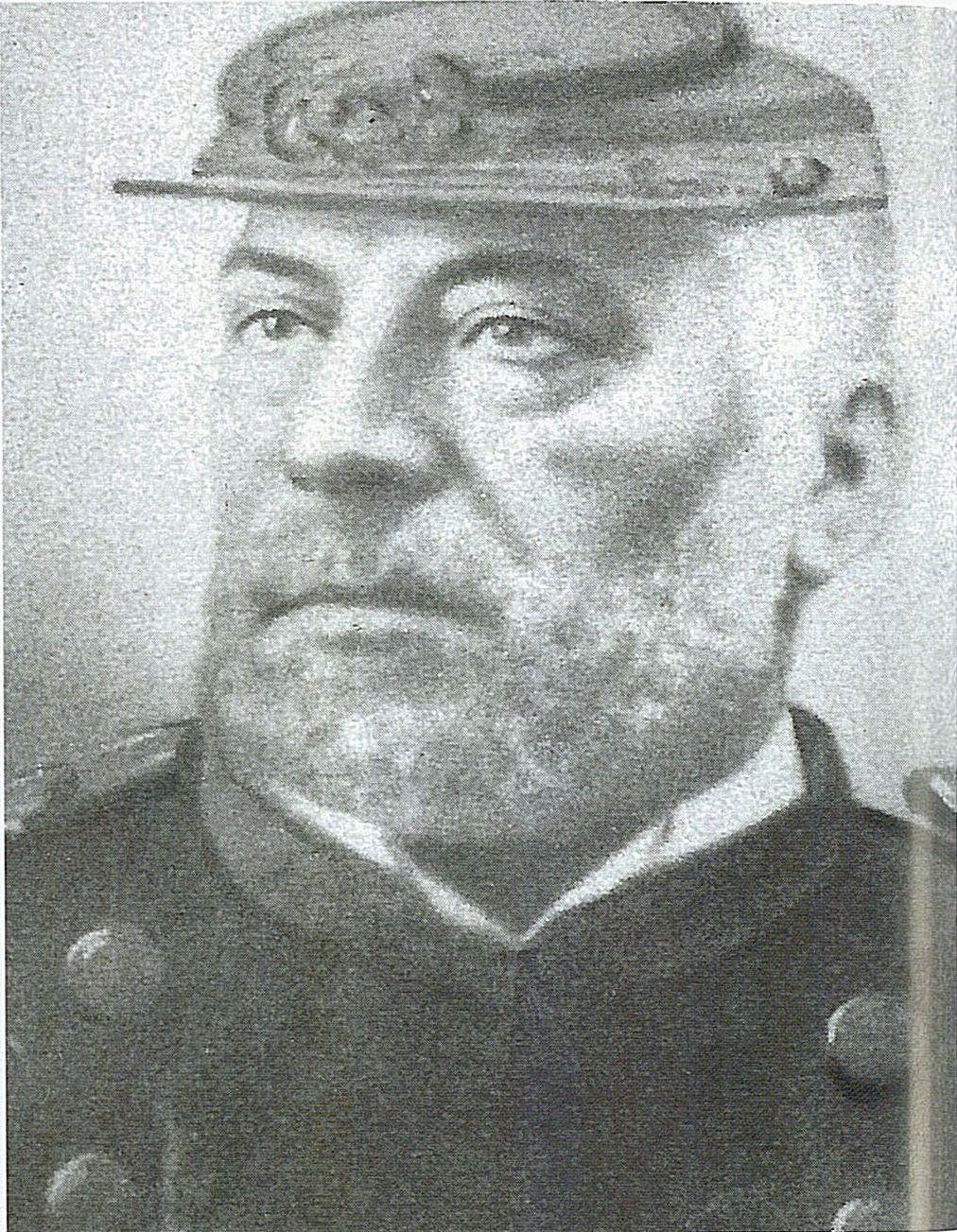
Black and white photograph of Morris Rosenthal in military uniform, taken many years after the Civil War. Originally published in Ted Goleman’s article “Gettysburg to Pittsburgh,” June 27, 2002.
—from Jewish Criterion
Pittsburgh Jewish Newspaper Project
| |
|
Morris Rosenthal was likely the first Jewish police officer in Pittsburgh, as well as a Jewish communal leader in Pittsburgh in the late 19th century.
After finishing a tour of duty in the Civil War, Morris Rosenthal and his wife Sarah Mollie Meyer Rosenthal came to Pittsburgh. Rosenthal was an early member of Beth Hamedrash Hagodol Congregation (then known as B’nai Israel Congregation) and was its most important early president, seeing the congregation through the dedication of its first synagogue on Grant Street downtown in 1880 and the construction and dedication of its synagogue on Washington Street in 1892 and the breakaway of Beth Jacob Congregation in 1883.
| |
The Jewish Encyclopedia of Western Pennsylvania brings together numerous online resources into a clearinghouse for conducting research about Jewish history in this region. As we migrate information to this new website, we’ll be announcing new entries and resources in this section of the newsletter. | |
|
Neighborhoods:
Homewood-Brushton
| |
|
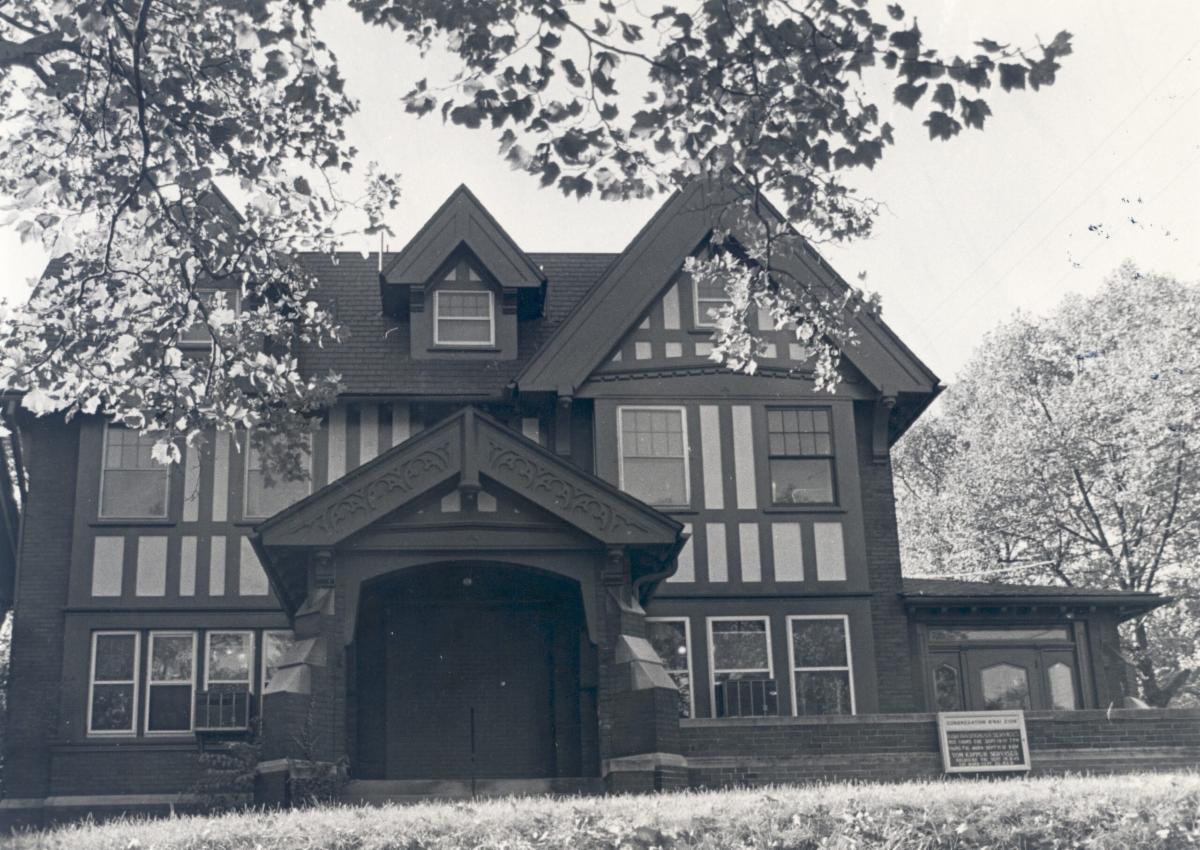
Black and white photograph of former B’nai Zion Congregation synagogue at the corner of Hamilton and Lang in the Homewood neighborhood of Pittsburgh.
—from Corinne Azen Krause Photographs [MSP 113]
| |
|
This is the story of two roads and one neighborhood.
The neighborhood is Homewood-Brushton. In the mid-19th century, it was a pastoral section of the city, far from the hazy chaos of the riverfront industry.
As the century progressed, sections of Homewood-Brushton started to resemble a city neighborhood—dense and full of different uses. Some of the large estates were subdivided into small lots, a street grid was laid out, and interurban rail lines were brought through the emerging neighborhood.
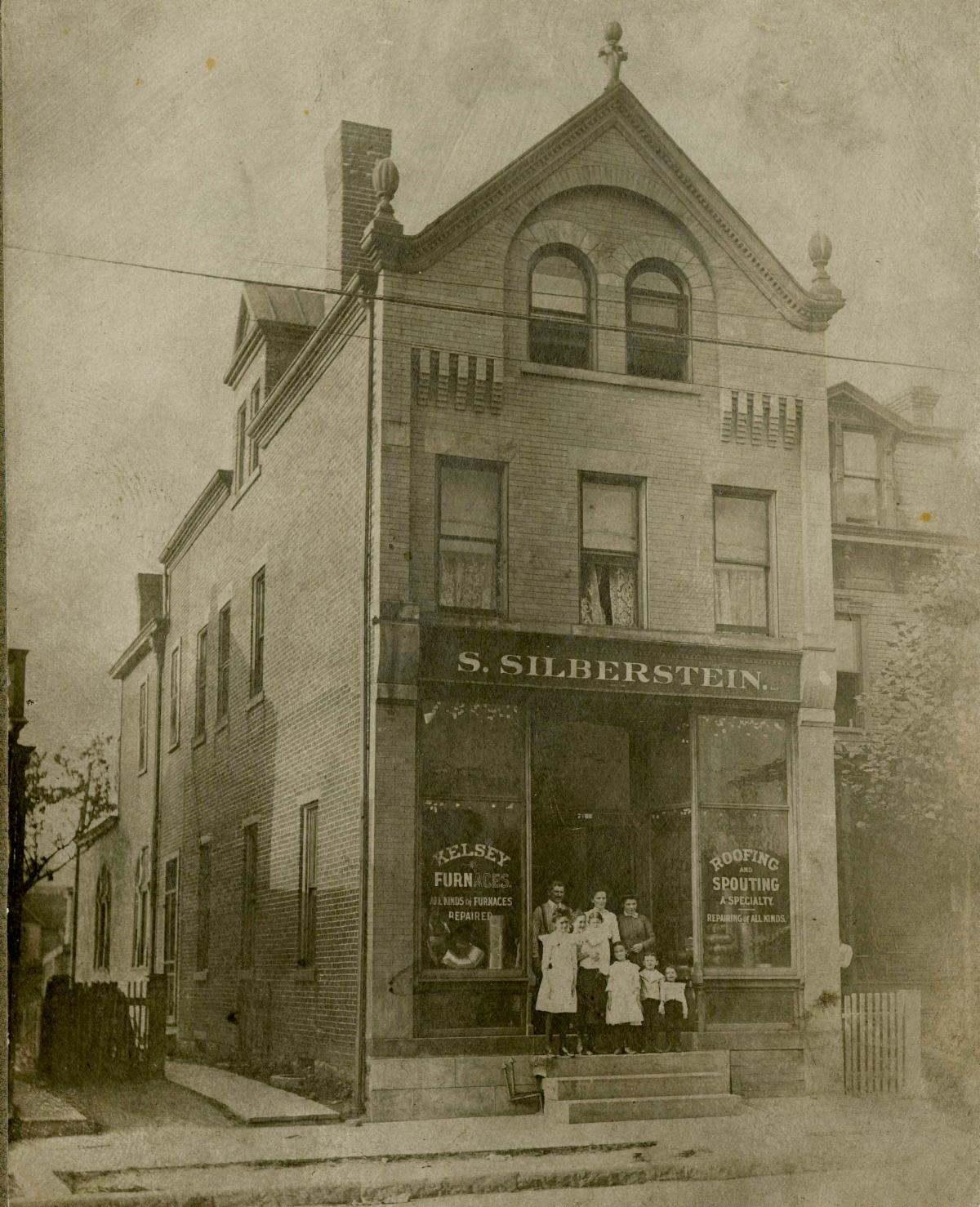
These years attracted many new people, including Jewish families like Samuel and Sara Silberstein. They ran a tinware shop on Hamilton Avenue.
| |
Color map showing the intersection of Kelly and Homewood in the Homewood section of the city, including Taylor Hall, 1904.
—from G. M. Hopkins Co. maps
University of Pittsburgh Archives & Special Collections (online)
| |
The beginnings of Jewish life in Homewood comes to us second-hand and poorly sourced but what we know suggests that the earliest Jewish settlers in the neighborhood struggled for decades to coalesce into an organized community. According to an un-sourced historical article from 1942, the first Jewish settlers in Homewood may have initially affiliated with the relatively new B’nai Israel Congregation in East Liberty, about two miles to the west.
Bigelow Boulevard (then Grant Boulevard) opened in 1900. Bigelow Boulevard greatly reduced travel times between East Liberty and downtown, making it possible to live in one part of town and work in another. That’s the first road in this story. Within a few years, a Jewish community emerged in East Liberty. The founders of B’nai Israel included many merchants who maintained businesses throughout downtown and Uptown, like Max and Bessie Azen.
Homewood sits a bit beyond the immediate reach of Bigelow Boulevard, and its Jewish community lagged behind East Liberty’s. The earliest primary source we’ve discovered for Jewish communal activity in Homewood comes in 1909. It’s a notice for upcoming High Holiday services to be held at Taylor Hall, at the corner of Kelly and Homewood. The record remains dims until 1921.
Then, suddenly, there is a lot of documentation.
| |
|
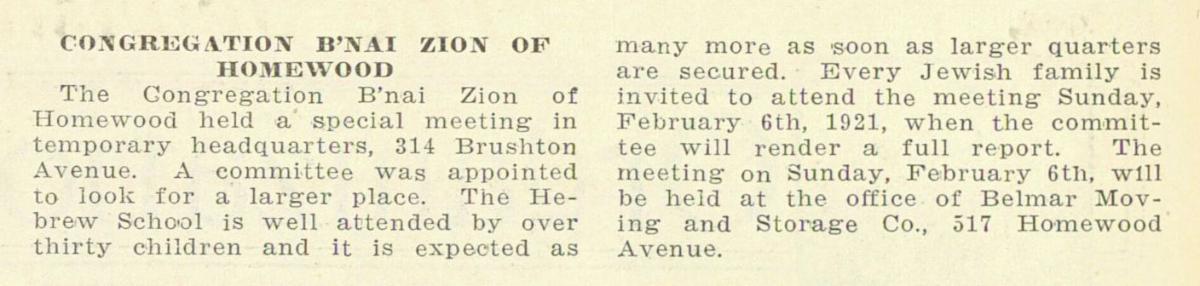
Notice for meeting of B’nai Zion Congregation of Homewood
at Belmar Moving & Storage Co. offices, Feb. 4, 1921.
—from Jewish Criterion
Pittsburgh Jewish Newspaper Project
| |
|
In the first three months of the year, a group of Jewish families in the area began promoting the name B’nai Zion Congregation, created a membership committee and building committee, formed the B’nai Zion Ladies Auxiliary, and opened the Homewood Religious School with help from the Southwestern District of Pennsylvania Jewish Religious Schools program.
What changed? They grew.
In the early 1920s, the group in Homewood-Brushton joined a separate group in Wilkinsburg to form one community. Independently, neither had been large enough to support institutions like a synagogue or school. Together, they were.
At this time when the Jewish populations of Homewood-Brushton and Wilkinsburg were just beginning to hold regular services and religious school classes in rented rooms throughout the neighborhood, nearby East Liberty already had two large congregations—B’nai Israel and Adath Jeshurun—both in the middle of expensive construction campaigns on new synagogues.
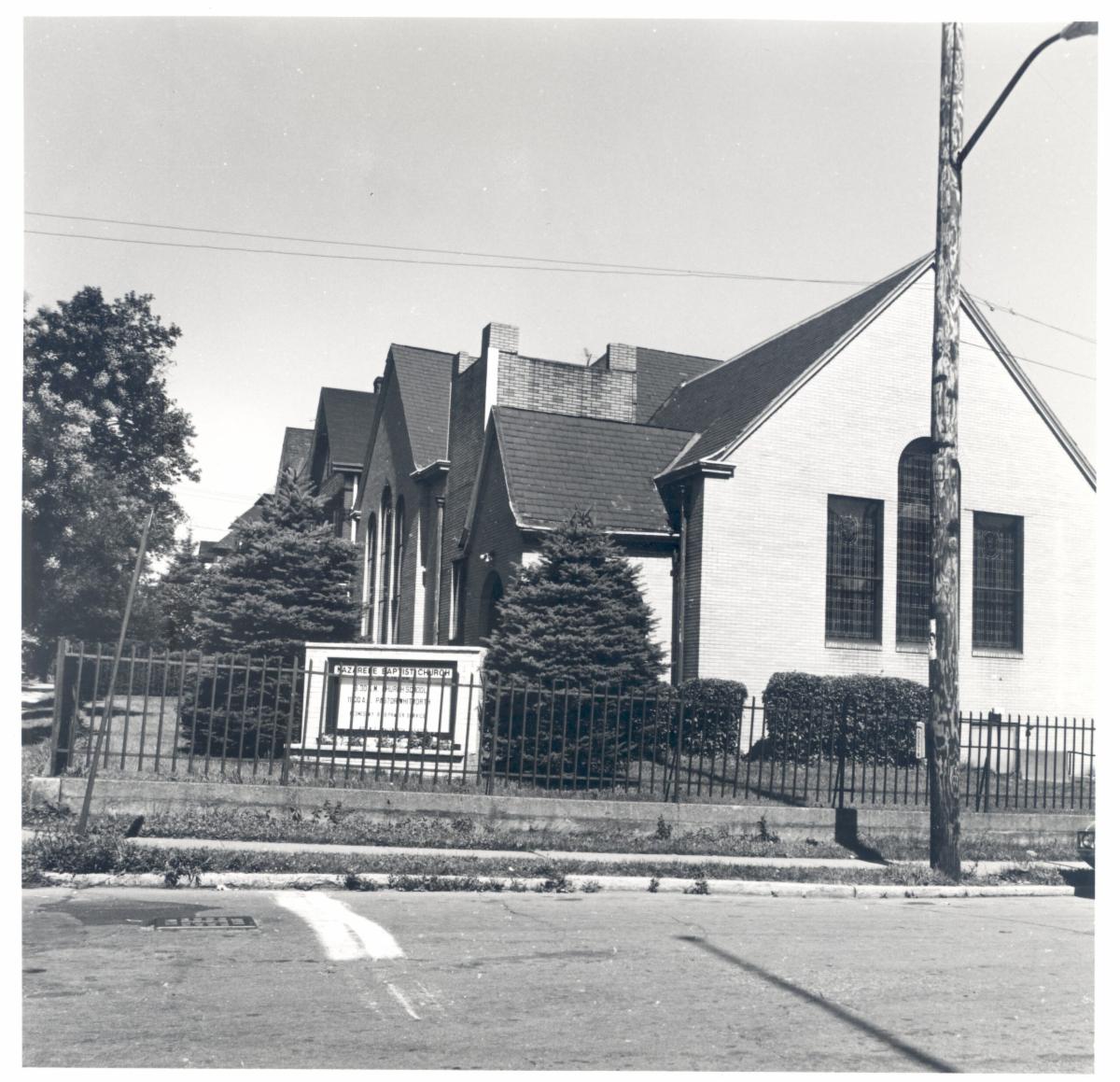
The coalition lasted 15 years. By the mid-1930s, the Wilkinsburg contingent had grown and began to separate, which we’ll consider in greater depth next month. The Homewood-Brushton contingent launched a building campaign, leading to the dedication of a synagogue at Hamilton and Lang in 1941. The building had originally been a church and was converted into a synagogue.
|  | |
|
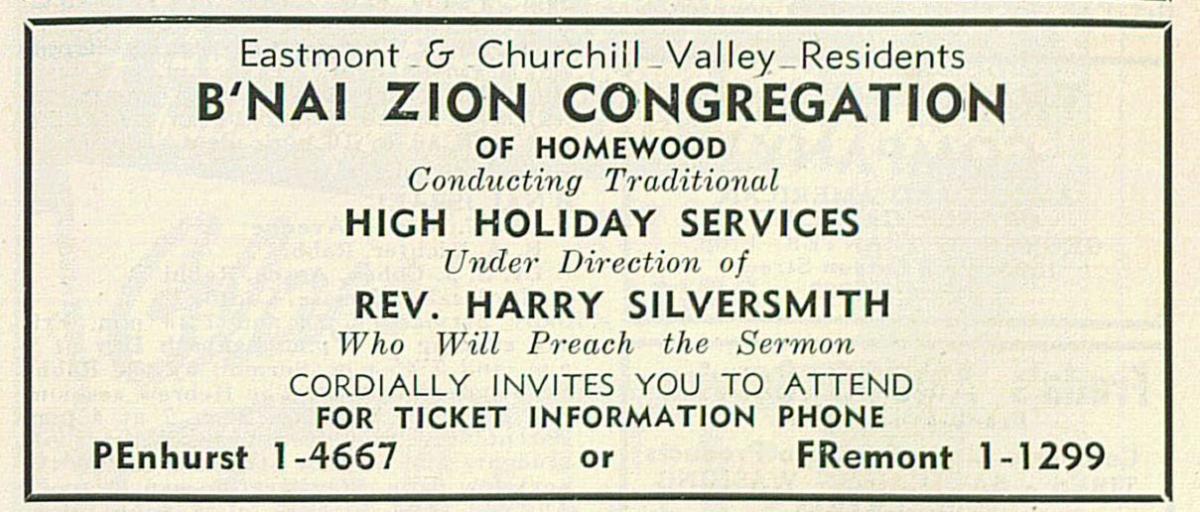
High Holiday advertisement for B’nai Zion Congregation of Homewood, announcing plans to hold High Holiday services at its synagogue at Hamilton and Lang with Cantor Harry Silversmith. Includes call for residents from Eastmont and Churchill Valley, Sept. 1, 1954.
—from American Jewish Outlook
Pittsburgh Jewish Newspaper Project
| |
|
In the mid-1950s, pressure came from the other direction.
The Squirrel Hill Tunnel opened in 1953, connecting Oakland to Churchill along US-22, and I-376. That’s the second road. The Parkway East opened the eastern suburbs to commuters, and many Jewish families settled in Churchill, Eastmont, Wilkins Township, and Monroeville and then commuted into town.
In a bid for new members, B’nai Zion Congregation appealed to these families in its High Holiday advertisements for a few years. But soon Parkway Jewish Center was established in Eastmont, followed by Temple David in Monroeville a few years later, creating much closer options for local Jewish families.
The Jewish population of Homewood was declining by the mid-1920s and continued steadily into the early 1950s. According to figures collected by the Hebrew Institute, the area had 157 children in 1924 and only 23 by 1950, with declines recorded in all but two of the two-year census during those years.
The Hebrew Institute blamed this decline on the consolidation of the local Jewish community. “This rise in Squirrel Hill is plainly at the expense of the Jewish settlements in Homewood, North Side, Lawrenceville and, possibly, some nearby small towns,” the organization wrote in a report from 1945.
But unlike almost every other small Jewish neighborhood in Pittsburgh, Homewood experienced a growth in Jewish population after the war.
According to the Hebrew Institute biannual census, Homewood nearly tripled from 23 children in 1950 to 74 in 1958. That changed in the 1960s, when the entire neighborhood of Homewood shrank by some 46 percent.
The decline was the result of policy decisions at the local and federal level, including the displacement brought about by the redevelopment of the lower Hill District and redlining. That story is beyond the expertise of this newsletter, but the Heinz History Center’s Sam Black discussed the details in an interview with WESA, as part of a 2019 series on the history and future of Homewood.
| |
|
Black and white photograph of synagogue at 6404 Forbes Ave. in Squirrel Hill.
Building used by B’nai Zion Congregation from 1966 until 1996
and by Young Peoples Synagogue after 1996, undated.
—from Corinne Azen Krause Photographs [MSP 113]
| |
|
B’nai Zion relocated to Squirrel Hill in 1965, becoming the only small neighborhood congregation in Pittsburgh to relocate rather than close.
The congregation held High Holiday services in the Labor Zionist Education Center in 1965 and the following year renovated a large house at 6404 Forbes Ave. into a synagogue. The synagogue is currently the home of Young People’s Synagogue but remains known as the “B’nai Zion” building.
| |
|
through August 13:
The Negro Motorist Green Book
| |
|
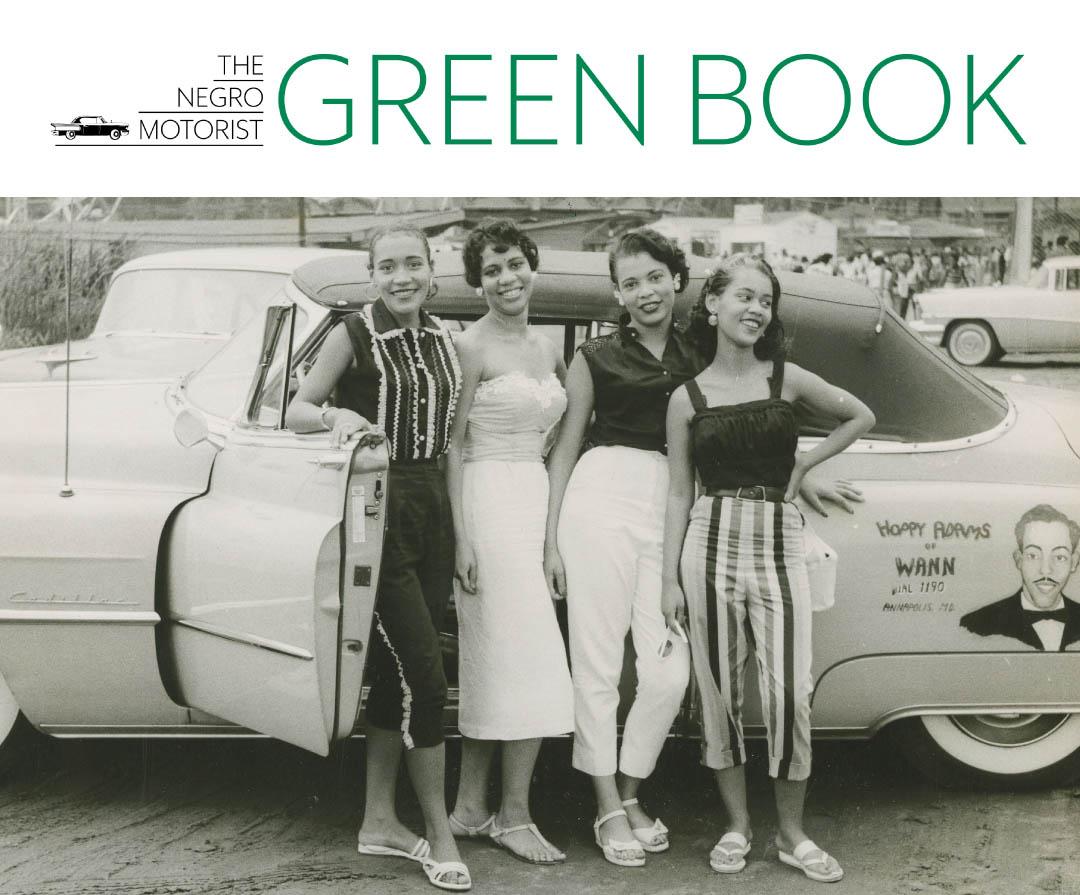
“The Negro Motorist Green Book” was a travel guide listing restaurants, gas stations, department stores, and other businesses that welcomed Black travelers. In an era of Jim Crow laws and “sundown towns,” the Green Book offered critical, life-saving information and sanctuary for Black individuals and families traveling the country. Harlem postman Victor Green started the publication in 1936, based in part on a similar volume published in Yiddish for Jewish travelers. The Green Book continued annually through 1967.
The new exhibit “The Negro Motorist Green Book,” on display in the McGuinn Gallery of the Heinz History Center through Aug. 13, tells the story of this landmark publication and its impact on the nation’s rising Black middle class in the middle 20th century. The exhibit also reveals the world of the Green Book in Pittsburgh with artifacts from hotels, jazz clubs, restaurants, and more than 30 local businesses listed in the Green Book, including the Terrace Hall Hotel, Harlem Casino Dance Hall, and Palace Hotel. The exhibit features images from the Melvin Seidenberg Photographs at the Rauh Jewish Archives and the Charles “Teenie” Harris Archive at the Carnegie Museum of Art.
| |
|
August 20:
JGS-Pittsburgh presents:
"Researching Institutionalized Family Members
at the Pennsylvania State Archives"
with Tyler Stump
| |
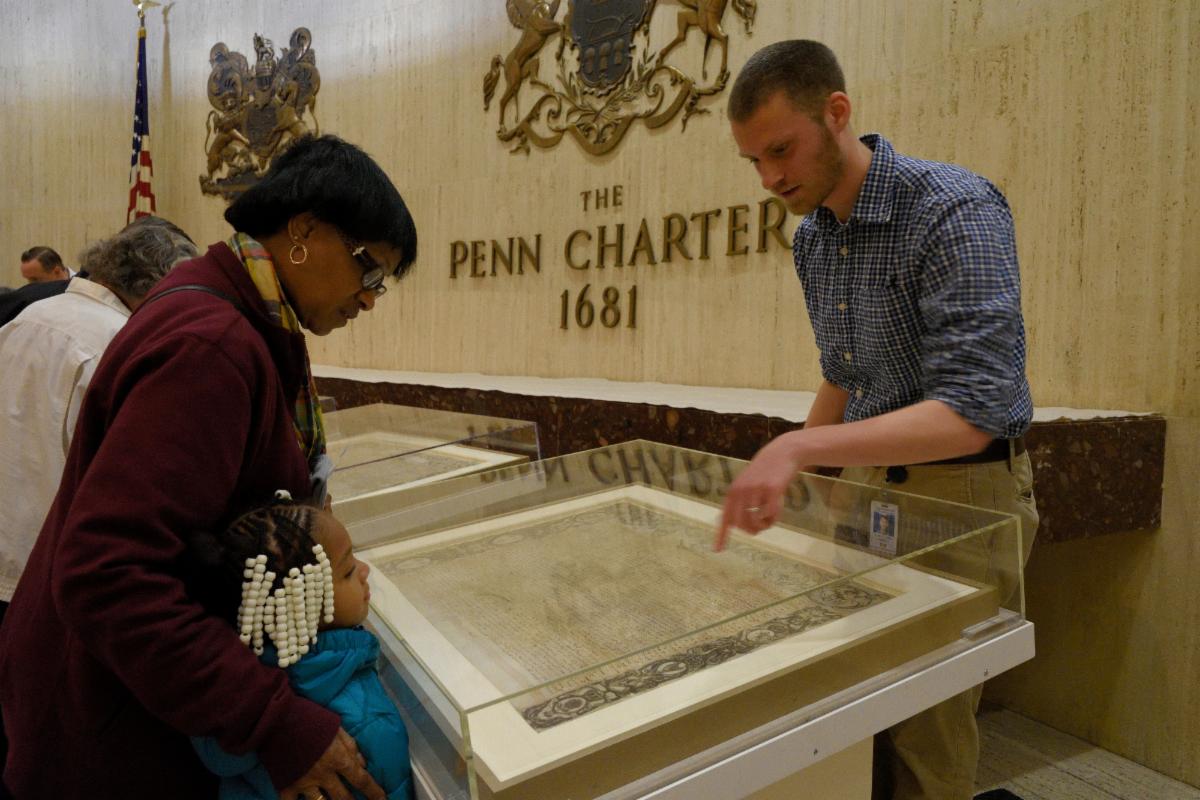
Color photograph of archivist Tyler Stump discussing a document with a patron. | |
|
Since the early 19th century, Pennsylvania has operated nearly 50 different state institutions for people with intellectual and mental disabilities. Hundreds of thousands of Pennsylvanians lived in these institutions. Today, the Pennsylvania State Archives holds the historical records created by these institutions, which are invaluable resources for researchers and genealogists.
Join archivist Tyler Stump to explore this important part of Pennsylvania’s history and to learn about the information in the archives’ collections.
The program is Sunday, Aug. 20, from 1-3 p.m. at the Library & Archives reading room on the sixth floor of the Heinz History Center with a virtual option for those who wish to attend remotely. The program will be recorded, and the recording will be made available to current JGS-Pittsburgh members.
"Researching Institutionalized Family Members at the Pennsylvania State Archives" is a collaboration between the Jewish Genealogy Society of Pittsburgh and the Rauh Jewish Archives at the Heinz History Center.
Please register online. This program is free for JGS-Pittsburgh members and $5 for the general public. To become a member of the JGS-Pittsburgh and to receive a free membership code for this program, please visit its website.
This program is possible through the support of the William M. Lowenstein Genealogical Research Endowment Fund of the Jewish Community Foundation.
| |
Tyler Stump has been an archivist at the Pennsylvania State Archives since 2016. He helps collect and preserve records from state-run institutions such as asylums, prisons, and hospitals as well as many other government offices around the state. Tyler has degrees in history and library science from the University of Maryland. Though he grew up in Baltimore, Tyler has deep roots in Pennsylvania, mostly around York County, that go back to the 18th century. He currently lives in Camp Hill, PA, with his wife Andra who is also an archivist. | |
Squirrel Hill Historical Society Archives | |
Squirrel Hill Historical Society has added a collection of 60 historic images of Squirrel Hill to the Historic Pittsburgh website. The collection contains selected images from three organizations: the Squirrel Hill Historical Society, Squirrel Hill Urban Coalition, and Mary S. Brown Memorial-Ames United Methodist Church. The photographs document many aspects of life in Squirrel Hill, including many beloved businesses from the 1990s that no longer exist. | |
From the Jewish Genealogy Society of Pittsburgh
"How We Got Here"
| |
|
Each family is unique.
Each family has its own traditions, its own spirit, and its own dynamics.
Despite all these differences, every Jewish family in Western Pennsylvania has at least one thing in common: They all have a story about how they got here.
Perhaps your family sailed in steerage across the Atlanti in the 19th century.
Or perhaps your family drove the Pennsylvania Turnpike in a station wagon in the 1960s to work for the universities and hospitals during Renaissance.
Or perhaps your arrival into one of the many Jewish communities of Western Pennsylvania involves marriage, or conversion, or a surprising DNA discovery.
Each of these stories is special, and each contributes to the larger story of our community. To collect and honor these origin stories, the Jewish Genealogy Society of Pittsburgh is launching a new initiative called “How We Got Here.” To participate, just write a short account explaining how you or your ancestors came to settle in Western Pennsylvania. All stories are welcome.
Stories will be eligible for inclusion in the JGS-Pittsburgh’s monthly newsletter Z’chor and also for preservation in the Rauh Jewish Archives. For more information about this initiative, or to contribute, contact Eric Lidji.
| |
From the Jewish Cemetery & Burial Association
"Road Trip: The Jewish Cemeteries of Western Pennsylvania"
| |
|
The Jewish Cemetery and Burial Association of Greater Pittsburgh has released a new documentary showcasing Jewish cemeteries in Western Pennsylvania.
“Road Trip: The Jewish Cemeteries of Western Pennsylvania” is a one-hour tour of the many cemetery properties overseen by the JCBA, as well as an overview of the organization’s ongoing work to care for these sacred burial grounds. The video is a wonderful opportunity to celebrate these special Jewish cultural sites in our region. The video includes many historic photographs and documents from the collections of the Rauh Jewish Archives.
| |
From Rodef Shalom Congregation
A mystery in primary colors
| |
The Pittsburgh Jewish Chronicle reports on an effort by Rodef Shalom Congregation to identify two people from a pair of mid-19th century portraits in the congregation's holdings. Do you recognize these two people? | |
Pittsburgh Jewish Newspaper Project | |
The Pittsburgh Jewish Newspaper Project contains digitized, searchable copies of four local English-language Jewish newspapers between 1895 and 2010. It is a valuable tool for researching almost any topic about Jewish history in Western Pennsylvania. For a primer on using the website, watch our video. | |
|
Western Pennsylvania Jewish Cemetery Project | | |
|
The Rauh Jewish Archives launched the Western Pennsylvania Jewish Cemetery Project in 1998 to preserve burial records from Jewish cemeteries across the region. Over a period of fifteen years, the information was compiled into a searchable, online database containing approximately 50,000 burial records from 78 Jewish cemeteries throughout the region. | |
Western Pennsylvania Yahrzeit Plaques Project | |
The Rauh Jewish Archives launched the Western Pennsylvania Yahrzeit Plaques Project in 2020. The goal was to create a comprehensive collection of burial records from memorial boards at synagogues across the region. Volunteers are currently transcribing these boards and records are being added monthly to our online database. The database currently contains more than 2,000 listings. | |
|
Rauh Jewish Archives Bibliography | | |
|
University of Pittsburgh librarian and Rauh Jewish Archives volunteer Laurie Cohen created this comprehensive bibliography of the Rauh Jewish Archives library holdings from 1988 through 2018. It lists nearly 350 volumes arranged by type and then by subject. This a great tool to use early in your research process, as you’re surveying available resources on a given subject. | |
Jewish Population Estimates | |
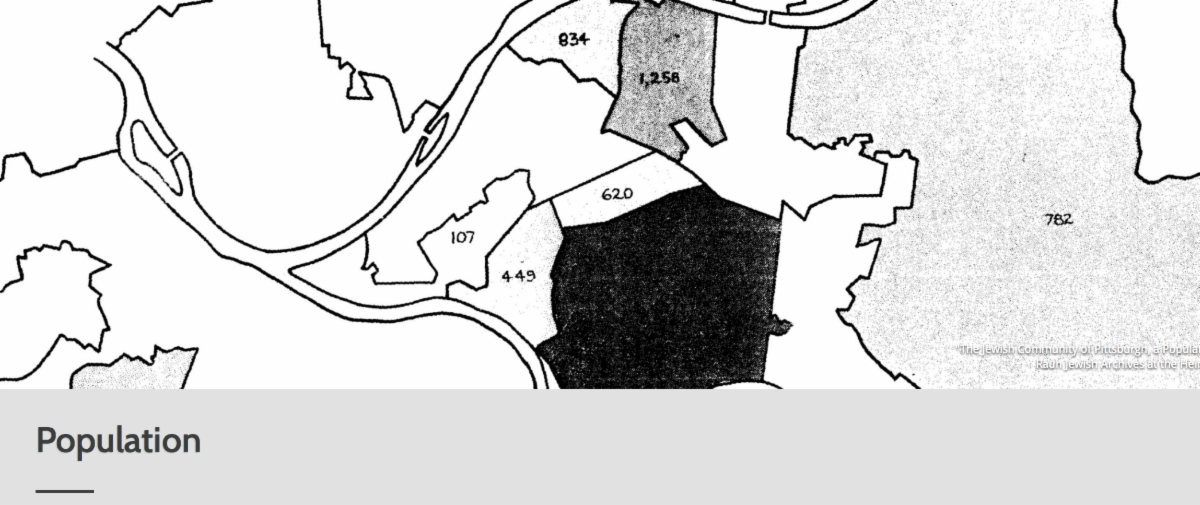
Looking to figure out how many Jews lived in a certain part of Western Pennsylvania at a certain moment in time? This bibliography includes more than 30 estimates of the Jewish population of Pittsburgh and small-towns throughout the region, conducted between 1852 and 2017. | |
| |
|
A database of buildings throughout Western Pennsylvania known to have hosted Jewish worship services. Includes links to photographs and citations with original source material. Database currently includes 57 locations from 18 institutions | |
Rauh Jewish Archives Newsletter | |
The Rauh Jewish Archives has been publishing a weekly newsletter since 2020. The newsletter contains a variety of articles about local Jewish history, including much original research not found anywhere else. You can find and read every issue—more than 150!— in our new index. | |
|
[IMAGE: Marian Schreiber and employees at the Schreiber Trucking Company, c.1943—from Schreiber Family Papers and Photographs, MSS 846.]
If you like this newsletter, why not forward it to a friend? We want to share the story of Western Pennsylvania Jewish history with as many people as possible.
If you've received this newsletter from a friend or neighbor, and you want to read more, just click on the link below to start receiving future editions.
| |
The Rauh Jewish Archives was founded on November 1, 1988 to collect, preserve, and make accessible the documentary history of Jews and Jewish communities of Western Pennsylvania. You can help the RJHPA continue its work by making a donation that will directly support the work being done in Western Pa. | | | | |