|
Now Showing:
Yiddish Newspapers in Pittsburgh
Restaurants:
2203 Murray Ave. (Part 2)
The Jewish Encyclopedia:
Self-Study on Jewish Education
Family Clubs:
Rebecca Bernstein Cousins Club
Calendar:
April 16: Tammy Hepps
May 21: W. Todd Knowles
Community:
Under the Dome of Rodef Shalom
JCBA "Road-Trip"
Shantytown
Jewish Daily Forward exhibit
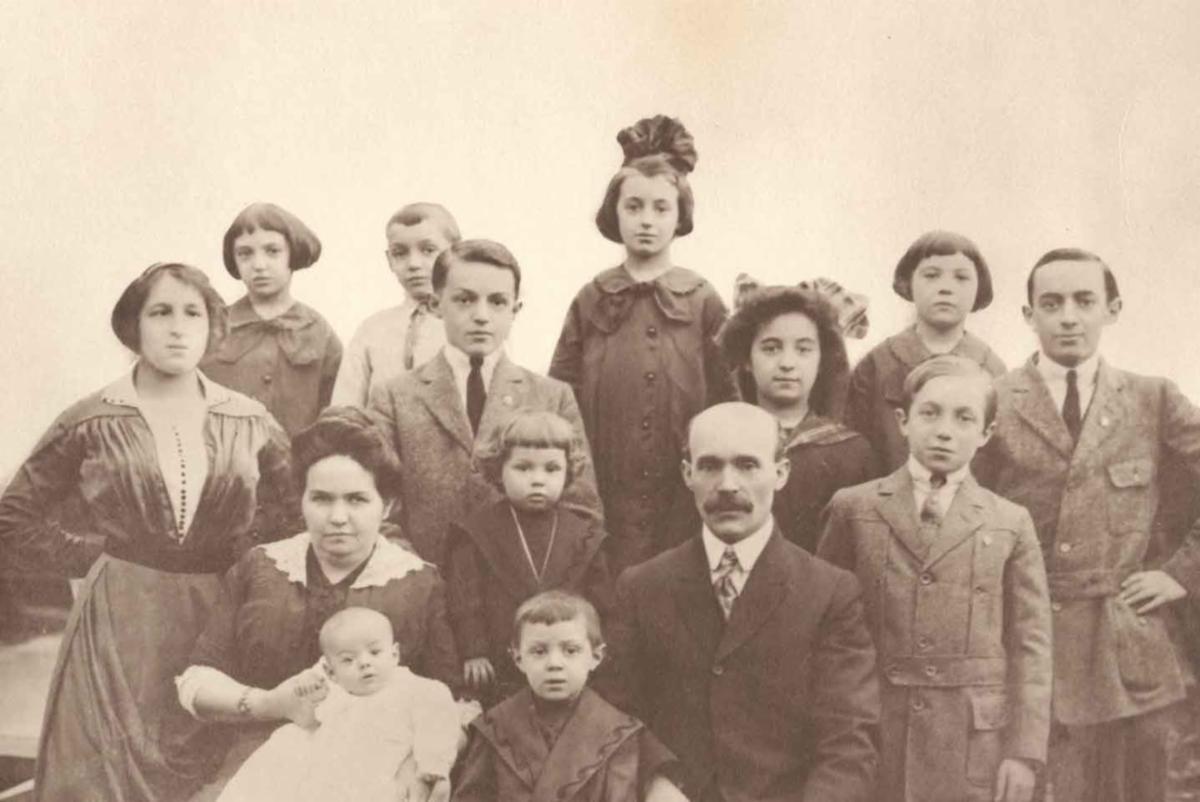
Mystery portraits
Research Tools:
Newspapers, Cemeteries, Memorial Plaques, Books, Newsletters
| |
|
|
Now Showing:
The Jewish Forward and Beyond:
Yiddish Newspapers in Pittsburgh
| |
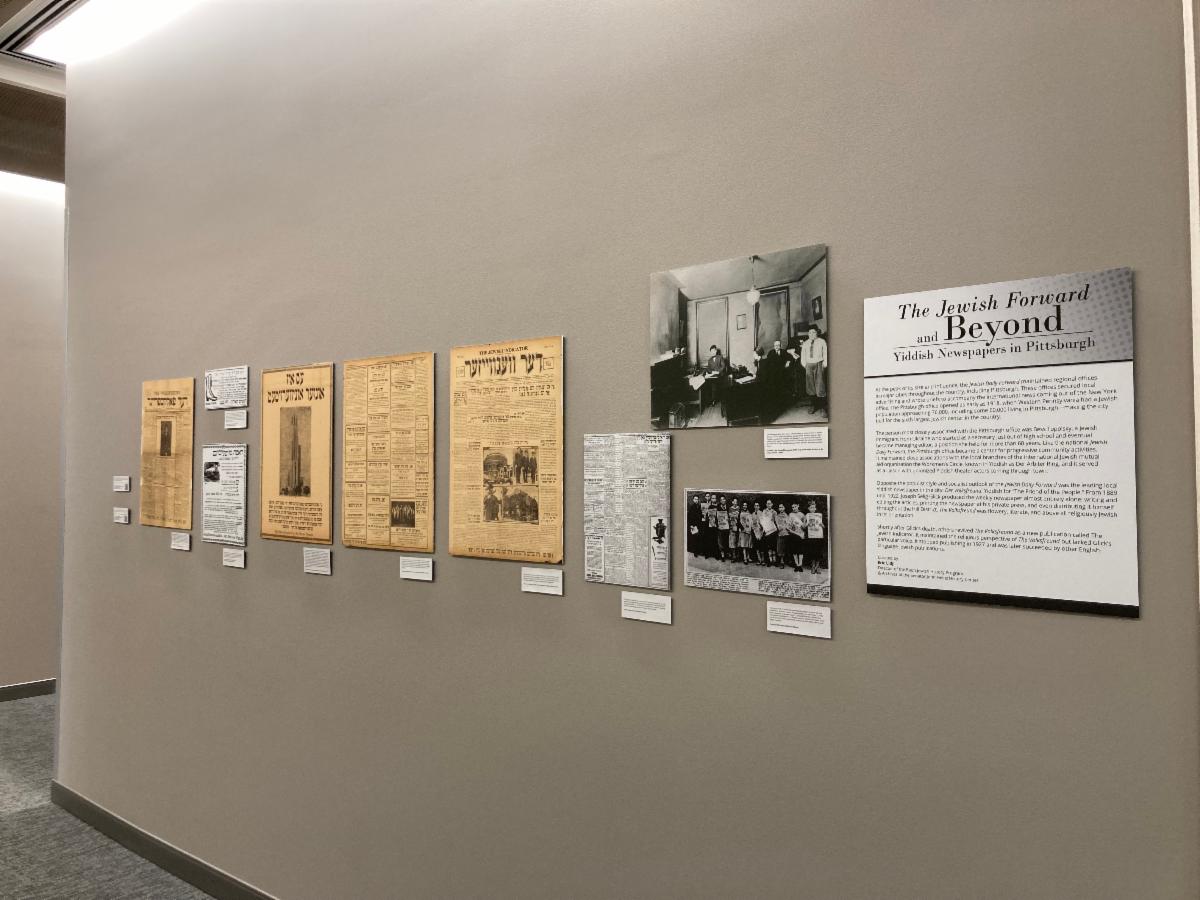
Photograph showing Yiddish newspaper display at Hillman Library. | |
As part of the exhibit “Pressed: Images from the Jewish Daily Forward” (see Community section below), the Rauh Jewish Archives has created a display surveying the history of local Yiddish newspapers in Pittsburgh. The display includes enlarged reproductions of pages and advertisements from The Volksfreund, the Jewish Indicator, and the regional office of the Forward.
The display will be up through April 2023 on the first floor of Hillman Library on the main campus of the University of Pittsburgh during normal library hours.
| |
|
Restaurants:
2203 Murray Ave. (Part 2)
| |
|
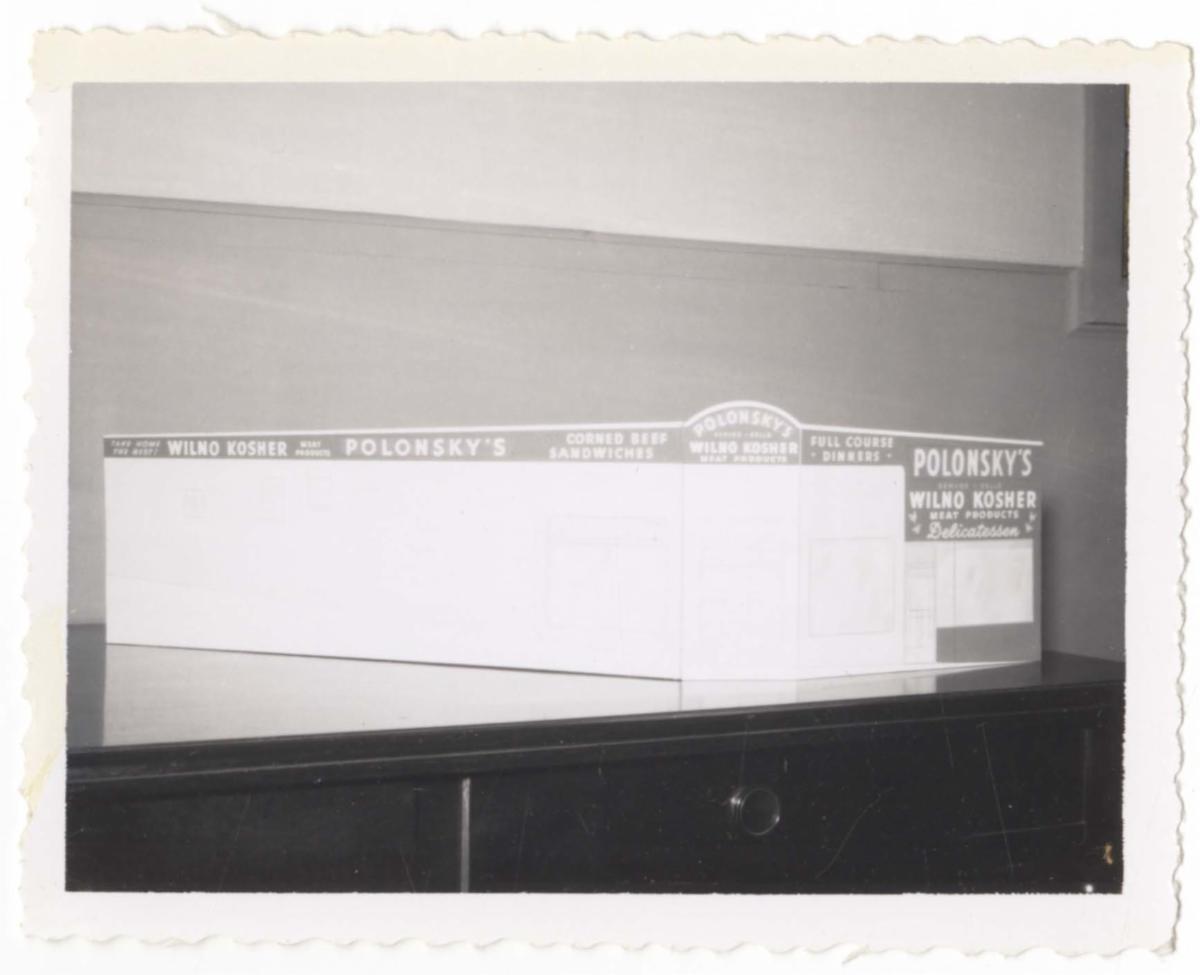
Photograph showing mock-up of façade for Polonsky’s Deli at Murray and Douglas in Squirrel Hill, created by the McBride Sign Company.
—from McBride Sign Company Photographs [1997.0097]
| |
|
In the early 1950s, after a decade overseeing the Hebrew National Delicatessen at 2203 Murray Ave., Abe N. Polonsky made several changes.
Polonsky expanded into the building next door at 2201 Murray Ave. He changed the name of the restaurant to Polonsky’s Deli. And he updated the façade. We’ve yet to find any photographs of the building, but we have a photograph (above) showing a mock-up created by the McBride Sign Company with a proposed design for the facade. It advertises Wilno Kosher Meat Products, suggesting that Polonsky had parted ways with Hebrew National.
| |
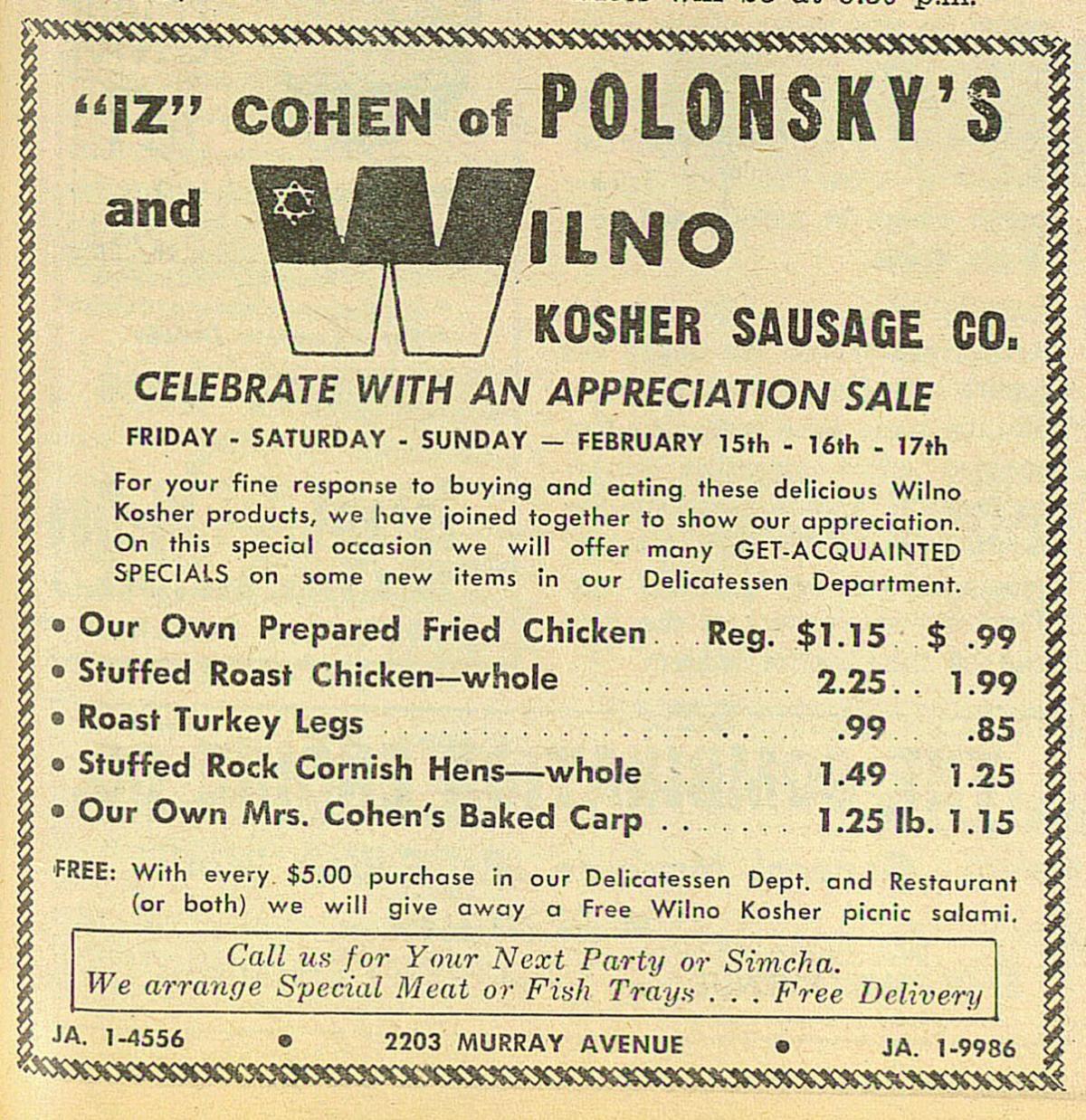
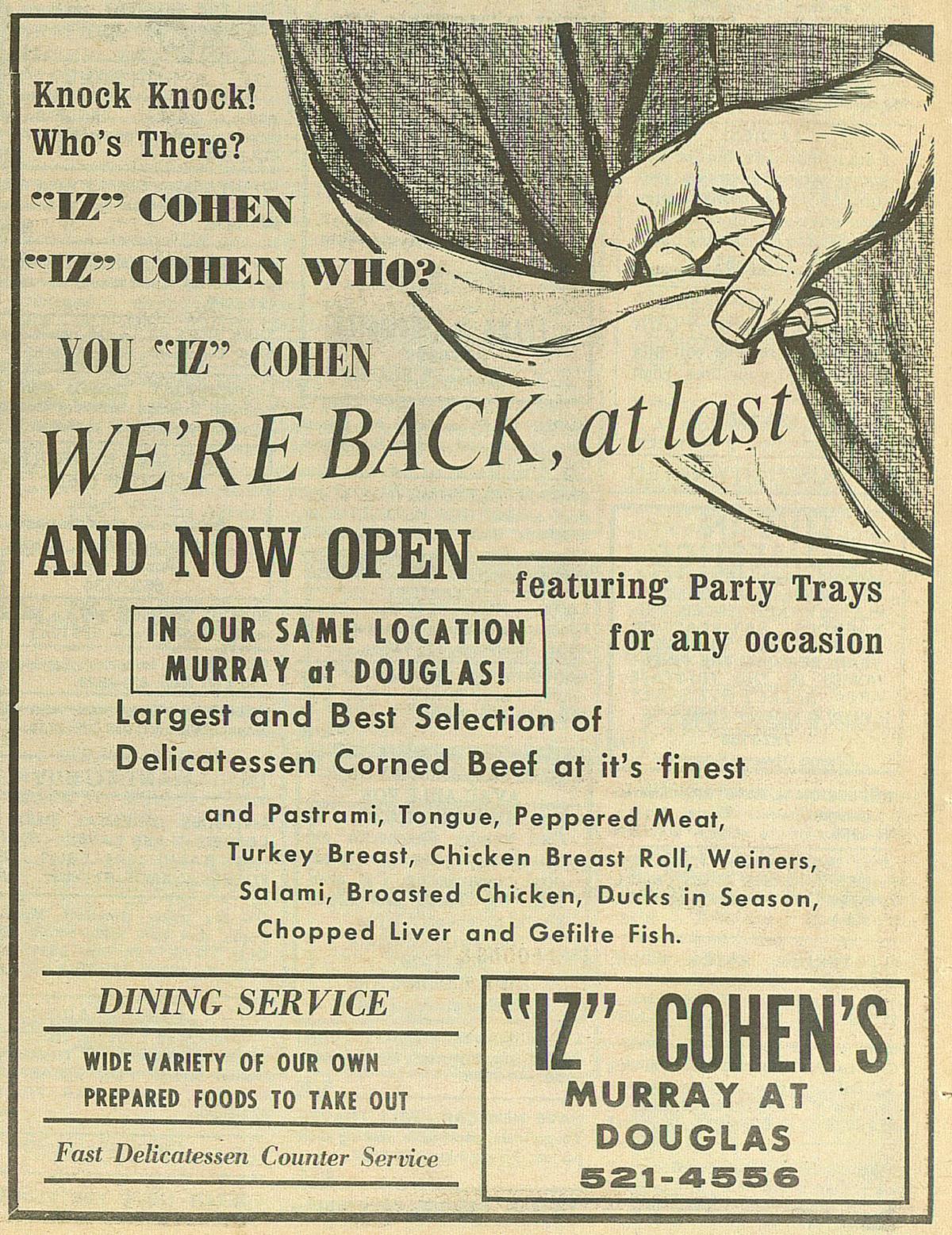
[LEFT] Advertisement for Iz Cohen of Polonsky’s at 2203 Murray Ave. in Squirrel Hill. Advertises Wilno Kosher Sausage Co. products. (Jewish Chronicle, February 15, 1963, Pittsburgh Jewish Newspaper Project); [Right] Advertisement for Iz Cohen of Polonsky’s at 2203 Murray Ave. in Squirrel Hill. Announces reopening following repairs after fire damage. (Jewish Chronicle, August 7, 1969, Pittsburgh Jewish Newspaper Project). | |
|
Abe Polonsky died in 1961. His son Gilbert briefly ran the business before selling to Iz Cohen, who had been running a nearby poultry market.
The restaurant was known as Iz Cohen of Polonsky’s until 1969, when the building was damaged in a fire. It reopened in 1970 as Iz Cohen’s Delicatessen, under the management of Robert and Rhoda Shugerman and Charles Criswell. Throughout the early 1970s, Iz Cohen’s Delicatessen ran an annual one-day promotion where the entire daily receipts from the restaurant were donated to the Israel Emergency Fund at the United Jewish Federation.
| |
|
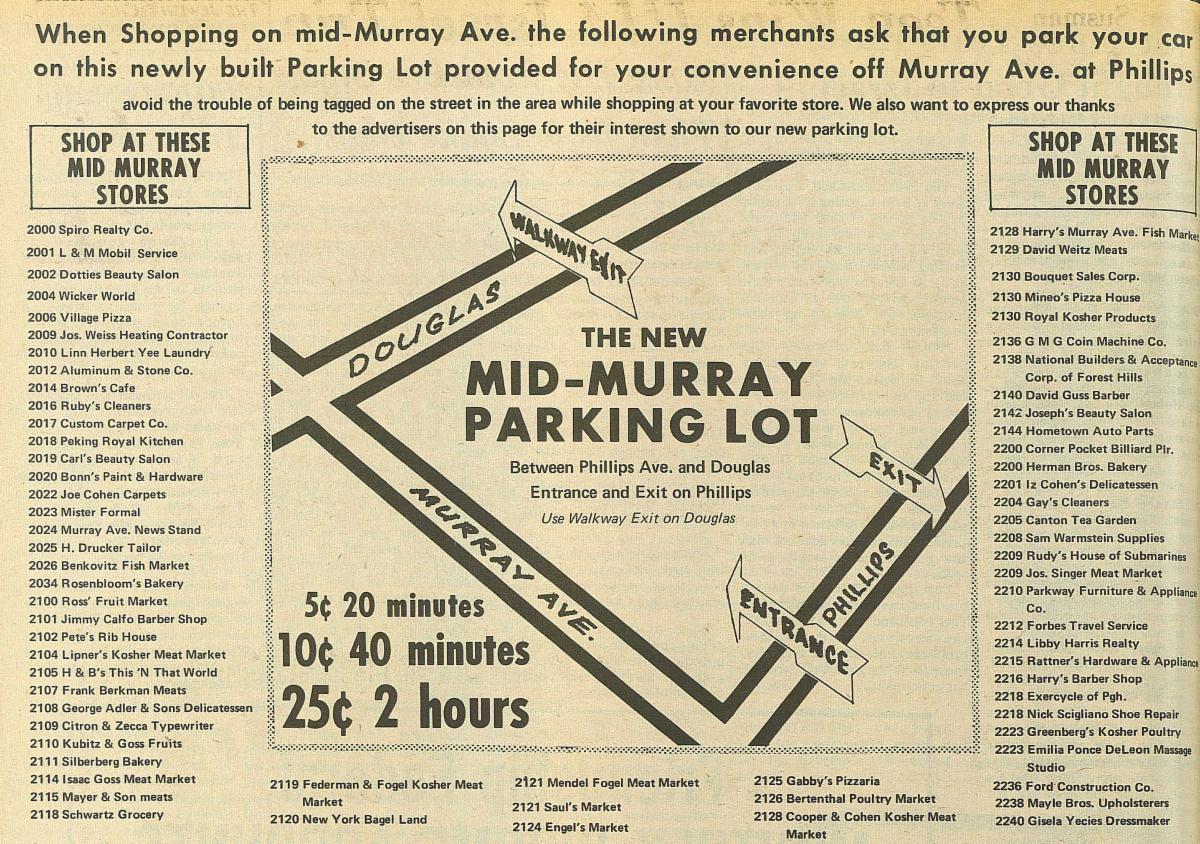
Advertisement for the new Mid-Murray Parking Lot.
—Jewish Chronicle, July 2, 1970 [Pittsburgh Jewish Newspaper Project]
| |
Iz Cohen’s Delicatessen benefitted from the opening of the Mid-Murray Parking Lot behind the restaurant in 1970. The lot was part of a decades-long effort by local groups and elected officials to improve the business climate of Squirrel Hill by expanding parking options in the business distric. Having it directly behind the restaurant certainly must have helped business through the years. | | |
|
|
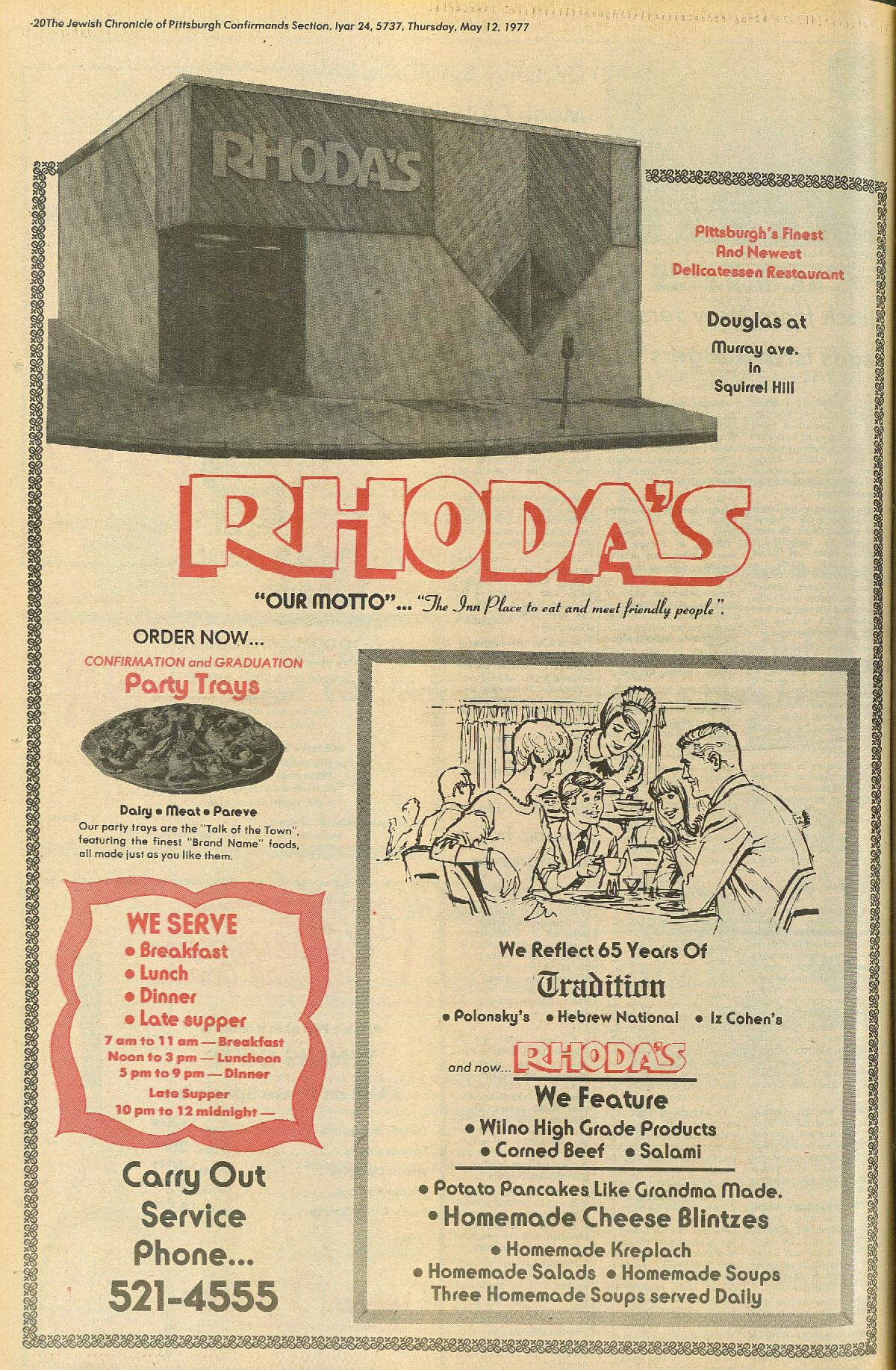
Iz Cohen’s Delicatessen became Rhoda’s in May 1977. In an early advertisement, the Shugermans marked Rhoda's as a link in a chain: “We reflect 65 years of tradition: Polonsky’s, Hebrew National, Iz Cohen and now… Rhoda’s.”
The Shugermans retired and passed the business to their daughters Amy Shugerman-Glasser and Pamela Shugerman, their nephew David Kendall, and their son-in-law Jack Glasser. The second generation expanded the building to the rear, nearly tripling the seating capacity.
Rhoda’s Delicatessen included a restaurant called The Eatery with seating for 117 and a small grocery store. It also had a liquor license and sold beer to go. The restaurant menu featured traditional deli items and diner breakfast specials but also expanded over the years to include non-traditional items such as stir-fry and lemon pepper fish.
| |
|
Advertisement for Rhoda’s Delicatessen at 2201-2203 Murray Ave. in Squirrel Hill. Announcing establishment of restaurant. Advertises breakfast, lunch, dinner, late supper, and party tray, as well as specific dishes. Lists predeccesor establishments Hebrew National, Polonsky’s, and Iz Cohen’s. Includes photograph of building.
—from Jewish Chronicle, May 12, 1977 [Pittsburgh Jewish Newspaper Project]
| |
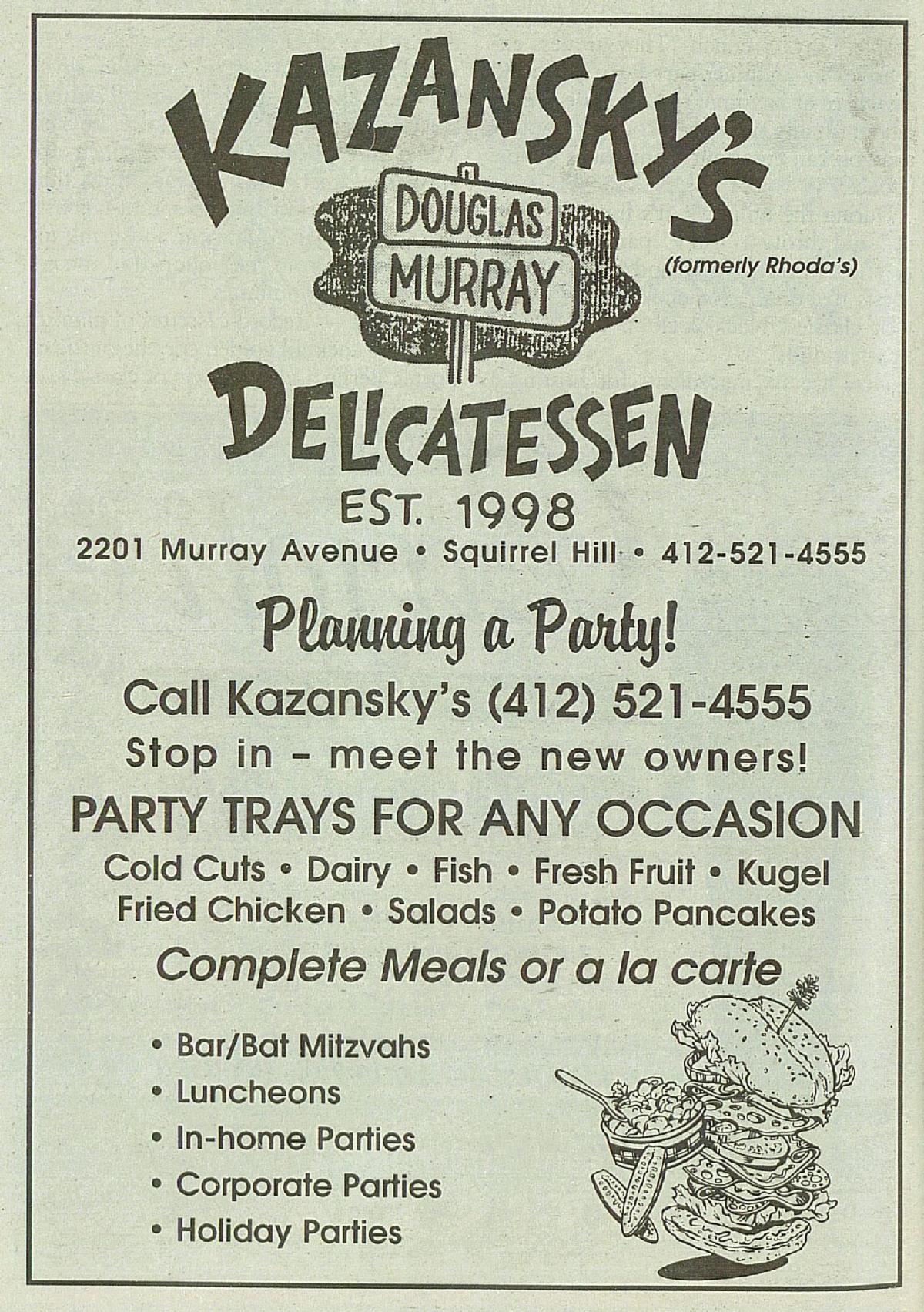
The Shugerman family sold Rhoda’s Delicatessen in 1998 to local restaurateurs Brian Bennett, Paul Krause, and Mark Riley. They changed the name to Kazansky’s. They maintained many of the traditional deli items from the Rhoda’s Delicatessen menu, while removing others and adding explicitly non-kosher products to the menu for the first time. They sold the business in 2010, ending the 82-year history of Jewish delicatessens at that address. | |
Advertisement for Kazansky’s Delicatessen at 2201 Murray Ave. Advertises catering for parties and life-cycle events.
—from Jewish Chronicle, August 28, 1998 [Pittsburgh Jewish Newspaper Project]
| |
|
The available records for the series of restaurants located at 2201-2203 Murray Ave. is slim, comprising a selection of newspaper advertisements and the one facade mock-up photograph above. Do you have any memories, menus, photographs, or other documentation of these Jewish restaurants? | |
Next Week: The Delis and Passover (Part 1) | |
All year, the Rauh Jewish Archives is highlighting Jewish restaurants in Western Pennsylvania. If you would like to donate a material from a Jewish restaurant, or just reminisce, contact the archive or call 412-454-6406. | |
|
Jewish Encyclopedia of Western Pennsylvania
Self-Study on Jewish Education
| |
|
Cover of “Jewish Education in Pittsburgh, a Self Study,” sponsored by the United Jewish Fund of Pittsburgh in consultation with Uriah Zevi Engelman (Department of Research and Information, American Association for Jewish Education) and David Bonder (National Jewish Welfare Board, Mid-West Central Region), May 1951.
—from Jewish Federation of Greater Pittsburgh Records [MSS 287].
| |
|
The Self Study on Jewish Education was a communitywide survey of Jewish educational resources in Pittsburgh. The study made a comprehensive assessment of the funding, facilities, and teacher training at Jewish schools, as well as student and parent attitudes.
The United Jewish Fund undertook the study in 1950 with the assistance of Dr. Uriah Engelman of the American Association of Jewish Education and David Bonder of the National Jewish Welfare Board, as well a local committee. The study conducted research through the spring and early summer of 1950, leading to a seven-part report published in the local Jewish press between late September and early November 1950 and a full report presented to the United Jewish Fund in May 1951. The report recommended the creation of a Pittsburgh Board of Jewish Education to improve local Jewish education.
Our entry for the Self Study on Jewish Education includes the seven-part public report as it appeared in the Jewish Criterion, as well as the full committee report from 1951.
| |
The Jewish Encyclopedia of Western Pennsylvania brings together numerous online resources into a clearinghouse for conducting research about Jewish history in this region. As we migrate information to this new website, we’ll be announcing new entries and resources in this section of the newsletter. | |
|
Family Clubs:
The Rebecca Bernstein Cousins Club
| |
|
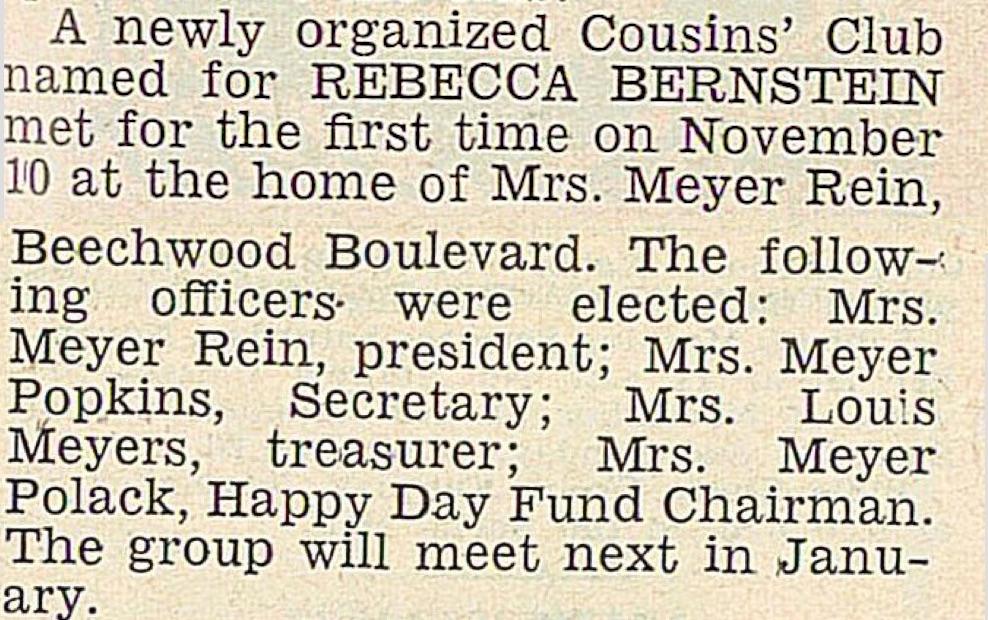
First notice of the Rebecca Bernstein Cousins Club.
—from Jewish Criterion, Nov. 11, 1955 [Pittsburgh Jewish Newspaper Project].
| |
|
Rebecca Bernstein died in November 1952, at the age of 67. She was survived by her husband Joseph Bernstein, their six children (Meyer, Morton, Morris, Phillip, Freda Gould, and Selma Blonstein), and their eight grandchildren.
Almost exactly three years later, on November 10, 1955, the second and third generations of the family formed the Rebecca Bernstein Cousins Club. The latest known documentation of the club was published in April 1964.
Known surnames in the Rebecca Bernstein Cousins Club include Bernstein, Blonstein, Bretton, Gould, Hollander, Kitman, Lecov, Levenson, Meyers, Podolsky, Pollack, Polack, Popkins, Rein, Rom, Roth, Stein, and Sukolsky. Known meeting places include Beechwood Blvd. (Meyer Rein residence), Beechwood Blvd (Jack Kitman residence), Beechwood Blvd. (Philip Bernstein residence), 2755 Beechwood Blvd. (Louis Meyers residence), Phillips Ave. (Martin Bernstein residence), Wightman Street (Burton Blonstein residence), 2352 Pittock St. (Joseph Blonstein residence), Dalzell Place (Nathan Sukolsky residence), Tilbury Street (Jack Gould residence), Negley Avenue (Morton Bernstein residence), the Morrowfield Apartments (Elizabeth Rom residence), Portland Street (Ted Lecov residence), 1011 Mellon Street (Meyer Polack residence), and the D. Blonstein residence, with special events at the Holiday House, the Penn-Shady Hotel, the Nixon Theatre, and the Ruskin Dining Room.
Do you have any information about the Rebecca Bernstein Cousins Club?
| |
|
April 16:
JGS-Pittsburgh presents:
"When Henry Silverstein Got Cold: How Terrible Enumerators Help Us Do Better Census Research"
with Tammy Hepps
| |
IMAGES (clockwise from upper left): Tammy Hepps; Google Map showing households included in Enumeration District 144 of Homestead's Third Ward in the 1920 Census; Section of page 11A, Homestead Ward 3, ED 144 of the 1920 Census. Handwritten text reads, "Here Ends Enumeration of District 144 Homestead Borough Henry Silverstein." | |
On Jan. 2, 1920, Henry Silverstein began his first day as a census enumerator by turning left instead of right. Things went downhill from there, and within days he became so overwhelmed that he resorted to an illegal scheme to finish the job. Through this shocking story and the painstaking detective work that uncovered it, you’ll come to see the census—and your ancestors’ presence or absence in it—in a whole new light. You’ll laugh at Henry’s misdeeds, and you’ll grow your census research skills. | |
|
The program is Sunday, April 16 from 11-1:30 p.m. ET. This is a hybrid program. It is designed for in-person attendance but will have a virtual option.
“When Henry Silverstein Got Cold: How Terrible Enumerators Help Us Do Better Census Research” is a collaboration between the Jewish Genealogy Society of Pittsburgh and the Rauh Jewish Archives at the Heinz History Center. Please register online. The program is free for JGS-Pittsburgh members and the general public. To become a member of the JGS-Pittsburgh and receive a free membership code for this program, please visit its website.
This program will be recorded and made available to current JGS-Pittsburgh members. Those who attend in person are encouraged to stick around after the program for refreshments and a meet-and-greet with JGS members.
This program is possible through the support of the William M. Lowenstein Genealogical Research Endowment Fund of the Jewish Community Foundation.
| |
Tammy Hepps is a historian of the Jewish experience in Western Pennsylvania. She combines in-depth historical research with techniques from technology and genealogy to reconstruct overlooked stories from the past in an engaging way. She has presented her findings around the world, including the Library of Congress and the International Jewish Genealogy Conference in Jerusalem. Her best-known research is into the history of the Jewish community in the former steel-making center of Homestead, PA (HomesteadHebrews.com). Tammy earned her AB in computer science from Harvard and is a Wexner Heritage Fellow. | |
|
May 21:
JGS-Pittsburgh presents:
"Using FamilySearch for Jewish Research"
with W. Todd Knowles
| |
|
Billions of family records. Where do you start?
FamilySearch is an international, nonprofit dedicated to helping all people discover their family story. It is one of the largest genealogical websites online and grows larger every day. Learn how to make the most of the FamilySearch collection, with a special focus on locating Jewish ancestors among the records.
The program is Sunday, May 21 from 1:00-3:00 p.m. ET. This is a virutal program, occurring only online. “Using FamilySearch for Jewish Research with W. Todd Knowles” is a collaboration between the Jewish Genealogy Society of Pittsburgh and the Rauh Jewish Archives at the Heinz History Center. Please register online. The program is free for JGS-Pittsburgh members and $5 for the general public. To become a member of the JGS-Pittsburgh and receive a free membership code for this program, please visit its website.
This program will be recorded and made available to current JGS-Pittsburgh members. Those who attend in person are encouraged to stick around after the program for refreshments and a meet-and-greet with JGS members.
This program is possible through the support of the William M. Lowenstein Genealogical Research Endowment Fund of the Jewish Community Foundation.
| |
W. Todd Knowles, AG, is a Deputy Chief Genealogical Officer at FamilySearch, where he has been for almost 25 years. Soon after being introduce to family history at the age of 12, he discovered his Jewish roots. The journey to find these Polish Jews led to the Knowles Collection, six databases containing the records of almost 1.5 million people. His blog about the collection can be found at knowlescollection.blogspot.com. | |
From NEXT Pittsburgh
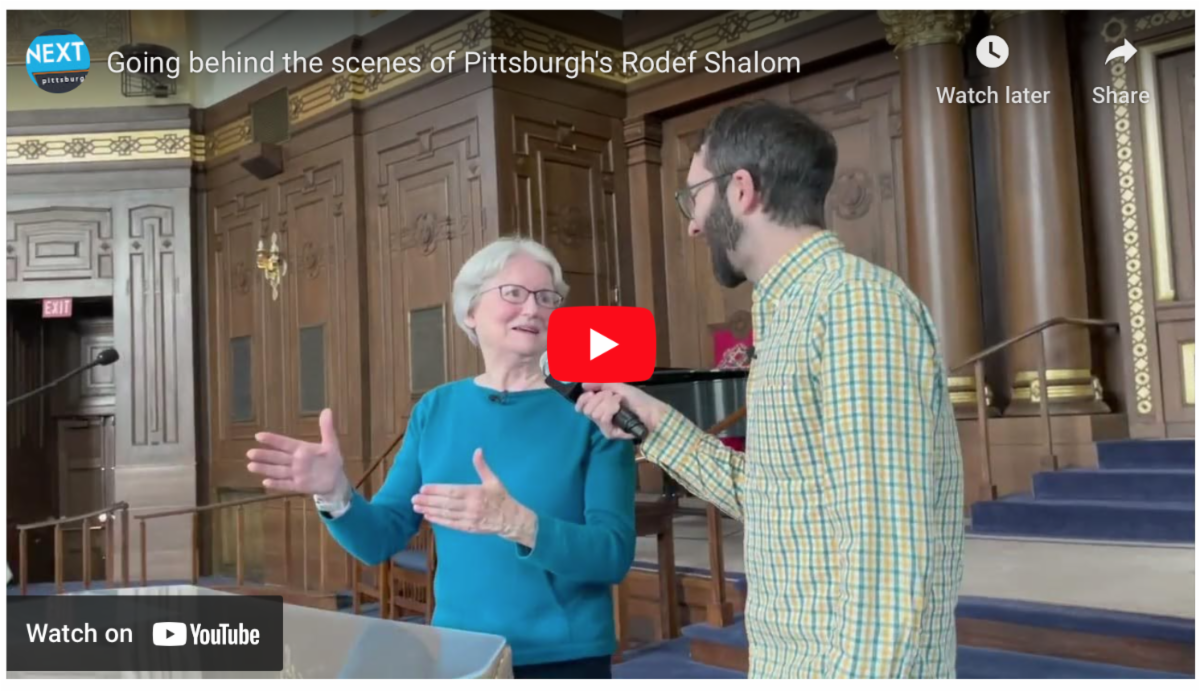
"What's Under the Dome at Rodef Shalom?"
| |
NEXT Pittsburgh's Boaz Frankel visits with archivist Martha Berg to discover the secrets of Rodef Shalom Congregation's historic Fifth Avenue synagogue. | |
From the Jewish Cemetery & Burial Association
"Road Trip: The Jewish Cemeteries of Western Pennsylvania"
| |
|
The Jewish Cemetery and Burial Association of Greater Pittsburgh has released a new documentary showcasing Jewish cemeteries in Western Pennsylvania.
“Road Trip: The Jewish Cemeteries of Western Pennsylvania” is a one-hour tour of the many cemetery properties overseen by the JCBA, as well as an overview of the organization’s ongoing work to care for these sacred burial grounds. The video is a wonderful opportunity to celebrate these special Jewish cultural sites in our region. The video includes many historic photographs and documents from the collections of the Rauh Jewish Archives.
| |
From the Pittsburgh Playwright Theatre Company
SHANTYTOWN
The Ballad of Fr. James Cox: A Musical
| | |
|
|
Father James Cox was the pastor of Old St. Patrick’s Church during the Great Depression. He printed the first food stamps, fed almost 3 million people, led a major march on our national’s capital with 25,000 jobless, and was even nominated for President. He was one of the first preachers on national radio, defended Jewish Americans, and went head-to-head against antisemites.
But who was the man behind it all?
“SHANTYTOWN: The Ballad of Fr. James Cox” explores the forgotten tale of Fr. Cox and celebrates what he accomplished—his courage, his ideas, his love for his people, his rise to near sainthood, and his survival of a federal trial for a lottery scam.
The musical also considers Father Cox's longstanding friendship with Henry Ellenbogen, using materials from the Rauh Jewish Archives.
| |
|
Performances runs March 11-26 at Madison School, 3401 Milwaukee St.
Book, music and lyrics by Ray Werner
Composer and Music Director: Dwayne Fulton with arrangements by Mike Gallagher, Bruce Foley, Jerry McCarthy and Walter Woodward
Directed by Gregory Lehane
| |
From the Jewish Studies Program
PRESSED: Images from the Jewish Daily Forward
| |
Detail from front page of Jewish Daily Forward, including photograph showing President and First Lady Kennedy, 1960. | |
|
Founded in 1897 on Manhattan’s Lower East Side, the Jewish Daily Forward became the most widely read Jewish news source anywhere. By the 1920s, this Yiddish-language daily had more readers than the New York Times. With rigorous reporting, incisive editorials and powerful commentary, the Forward chronicled the events that affected immigrants eager to earn their place in American life. This was the paper read by congregants from its neighborhood’s many synagogues, by families squeezing into tenement apartments, by sweatshop workers and pushcart vendors. Its articles were debated on park benches and at local haunts like the Garden Cafeteria and the Royal Café, its discarded pages then used to wrap fish for Friday night Sabbath eve dinners. The Forward’s ideals have been held dear for generations of readers, not just on the Lower East Side but across the country and around the world.
The new exhibit Pressed at Hillman Library on the University of Pittsburgh campus looks into the vast Forward archive to present a selection of metal plates used to print photographs in the paper from the 1920s to the 1960s. These plates are accompanied by prints made just for this exhibition. These prints have rendered the images with greater clarity than they had as dotted, halftone prints in the newspaper. The Forward pages on which some of these images appeared are also displayed. These pages are enlarged and reproduced from microfilm and photographs because printed copies of the newspaper have not been preserved at the Forward or in any other archive, although they occasionally pop up at auction or in private collections. Together these images of strikes and activists, Yiddish theater stars and baseball players, daily life and historic moments, present the depth and breadth of this singular publication, its audience and Jewish life in America and around the world.
Pressed is organized by the Forward in collaboration with the Museum at Eldridge Street, and hosted by the University of Pittsburgh Library System and the Jewish Studies program. It will remain on display through April 2023.
| |
From Rodef Shalom Congregation
A mystery in primary colors
| |
The Pittsburgh Jewish Chronicle reports on an effort by Rodef Shalom Congregation to identify two people from a pair of mid-19th century portraits in the congregation's holdings. Do you recognize these two people? | |
Pittsburgh Jewish Newspaper Project | |
The Pittsburgh Jewish Newspaper Project contains digitized, searchable copies of four local English-language Jewish newspapers between 1895 and 2010. It is a valuable tool for researching almost any topic about Jewish history in Western Pennsylvania. For a primer on using the website, watch our video. | |
|
Western Pennsylvania Jewish Cemetery Project | | |
|
The Rauh Jewish Archives launched the Western Pennsylvania Jewish Cemetery Project in 1998 to preserve burial records from Jewish cemeteries across the region. Over a period of fifteen years, the information was compiled into a searchable, online database containing approximately 50,000 burial records from 78 Jewish cemeteries throughout the region. | |
Western Pennsylvania Yahrzeit Plaques Project | |
The Rauh Jewish Archives launched the Western Pennsylvania Yahrzeit Plaques Project in 2020. The goal was to create a comprehensive collection of burial records from memorial boards at synagogues across the region. Volunteers are currently transcribing these boards and records are being added monthly to our online database. The database currently contains almost 400 listings. | |
|
Rauh Jewish Archives Bibliography | | |
|
University of Pittsburgh librarian and Rauh Jewish Archives volunteer Laurie Cohen created this comprehensive bibliography of the Rauh Jewish Archives library holdings from 1988 through 2018. It lists nearly 350 volumes arranged by type and then by subject. This a great tool to use early in your research process, as you’re surveying available resources on a given subject. | |
Rauh Jewish Archives Newsletter | |
The Rauh Jewish Archives has been publishing a weekly newsletter since 2020. The newsletter contains a variety of articles about local Jewish history, including much original research not found anywhere else. You can find and read every issue—more than 150!— in our new index. | |
|
[IMAGE: Marian Schreiber and employees at the Schreiber Trucking Company, c.1943—from Schreiber Family Papers and Photographs, MSS 846.]
If you like this newsletter, why not forward it to a friend? We want to share the story of Western Pennsylvania Jewish history with as many people as possible.
If you've received this newsletter from a friend or neighbor, and you want to read more, just click on the link below to start receiving future editions.
| |
The Rauh Jewish Archives was founded on November 1, 1988 to collect, preserve, and make accessible the documentary history of Jews and Jewish communities of Western Pennsylvania. You can help the RJHPA continue its work by making a donation that will directly support the work being done in Western Pa. | | | | |