|
Ponzi Scheme Operators are Sentenced to Prison for $4 Million Investment Fraud
| |
NC Secretary of State Elaine F. Marshall joined U.S. Attorney for the Western District of North Carolina, Dena King, in December in announcing the sentencing of Austin Delano Page and Brandon Alexander Teague for a $4 million investment scam following an investigation by the Secretary of State’s Securities Division, the FBI and the U.S. Postal Inspection Service. | |
|
Page, 27, of Grover, N.C., was sentenced to just over 8 years in prison, followed by two years of supervised release. Teague, 27, of Belmont, N.C., was sentenced to 4 years in prison and two years of supervised release. The defendants were also ordered to pay restitution in the amount of more than $4.1 million.
“The defendants orchestrated an elaborate investment fraud scheme that caused extensive financial harm to their unsuspecting victims, some of whom were at or near retirement age,” said U.S. Attorney King. “Working with our law enforcement counterparts we will continue to investigate and prosecute scoundrels who cheat and lie their way into their investors’ pockets, only to squander away their victims’ money.”
“People placed their faith as well as their funds with Mr. Page and Mr. Teague. That trust was repeatedly broken over the course of this scam as Page and Teague spun false promises and falsified documents to create a fiction of highly lucrative trading, at one point indicating a $16 million balance for a brokerage account that was in fact broke, with a balance of under $7. Calling our Securities Division would have revealed that neither Page nor Teague were registered to sell securities in North Carolina, and that should always send up a major red flag for anyone considering an investment,” said Secretary Marshall.
“The U.S. Postal Inspection Service has been at the forefront of protecting consumers from fraud schemes for many years,” said Tommy D. Coke, Inspector in Charge of the Atlanta Division of the U.S. Postal Inspection Service (USPIS). “The U.S. Postal Inspection Service is proud to work along our fellow law enforcement partners and hold accountable anyone who engages in this type of financial fraud scheme.”
According to filed documents and court hearings, from October 2020 to December 2021, Page, assisted by Teague, engaged in an investment scheme that defrauded hundreds of investors of more than $4 million. Court documents show that the defendants falsely represented to victims that Page and Teague were operating D&T Investment Group (D&T), a hedge fund in Kings Mountain, N.C., that invested in various securities, including stock of well-known companies like Apple. Contrary to representations made to victim investors, D&T was not a hedge fund and it did not hold any securities licenses or registrations. Also, Page and Teague were not licensed to sell securities and did not have a background associated with the sale of securities.
According to court documents, Page was largely responsible for the “trading” side of the D&T business while Teague was largely responsible for the “back office” side of the D&T business. Both Page and Teague, as well as other D&T employees, were involved in the solicitation of investors. Page and Teague had investors sign, among other documents, an investment contract with D&T. These documents contained false information, including that D&T would guarantee 100% of the investors’ initial investment, and that investors would receive 70% of the trading profits.
In reality, the investors’ money was not guaranteed, and the purported profits investors received were Ponzi-style payments, whereby the defendants used new investors’ money to make payments to existing investors. To cover up the fraud, Page caused Teague to send victim investors monthly statements that reflected fictitious trading gains, which Page had falsely reported to Teague. When certain investors and D&T employees, including Teague, began to question the legitimacy of D&T’s operations, Page created fictitious screenshots of various financial accounts that reflected inflated D&T account balances.
In addition to using a portion of the funds to make Ponzi payments, the defendants spent a significant portion of the investors’ money to pay excessive salaries and other compensation to D&T employees, including to members of Page’s family. Page also used victims’ money to pay for personal expenses such as clothing, jewelry, travel, luxury car rentals, and entertainment.
On December 2, 2021, as the fraudulent scheme was collapsing, the defendants traveled to Italy. On the same day, Page informed D&T employees, who did not know that D&T was a fraud, that they would be closing the company. The defendants were arrested on New Year’s Eve at JFK Airport in New York upon their voluntary return to the United States.
On April 20, 2022, Page pleaded guilty to wire fraud and Teague to securities fraud. They are currently released on bond and will be ordered to report to the federal Bureau of Prisons to begin serving their prison sentences upon designation of a federal facility.
In making the announcement U.S. Attorney King thanked the Securities Division of the North Carolina Secretary of State, the FBI and USPIS for their investigation of the case.
Assistant U.S. Attorney Daniel Ryan of the U.S. Attorney’s Office in Charlotte, prosecuted the case.
| |
|
California Man Extradited from Australia to Face Charges for Investment Scheme
Gustavo Guzman is facing charges in an alleged $2 million investment fraud scheme following an investigation by the FBI in Charlotte and the Secretary of State’s Securities Division. Guzman, 59, previously of Fullerton, Calif., made his initial appearance in federal court in Charlotte following his extradition from Australia. Guzman is facing wire fraud, securities fraud and transactional money laundering charges.
NC Secretary of State Elaine F. Marshall joined Dena J. King, U.S. Attorney for the Western District of North Carolina, as well as Michael C. Scherck, Acting Special Agent in Charge of the Federal Bureau of Investigation (FBI), Charlotte Division in making the announcement.
According to allegations contained in the indictment, from April 2010 to August 2015, Guzman, through various entities he controlled, including G2 Asset Management and East Egg Private Equity, executed a scheme to defraud approximately 10 investors of at least $2 million, by falsely representing that he would use the investors’ money to trade in options and other similar investments.
Instead of investing the funds as promised, Guzman allegedly stole a substantial portion of the investors’ money and used it to fund his personal lifestyle, including to make large credit card payments and cash withdrawals, and to pay for personal expenditures.
As alleged in the indictment, Guzman suffered massive trading losses with the money that he did invest and used some of the victim’s money to make Ponzi-style payments to investors. To conceal the trading losses and the fraudulent scheme, and to prevent his victims from redeeming their investments and complaining to authorities, the indictment alleges that Guzman lied to his victims about the status of their investments, and provided them with fake documents, including sham IRS forms and fraudulent account statements.
The wire fraud charge carries a sentence of up to 20 years in prison and a $250,000 fine. The securities fraud charge carries a statutory sentence of up to 20 years in prison and a $5 million fine, and the transactional money laundering charge carries a penalty of up to 10 years in prison and a fine of up to $250,000 or not more than twice the amount of the criminally derived property involved in the transaction.
The charges contained in the indictment are allegations. The defendant is innocent until proven guilty beyond reasonable doubt in a court of law.
The investigation was conducted by the FBI in Charlotte and the Securities Division of the North Carolina Department of the Secretary of State. The U.S. Securities and Exchange Commission conducted a parallel investigation that resulted in the entry of a default judgment against Guzman in Civil Action No. 3:17-cv-00276 (WDNC). The Department of Justice also appreciates the significant assistance provided by the Department’s Office of International Affairs, the Government of Australia, including the Attorney General’s Department of Australia and the Australian Federal Police, in securing the extradition of Guzman and obtaining evidence from Australian authorities.
Assistant U.S. Attorney Daniel Ryan of the U.S. Attorney’s Office in Charlotte is prosecuting the case.
| |
|
Rural RISE Launches on sosnc.gov
| |
The Secretary of State’s Rural RISE NC Initiative continues to expand across North Carolina to provide a roadmap to an array of free or low-cost resources to help businesses prosper – and now the initiative has a home on the Agency’s website at www.sosnc.gov/rise to give business owners around the state an easy way to search for resources available in their county. | 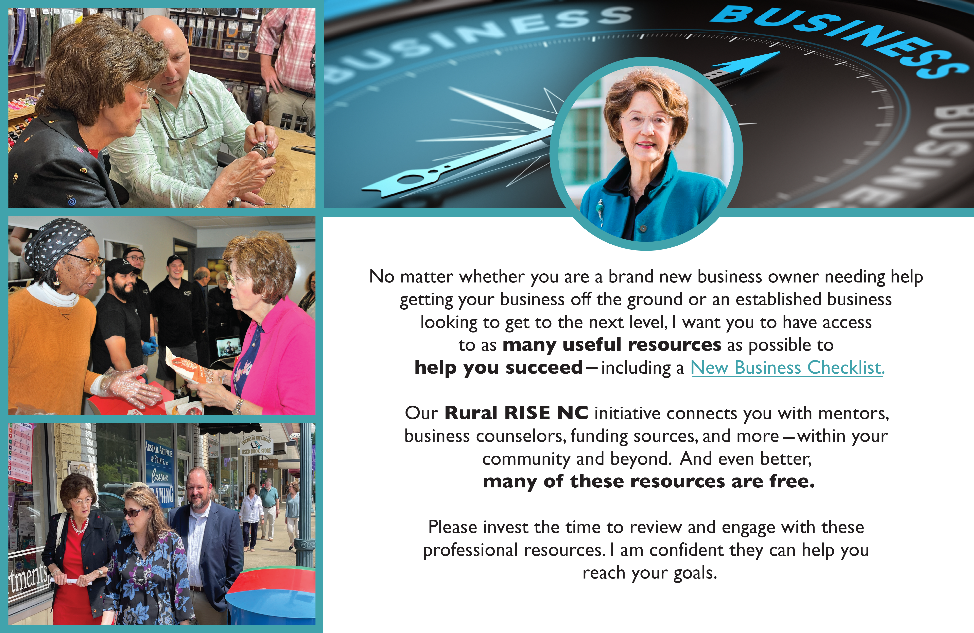 | |
The Secretary of State’s Rural RISE NC Initiative continues to expand across North Carolina to provide a roadmap to an array of free or low-cost resources to help businesses prosper – and now the initiative has a home on the Agency’s website at www.sosnc.gov/rise to give business owners around the state an easy way to search for resources available in their county.
Rural RISE (Resources for Innovators, Start-Ups, and Entrepreneurs) grew out of surveys the Department conducted in response to the historic rise in new business creations that our Business Registration Division has been processing since 2020. Because the Secretary of State’s Office engages with entrepreneurs at the earliest point in the life cycle of their businesses, we are in a unique position to help new businesses quickly connect with resources in their individual counties, from business counseling services and lenders to incubators and co-working spaces in their communities.
The Initiative began with 14 pilot rural counties and has so far expanded to 24 of North Carolina’s 78 rural counties. The initiative has already had success through the Resource Bulletins being emailed out to new businesses.
Secretary Marshall says the initiative could be vital for North Carolina’s business community. “Every new business is on a tight timeline to find success,” noted Secretary Marshall. “One in four new businesses in North Carolina shut their doors after three years. Half of new businesses are shuttered after seven years. Rural RISE is our attempt to throw a lifeline to these small businesses that are the backbone of so many local economies. This is crucial for our state economy as a whole. After all, it doesn’t help anyone when a business fails.”
| |
|
Investor Alert: Identity Theft, Data Breaches and Your Investment Accounts
The SEC’s Office of Investor Education and Advocacy issued this Investor Alert to provide investors with important steps to take regarding their investment accounts if they become victims of identity theft or a data breach.
Investors should always take steps to safeguard their personal financial information (e.g., Social Security number, financial account numbers, phone number, e-mail address, or usernames and passwords for online financial accounts). However, if identity theft or a data breach compromises your personal financial information, here are some important steps to take immediately.
Contact your investment firm and other financial institutions immediately. If you think your personal financial information has been stolen, contact your broker-dealer, investment adviser or other financial professional immediately to report the problem and ask what steps you should take to protect your account. You should also contact any other financial institutions where you have accounts that may be impacted by the loss of your personal financial information. These may include banks, credit card companies, or insurance companies. Please remember to document any conversations with your investment or financial firms in writing.
Change your online account passwords or passphrases. Immediately change the password or passphrase for any investment or financial accounts associated with the compromised personal financial information. Always remember to use strong passwords or passphrases that are not easy to guess. Strong passwords should consist of at least twelve or more characters that include symbols, numbers and both capital and lowercase letters. Strong passwords should not use words found in a dictionary, or personal information such as a name or birthday. Strong passphrases should consist of random words, using characters that include symbols, numbers, and both capital and lower-case letters. Strong passphrases should not use: (1) common phrases from literature, music, or other media; (2) personal information such as your name or birthday; or (3) only words found in a dictionary. To help keep your accounts safe in the future, remember to change your passwords and passphrases regularly.
Close compromised accounts. If you notice any unauthorized access into your investment account, you should ask your investment firm to close the account and move the assets to a new account. You should consult your investment firm about the best way to handle closing an account.
Activate two-step or “multifactor” verification, if available. Your brokerage firm or investment adviser may offer (or require) a two-step verification process for gaining access to your online accounts. With a two-step verification process, each time anyone attempts to log into your account through an unrecognized device (i.e., a device you have not previously authorized on the account), your investment firm sends a unique code to either your e-mail or cell phone. Before anyone can gain access to your account, they must enter this code and your password. Activating this added layer of security may help reduce the risk of unauthorized access to your accounts by identity thieves.
Monitor your investment accounts regularly for suspicious activity. Closely monitor your investment accounts for any suspicious activity. Look out for any changes to your account information that you do not recognize (e.g., a change to your address, phone number, e-mail address, account number, or external banking information). You should also confirm that you authorized all of the transactions that appear in your account statements and trade confirmations.
See the full details of this Alert here.
| |
One Call Could Save Your Life Savings!
Is that individual offering you an investment opportunity licensed to sell securities in North Carolina? Is the investment opportunity itself registered? Know before you sign!
While registration in and of itself is no guarantee against fraud, not being registered is a very big red warning flag.
We urge you to take five minutes to call our NC Investor Hotline at 1-800-688-4507 to see if the person you have been dealing with – perhaps even for years – is properly registered and/or has a disciplinary history. You can also check to see if the actual investment itself is properly registered.
Pick up the phone and call us. You owe it to yourself and your family to check. And please also consider sharing the information in this newsletter with YOUR contacts or your social networks. Doing so will help keep your friends and loved ones safe, too. More information can be found at https://www.sosnc.gov/divisions/securities/for_investors.
| |
|
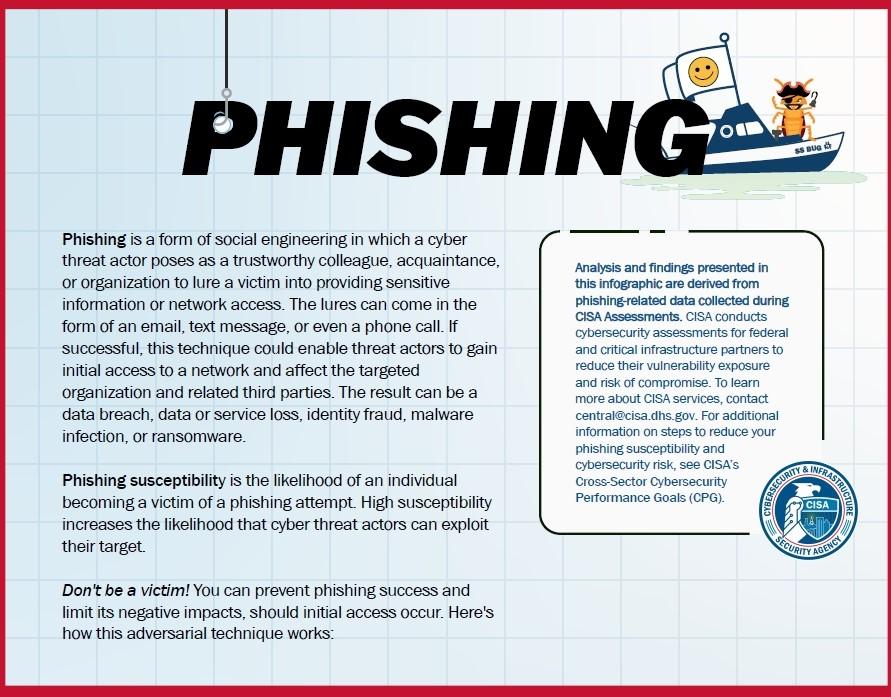
The Cybersecurity and Infrastructure Security Agency (CISA) has produced this infographic to summarize the anatomy of a phishing attack.
Click on the image below to learn more about how threat actors "hook" their victims and to check out metrics comparing the likelihood of certain kinds of "bait" being clicked on.
| |
|
Securities Division Provides Training for Advisers
More than 150 registered investment advisers attended voluntary 3-hour compliance webinars, entitled "Compliance in the Time of COVID, 3rd Edition," offered by the Secretary of State’s Securities Division on December 7th and 9th.
Secretary of State Elaine F. Marshall kicked off each session by thanking attendees for registering for the sessions, and for the spirit of cooperation that exists between her office and state-registered investment advisers. Attendees were then led through an abbreviated overview of their legal obligations by Betty Guido, Senior Financial Investigator with the Securities Division. Advisers wishing to review the slides and handouts referenced during the sessions can find them on our website at https://www.sosnc.gov/forms/by_title/_Investment_Advisor.
Since September of 2010, the Securities Division has conducted 43 voluntary compliance workshops for state-registered investment advisers, attracting more than 1,500 attendees.
| |
SEC Charges Eight Social Media Influencers in $100 Million Stock Manipulation Scheme Promoted on Discord and Twitter
The Securities and Exchange Commission on December 14th announced charges against eight individuals in a $100 million securities fraud scheme in which they used the social media platforms Twitter and Discord to manipulate exchange-traded stocks.
According to the SEC, since at least January 2020, seven of the defendants promoted themselves as successful traders and cultivated hundreds of thousands of followers on Twitter and in stock trading chatrooms on Discord.
These seven defendants allegedly purchased certain stocks and then encouraged their substantial social media following to buy those selected stocks by posting price targets or indicating they were buying, holding, or adding to their stock positions. However, as the complaint alleges, when share prices and/or trading volumes rose in the promoted securities, the individuals regularly sold their shares without ever having disclosed their plans to dump the securities while they were promoting them.
"As our complaint states, the defendants used social media to amass a large following of novice investors and then took advantage of their followers by repeatedly feeding them a steady diet of misinformation, which resulted in fraudulent profits of approximately $100 million," said Joseph Sansone, Chief of the SEC Enforcement Division’s Market Abuse Unit. "This action exposes the true motivation of these alleged fraudsters and serves as another warning that investors should be wary of unsolicited advice they encounter online."
The following seven individuals were charged with securities fraud:
Name State of Residence Twitter Handle
Perry Matlock Texas @PJ_Matlock
Edward Constantin Texas @MrZackMorris
Thomas Cooperman California @ohheytommy
Gary Deel California @notoriousalerts
Mitchell Hennessey New Jersey @Hugh_Henne
Stefan Hrvatin Florida @LadeBackk
John Rybarczyk Texas @Ultra_Calls
The complaint further charges Daniel Knight (Twitter Handle @DipDeity), of Texas, with aiding and abetting the alleged scheme by, among other things, co-hosting a podcast in which he promoted many of the other individuals as expert traders and provided them with a forum for their manipulative statements. Knight also traded in concert with the other defendants and regularly generated profits from the manipulation.
| |
SEC Small Business Advocacy Office Releases Annual Report on Capital Raising
The Securities and Exchange Commission’s Office of the Advocate for Small Business Capital Formation has issued its 2022 Annual Report to Congress and the Commission. The report details how entrepreneurs and investors are building companies together, from startups to small public companies.
The report provides an in-depth analysis of the dynamics of capital raising in communities across the country. The report includes:
- Highlights of the Office’s advocacy work in fiscal year 2022;
- Policy recommendations;
-
Summary of the Small Business Capital Formation Advisory Committee’s 2022 activities; and
- Data on small business capital formation, broken down by:
- Small and emerging businesses
- Mature and later-stage businesses
- Small public companies
- Women business owners and investors
- Minority business owners and investors
- Natural disaster areas
- Rural communities
The Office of the Advocate for Small Business Capital Formation is an independent office, established by Congress in January 2019, to advance the interests of small businesses. The Office also works to identify and address unique challenges faced by minority-owned, women-owned, rural, and natural disaster area small businesses and their investors, and provides educational resources to help small businesses navigate capital raising.
On January 24, 2023, the Office will host its fourth annual Capital Call virtual event, during which the public can ask questions about the report and share perspectives on capital raising. Registration for the Capital Call will open in January.
| |
-
On April 17, 2022, the founders of a Fake "Hedge Fund," Austin Delano Page and Brandon Alexander Teague, pleaded guilty to federal charges for orchestrating a $4 Million Ponzi scheme. For more information, see this press release.
-
On April 22, 2022, Marlin Hershey and Dana Bradley, were indicted on federal charges in connection with a multi-million dollar investment scheme. Click here for details.
-
On March 8, 2022, former Forsyth County Investment Adviser, Russell Joseph Mutter, pleaded guilty and was sentenced to a minimum of 16 years, 3 months and a maximum of 22 years, 5 months in prison for a scam that cost 12 victims - most of them elderly -- more than $3.3 million. Click here for more details.
-
On November 15, 2021, Joshua Matthew Houchins, 36, of Raleigh, NC, was sentenced to ten years in prison on charges of Wire Fraud, in violation of Title 18, United States Code, Section 1343, and Possession of a Firearm by a Felon, in violation of Title 18, United States Code, Section 922(g). The defendant was also ordered to serve three years of supervised release and to pay restitution to victims in the total amount of $1,771,382.25. According to court documents and arguments made in court, Houchins, owner of various Raleigh real estate development companies, carried out a Ponzi scheme upon numerous local real estate investors. Houchins also possessed a rifle and several rounds of ammunition after having been convicted of a felony. For more details, see the related story in this newsletter and this press release.
-
On July 29, 2021, the North Carolina Department of the Secretary of State, Securities Division entered into a Final Consent Order ("Order") with Tannin Capital, LLC. The Order states that Tannin Capital was ineligible for an exemption from state registration as an investment adviser from October 2019 through on or about April 2020. Pursuant to the Order, Tannin Capital agreed to immediately cease and desist from violating any provision of the North Carolina Investment Advisers Act and any related administrative rules, to pay a civil penalty and reimbursement of the costs of investigation. The North Carolina Department of the Secretary of State thanks the U.S. Securities and Exchange Commission, Atlanta Regional Office for their assistance in this matter. For more information on this Order, click here.
| | |
NC Department of the Secretary of State
Securities Division
Investor Protection & Education Services
| |
| | | |