Quick, Timely Reads
On the Waterfront
| |
|
Hammermill Paper Company
Some Kids Were Really Lucky
| |
|
Every year, just before Christmas, Hammermill Paper Company’s personnel department would rent Gannon Auditorium (at a time when the “Audi” was the biggest and best gathering place in Erie) and throw an enormous holiday party for employees and their families. The most exciting part of the event for the employees’ children was a gift-giving ceremony during which each youngster received an amazing present. In reflecting upon the gifts that our lucky friends received, their parents must have assisted in the selection process because they always seemed to receive exactly what the lucky kids had been hoping for. Each year it seemed that my “Hammermill” friends received “big stuff” at the Gannon party, like archery equipment, erector sets, and other expensive items. Those Hammermill gifts were often bigger and better than the ones that “Santa” provided on Christmas morning.
The annual Christmas party and generous children’s gifts fit with Hammermill’s reputation for being paternalistic. From the onset, the company seemed to reward employee loyalty with a culture of caring, which included better benefits than most local firms. During its early years, the company even provided housing for first-level supervisory employees, effectively a company town that was developed on the factory campus. During the 1950s, Hammermill along with General Electric, was one of the region’s largest employers. Erie’s paper company, which was celebrated as one of the region’s very best places to work, was even older than GE Transportation, having been established on the east side of town in 1898.
The Behrend family, Hammermill owners, made the decision to build their business here because Erie was located halfway between the two largest paper markets in the world: New York and Chicago. In addition to that important location criterion, Erie was situated on one of the Great Lakes where it was accessible to the Canadian softwood market via ship. Erie’s location on Lake Erie provided access to the huge volumes of water needed for the milling process, and the nearby shelter of Presque Isle Bay made it possible to receive and process the boatloads of softwood needed to produce paper.
Like other local elites, the Behrend family purchased family farm-retreats on the outskirts of the city. One of those farms eventually became the campus of Penn State Behrend, which has evolved into one of Penn State’s most successful satellite campuses. Originally imagined as a remote location where one year of general undergraduate studies would be offered to aspiring, main-campus students from the Erie area, Penn State Behrend’s campus now offers several four-year degrees as well as master’s degrees and has become one of Pennsylvania’s leading universities. The original intent of the new college was to provide non-sectarian, undergraduate education for a region whose only colleges were religiously affiliated.
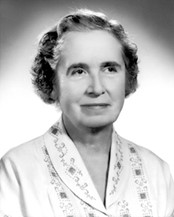
Mary Behrend, wife of Hammermill co-owner Ernst Behrend, donated the family’s Glenhill Farm to Penn State for Erie’s new college in 1948. Before she did, however, she left a related and long-lasting gift. An avid gardener, she had worked with the Carrie T Watson (Watson-Curtze Mansion) Garden Club to gift the community with trees, gardens, and green spaces. Carrie Watson was regarded as the area’s first horticulturist and the garden club that she helped establish is still actively working in the community. As a part of the gift of land to Penn State, several acres were set aside by Mary Behrend for the development of an arboretum. The original arboretum at Behrend has since been expanded with the growth of the campus. In recent years, the Carrie T Watson Garden Club has helped to establish a second local arboretum (L.E.A.F.) at Frontier Park. The two arboretums are connected by an all-purpose (hiking and biking) trail, which follows the Bayfront Parkway east from L.E.A.F. toward Interstate 90, where it connects with the arboretum at Penn State Behrend.
| |
|
Mary Behrend
Believers in Henry Ford’s philosophy of vertical business integration, the Behrends established several additional and important local enterprises that were designed to support the papermaking factory on the city’s east side. The most important of these were (1) a leased pier, east of today’s Dobbins Landing, for receiving and processing pulpwood; (2) a fleet of Great Lakes ships intended to carry pulpwood and other supplies from Canada to Erie; and (3) a dedicated railroad to carry wood from downstate, where it was being harvested, to the Erie factory. The Hammermill Railroad also connected Hammermill’s downstate operation at Lock Haven with the Erie facility.
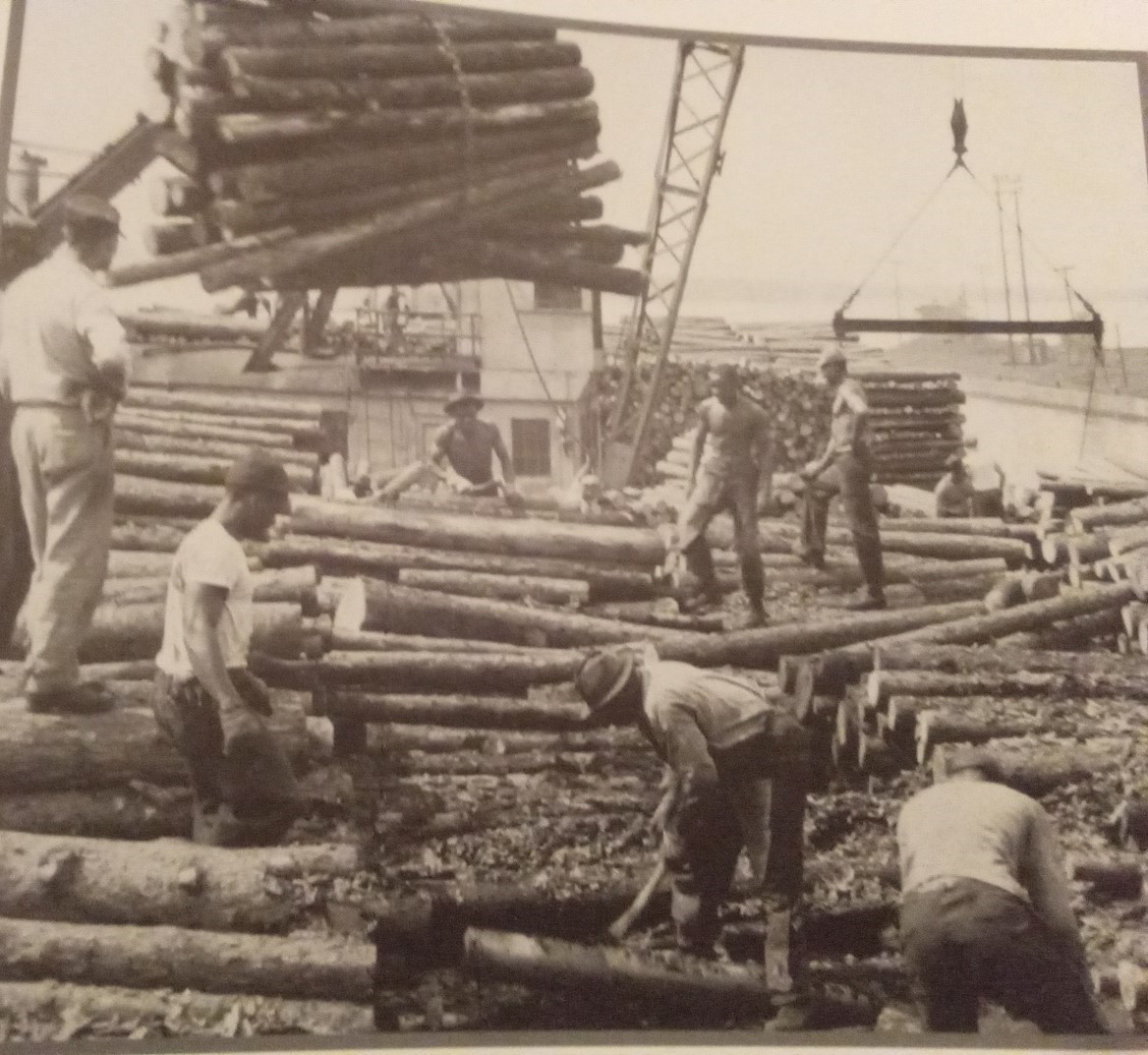
For Bay Rats on Erie’s lower west side, the most familiar of the adjunct operations was the Hammermill Dock. Located in the general area of today’s Don Jon dry dock, we often walked there to watch the operations as ships tied up to unload. The Hammermill Dock was a frantic place when ships arrived. Unloading crews would descend upon the ships when they docked, quickly moving bundles of logs from the deck to the pier and then preparing them for transport to the East Lake Road plant. Some of the older kids managed to get hired to help with unloading when there was a large or a last-minute shipment. While we loved watching the “action” on the dock, the ships were our favorite attractions and Hammermill had managed to create its own fleet of unique vessels.
| |
|
Action on the Hammermill Dock
During the company’s first year of operations, the most pressing business problem was securing in-time delivery of the raw pulpwood required to feed the factory processes. To solve that issue, Hammermill created its own fleet so that it could control the arrival of pulpwood. Their first ship purchase was in 1900 and included one steamship and three barges. Within a few years, the company had developed a tradition of retrofitting old ships that were well beyond their useful lives. The ship and barge strategy allowed them to bring a ship and loaded barge, leave the barge to be unloaded and return to a paper port to fetch another barge. Like several other local fleet owners, Hammermill’s specialty was purchasing ships that seemed destined for the scrapyard and retrofitting them (in their case) for lumber hauling. They were able to approach fleet management in this manner because most of Hammermill’s supply runs were neither long nor arduous. Most involved crossing the lake to Ontario or making the occasional trip through the Welland Canal to Montreal.
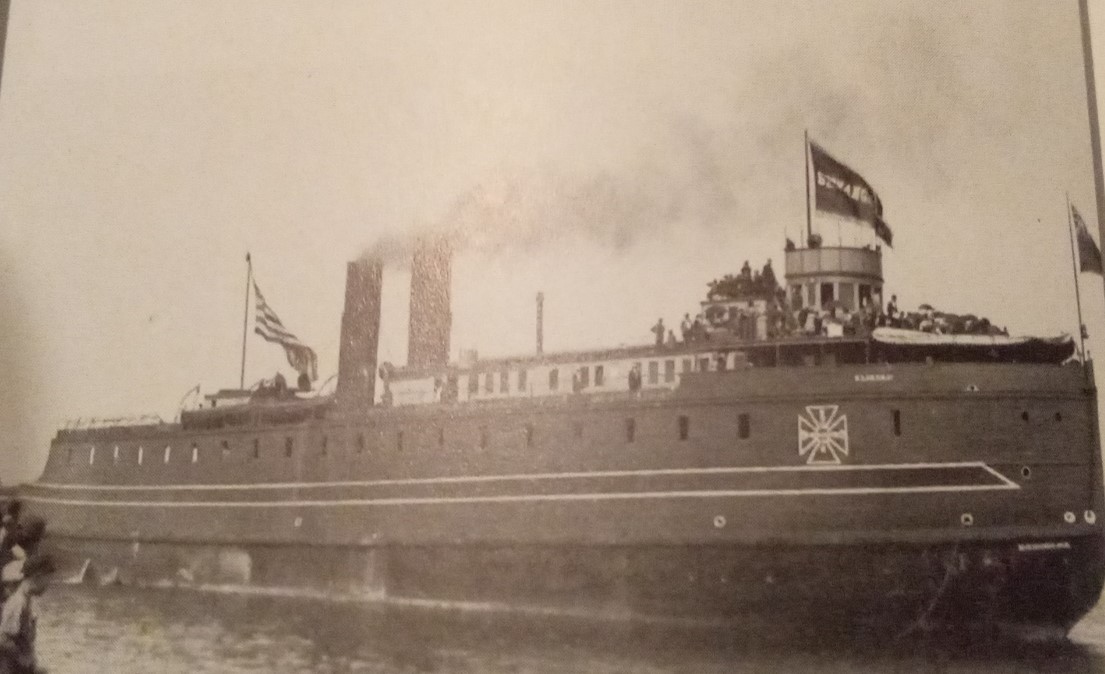
One of the most stunning retrofits involved the former railroad-car ferry, Shenango No. 2, which had been used to haul train cars filled with coal from Conneaut, Ohio to Ontario ports, including Port Stanley and Port Dover. Shenango No. 2 was acquired in 1915, cut down so that it would have a flat deck, and renamed Harriet B (Behrend) after the company owner’s daughter. Hammermill continued to defy maritime superstition by renaming ships even after suffering bad luck with shipwrecks. The new names were often creative, including the christening of two of their ships, Tristan and Isolde, after famous medieval characters.
| |
Shenango No. 2 docking at Conneaut, Ohio | |
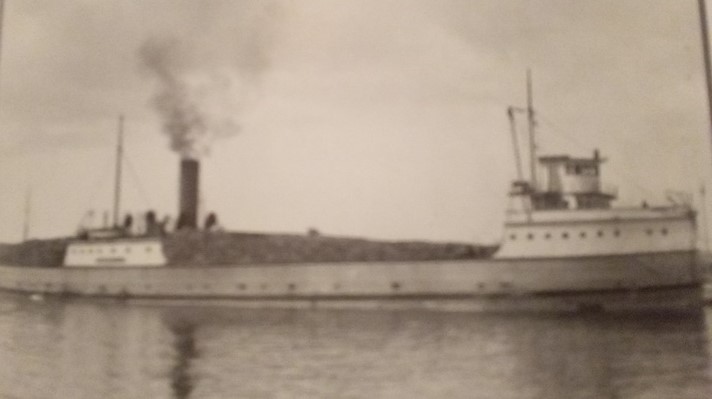 | |
Harriet B after being reconfigured from Shenango No 2
The company announced that it was giving up its proprietary fleet in 1933, noting that it had become easier to acquire pulpwood by having it delivered directly to the factory and that Canadian taxes and shipping restrictions had made that source non-viable. In 1959, it failed to renew its lease on the eastside dock, noting that pulpwood would be delivered directly to its eastside plant via truck, thus eliminating the unloading and a local transfer. The closing of the dock eliminated 65 jobs but on a positive note it created the space needed to attract Litton Industries and its dry dock to Erie’s waterfront, where the Stewart J. Cort, the Great Lakes’ first 1,000-foot ship, was assembled and launched.
Hammermill’s final major acquisition was a 171-mile rail-line that led from its eastside plant through Union City, Warren, and Kane to Emporium, Pennsylvania. Its new Allegheny Railroad was cobbled together by purchasing several smaller railroad lines and was a final step toward insuring a steady supply of pulpwood, this time from the forests of Pennsylvania rather than Canada. The Allegheny Railroad opened in 1985 and continued to operate intermittently even after the company was taken over by International Paper in 1986. In 1992 it was purchased and merged into the Buffalo and Pittsburgh Railroad.
| |
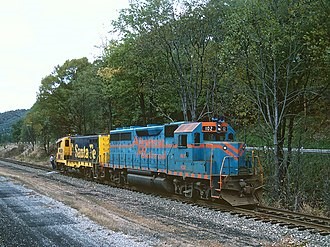 | |
A pair of Allegheny Railroad locomotives
Erie’s family-oriented and community-minded employer came to a sudden and nasty end when a hostile takeover began to descend upon it in 1986. Unbeknownst to upper-level staff and the board of directors, the company had slowly evolved such a positive cash position that it had unwittingly become a highly attractive “financial target.” Fortunately for the company and its upper-level staff, the takeover was headed off by International Paper, a larger and competing manufacturer from the paper industry, which purchased Hammermill with the consent and cooperation of the board. Sadly for Erie and most of the hourly employees, however, the only way that the merger made financial sense was to shutter the local facility and move select component parts to other International Paper locations.
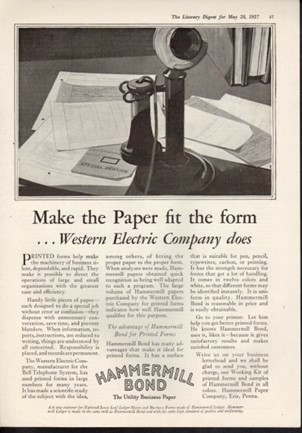
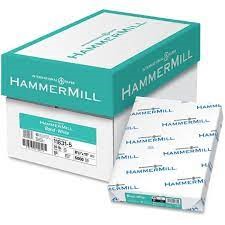
As a homage to Hammermill’s long-standing reputation for quality, International Paper launched a luxury product called “Hammermill Bond.” The wonderful company with its docks, fleet of ships, and 2,500 good jobs is gone but Hammermill Bond paper is still available. Small consolation.
| |
A 1927 advertisement for Hammermill Bond | |
The company may be gone but its premium paper is still available | |
Note: Today’s Asbury Woods was also a Behrend family property that was donated to the community. | |
Accidental Paradise Available at TRECF!
Accidental Paradise
by Dr. David Frew and Jerry Skrypzak
| |
The beautiful book on Presque Isle published by authors David Frew and Jerry Skrypzak – “Accidental Paradise: 13,000-Year History of Presque Isle” – is on sale at the Tom Ridge Environmental Center’s gift shop and through a special website, AccidentalParadise.com.
The book, priced at $35 plus tax and shipping, can be ordered now through the website sponsored by the TREC Foundation, AccidentalParadise.com.
Presque Isle Gallery and Gifts on the main floor of TREC, located at 301 Peninsula Drive, Suite #2, Erie, PA 16505 will also handle sales daily from 10 a.m. to 4 p.m.
For more information, send an email to aperino@TRECF.org.
To watch "Accidental Paradise: Stories Behind The Stories" click here.
| |
ABOUT THE AUTHOR
Historian and author David Frew, Ph.D., is a Scholar-in-Residence at the JES. An emeritus professor at Gannon University, he held a variety of administrative positions during a 33-year career. He is also emeritus director of the Erie County Historical Society/Hagen History Center and is president of his own management consulting business. Frew has written or co-written 35 books and more than 100 articles, cases, and papers.
| | | | |