|
|
|
|
Ronald Young Program Manager |
Dear Flight Opportunities Community,
Fall is quickly approaching, and the end of summer carries some exciting news to share as we look to a new season of opportunities.
As always, you'll want to check out the solicitations news to find opportunities that might be a good match for you. Be sure to read the details in our Opportunities section, and please don't hesitate to reach out to the Flight Opportunities staff to learn more.
In addition, we're highlighting other exciting news this month:
- A spotlight on the Deployable Rigid Adjustable Guided Final Landing Approach Pinions (DRAG FLAPs) technology from Masten Space Systems, which was tested on a balloon flight from Near Space Corporation last month.
- A feature covering Near Space Corporation, one of Flight Opportunities' high-altitude balloon flight providers.
- An interview with NASA's Paul De León, providing insight into his role as well as tips for researchers.
We hope you enjoy reading!
Ronald Young,
Program Manager
NASA's Flight Opportunities program
|
|
|
Flight Opportunities Participates in NIAC Symposium
|
|
|
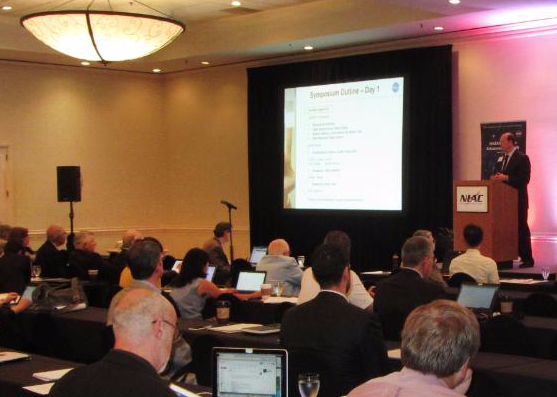
Jason Derleth introduces Bob Yang at the recent NIAC Symposium. |
Bob Yang, Program Executive for Flight Opportunities, recently spoke at the NASA Innovative Advanced Concepts (NIAC) Program Symposium to highlight how these two NASA Space Technology Mission Directorate (STMD) programs work together. The NIAC program seeks to fund researchers from NASA, academia, and industry who are pursuing visionary ideas with the potential to transform future NASA missions. NIAC focuses on early stage (TRL 1-3) research, while Flight Opportunities offers platforms for testing technologies that find success in the NIAC program. Bob's talk can be found at minute 11:11 on the Livestream recording. For more information about opportunities that might be suitable for your work, please visit the NIAC website. |
"Bob's participation in the Symposium was great. He inspired the NIAC Fellows to consider alternative pathways for continuing to develop their technologies after NIAC. Bob also had several follow-up conversations with Fellows, helping them to find their 'path toward the stars.'" -- Jason Derleth, NIAC Program Executive
|
 Tech Spotlight
|
|
|
DRAG FLAPs from Masten Space Systems
|
|
|
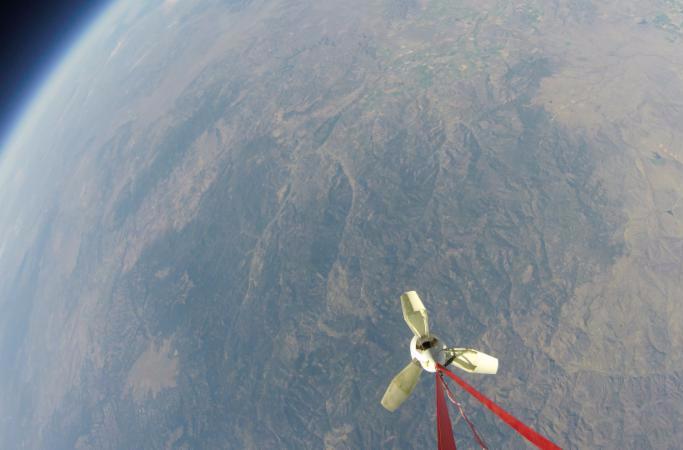
| Masten DRAG FLAPs payload performs self-test prior to drop from high-altitude Near Space Corporation balloon. |
|
Deployable Rigid Adjustable Guided Final Landing Approach Pinions (DRAG FLAPs) (
T0064-B), developed by Masten Space Systems, are poised to enable game-changing capabilities for precision entry, descent, and landing (EDL) trajectories. Selected for the Flight Opportunities program in January 2013 via the Announcement of Flight Opportunities (AFO5), Masten's technology is a major advancement enabling higher altitudes, engine-off descent, and safe and precise landings. With drop tests completed last month by Near Space Corporation (NSC), Masten is currently reviewing data from the successful flights to assess next steps in the technology development.
According to Masten principal investigator Joey Oberholtzer, the DRAG FLAPs program was conceived because of the company's interest in adding new control features to future vehicles it will use as a flight provider for the Flight Opportunities program. These new features would benefit not only NASA but also all researchers testing payloads on Masten vehicles through NASA's program in the future.
The DRAG FLAPs technology is specifically designed to augment the aerodynamic characteristics of a vehicle during the descent phase. Oberholtzer notes that employing such devices provides aerodynamic stabilization and control. It even expands the descent timeframe researchers have to accomplish critical events while improving landing. It also increases the payload mass-to-surface ratio, which enables more massive payloads to be flown to the same altitude.
While Masten and Flight Opportunities' partners stand to benefit from the technology, Oberholtzer notes that the advantages of the technology extend to planetary science missions as well. As plans for these missions become more ambitious and complex, they demand larger payloads with an emphasis on precision landing-exactly what the DRAG FLAPs technology is designed to achieve.
Oberholtzer says the recent flight tests with NSC were very successful and a great experience for the company. Not only did the drop tests on NSC's platform reach the required altitude of 35 km, but the payload release and descent were successful, with the vast majority of collected data recoverable. An added benefit of the tests, Oberholtzer notes, was the collaboration enabled by two flight providers being involved in the same flight test through Flight Opportunities. Masten was able to learn from NSC's flight test process to make its own flights more successful.
Oberholtzer says the successful flights will likely increase the DRAG FLAPs' technology readiness level (currently TRL 4), and the company is now in the process of analyzing the recovered data. The results will inform the next steps in the development process, with the ultimate goal of making the technology available for future Masten flights and potentially other NASA missions.
|
"Working with NSC was a really great experience. We were very curious to see how other service providers handle their interaction with the payload provider, and I think both of our companies were able to learn a lot from each other. And working with NASA was incredibly valuable. Our technical contact, Paul De León, had so much experience to bring to the table from his experience with similar tests, so we had more resources and were set up for a really successful flight campaign given everyone involved." -- Joey Oberholtzer, principal investigator, Masten Space Systems
|
|
Flight Provider Profile
|
|
|
|
|
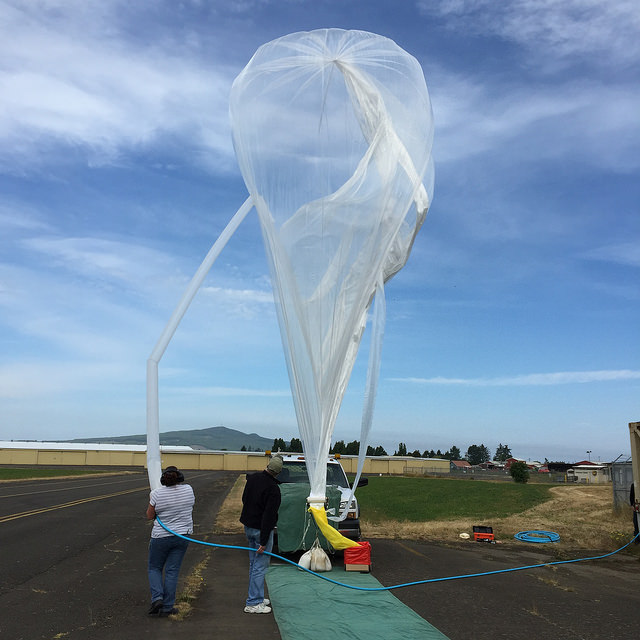
The NSC team prepares for Flight Opportunities SBS-12 launch in June 2015.
|
Near Space Corporation
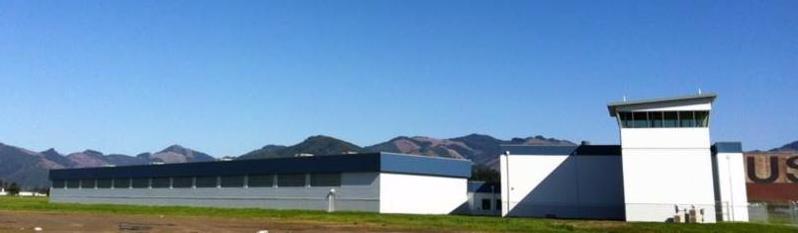
As one of Flight Opportunities' commercial flight providers, Near Space Corporation (NSC) provides high-altitude/near-space platforms and flight services for government, academic, and commercial researchers. The company operates from facilities at the former WWII Naval Air Station
Tillamook, providing an ideal location for end-to-end engineering, production, and flight testing.
Specializing in stratospheric balloon flights for payload testing, NSC uses a variety of launch techniques and balloon systems to provide test services for a wide range of payload masses and altitudes. Working with Flight Opportunities and other research partners, the company provides many critical capabilities, including engineering design, analysis, integration, and testing as well as manufacturing through prototyping, fabrication, and assembly of complex designs. The company also uses a custom 5,000-square-foot attached integration hangar, hosting an avionics laboratory with test benches and an atmospheric
test chamber capable of simulating altitudes to 130,000 feet as well as a wide range of relevant temperatures.
NSC also offers access to the Tillamook Unmanned Aerial System (UAS) Test Range, with 32,000 square miles of regional airspace, offering access to a wide variety of operational areas including open ocean, coastal areas, mountainous terrain, and agricultural areas off the Oregon coast. Additionally, the test range provides access to W-570 Special Use Airspace. Established balloon launch locations in central Oregon at Madras and at South Point, Hawaii, round out the range of testing locations the company operates to meet a variety of customer requirements. NSC can also operate from customer locations with appropriate FAA waivers.
For Flight Opportunities, NSC's first flight was in January 2013, providing flight testing for a technology from the New Mexico Institute of Mining and Technology (NMT) designed to monitor the structural integrity of space vehicles. NSC has flown a number of other payloads over the course of its Flight Opportunities contract, with its most recent flight for Masten Space Systems' Deployable Rigid Adjustable Guided Final Landing Approach Pinions (DRAG FLAPs) payload last month.
To learn more about Near Space Corporation's flight platforms for consideration to flight test your payload, visit the
company's website.
|
|
|
Near Space Corporation's Johnson Near Space Center (JNSC).
|
|
"Near Space Corporation is pleased to have been a part of the Flight Opportunities program over the past several years and looks forward to continuing to provide access to flight platforms and services that help advance the development of payloads."
-- Tim Lachenmeier, President, Near Space Corporation
|
Staff Spotlight
|
|
|
|
|
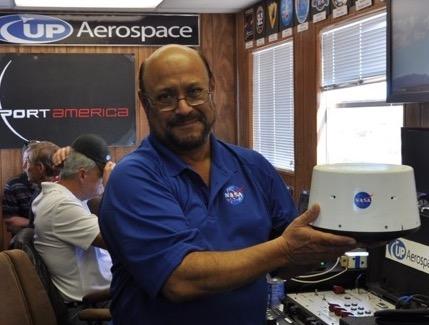
Paul De León holds NASA's Maraia Capsule technology payload, which launched on an UP Aerospace flight in Nov. 2015 |
Meet NASA's Paul De León
What is your job in Flight Opportunities?
I am the Campaign Manager for three of the program's flight providers for government research: Near Space Corporation and World View, which both offer balloon flights, and UP Aerospace, which provides suborbital rocket flights. I also serve as a Technical Officer for the SpaceTech-REDDI program.
What does it mean to be the Campaign Manager? What is your role?
I make sure that the NASA and other government agency technology payloads accepted into the program get flown with their requirements and expectations satisfied. Early in the process, I help determine the compatibility between technology proposals and our flight provider capabilities, so the researchers get the data necessary to understand how their technology will perform in the applicable environment. I also coordinate flight campaigns and determine if they should have a single or multiple payloads based on their compatibility, total lift mass, payload readiness, desired flight profile, and many other factors.
Once the flight campaign has been scheduled, then what do you do?
I am the moderator between the researchers providing the technology payloads and the flight provider. We're in constant three-way communication from when they're selected into the program until we fly and recover the payloads.
I take it the weather is pretty important for balloon flights?
Weather conditions are important for suborbital flights too, but balloon flights depend on trajectory calculations based mainly on wind direction and speed at the different altitudes to predict the final flight path and potential drop area. Once the balloon is launched, you don't have much control over it, with the exception of terminating the flight early. And if it's a cloudy day or raining or if the ground wind is above a certain speed, you can't launch the balloon.
What do you like best about your job?
The main reward for me is to be part of the development of new space technologies that will be utilized in future NASA missions. Also with every launch I see closure and get a sense of accomplishment. With some missions at NASA, you work on preparing a flight for a long time, and then you jump into another project before it even flies. In my current role, I start something from the very beginning and I finish it, and sometimes even with a big bang! There's a big sense of satisfaction when I see the smiles from the payload teams when they get their payload back and take a first look at their data after a flight.
Do some of the technologies you see eventually get used by NASA?
Oh, yes. Back when I first started supporting Flight Opportunities, my first parabolic flight included a 3-D printer technology being tested by a company named Made In Space. They were testing their printer to operate in zero gravity. Now that same technology is flying on board the International Space Station printing parts! It's very exciting to see some of our technology payloads graduate and have real space applications.
|
|
Opportunities
|
|
|
NASA Internal Call for Payloads
Announcements of the July 2016 NASA Internal Call for Payloads are expected by late September. The next call will open on Oct. 3, 2016, with submissions due Oct. 31, 2016. If you are thinking of proposing in the future (either in October or for a later call), don't wait to get in touch! Contact Steve Ord to learn more about the program and discuss how to best prepare for your submission.
The NASA Internal Call for Payloads applies to internally funded NASA development activities seeking maturation advancement beyond Technology Readiness Level (TRL) 4. The call is open to NASA and other U.S. government researchers and is made quarterly. Principal investigators (PIs) can be from a NASA center, or the PI can be from an external organization if the technology is for a NASA-funded activity (e.g., SBIR/STTR, NIAC, GCD, HEOMD, SMD programs).
For more information,
visit the Flight Opportunities website
.
|
|
SpaceTech-REDDI-2016
The most recent solicitation (SpaceTech-REDDI F1[B]) closed on Sept. 9, 2016. Technical reviews of the proposals have been initiated, and selections are expected to be announced near the end of the year. To learn more, visit the SpaceTech-REDDI section of the Flight Opportunities website.
|
|
Tipping Point 2016
NASA recently released the 2016 "Utilizing Public-Private Partnerships to Advance Tipping Point Technologies" Appendix under the REDDI-2016 NASA Research Announcement (NRA).
Flight Opportunities will invest in this appendix as part of its continuing efforts to foster new commercial capabilities to serve the orbital and suborbital launch communities. Proposals are due Oct. 6, 2016.
You can find more information about this opportunity on
NSPIRES
.
|
Upcoming Conferences & Events
|
|
Don't forget to check out these upcoming events...
|
Ha
ve ideas
or
feedback
for the
Flight Opportunities
newsletter
?
|
|
NASA Flight Opportunities Program
|
|
|
|
|
|