|
|
|
|
Ronald Young Program Manager |
Dear Flight Opportunities community,
Fall is here already and at the Flight Opportunities program, we're excited to share news about recent technology demonstrations. We're also gearing up for more flights in the coming months, as well as some exciting industry events. Now is the time to mark your calendars and start planning!
This month, we're covering:
- Recent successful demonstrations on World View and Near Space Corporation platforms
- An introduction to Contracting Officer Jenny Staggs in our Staff Spotlight
- Announcement of new calls and solicitations, including the latest REDDI solicitation
- Information about upcoming events, including the must-attend NSRC
We hope you enjoy reading up on the latest news. As always, we're glad to have you along for the journey. And of course, we would love to hear from you if you have suggestions for content you'd like to see in the newsletter.
Ronald Young,
Program Manager
NASA's Flight Opportunities program
|
|
|
World View Successfully Flight Tests Groundbreaking Altitude Control Technology
|
|
|
|
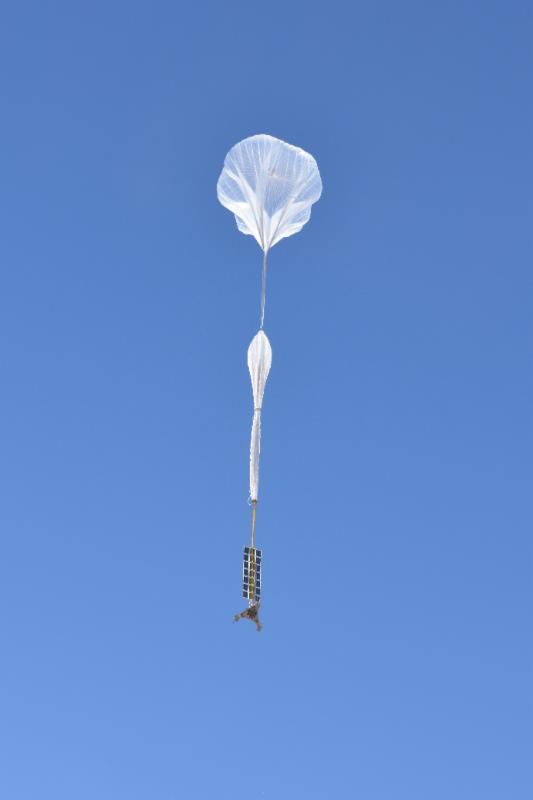
The World View Stratollite consists of a primary lift balloon (top), secondary balloons (middle), a solar panel power generation and distribution system, and a Stratocraft payload-carrying structure (bottom).
Photo credit: World View
|
|
Long-duration stratospheric research missions could allow scientists to collect vast amounts of data continuously for their payloads. Such missions could benefit NASA by maturing future space technology as well as allowing for Earth observations, such as storm monitoring and forest fire tracking.
World View's novel altitude control technology aims to make this vision a reality. Selected to receive funding through NASA's
Research Announcement: Space Technology - Research, Development, Demonstration, and Infusion (REDDI) 2016 solicitation, the system was demonstrated on flight tests this summer.
"This really is an enabling technology and platform for testing science payloads," said World View's Iain Beveridge, principal investigator. "Now a lot of payloads may be interested in altitude control so they can put their payloads in the stratosphere and gather data continuously. We call it persistent coverage over an area."
The altitude control technology is one component in a complex network of advances making up the company's Stratollite system. During the company's summer 2017 demonstrations, the success criteria that were met included demonstrating altitude changes, maintaining altitude levels during periods of both high and low solar elevation, and showing that the system is able to perform station keeping over a 24-hour flight.
In addition to achieving its primary objectives, the vehicle also performed a large altitude excursion of 25,000 feet, limited only by the commercial airspace ceiling. The flight test raised the
technology readiness level (TRL)
of the Stratollite system to 9.
"One of the biggest advantages we now have over other systems is that we have a vast altitude range for station keeping," Beveridge said. "It is more difficult the higher you go because of the density of the air, but based on our testing it does look like our system will go 90K feet or above, and then still be able to perform down to the 50,000-60,000-foot range."
By making meaningful shifts between altitudes as needed within a given trajectory, World View's system may be able to support much longer balloon missions than previously possible.
Paul De León, campaign manager for NASA's Flight Opportunities program, agrees that this technology has the potential to enable missions to be more efficient. "Rather than flying multiple flights, researchers may be able to achieve their goals with a single long-duration flight," De León said. "This capability will also enable experiments requiring long-term exposure, which are currently very difficult to achieve."
World View is continuing development of this exciting capability and has more flights scheduled later this year to test different mission scenarios, longer duration, and higher altitudes.
|
|
|
Near Space Corporation Takes Its Flying Testbed to New Heights
|
|
|
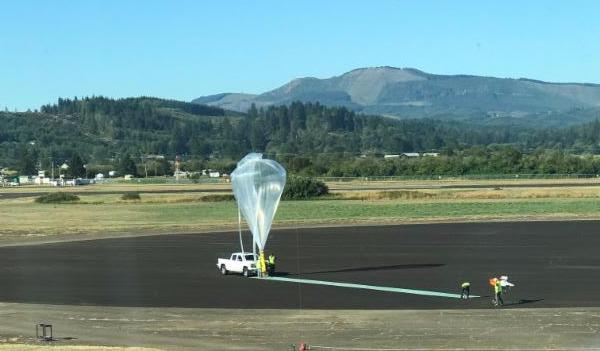
NSC personnel prepare for launch of the High Altitude Shuttle System (HASS). |
On September 2, 2017, Near Space Corporation (NSC) launched its High Altitude Shuttle System (HASS) to an altitude of 92,000 feet before landing safely back at the NSC headquarters in Tillamook, Oregon. The flight was a new milestone in NSC's plans to use HASS as a flying testbed with a lifting body glider--allowing it to operate as a surrogate launch vehicle in support of sRLV operations.
Building on a September 2016 test flight that demonstrated proof of concept for the vehicle, the latest flight was designed to integrate ADS-B surveillance technology as well as to help researchers better understand the flight dynamics of HASS.
"The ADS-B technology manifested on these flights allows the researchers and flight vehicle operators to obtain and monitor GPS coordinates in real time throughout the flight,"
said Flight Opportunities Campaign Manager Paul De León.
De León explained that internal sensors and video cameras on the HASS vehicle also record flight dynamics from the time it's released from the balloon at a high altitude, all the way through landing.
"Weather and wind conditions need to be optimal for a launch, so that the resulting trajectory places the balloon in a general geographical location when it reaches the planned altitude,"
De León said. "Then, the payload is released from its carrier and flies under autopilot commands to the predetermined landing site."
According to De León, NSC will analyze the data from its recent HASS vehicle flight in preparation for the next flight demonstration, which aims to achieve a parabolic flight profile in order to simulate a microgravity environment.
|
|
Meet Flight Opportunities Contracting Officer Jenny Staggs
As the contracting officer for NASA's Flight Opportunities program, Jenny Staggs maintains close relationships with the program's flight providers and works with campaign managers to ensure that the right provider is selected to meet the needs of government payload demonstrations. We recently had the opportunity to chat with her about her role and the procurement process at Flight Opportunities.
Tell us a bit about your career. How long have you been at NASA and with Flight Opportunities?
I've been with NASA for about seven years now--time flies! All of my positions here have been in procurement. I first worked on construction contracts for our outside facilities team, and then on services contracts. Last fall a position opened up within Flight Opportunities, and I was offered the chance to work with Ron and the team. In procurement we rotate between programs quite often, so there's an opportunity to work on many different types of contracts. It's a great learning experience and really keeps me challenged and growing.
What do you enjoy most about working in procurement?
I enjoy working directly with customers and the interactions we have on a regular basis really help to ensure that we're meeting the needs of the mission. I always like to build a strong foundation of trust with each customer. Also, procurement is very specific and unique in that it's always changing. There's a lot of gray area in contracts, so as soon as you think you know something, regulations or parameters change. It keeps me on my toes.
What is your specific role in your work with the Flight Opportunities flight providers?
I work most frequently on the Indefinite Delivery Indefinite Quantity (IDIQ) contracts used for government flights. So the current flight providers know me as the person who delivers their contract to provide flight services. When there are contractual changes or time extensions--schedule changes and that sort of thing--we work closely together to negotiate those. Many of our current flight providers have been with us for quite some time and I think there is a large degree of mutual understanding and respect there. They are very good about getting proposals in on time and sending information quickly when we need it. I really enjoy the strong relationships we've built.
We're also currently working on a new IDIQ--it hasn't been released yet, but that will be a focus in the near future.
Speaking of which, for flight providers who are not currently on the IDIQ with Flight Opportunities, what is your advice to them? How can they be considered to join the group of designated government payload providers?
First and foremost I would say to make sure we know who you are. Any flight provider can propose their services when the next request for proposal (RFP) goes out, but it certainly helps to make sure we know about you in advance. Definitely reach out to us, send us a capabilities statement, and make sure we know about your interest. Also, many flight providers are small businesses, so they should definitely reach out to our small business specialists who can bring them to our attention. We also issue announcements on
Federal Business Opportunities
. We have a lot of information there as well and they can reach out to us with any questions.
Thanks so much, Jenny!
|
|
|
Current SpaceTech-REDDI Solicitation Closes November 17
The SpaceTech-REDDI solicitation seeks proposals to demonstrate cross-cutting space technologies in relevant space-like environments using currently available U.S. commercial reduced-gravity, high-altitude balloon and suborbital reusable flight opportunities. Applications are due on or before November 17, 2017, and NASA plans to announce selections in February 2018. See the solicitations page on
NSPIRES
for more details, including answers to frequently asked questions.
Selections from the most recent solicitation, SpaceTech-REDDI-2017 F1(A), are underway, with announcements expected in early November.
|
|
Call for MISSE-12 Expected to Open in December
The call for NASA's Materials International Space Station Experiment (MISSE)-12 mission is expected to open this December. Materials researchers at NASA are eligible to submit proposals for their sample specimens. Researchers from commercial organizations have the opportunity to purchase space on the MISSE-Flight Facility (FF) directly from Alpha Space Test and Research Alliance, which built and retains ownership rights to the hardware. For more information about the MISSE program and announcements about upcoming missions, stay tuned to the
Flight Opportunities website
.
|
|
Upcoming Conferences & Events
|
|
NSRC-2017 Early Bird Registration Ends Nov. 10, 2017
Registration is open for the Next Generation Suborbital Researchers Conference (NSRC-2017), December 18-20 in Broomfield, CO.
NSRC-2017 is a commercial space science conference for researchers, educators and industry partners interested in commercial suborbital reusable vehicles. The three-day conference will include keynote talks, workshops by individual flight providers and NASA's Flight Opportunities program, and a variety of panel discussions including researchers, educators, and industry leaders. There are also many opportunities for networking during breaks, breakfasts, and receptions.
Organized by Southwest Research Institute (SwRI) and the Commercial Spaceflight Federation (CSF), NSRC-2017 will feature invited presentations, panels, workshops, contributed talks, and numerous networking opportunities. The lead keynote speaker will be Dr. Thomas Zurbuchen, NASA's Associate Administrator for science. Other high profile speakers include former NASA Shuttle commander and Blue Origins executive Jeff Ashby, World View stratospheric ballooning CEO Jane Poynter, Virgin Galactic CEO George Whitesides, Griffin Communications CEO Gwen Griffin, FAA Associate Administrator for spaceflight Dr. George Nield, space angel Dylan Taylor, and NASA Associate Administrator for space technology Steve Jurczyk.
Topics on the
agenda will cover planetary science, atmospheric science, microgravity sciences (fundamental biology and physics), commercial applications, education, public outreach, life sciences, suborbital and commercial markets and policy, plans for human-tended experiments, and REM flight crew training, among others. For complete information, visit the
NSRC-2017 website.
|
|
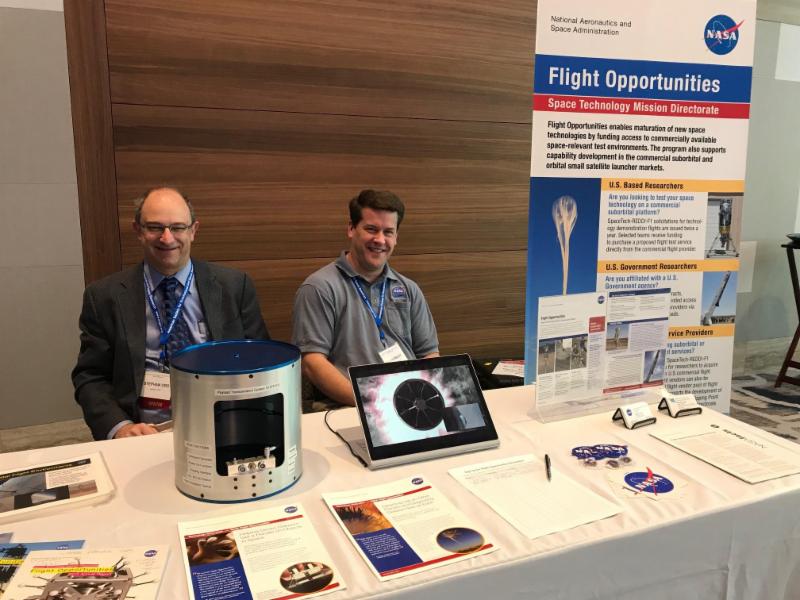
| Flight Opportunities Technology Manager Stephan Ord (left) and Campaign Manager Ryan Dibley support the Flight Opportunities booth at the recent American Society for Gravitational and Space Research (ASGSR) conference. |
Be sure to note these other events, also coming up in December:
|
|
|
|
|
Ha
ve ideas
or
feedback
for the
Flight Opportunities
newsletter
?
|
|
NASA Flight Opportunities Program
|
|
|
|
|
|