|
|
|
|
Bob Yang,
Program Executive |
Dear Flight Opportunities community,
The start of the summer season has been an active one for the Flight Opportunities program, and I'm pleased to share with you some of our recent activities.
Earlier this month, we wrapped up the most recent SpaceTech-REDDI solicitation, and have begun the process of reviewing proposals. We also attended Space Tech Expo and the International Space Development Conference -- it was great to see some of you there!
In this issue, we're also covering:
- A closer look at the recent Masten Space Systems technology demonstration for Honeybee's PlanetVac payload
- Details about a recent ZERO-G parabolic flight campaign, which demonstrated three REDDI payloads in March 2018
- Information about World View's latest balloon flight--a matchmaking mission of sorts
- NASA's Request for Information to assess availability of potential lunar payloads--responses are due by June 27
- Upcoming events and important dates--including CRASTE and the ISS R&D Conference, both of which Flight Opportunities will be attending
Thank you once again for reading, and for being a part of our community.
Bob Yang,
Program Executive
NASA's Flight Opportunities program
|
|
|
Parabolic Flights Advance Technologies for Gesture Control, Propellant Gauging, and Mars Sample Return Capabilities
|
|
|
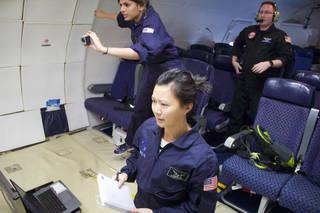
| Researchers on the SPECTRE 2 team monitor their experiment. Credits: NASA JPL/Cornell University |
|
A recent series of parabolic flights onboard Zero Gravity Corporation's G-FORCE ONE aircraft demonstrated a variety of technologies selected by the
Flight Opportunities program. The campaign consisted of two successful flights on March 21, 2018, lifting off from Orlando Sanford International Airport in Florida.
Payloads demonstrated were Carthage College's Microgravity Propellant Gauging Using Modal Analysis: Phase III experiment (T0191), and the SPECTRE 2 (T0184) and Biosleeve Gesture Control Interface (T0185) experiments, both from NASA's Jet Propulsion Laboratory (JPL).
All three research teams were able to successfully gather data that will help advance their experiments toward future testing and/or inclusion in future missions.
Kevin Crosby, principal investigator (PI) for the Carthage College experiment, noted the success of the flight campaign in increasing the team's knowledge base, and the value of demonstration with Flight Opportunities to advancing the technology.
"We've relied entirely on Flight Opportunities to make the advancements that we've seen to date--there simply is no other way to increase the technology readiness level," Crosby said. "Your intuition cannot get you anywhere close to the knowledge that 30 seconds of microgravity can reveal."
To learn more about the flights and the technologies demonstrated, read the full web feature.
|
|
Sample Return Technology Successfully Tested on Masten's Xodiac Rocket
|
|
|
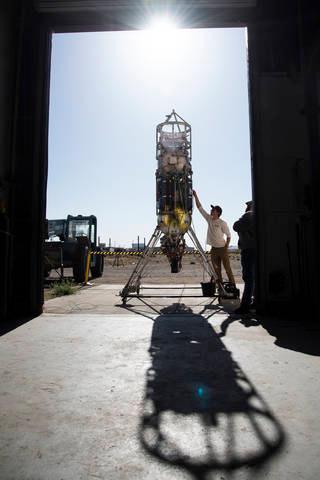
Masten Space Systems technicians check
the Xodiac rocket after sliding it from the company's facility in preparation for the PlanetVac demonstration.
Credits: NASA Photo/Lauren Hughes
|
Honeybee Robotics (Pasadena, California) demonstrated its pneumatic surface soil collection system, Planet Vac (T0179), on Masten Space Systems' Xodiac rocket on May 24. The rocket launched from Mojave, California, and landed to collect a sample of more than 320 grams of top soil from the surface of the desert floor. The technology is being developed for a possible sample return mission.
"Bringing something back from another planet [or] celestial body is the Holy Grail of planetary science," said Justin Spring, senior project engineer for Honeybee Robotics. "It allows you to have something from another world, here, so Earth instruments can anlayze it. We're still analyzing what [NASA] collected from the moon years ago!"
Spring said the Flight Opportunities program has been instrumental in maturing the payload.
"The Flight Opportunities program allowed us to take the PlanetVac idea and actually strap it on to Masten's rocket, putting it in a situation more realistic to what it might encounter in a space mission," said Spring. "This reduces the risk since we now know it can survive both landing and heating loads as well as the rocket environment and still collect the sample and retain it to come back."
To learn more about the recent flight and the PlanetVac technology, read the full web feature and check out the Planetary Society video that covers Honeybee's innovation.
|
|
A Match Made on a High Altitude Balloon
On March 29, 2018,
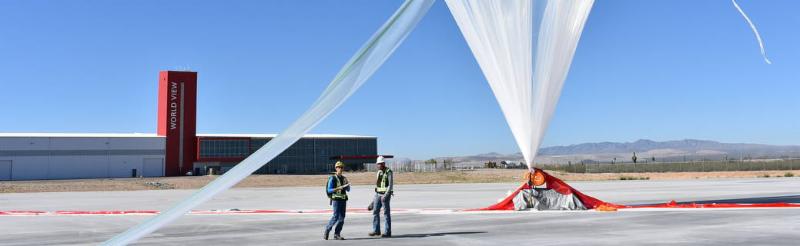
World View's Stratollite high-altitude balloon lifted off from the company's launch facility in Tucson, Arizona, embarking on a matchmaking mission of sorts. Onboard: the Low-Cost, Lightweight, Reusable Radiation Nose (
T0174) payload from
NASA's Ames Research Center in Silicon Valley and the Automated Radiation Measurements for Aerospace Safety-High Altitude (ARMAS-Hi) (
T0176) payload from
Space Environment Technologies and the
University of Southern California, both in Los Angeles. Both payloads aim to detect or monitor radiation on space-based missions--similar capabilities identified by Flight Opportunities Campaign Manager Paul De León as being a likely match for a fruitful collaboration.
|
|
| World View personnel prepare for the Stratollite launch. Credits: World View Enterprises |
"I knew that the Ames principal investigator wanted to fly along another radiation sensor in order to validate his data," explained De León.
Other sensors that were potential candidates were either unavailable or too bulky to fly with the Ames payload, but ARMAS-Hi--a commercial off-the-shelf sensor experiment featuring a very small footprint, low weight, and low power consumption--seemed ideal.
De León followed his instinct and connected the principal investigators, who then discussed the possibilities for leveraging data from a shared flight, leading to the joint manifest.
"It turned out to be a win-win situation for everyone," said De León.
|
|
|
Request For Information on the Availability of Potential Lunar Payloads
NASA's Science Mission Directorate has released a Request for Information (RFI) to assess availability of potential lunar payloads. NASA has recently released a draft Request for Proposals (RFP) for Commercial Lunar Payload Services (CLPS) to provide end-to-end services for payloads to the lunar surface; this RFI is seeking information about potential payloads for these landers. Responses to this RFI are sought broadly from U.S. industry, universities, non-profit organizations, NASA centers, and other U.S. government agencies, and will be used by NASA to further inform planning and acquisition strategy development.
Responses to this RFI are due via NSPIRES by June 27, 2018
. Full text of the RFI, including instructions for submitting a response, can be accessed by following this link or by searching on NNH18ZDA012L at http://solicitation.nasaprs.com/open.
|
|
June 25, 9:35 a.m. (Track 2)
July 9-11
Attend the "Small Launch Vehicle Propulsion" panel, chaired by Flight Opportunities' Tim Chen
July 9, 3:30-6:00 p.m. (room 232)
Contact us to arrange a time for a meeting during the conference
Also coming up...
|
Ha
ve ideas
or
feedback
for the
Flight Opportunities
newsletter
?
|
|
NASA Flight Opportunities Program
|
|
Flight Opportunities is part of NASA's Space Technology Mission Directorate.
|
|
|
|
|
|