|
|
|
|
Robert Yang,
Program Executive |
Dear Flight Opportunities community,
Season's Greetings! We hope you are enjoying the holidays, and we thank you for taking the time to tune in to the latest Flight Opportunities news. In this issue, we cover recent flights, proposal selections, and key events, including:
- A successful flight from World View Enterprises, Inc. that showcased the company's new remote launch capabilities
- Announcement of the technology proposals selected from the latest Space Technology Research, Development, Demonstration, and Infusion (REDDI) solicitation
- Information about upcoming events, including opportunities to meet with the Flight Opportunities team at the Next-Generation Suborbital Researchers Conference (NSRC)
We hope you enjoy reading up on the latest. From all of us at Flight Opportunities, Happy Holidays and all the best for a joyous new year.
Robert Yang,
Program Executive
NASA's Flight Opportunities program
|
| Connect with Flight Opportunities
|
Schedule a Meeting with Flight Opportunities at NSRC
The Next-Generation Suborbital Researchers Conference (NSRC-2017) will be held December 18-20 in Broomfield, Colorado
NSRC-2017
is a conference for researchers, educators, and industry leaders interested in commercial suborbital reusable vehicles. The three-day conference will include keynote talks, workshops by individual flight providers and NASA's Flight Opportunities program, and a variety of panel discussions. There are also many opportunities for networking during breaks, breakfasts, and receptions.
Please make plans to stop by the Flight Opportunities booth to meet the team and see examples of technology payloads. In addition, Flight Opportunities personnel will be available for brief one-on-one meetings to answer questions. If you are interested, please
schedule an appointment
and provide a brief description of the topic you would like to discuss.
|
|
|
Balloon Flights Help Advance Technology to Probe the Evolution of Planets
|
|
|
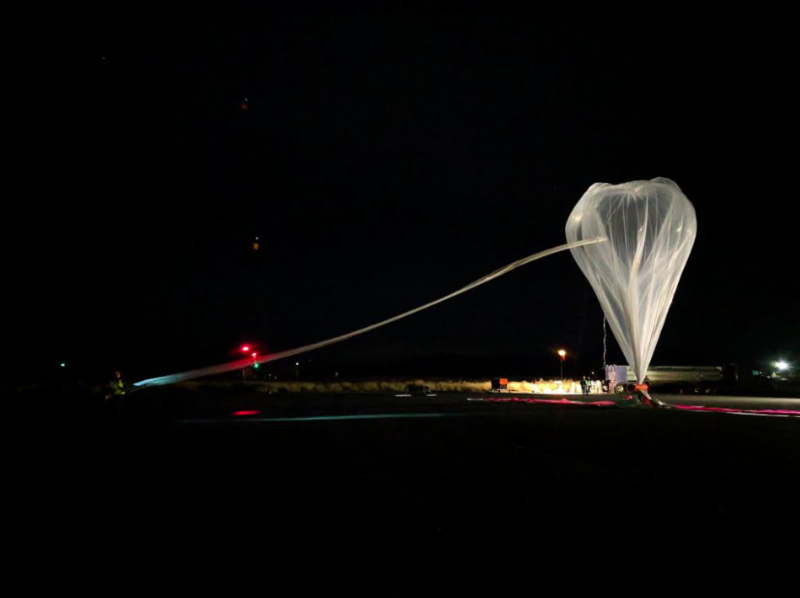
World View's flight preparations in the early morning hours at McCall Idaho Municipal Airport. Photo courtesy of World View Enterprises. |
How and why did the Earth evolve in such a way that would be habitable to humans, while other planets evolved to have distinctly inhabitable compositions?
"Understanding these questions has become even more important in recent years as exoplanets and other Earth-sized planets are being detected," said SwRI principal investigator Robert Grimm. "And looking at those planets that are Earth-sized and seeing to what extent they may be Earth-like is going to be a big focus of future space research."
SwRI's experiment is edging closer to this goal thanks to a successful balloon flight in October 2017 facilitated by
World View
and supported by Flight Opportunities through a Space Technology REDDI grant.
For the demonstration, World View sent a crew to the Idaho Batholith, a vast mountain range in central Idaho. The Batholith has terrain similar to that of Venus--a planet close in size and proximity to Earth, yet completely different geologically.
"It's as close as we can get to having something that looks like Venus here on Earth," said Grimm.
The geologic requirements compelled World View to mobilize to a new launch location and develop a unique launch implementation specifically for the flight. Not only did the company succeed, but the unique launch site, as well as cooperation and support of the McCall Idaho Municipal Airport, may make other remote launch locations likely in the future.
"World View's mobile flight service operations expands our ability to meet the needs of unique science investigation efforts, and comes with the added benefit of exposing new communities to stratospheric exploration," noted Travis Palmer, World View's program manager for Stratollite operations.
With the flight completed successfully, SwRI will begin analyzing the data in preparation for a second balloon flight in spring 2018. Grimm said they hope to complete the process over the winter and then determine how to change the flight conditions to gather data at different times of day as well as any hardware and software modifications needed.
|
|
|
|
Flight Opportunities Announces Selections from Latest REDDI Solicitation
Flight Opportunities recently selected nine space technologies from proposals to the latest Space Technology REDDI solicitation.
Two topics were included in the solicitation. Under the first topic, demonstration of space technology payloads, NASA selected seven proposals:
- Gravity Effects on Flow Boiling Heat Transfer Using Temperature-Sensitive Paints in Preparation for an ISS Flight Experiment, Jungho Kim, principal investigator, University of Maryland, College Park. Flight provider: ZERO-G
- Demonstration of Optimal Chilldown Methods for Cryogenic Propellant Tanks in Reduced Gravity, Jacob Chung, principal investigator, University of Florida, Gainesville. Flight provider: ZERO-G
- EMPANADA: Ejecta-Minimizing Protocols for Applications Needing Anchoring or Digging on Asteroids, Karen Daniels, principal investigator, North Carolina State University, Raleigh. Flight provider: ZERO-G
- Draper Multi-Environment Navigator High-Altitude Balloon Campaign, Brett Streetman, principal investigator, Charles Stark Draper Laboratory Inc., Cambridge, Massachusetts. Flight provider: World View Enterprises
- Cryogenic Gauging Technology Geometry Development, Steven Collicott, principal investigator, Purdue University, West Lafayette, Indiana. Flight provider: Blue Origin
- Microgravity Propellant Gauging Using Modal Analysis: Phase III, Kevin Crosby, principal investigator, Carthage College, Kenosha, Wisconsin. Flight providers: ZERO-G and Blue Origin
- LISA-T Microgravity Deployment Demonstration, Greg Laue, principal investigator, ManTech International Corporation, Huntsville, Alabama. Flight provider: ZERO-G
Under the second topic, demonstration of vehicle capability enhancements and onboard research facilities for payload accommodation, NASA selected two proposals:
- JANUS 3.0: Enabling Game-Changing External Environment Payload Accommodation on Suborbital Reusable Launch Vehicles, H. Todd Smith, principal investigator, Johns Hopkins University, Baltimore, Maryland. Flight provider: Blue Origin
- Stratospheric and Suborbital Flight Experiments and Equipment, Elizabeth Kennick, principal investigator, Teachers In Space, Inc., New York. Flight provider: Blue Origin
For more information, including descriptions of each selected proposal, read the full web feature.
|
|
|
NASA Announces Opportunities to Advance 'Tipping Point' Space Technologies
NASA's Space Technology Mission Directorate (STMD) is seeking industry-developed commercial space technologies that are at a "tipping point" in their development cycle. NASA seeks to enable industry to develop and qualify selected technologies for market through the solicitation titled "Utilizing Public-Private Partnerships to Advance Tipping Point Technologies" released on November 30.
Each proposal to the Tipping Point solicitation must be spearheaded by a U.S. for-profit entity. Funding will occur through milestone payments as part of firm-fixed-price contracts that require a minimum 25 percent contribution from the industry partner.
Mandatory Preliminary Proposal submissions are due January 30, 2018. Read the full solicitation online.
Questions and comments about this solicitation should be submitted via email to:
HQ-STMD-TippingPointAppendix@nasaprs.com
.
|
|
|
RFI Responses Due December 21: Suborbital Flight Testing and Flight Experiments with CubeSat Payloads
NASA's Ames Research Center is requesting broad community input under a Request for Information (RFI) to determine interest in using high altitude aircraft as a means for flight testing CubeSat form factor science payloads.
NASA's Airborne Science Program (ASP)
, managed under the Earth Science Division (ESD) within the Science Mission Directorate (SMD), operates a fleet of highly modified aircraft that support NASA satellite missions, technology development, and science investigations. The primary objectives of the program include supporting satellite calibration and validation, new sensor development, process studies of the Earth system, and developing the next generation of scientists and engineers.
NASA is seeking input from the science and technology community regarding CubeSat instruments and experiments that would benefit from flight testing on aircraft. Read the
full RFI for more details.
Responses are due by December 21, 2017 at 3 p.m. PST.
|
|
|
Upcoming Conferences & Events
|
|
NSRC-2017 is Just Around the Corner
As mentioned above,
NSRC-2017
will be held Dec. 18-20 in Broomfield, CO.
Please make plans to stop by and meet the Flight Opportunities team. If you are interested, please
schedule an appointment
for a one-on-one meeting with one of our team members.
Be sure to note these other upcoming events:
|
Ha
ve ideas
or
feedback
for the
Flight Opportunities
newsletter
?
|
|
NASA Flight Opportunities Program
|
|
Flight Opportunities is part of NASA's Space Technology Mission Directorate.
|
|
|
|
|
|