|
|
|
|
Ron Young, Program Manager |
Dear Flight Opportunities community,
As we welcome a new season, our team is gearing up for new flights, events, and other news of note. This month we're pleased to share:
- Announcement of the 2018 SpaceTech-REDDI F1 Tech Flights solicitation for technology payloads - proposals due June 8
- Announcement of technology selections under NASA's 2017 SpaceTech-REDDI F1(B) solicitation
- Highlights of the maturation of Orbital Medicine's Evolved Medical Microgravity Suction Device
- A reminder of online resources available for researchers and flight providers
- Information about NASA's FY2019 budget proposal
- A listing of exciting upcoming events, including Space Tech Expo 2018, which will feature Flight Opportunities speakers on several panels
As always, we hope you enjoy reading this issue, and thank you for being a valued part of the Flight Opportunities community.
Ron Young,
Program Manager
NASA's Flight Opportunities program
|
|
SpaceTech-REDDI-2018 F1 Solicitation--Proposals Due June 8
NASA has released a solicitation, titled "NASA Flight Opportunities (FO): Technology Advancement Utilizing Suborbital Flight Opportunities" as an Appendix to the Space Technology Mission Directorate (STMD) NASA Research Announcement (NRA), titled "Space Technology Research, Development, Demonstration, and Infusion 2018 (SpaceTech-REDDI-2018)."
Proposals are due on or before June 8, 2018, and selections will be announced in November 2018 (target). The solicitation is available on NSPIRES.
Several elements of SpaceTech-REDDI-2018 F1 differ from previous solicitations and should be noted:
- Beginning in 2018, there will now be only one call for proposals each year, although the total level of funding is intended to remain the same.
- The amount of allowable "other costs" has been reduced.
- Key Technology Focus Areas have been added.
- A grant option for commercial entities has been added.
Proposals must be submitted electronically using NASA's proposal data system, NSPIRES. Potential proposers and proposing organizations are urged to access the electronic proposal system well in advance of the proposal due date to familiarize themselves with its structure and enter the requested information.
|
|
|
NASA Selects SpaceTech-REDDI-2017 F1(B) Technologies for Flight Tests
NASA has selected six promising technologies to be tested on commercial low-gravity-simulating aircraft and suborbital rockets. Selected under NASA's 2017 Space Technology Research Development Demonstration and Infusion (SpaceTech-REDDI) F1(B) solicitation, the technologies have the opportunity to leverage flight tests that will improve their potential for
infusion into future exploration and agency missions by taking them from a ground-based laboratory environment to demonstration in microgravity.
Two topics were included in this call for research. Under the first topic, which requested demonstration of space technology payloads, NASA selected five proposals:
- CubeSat Articulated Boom Option Optimization in Microgravity (CABOOM)
David Miles, principal investigator, University of Iowa, Iowa City, Iowa
- Investigation of Gravity Effects on Electrically Driven Liquid Film Boiling: A Microgravity Flight Campaign in Preparation for ISS Flight Experiment
Jamal Yagoobi, principal investigator, Worcester Polytechnic Institute, Worcester, Massachusetts
- Suborbital Testing of Liquid Acquisition Devices for Cryogenic Fluid Management
Kevin Supak, principal investigator, Southwest Research Institute, San Antonio, Texas
- Small-sat Propellant Management Technology
Steven Collicott, principal investigator, Purdue University, West Lafayette, Indiana
- Lightweight Strain-energy Deployed Spacecraft Booms
Mark Pankow, principal investigator, North Carolina State University, Raleigh, North Carolina
NASA selected one proposal under the second topic, demonstration of vehicle capability enhancements and onboard research facilities for payload accommodation:
- Human Tended Space Biology: Enabling Suborbital Genomics and Gene Expression
Robert Ferl, principal investigator, University of Florida, Gainesville, Florida
|
"The selected institutions will be able to demonstrate their technologies that are of interest to NASA in a much more realistic environment than what can be done using ground-based facilities. This program is a valuable platform for NASA to mature cutting-edge technologies that have the potential of supporting future exploration and agency mission needs."
-- Stephan Ord, program technology manager, Flight Opportunities
|
|
A Double Boom for Promising Space-Based Medical Technology
Team Expertise and Iterative Flights Help Mature Technology for Microgravity Emergencies
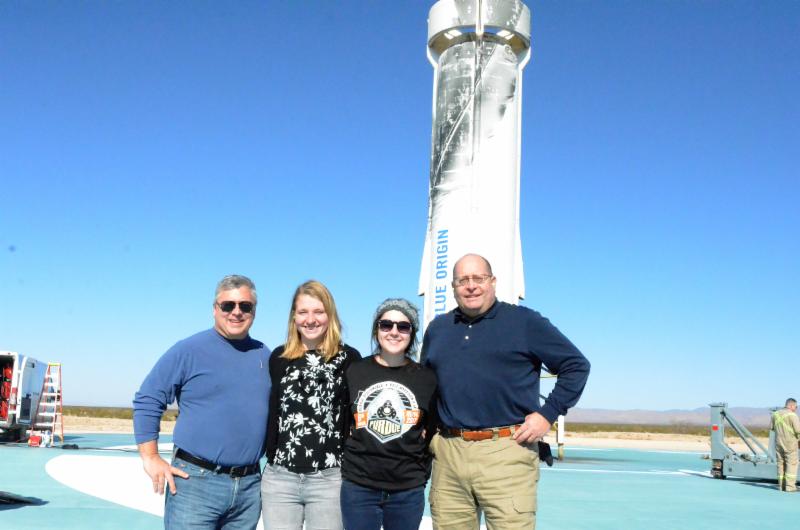
When Dr. Charles "Marsh" Cuttino heard the double sonic boom as Blue Origin's New Shepard vehicle landed on December 12, 2017, the sound signaled the return of his technology payload--and a full circle for his medical research for space exploration.
|
|
|
(Left to right) Principal Investigator Dr. Marsh Cuttino, MD; Stefanie Duessler; H. Hodgson; and Steven Collicott, PhD at the New Shepard landing site after completion of the flight.
Photo courtesy of Orbital Medicine. |
|
"It was the first time I'd heard a double sonic boom since the Shuttle landing," recalled Cuttino.
At that time in the mid-1990s, the physician was providing medical support for Space Shuttle takeoffs and landings.
"Of course, the Shuttle had a double boom coming back down for landing. So when I heard that, it just brought back so many memories," said Cuttino, who now serves as chairman of emergency medicine for Henrico Doctors' Hospital system and as CEO of Orbital Medicine.
Along with those memories, New Shepard brought back Cuttino's Evolved Medical Microgravity Suction Device experiment--intact and ready for evaluation.
The device provides thoracic drainage designed to treat traumatic chest injuries that may occur in space.
"When we opened it up, it was like Christmas to see the full device and see that everything had functioned perfectly," Cuttino recalled.
That success came as little surprise for the experienced team, however. They had planned intensely for the flight over the six months prior to their four days at the launch site in West Texas. In fact, many of the researchers in this niche area of specialized emergency expertise have worked together even longer, on various experiments since those early days of the Space Shuttle.
The payload demonstration on New Shepard was itself a second success for the medical suction technology, which was demonstrated in 2017 in a flight campaign with Zero Gravity Corporation (ZERO-G). An earlier prototype was demonstrated in 2012. Funded by a NASA SpaceTech-REDDI grant through Flight Opportunities, both the ZERO-G and Blue Origin demonstrations have helped to mature the technology significantly with each iterative flight.
"In the parabolic flights with ZERO-G, we were able to confirm that the design was good--that it was functioning just as expected in a microgravity environment," said Cuttino. "And then the suborbital flight with Blue Origin let us test a larger scale experiment with a full-sized functional device that could be used to treat humans."
Treating humans for traumatic chest injuries in space is not something NASA has had to confront yet, but as human presence in space is expected to increase, so do the chances of such injuries.
|
|
|
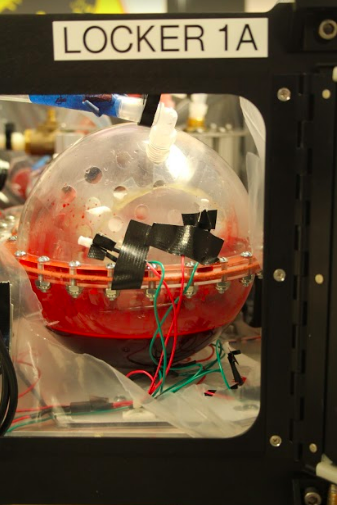
The experiment is shown here post-flight in the locker, demonstrating successful collection of the blood in the separator containment system. Photo courtesy of Orbital Medicine. |
"Traumatic injuries like collapsed lungs happen often here on Earth, and it's easily treated with a chest drain," explained Cuttino. "But that device relies on gravity, which we won't have the luxury of in space."
Beyond Earth's atmosphere, the task of separating blood from other fluids and air is a bit more complicated.
"In microgravity operations, everything gets mixed together and foamy," said Cuttino. "So there's a real need for a technology that can effectively separate it out, which is why it's listed under NASA's Human Research Roadmap as a critical need."
Orbital Medicine's device addresses this challenge by employing a two-phase separator with passive fluid management, and suction that utilizes surface tension to stabilize the flow and separation of the air and fluids. The air can be removed quickly to re-inflate the lung, and the blood is collected and can be transfused, bringing an injured person back to a functional state in a relatively short time, said Cuttino.
With these successful flight campaigns on the books, Cuttino and his team are looking ahead to the next steps for the technology.
"Now begins the process of submitting patents and getting FDA approval," said Cuttino. "That can be time consuming, but we feel optimistic with the successful testing of the prototype and hope to fly the final design again in preparation for an orbital mission."
|
|
Bookmark Flight Opportunities Online Resources
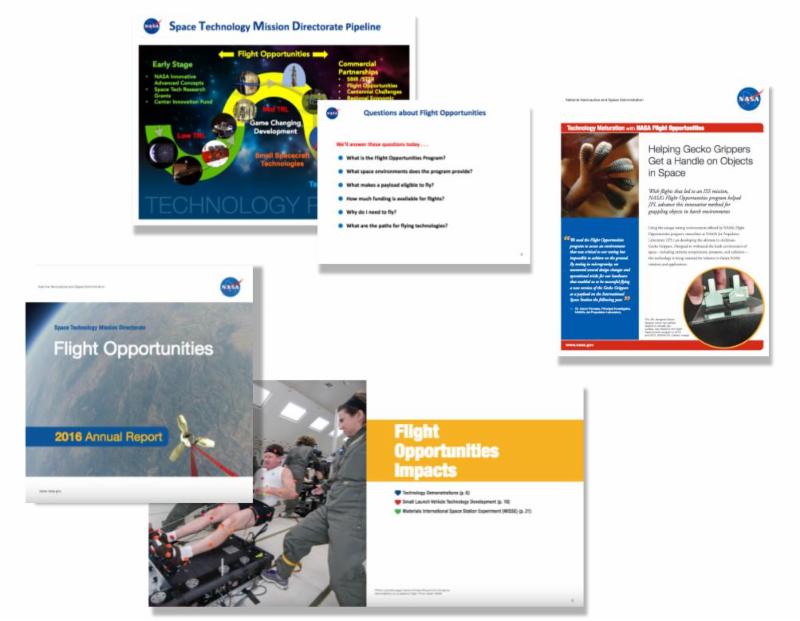
- Annual reports showcasing key accomplishments
- Presentations with guidance on submitting proposals
- Technology stories highlighting recent technology maturation successes
- FAQs, tip sheets, and more
Be sure to check out and bookmark the resources available
here
, and get in touch if you have feedback or suggestions.
|
NASA Releases FY2019 Budget Proposal
NASA released its FY2019 budget proposal on February 12. Highlights are captured in
this PDF and more details are available at:
www.nasa.gov/budget
|
|
Upcoming Conferences & Events
|
|
Mark Your Calendar for These Events & Important Dates
|
Ha
ve ideas
or
feedback
for the
Flight Opportunities
newsletter
?
|
|
NASA Flight Opportunities Program
|
|
Flight Opportunities is part of NASA's Space Technology Mission Directorate.
|
|
|
|
|
|