|
By: Hannah Beckett, Piano Buyer Guide
There is a critical piece of overlooked or ignored information in the selling and buying process: Pianos have limited lifespans.
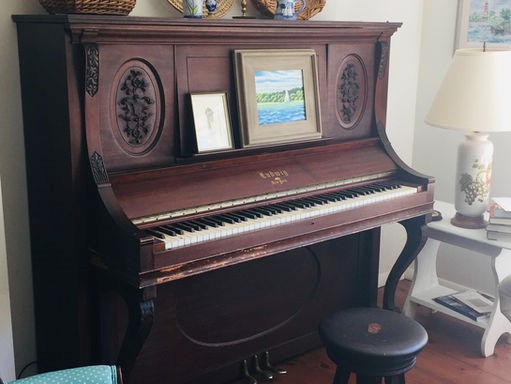
My great-aunt had a Ludwig piano in her island cottage in Maine. Its ornate panels and legs blended in seamlessly with the other furniture in the house, so much so that it almost went unnoticed. By the turn of the 21st century, the few keys that still worked produced a pitch far from standard. Family legend says it accompanied a famous opera singer on her tour through the west in the early 1900s. By the time I saw it for the first time, it had already been designated a furniture piece, with the sole purpose of displaying art and hand-woven baskets.
Like many piano manufacturers, Ludwig didn't make it through World War II. The brand is one of the thousands representing a time in American piano manufacturing, now a century removed from the modern-day musical world. These relics of the past highlight a fascinating shift in values from the nineteenth to the twentieth centuries.
A Brief Overview of American Piano-Manufacturing Trends
By the end of the industrial revolution, piano factories produced thousands of pianos to satisfy a demanding public. Universally regarded as a necessary entertainment piece, the piano could be found in most middle- and upper-class homes. By the 1930s, wars and economic hardships forced manufacturers to make pianos that were more suitable for the changing lifestyle of the American public.
The console piano was developed as an alternative to the large, imposing upright pianos of the earlier periods. The console was small, easier to transport, more affordable, and adaptable to the new suburban lifestyle of the post-war era. Over the next several decades, efforts to compete with emerging Asian markets led to compromises in quality that cut down on production costs. As globalization increased during the 60s-80s, most American manufacturers closed or sold their assets to Asian companies. Of the thousands of early American piano manufacturers, only a handful remain today.
In addition to these changes in the manufacturing world, the piano itself also plays a different role in society today than it did a century ago. Before the digital age, music was a casual in-home entertainment standard. Over a few transitional decades, the piano went from being valued as a standard entertainment piece to an object of study. While some pianists study to advance a career in music, the vast majority of modern-day piano buyers value the piano for its more basic educational opportunities: either for the development of young minds or as an outlet of artistic expression.
This shift in values has created conflict in the used-piano marketplace as we enter a transitional era. Forty years after globalization, the piano industry continues to move towards improved quality and reliability, but the used-piano marketplaces reflect a problematic misconception about the true value of the piano in the modern-day world. I call this problem, “The Grandma's Piano” problem.
The “Grandma’s Piano” to “Free” Piano Pipeline
The "free" piano has increasingly plagued the piano industry since the birth of online, private-sale marketplaces. If you check Craigslist, Facebook Marketplace, or any other familiar internet shopping sites right now, you'll find dozens of pianos from the mid-20th century listed. The “Grandma's Piano” problem is the story behind most of these old pianos. These pianos often end up in the homes of uneducated buyers excited to find an "antique" piano for such an affordable price, only to hear the same news from the technician they hire to tune the piano: It can't be fixed. And so the cycle continues.
While the intentions of sellers hoping to offload an unusable piano are not necessarily nefarious, there is a critical piece of overlooked or ignored information in the selling and buying process: Pianos have limited lifespans.
It's a reality that comes as a surprise to most people. Like all material things, a piano cannot last forever. While some smaller stringed instruments can continue for centuries, the piano holds an unsustainable tension load from ~250 strings and houses thousands of organic parts, including wood, glue, felt, and leather. As a result, when a piano exceeds its intended lifespan, it stops responding to routine maintenance. A piano that cannot be tuned or maintained is a sign that it has reached its expiration date. Unfortunately, pianos don't come with printed expiration dates, and a lack of understanding about piano maintenance leads people to believe that ancient pianos still have a monetary value.
Most of the instruments circling the used marketplace are pre-1980s pianos. On average, these instruments are a minimum of 50 years old and made by manufacturers that do not exist anymore. Pianos manufactured in the mid-20th century were not built to last more than a few decades at most, and replacement parts are long out of production. While the owners of these instruments post them for sale in hopes that "someone can fix it," the reality is that their piano will unfortunately, and unfairly, become someone else's problem.
While piano technicians and rebuilders are highly skilled, they are not miracle workers, and most of the time, the cost and labor required to rebuild an instrument far exceeds its market value.....
|