|
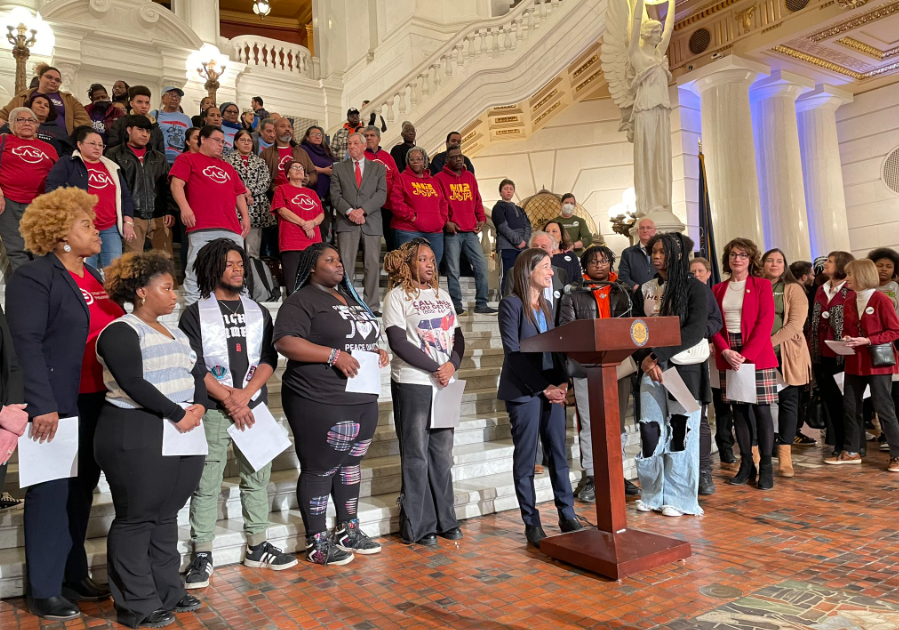
Above: Educators, parents, students and advocates gather in the capitol rotunda to mark the one-year anniversary of Commonwealth Court's decision in our school funding lawsuit.
Today, more than a year after Commonwealth Court's historic decision in our school funding lawsuit, there's a serious plan on the table for public school funding based on what students need, not what local communities can afford. Now, it's up to all of us to make this plan a reality.
On February 6, Governor Josh Shapiro made a historic commitment to public schools in his state budget address. He endorsed the work of the Basic Education Funding Commission, which released a plan to close school funding gaps in Pennsylvania by providing an additional $5.1 billion in state funding annually within seven years, targeted to students in low-wealth districts that have been deeply shortchanged, along with an additional $970 million for districts where local taxpayers have picked up the slack for insufficient state funding.
For the 2024-25 school year, Governor Shapiro's budget proposal would make a down payment on bringing the system into compliance, targeting $872 million to underfunded school districts where students have been denied sufficient resources. With a proposed additional $200 million for all school districts and a proposed $300 million investment in school facilities, Governor Shapiro's proposal puts the plan for a constitutional school funding system in motion.
Our clients in the school funding lawsuit, and educators across the commonwealth, recognized the life-changing impact this plan could have for their students.
“Thank you, Governor Shapiro, for putting forward a budget plan that will help public schools meet the needs of all their students,” said our client Dr. Amy Arcurio, superintendent of Greater Johnstown School District. “The sustained, predictable funding that the long-term plan begun by this budget provides would be transformative. Our limited local wealth would no longer lead to a triage for essential educational resources. Instead, we could provide the tools in Greater Johnstown to give our learners a meaningful opportunity to become what we know they can be—the people who build the future of Pennsylvania.”
On February 7, we marked the one-year anniversary of Commonwealth Court's decision finding Pennsylvania's public school funding system unconstitutional, joining our co-counsel from Education Law Center - PA and more than 100 Pennsylvania educators, students and parents in the Capitol Rotunda.
In closing remarks, our senior attorney Dan Urevick-Ackelsberg made the next step clear: we need the General Assembly to pass to pass the Governor’s budget proposal, and back it up with a multi-year commitment to see the plan for constitutional school funding through.
"If we want the decision to be real, and to be real before a Kindergartner reaches adolescence, we all must be engaged, every single one of you," Urevick-Ackelsberg said. "So here is my challenge to you. This week: call your elected officials. Start with the Governor himself. Call his office. Thank him for the bold step he took.
And then demand from the Governor and General Assembly the enactment of a complete, multi-year plan to provide children what they need."
Here are a few highlights of statewide press coverage:
-
School officials view state funding plan as 'game changer' and 'transformative' - Pottsville Republican Herald, 2/24/24
-
Lawmakers weigh solutions to fix 'crumbling' Pa. Schools - Fox 43, 2/18/24
-
Pottstown School Board working to get fair funding over the finish line – Pottstown Mercury, 2/17/24
-
Advocates mark 1st anniversary of court ruling, commend governor’s education budget – Citizens’ Voice, 2/7/24
-
Lancaster County leaders respond to Gov. Shapiro’s proposed $1.1 billion increase to education funding – Lancaster Online, 2/7/24
-
Pennsylvania Gov. Shapiro proposes $48 billion budget with focus on education, economy, and people – Pennsylvania Capital-Star, 2/6/24
-
Pa.’s school funding was supposed to be revamped. Will Gov. Shapiro’s budget get the job done? – Philadelphia Inquirer, 2/6/24
-
Shapiro budget expected to address court ruling on school funding – The Citizens’ Voice, 2/4/24
|