Part of me is exhilarated and welcomes April with a great sigh of relief. We’ve made it through! We relish more daylight, less strict policies to meet each other, telltale bits of green protruding here and there in garden beds and lawns and fields.
Another part of me is determined not to be exhausted by the to-do lists, especially April’s preparations for Mad May.
There are important messages to pass along.
Please join us at Aqua Turf Wednesday, April 13, 2022, for our Annual Meeting. We commissioned Leslie Martino to help us celebrate the 200th Birthday of Connecticut native Frederick Law Olmsted. She titles her talk “People, Places and Parks: Frederick Law Olmsted’s Relevance Today.” If you haven’t already done so, go to www.ctgardenclubs.org to register.
Mary Warshauer, President of National Garden Clubs, Inc., whose theme is “Plant America – Play Outdoors” announced her intention to support a former President’s Theme, to challenge all of us to plant native trees.
To respond formally is tricky. There are 6300 of us. NGC expects us, rightly, to document what we do. Specifically, that means to collect and collate: 1- Proper name/Common name; 2- who (Individual’s name and Club Affiliation); 3- where; 4- when. Additionally, to do this by the end of this month, for this year, from 115 clubs who are hearing about this now, is… not possible.
However, we have two years. Ahaa! If your club planted native trees or shrubs last year, if you kept records, please use the format noted above, and email the information to me at fgcctpresident@ctgardenclubs.org. We’ll hold onto it.
As we defrost, perhaps your Horticulture Chair or your Conservation Chair might keep track of native trees and shrubs you and your club plant this year. Pick someone. We’ll ask for the numbers in next year’s Club Annual Report. Club Presidents can attach their lists. How many might we plant?! What a difference we may make.
Friday, April 22, 2022, is an excellent date to begin, as a club. That’s Earth Day.
Friday, April 29, 2022, marks the 150th Anniversary of Arbor Day.
Be festive! Invite local groups such as Audubon or scouts to join you.
Post your May Markets and Plant Sales on The Federation’s website Calendar!
Play Outdoors, plant a native or two.
|
|
|
|
Leslie, a landscape designer and a member of the Landscape Design Council, will help us celebrate the bicentennial of the birth of Frederick Law Olmsted, considered the father of American landscape architecture. His designs provided an opportunity for people to interact with nature as well as other people. Olmsted understood the impact a designed green space had on people’s social, mental, and physical health when he began designing public parks. We will explore the relevancy of his design principles and our interests in public green spaces by looking at Olmsted parks, their current issues, and the newest trends in public green spaces. We will use Olmsted’s Connecticut parks as a starting point and then look at some of the newest and most intriguing new park spaces through the design lens of Olmsted design principles. Leslie will speak about today’s parks, their role in our lives. |
|
|
|
Registration deadline: April 8, 2022 (Cancellations after that date will not be refunded) |
|
|
|
Check the Event Calendar for any Member Clubs, Affiliate Organizations*, State or National events.
*Affiliates may submit up to six events each calendar year.
|
|
|
|
SAVE THE DATE!
NEGC Annual Meeting October 18-19 in Nashua, NH
|
|
|
|
NHFGC is hosting the New England Garden Clubs, Inc., 6th Annual Meeting on October 18 – 19, 2022 (Tuesday and Wednesday) in Nashua at the Event Center/
Courtyard Marriott. We have two excellent presenters lined up to both entertain and educate you, Arabella Dane will be coordinating a fabulous photography exhibit, and we will all have the opportunity to reconnect with some of our garden club friends throughout New England that we have been missing. Come enjoy a few days in Southern NH amid the beautiful October foliage and take in all that the area has to offer. We hope to see many NEGC members attending. More details will follow soon.
|
|
|
|
NEGC Announces New Photography Group
New England Garden Clubs, Inc. is thrilled to announce our new Photography Group. The NEGC Photography group will offer New England Garden Club members photography opportunities to learn and participate in online ZOOM programs, as well as workshops and other activities that will help them to develop their photography skills. As a member of the Photography Group, you will automatically be a member of the New England Council of Camera Clubs (NECCC) and the Photography Society of America (PSA).
If you would like to be included in the email list for the Photography Group’s newsletter and other announcements, please contact Arabella Dane at arabellasd@aol.com. Here is the link to the first newsletter: https://conta.cc/3LaTiTt
|
|
|
|
Grow New Members!
Announcing our new Membership Rack Card – 2-sided, full color, 4” wide x 9” high. These were very handy with prospective garden club members at The Federation’s Membership Table at the recent CT Flower & Garden Show. The card shows all the fun and interesting things that garden clubs do, how local clubs are organized, and the benefits of belonging to The Federation and National Garden Clubs. In addition, the QR code on the back side goes directly to the FGCCT website page, which directs you to local clubs near your home.
You can download and print these locally and even add your own club contact information. These would be great to have at public events, garden tours, plant sales, and to give to new residents in your neighborhoods. Download the PDF file of the Membership Rack Card HERE.
Enjoy the card — and let me know how it goes or if I can help with any membership matters.
— Nan Merolla, Second Vice President and Membership Chair
|
|
|
|
Garden Club Accountability and Transparency
Officers of 501 (c )(3) Non Profits have an obligation to embrace the values of accountability and transparency, as a matter of ethical leadership as well as legal compliance. Wow – that’s a big sentence that I recently read online. Let’s look at what this statement implies, especially for our Garden Club Treasurers.
Accountability is the obligation to explain, justify, and take responsibility for one's actions. As Treasurers we must know the rules and know why we have these rules and be prepared to enforce them, and, most importantly, we take responsibility for the integrity and accuracy of our club’s finances.
Transparency refers to conducting our actions and financial activities in an open and clear manner. Do we report income and expenses as a lump sum for the month and not itemize? Giving our members all the information about both income and expenses is preferable to not giving them enough. Your club members deserve to know how much money is in your treasury and investments – after all, it is THEIR money.
Giving out specific financial information and account balances in a Treasurer’s Report is not always advisable at an open club meeting with speakers and non-member guests in attendance. Sometimes mentioning that we paid the speaker $400 for last month’s program, but the speaker sitting in the back of the room waiting to give their program for this month only requested $150. Well, you can see it sometimes can get awkward. But the information must always be made available to your members, perhaps in the meeting minutes that are distributed to your members. Financial information must always be available on request, both historic information and current conditions. That is Transparency.
Ethical leadership cultivates trust in the actions we take, especially regarding our club finances. Garden Club Members look to our officers to set the tone and character of the club, and our clubs look to the leaders of The Federation for that same ethical guidance. Do our leaders strive to do what is right, and not just what we are legally bound to do? If we have a club policy such as “no refunds” can we do the right thing occasionally if a special situation warrants? I’m not talking about breaking a law, but sometimes a policy needs to be revisited or examined, especially as it concerns people. Treasurers must be worthy of trust, which is to present facts as they are, play fair, and communicate honestly. As Treasurers, do we use the same set of rules and procedures for all members of our organization? Do we require receipts before we reimburse or do we occasionally “let it slide?” This can lead to dangerous territory and can imply that we “play favorites.”
Legal compliance is probably the concern of our Treasurers more than any other officer of our clubs. As Treasurer, you must endeavor to be aware of all Federal and State laws and regulations regarding your tax exempt status as well as the bylaws and standing rules of your own club. Knowing the laws certainly makes it easier to be in compliance! As Treasurer, do you know the dates of your fiscal year, thus the date your 990-N filing is due? I am amazed at how often a Treasurer uses the wrong dates. Do you know if your club is Incorporated or not? If yes, do you know which month your CT Secretary of State Annual Report filing is due? Do you know and adhere to the date your club dues is to be paid each year? If you are reading this and your club has not yet paid your 2022 dues to the Federation, then you are not in compliance and your club is delinquent.
Shirley Hall, FGCCT Treasurer
|
|
|
|
The Lovely Garden Award
Do you have a lovely garden? Do you plant it and maintain it?You can receive recognition from The Federation for your efforts. Consider nominating your garden or another club member’s garden for the Lovely Garden Award to be presented by the Gardening Council at the Annual Awards Meeting in October at the Aqua Turf Club.
The Lovely Garden Award was established in 2006 through a generous gift bequeathed by past member Penny Jarvis of Portland/Old Lyme, Connecticut. In the spirit of its benefactor, the award is presented to someone who has demonstrated a love of gardening. Nominations are open to all FGCCT members, March 15th −August 24th. Click here for details!
— Shelley Hedberg, Lovely Garden Chair
FGCCT Gardening Council
|
|
|
|
FGCCT Award Applications - Deadline May 31
Over the next few weeks, please consider if your club has a significant project or an outstanding club member worthy of an award. If so, please complete an Award Application. The application and information is available on The Federation website, “Awards by Category.”
You may submit applications for numerous projects/or members. However, I encourage you to make a compelling, detailed nomination in only one category for each project/club member. If you attach pictures, insert them as .pdf or jpeg, no more than six on a page. Return the completed form to the appropriate Award Committee Chair, i.e., Civic, Environment and Conservation, Horticulture, etc. Also provide a copy to the Awards Chair at awards@ctgardenclubs.org
The deadline for submissions is May 31.
May 31 is also the deadline for nominations for two very special named awards:
-
The Lillian B. Rathbun Award may be presented annually to an individual involved in all phases of garden club work. It is the highest award presented to an individual garden club member.
-
The Lucille Schavoir Award may be awarded annually to a club for outstanding garden club work during the awards year, June 1 to May 31. It is the highest award presented to a club.
For either of these two awards, complete the FGCCT Award Application and send it to the Awards Chair at awards@ctgardenclubs.org
Please consider a community organization, perhaps a person of significant note, you or your club would nominate for The Bronze Medal.
The Bronze Medal, established in 1935, is the highest award by The Federated Garden Clubs of Connecticut, Inc. It is awarded to an individual, couple, group or club for outstanding accomplishments in upholding the aims and purposes of The Federation. A letter of nomination is due July 1 to awards@ctgardenclubs.org
A list of prior recipients of The Bronze Medal is here.
— Vonice Carr, FGCCT Awards Chair
|
|
|
|
Tribute Awards
Tribute Awards — the highest awards after The Lillian B. Rathbun, The Lucille Schavoir and The Bronze Medal — are distinct awards to honor individuals who have made a real impact on their club, The Federation, and/or the community, in the following categories:
- Civic Development
- Communications
- Conservation
- Floral Design
- Garden Therapy
- Horticulture
- Landscape Design
- Photography
- Youth
- All-Around Excellence
Any club member can nominate any member of The Federation for a Tribute Award. Recipients will be honored with a Tribute Pin and a Certificate at The Federation’s 93rd Annual Awards Meeting on October 26, 2022.
The deadline for submitting nominations for Tribute Awards is May 31, 2022. Simply submit a letter, explaining who the candidate is and all of their contributions that make them worthy of this distinction. Photos are welcome.
Submit the letter by email to:
or USPS mail to:
Nan Merolla
Second Vice President and Membership Chair
P. O. Box 394
Wilton, CT 06897
|
|
|
|
41st Annual Connecticut Flower and Garden Show ~ Meet the New Chair!
After the successful conclusion of the 40th annual Connecticut Flower and Garden Show, FGCCT President Polly Brooks is pleased to announce the appointment of Lynda Brown as Chair of the 41st Annual Connecticut Flower and Garden Show, to be held at the CT Convention Center on February 23-26, 2023.
Currently, Lynda is Corresponding Secretary on the FGCCT Board of Directors. A member of the Manchester Garden Club since 2009, she has served as Secretary and President. With overlapping activities among Town of Manchester and Garden Club projects, Lynda has initiated a Monarch Butterfly Waystation at Bigelow Brook, chaired the 90th Celebration of the club and clothed a mannikin entitled “Seeded Runner” for Runners’ Art Parade in downtown Manchester.
As a past exhibitor and committee member, and now as Chair, Lynda looks forward to working with garden club members and listening to their ideas. She may be reached at fschair@ctgardenclubs.org
|
|
|
|
NGC Offers Free "Membership Mondays" Workshops on Zoom
National Garden Clubs invites all members to Join them on the 2nd Monday of each month from 2 pm - 3 pm EST for “Membership Mondays,” a free Zoom workshop. Membership is the lifeblood of our organization, and we can all benefit when we explore aspects of Member Recruitment, Retention, and the Revitalization of shrinking clubs. Learn new skills, share success stories, resolve commonly encountered issues, and brainstorm solutions with fellow garden club members across the Americas.
Each workshop will present a topic of the month with a special guest speaker, followed by Q&A and member dialogue. NGC Membership is committed to connecting us all together to explore solutions in a spirit of collaboration. Below is the list of upcoming “Membership Mondays” workshops:
- April 11, 2022
- May 9, 2022
There are also helpful membership resources on the NGC website, including:
|
|
|
|
Coming up in 2022 (check the website for more information on these tours, including full brochures and current status) :
-
The Lowcountry: Beaufort and Savannah (April 18-24) Note: this trip is full with a waiting list.
-
Alaska: Land of the Midnight Sun (June 19-28) Note: one spot left.
-
Long Island Getaway (July 26-29) Note: This trip is sold out.
-
Finger Lakes, NY (September 7-11) Click here for brochure.
-
Hidden Treasures of Le Marche (October 5-13): Wait list only.
In the works for 2023:
- January: Costa Rica (January 12 - 22, 2023)
-
April: Charleston
-
April 24-May 2: Madeira Flower Festival
-
July: Hudson Valley Getaway
-
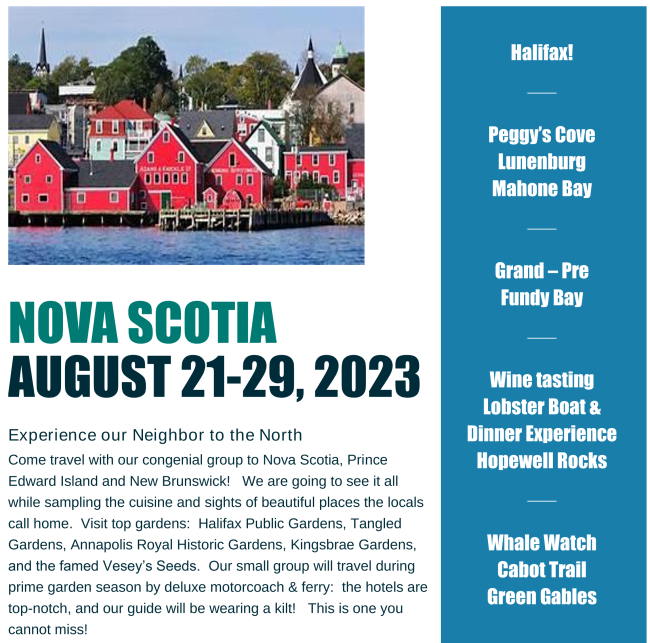
September: Nova Scotia & Prince Edward Island
-
Late October/Early November: South Africa Garden Tour with Safari Extension
— Kathy Lindroth, FGCCT Tours Coordinator
|
|
|
|
Connecticut Life Memberships
A wonderful way to recognize an individual's accomplishments and dedication to your club is to honor them with a Connecticut Life Membership in The Federated Garden Clubs of Connecticut, Inc. There are no specific qualifications — Life Memberships may be given by a garden club or an individual.
This prestigious honor is often presented at a special celebration, such as your club’s annual luncheon. The honoree will receive a lovely Life Member pin, a letter of congratulations describing their achievements, and a Life Membership Card, signed by The Federation President.
(See this issue's Club Corner for how clubs are honoring members with Life Memberships!)
|
|
|
|
— Nan Merolla
Second Vice President and Membership Chair
|
|
|
|
April is the cruelest month, breeding
Lilacs out of the dead land, mixing
Memory and desire, stirring
Dull roots with spring rain.
— The Waste Land, by T. S. Eliot
There are things that persist from literature classes long ago. This verse is one and I never smell lilacs without it running through my head. Common lilac is beloved in our poetry, our landscapes and our memories. Everyone loves them — except me. I rarely can dissuade fans so let’s explore common lilac as well as some Canadian and Asian kin.
Lilac, genus Syringa in the olive family Oleaceae, is native to the cooler regions of southeastern Europe and eastern Asia. There are no lilacs native to North America. There are twelve species of which common lilac, Syringa vulgaris, is the oldest in cultivation. It, along with the finer, smaller Persian lilac, S. × persica, were introduced into northern European gardens from the Ottoman Empire at the end of the 16th century.
Hybridization became an obsessive endeavor with many crosses and cultivars being introduced over the centuries.
|
|
|
|
The species S. vulgaris has fragrant, lavender blooms and grows to upwards of 15 feet. It was improved upon by the French breeder, Victor Lemoine, who introduced many cultivars between 1876 and 1927.
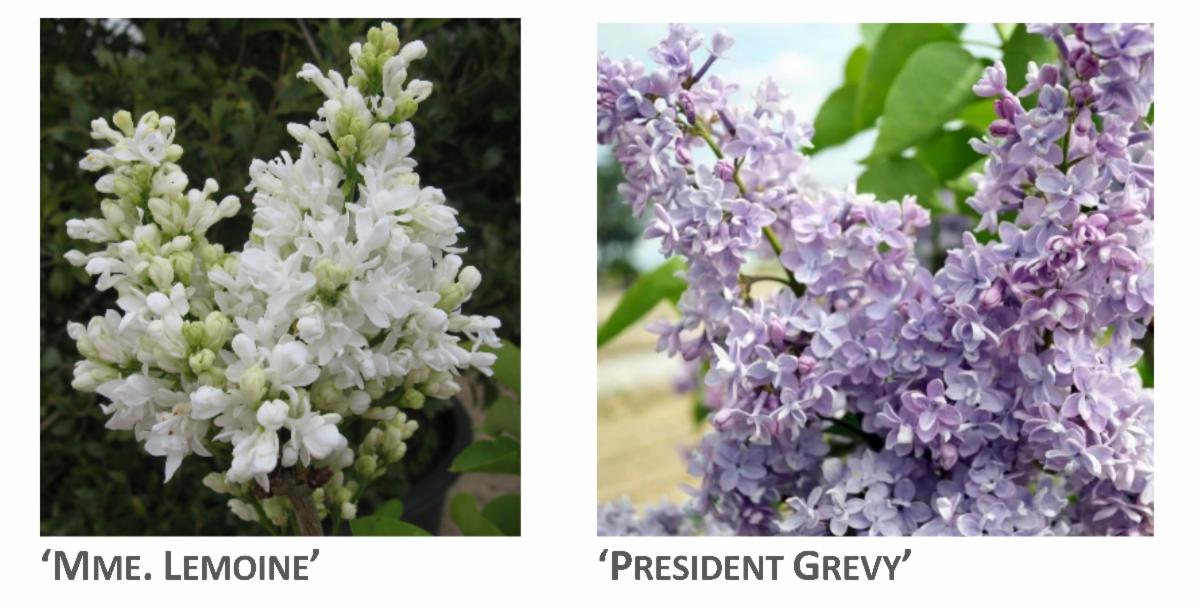
These "French lilacs" had deeper, more saturated colors. He also developed double-flowered cultivars where the stamens were replaced by extra petals. One standout is 'Mme. Lemoine,’ named in honor of his wife, which has double, pure-white, fragrant flowers. Another is ‘President Grevy’ with double, lilac-blue florets in immense, upright panicles.
|
|
|
|
I will not dispute that common lilac has charming, very fragrant flowers. I just dislike the rampant powdery mildew, ugly seed heads, zippo fall color, and ho-hum winter looks. Oh, and did I mention leggy? People often ask me how to prune old, overgrown lilacs. “With a chain saw” is not the answer they generally want to hear. Now, lilacs bloom on old wood so unless you want to sacrifice flowers, you need to prune immediately after flowering. Really overgrown ones,with flowers so high up that you can’t even see them, benefit from renovation pruning. This involves cutting one-third of the oldest canes to the ground and repeating two more years until all the oldest canes are removed. If you are a risk-taker you can cut everything to the ground and hope it will send up new suckers. You know my vote.
|
|
|
|
Another interesting group of lilac hybrids are the Canada or Preston lilacs, Syringa x prestoniae, which were developed in Canada by Isabella Preston. These lilacs are very hardy (Zone 2/3), and vigorous growers that are ideal for hedges. They bloom two weeks later than common lilac so you can stretch your lilac experience out. ‘James McFarland’ reaches 8 to 10 feet with bright pink blooms. ‘Donald Wyman’ is in the same size range with large pyramidal spikes of purple beds that open to red-purple booms.
|
|
|
|
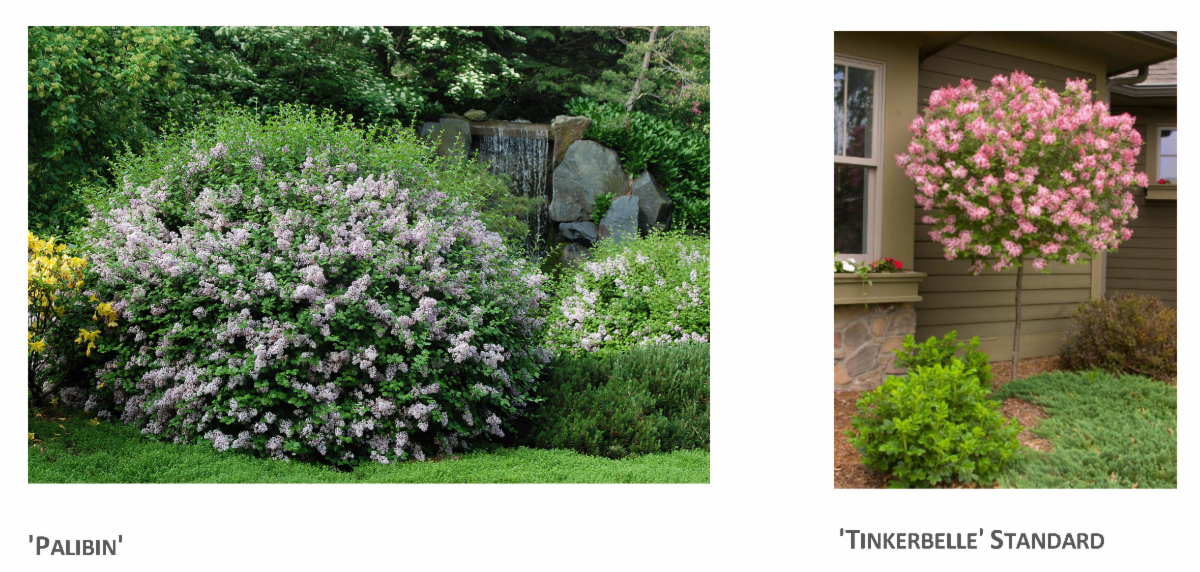
For small gardens, Meyer lilac, Syringa meyeri, is a more rational choice. It is half the size of common lilac and mildew resistant. The flowers have a strong, spicy fragrance that is definitely not the same as common lilac. A favored cultivar ‘Palibin’ is in the five foot range and sports numerous pink to lavender flowers. I have seen this shrub meatballed and mulched to death by “landscapers” and still carry on. Tough plant. A less known cultivar, 'Tinkerbelle,' is about a foot larger and has dark pink buds that open to light pink flowers. Both are available as a standard (tree form) and they are just cute as can be.
|
|
|
|
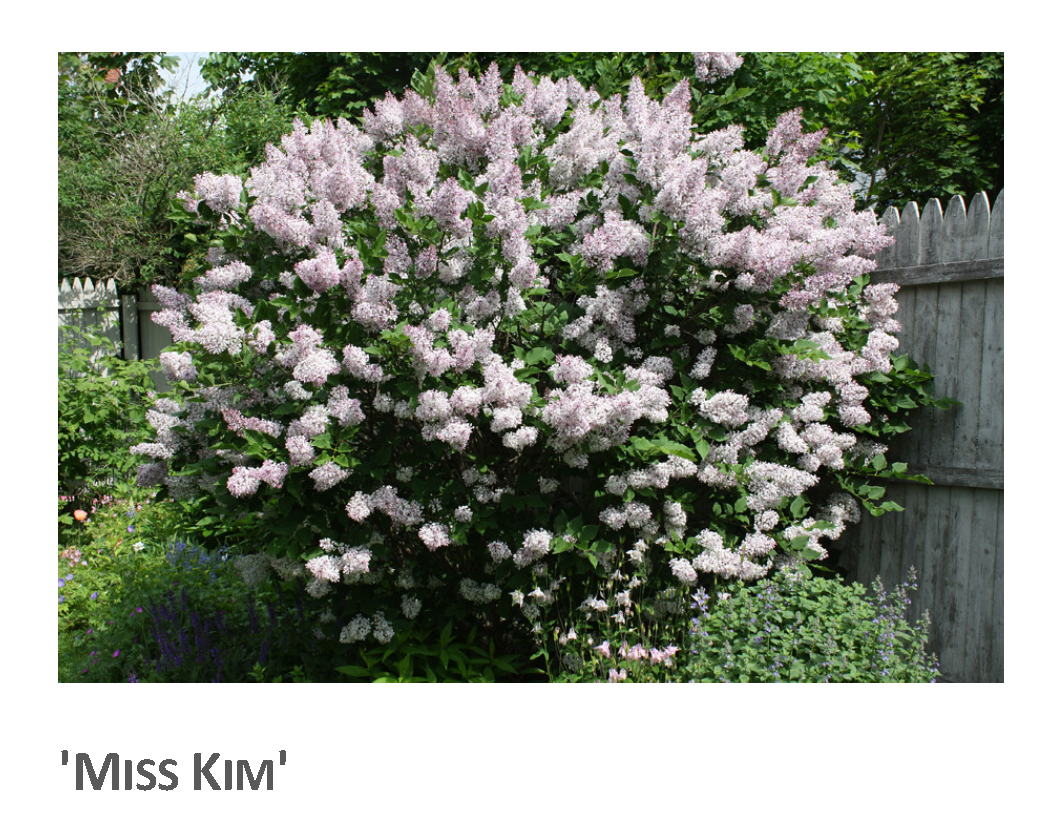
Even better is the Korean or Manchurian lilac, Syringa pubescens subsp. patula. The most common cultivar is 'Miss Kim,' a dwarf form growing four to six feet round. She has lavender flowers with a funky, clove-like scent and handsome dark green foliage that turns red/burgundy in autumn. I have one that grows in a rather difficult foundation spot on the north side of the house. It never has powdery mildew and requires very little care other than pruning a stray branch. It is a long lasting cut flower though the scent can get overwhelming. Checks all my boxes.
|
|
|
|
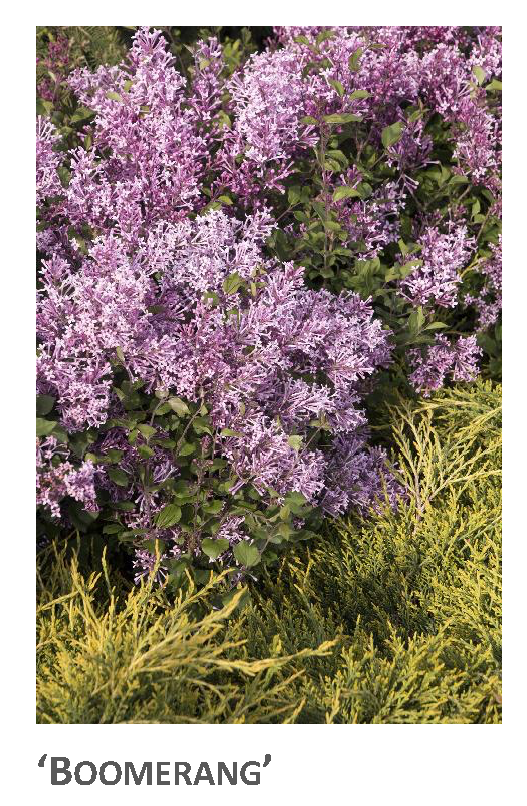
The latest addition to the lilac family is the ‘Bloomerang’ lilac, a hybrid introduced in 2009. According to its PR people, it blooms heavily in May around the same time as common lilac, takes a break in June, then blooms in July until the first frost. In general I am leery of “rebloomers” of every ilk. Growers are prone to over generous descriptions of the second coming. But mostly, I believe to every thing there is a season. Don’t muck with it.
Have a glorious spring and stop and smell the lilacs, even the common ones.
There are many other members of the Syringa genus to explore. If you are interested, an excellent resource for lilacs (and plants in general) is Oregon State University. https://landscapeplants.oregonstate.edu/
— Renee Marsh, FGCCT Horticulture Chair
|
|
|
|
Spotlight on Our FGCCT Affiliates:
The American Chestnut Foundation
|
|
|
The Federation Welcomes a New Affiliate Member,
The Connecticut Chapter of The American Chestnut Foundation
|
|
|
|
The American chestnut once dominated portions of the eastern U.S. forests. Numbering nearly four billion, the tree was among the largest, tallest, and fastest growing in these forests. However, at the turn of the 20th century, all the American chestnuts succumbed to a lethal fungus infestation, known as the chestnut blight, and an estimated 4 billion trees were reduced from giants to trees that grows mostly as a shrub. The blight cannot kill the underground root system and stump sprouts will grow again until they inevitably succumb to the blight. This cycle of death and rebirth has kept the species alive, but it is considered functionally extinct. |
|
|
|
The scientists at The American Chestnut Foundation (TACF) and the volunteers in its local chapters are leading an unprecedented mission to restore the American chestnut tree to its native range, including in Connecticut forests, by employing complementary methods of traditional breeding, biotechnology and biocontrol. The newest and most promising tool in our quest to bring back the American chestnut is Darling 58, a revolutionary transgenic American chestnut tree with enhanced blight tolerance thanks to the introduction of a gene from wheat called OxO. The gene codes for an enzyme, oxalate oxidase, that detoxifies the acid produced by the fungus and prevents lethal cankers on the tree, essentially allowing the tree to coexist with the blight pathogen. This enzyme has been carefully chosen because it is well understood, commonly found in nature as a defense against pathogens, and is not harmful to human or animal health, or the environment.
|
|
|
|
The scientists at The American Chestnut Foundation (TACF) and the volunteers in its local chapters are leading an unprecedented mission to restore the American chestnut tree to its native range, including in Connecticut forests, by employing complementary methods of traditional breeding, biotechnology and biocontrol. The newest and most promising tool in our quest to bring back the American chestnut is Darling 58, a revolutionary transgenic American chestnut tree with enhanced blight tolerance thanks to the introduction of a gene from wheat called OxO. The gene codes for an enzyme, oxalate oxidase, that detoxifies the acid produced by the fungus and prevents lethal cankers on the tree, essentially allowing the tree to coexist with the blight pathogen. This enzyme has been carefully chosen because it is well understood, commonly found in nature as a defense against pathogens, and is not harmful to human or animal health, or the environment.
|
|
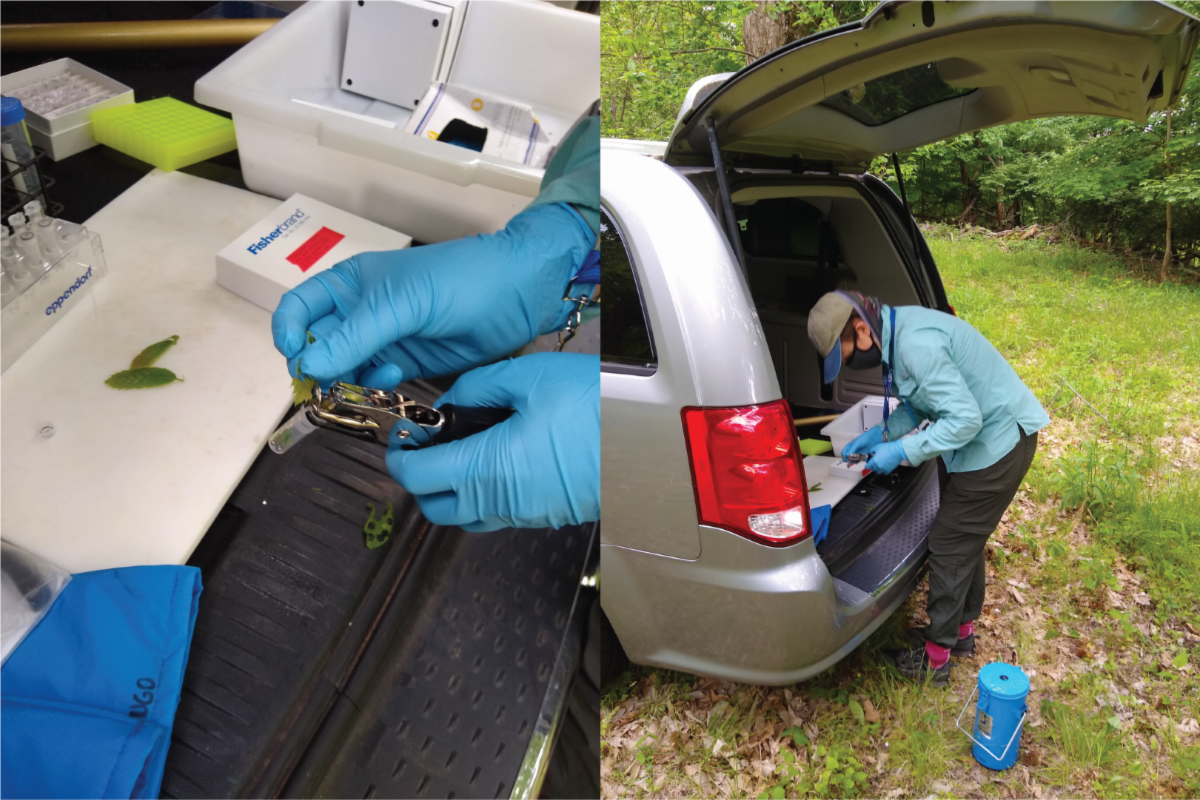
Above, Susanna Kerio, Assistant Agricultural Scientist at CAES, punching holes in young leaves of the Mahogany Chestnut tree in CAES Sleeping Giant orchard (Hamden) to help decrypt the Chinese chestnut genome, giving valuable clues on blight resistance. |
|
|
|
Our Connecticut chapter is supporting these efforts by searching and inventorying wild American chestnuts in Connecticut forests (join us for these fun hikes in the summer), manually pollinating them (many wild trees lack a pollination partner to produce viable seeds—we help them a little!), harvesting and planting these nuts in Germplasm Conservation Orchards all over the state (you can lend us your land to host an orchard!) to preserve the genetic diversity of the American chestnut in Connecticut. These trees will be bred with Darling 58 to produce the closest form to wild American chestnuts with blight resistance and provide regional adaptation to our Connecticut forests.
|
|
|
|
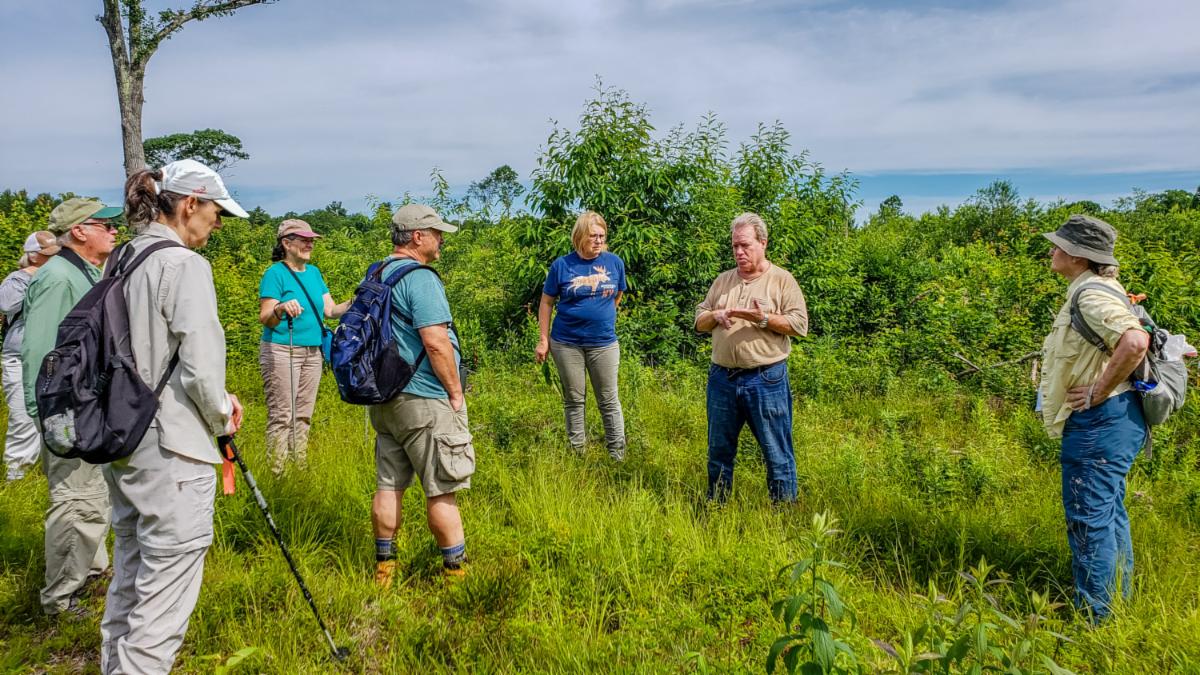
CT-TACF member David Liedlich (tan shirt) and CT-TACF President Jack Swatt (blue shirt and backpack) discuss how the forest opening gives chestnut sprouts an opportunity to flourish with the chestnut hike attendees. Several healthy chestnut saplings are seen at the successional forest edge. [Photo by Gosia Liedlich]
|
|
|
|
|
"Club Corner" is a feature of the CFNews designed to be a place where clubs or individual club members can showcase club achievements and activities. Visit " Club Corner" on the FGCCT website for latest news from—and tips for—our member clubs!
Send photos, along with a very brief writeup or detailed photo captions that describe your event or activity, to CFNewsManager@ctgardenclubs.org to be considered for inclusion.
Check out more photos from this issue's Featured Club, the Colchester Garden Club, on our website! |
|
|
|
FEATURED CLUB: In Colchester, Growing a Children's Garden |
|
|
|
The Colchester Garden Club understands the importance of encouraging children to get out in nature, as they will be the next generation of gardeners and stewards. Through the years, the club has worked to encourage children to garden – creating a butterfly pollinator garden to visit, giving away plants and seeds, supporting gardening/wildlife badges and conservation project hours with the Scouts, hosting family nature activities to earn points for Community Wildlife Habitat ongoing certification through the National Wildlife Federation, teaching some basic gardening skills to children volunteering in the town’s Spring Clean-up Day, and more.
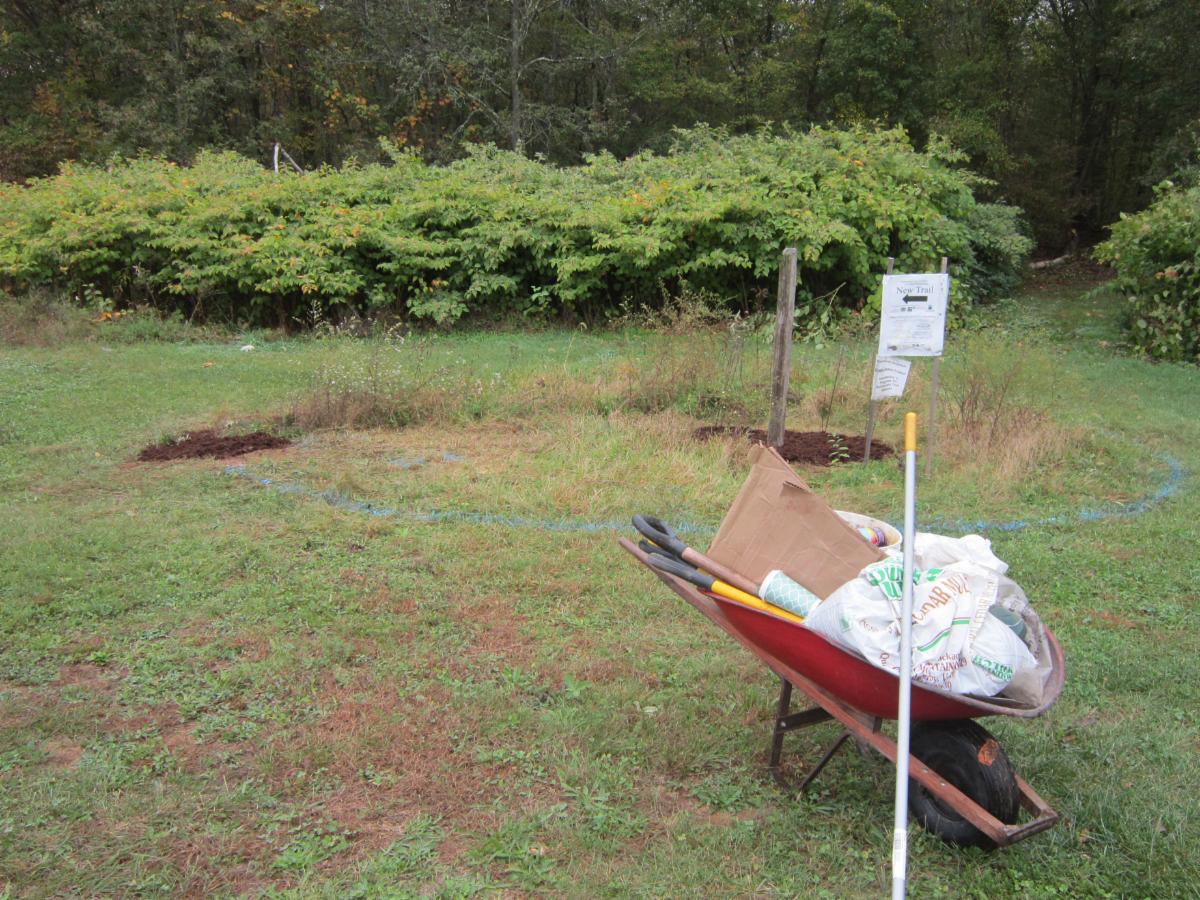
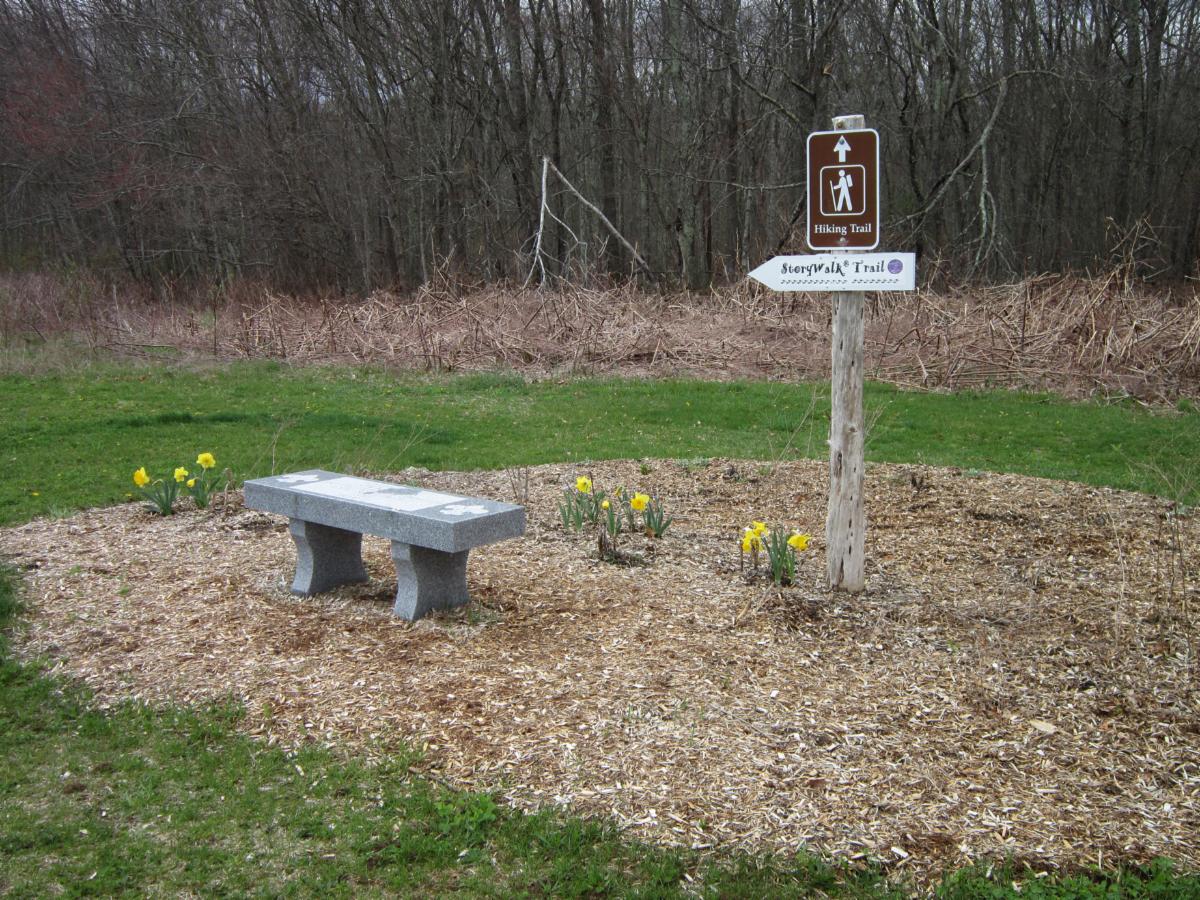
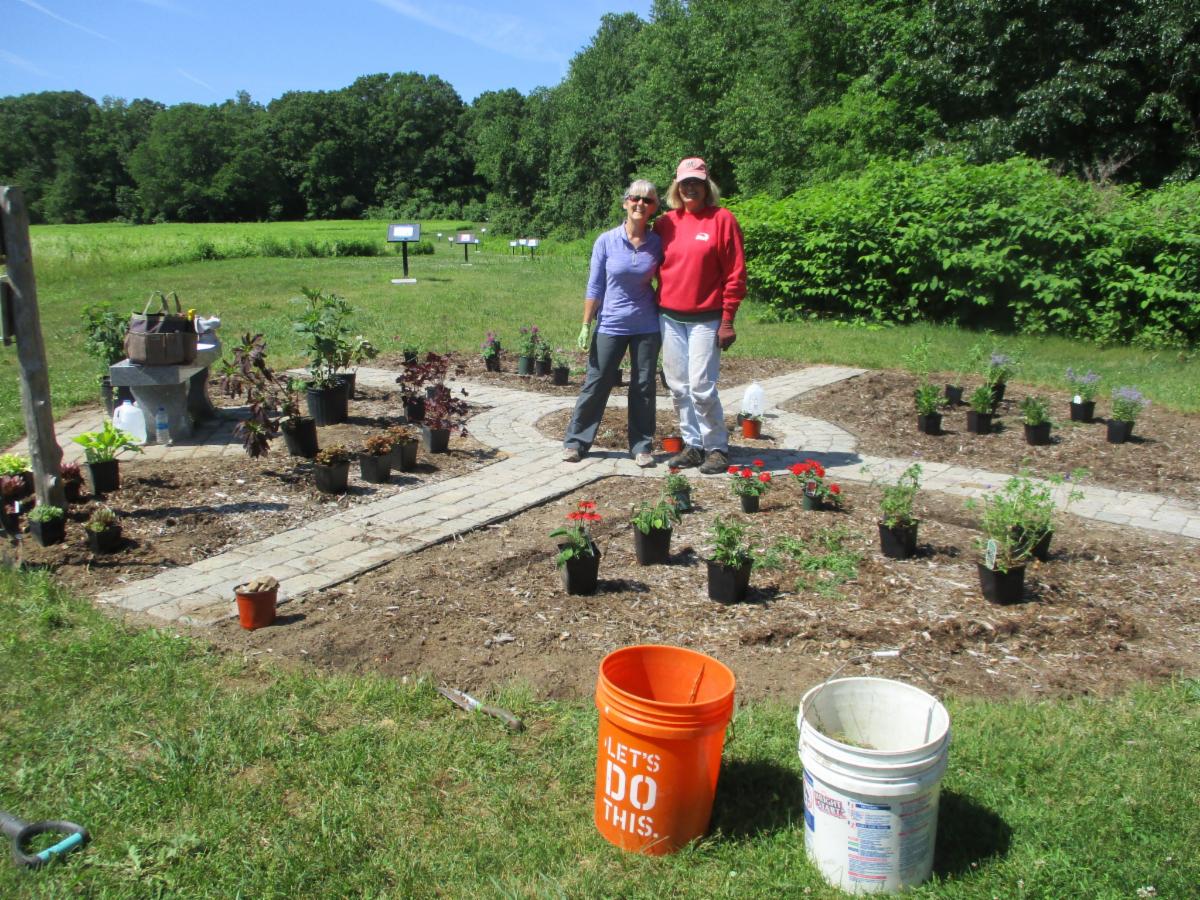
The club's most recent effort is the renovation of a small children’s garden the club originally installed as a project of opportunity for the ribbon cutting ceremony of an Eagle Scout’s StoryWalk installation. An unmowed turnaround circle was a perfect location for this garden to have children view flowers and their insect visitors close up. The original 12-ft circle garden was roughed out in November 2017 and planted the next year. (CF News Dec 2017-Jan 2018)
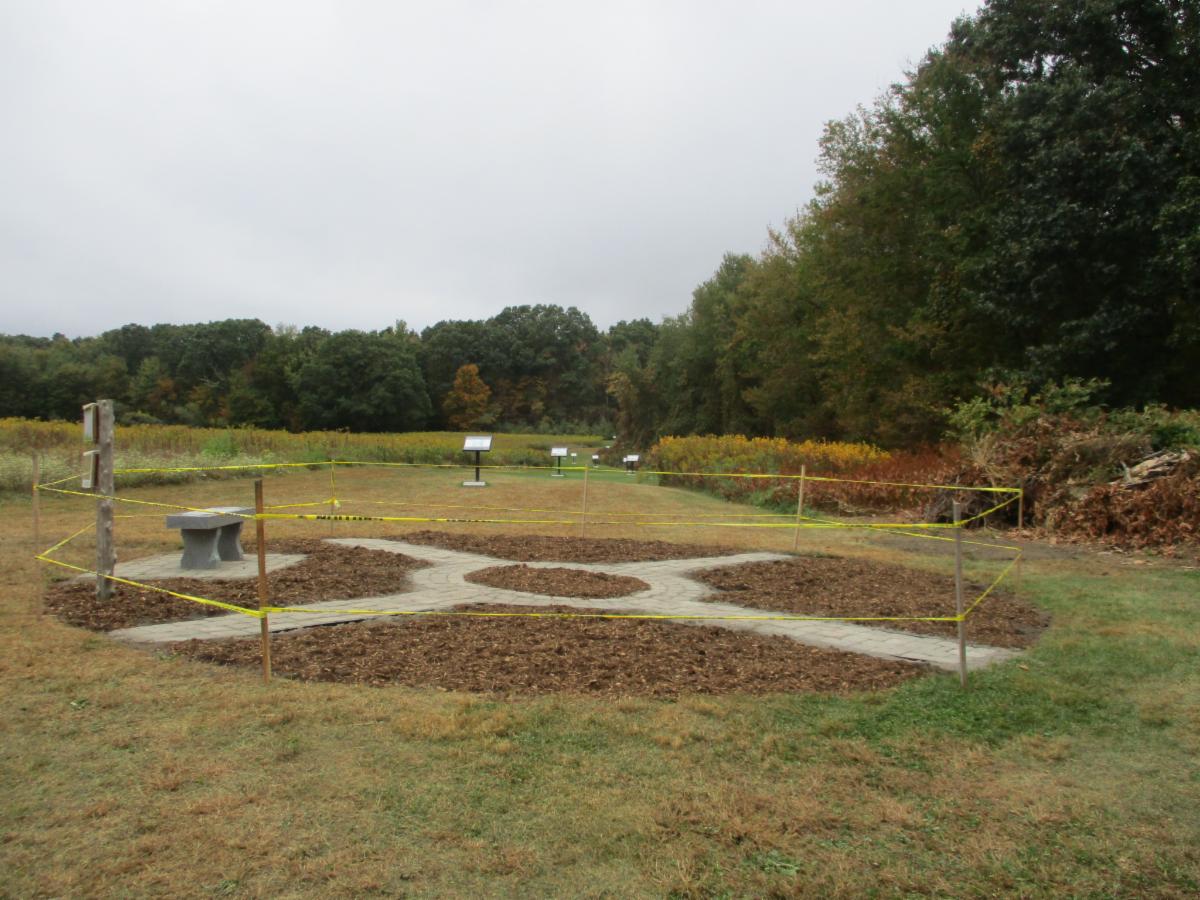
Over time, garden edging increased the size to 16-ft making it difficult for visitors to experience the garden, and more difficult for maintenance. A major redesign was needed to better fulfill the original vision of bringing children into the garden to experience some of what nature offers. The plan was to add 4 paver paths radiating from a center circle, and a paver pad for the donated granite StoryWalk bench.
In April 2020, a former CGC member brought his tractor to clear the area and dig out a large boulder moving it to the woods’ edge for children to climb on, while members did other tasks. Later a member laid out the garden and installed all the pavers acquired, however more material was needed to widen the paths for safety and aesthetics. With the COVID pandemic and increased home improvement projects, there were no pavers to be found. The garden was covered with cardboard and tarps to protect the work done and keep the weeds from emerging until more materials could be secured.
|
|
|
|
|
|
|
Waiting for pavers!(2019) |
|
Fall 2020: Ready for planting! |
|
|
|
|
|
Left: The garden and memorial stone bench in 2021. In 2022, the club plans to work on things to put into the garden to help parents use it to teach early childhood concepts – colors, counting, shapes and more. The brochure will also be revised to include activities to do with child in garden for this purpose.
|
|
|
|
Green Farms, Westport Clubs Honor Members with CT Life Memberships |
|
|
|
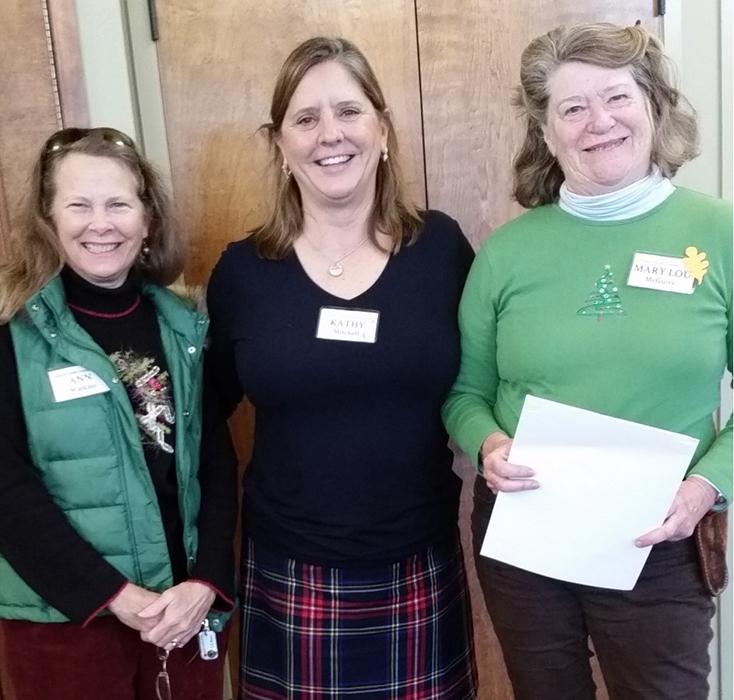
L to R: past President Ann Watkins, current President Kathy Mitchell, and Honoree Mary Lou McGuire.
The Greens Farms Garden Club honored longtime member Mary Lou McGuire with a Federated Garden Clubs of CT., Inc. Life Membership in December. The award was a complete surprise, making it extra special.
|
|
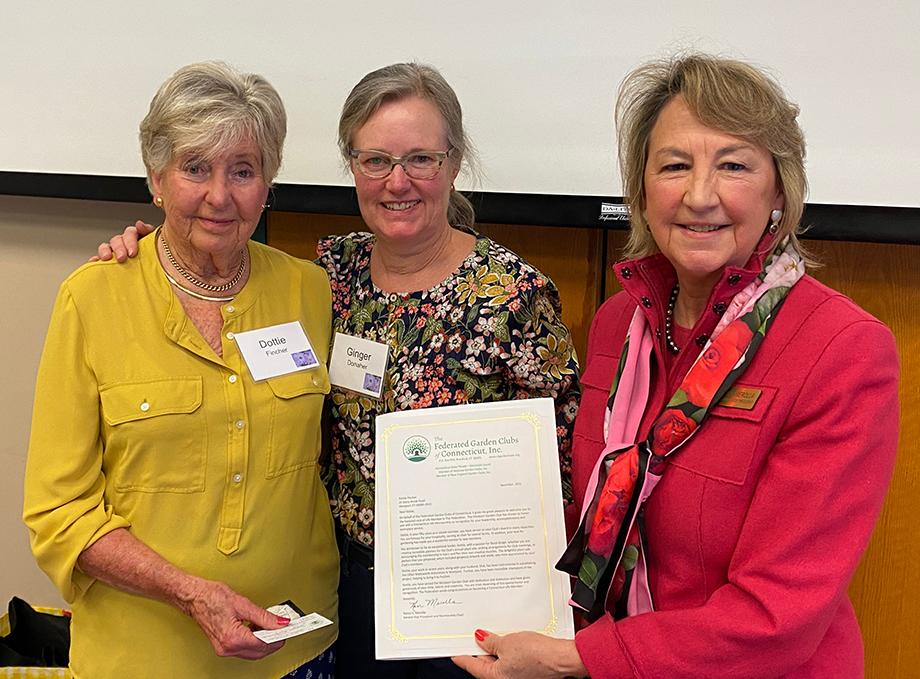
Above, left to right: Dottie Fincher, President Ginger Donaher, Nan Merolla
FGCCT Vice President Nan Merolla and Westport Garden Club President Ginger Donaher surprise Dottie Fincher with a FGCCT CT Federation Life Membership at the club's meeting in March.
|
|
|
|
All Around Connecticut, Garden Clubs are Getting Back to Business (and FUN!) |
|
|
|
Pictured above, left to right: Nancy Tauscher, Sherry Beke, Jennifer Rumbelow, Annette Maiberger (President) FGCCT VP Nan Merolla, and Diane Russell.
The Norwalk Garden Club held their March meeting and program at Gilbertie's Herb and Garden Center in Westport.
|
|
The Litchfield Garden Club welcomed award-winning floral artist Claire Won Kang for a live floral design demonstration at its March meeting. (Won Kang, who emigrated from Korea, donated her speaker fee and proceeds from her book sales at the meeting to help the Ukrainian war effort.)
|
|
|
|
April 2022: Celebrating Earth Day and National Arbor Day
“A true conservationist is a man who knows that the world is not given by his fathers, but borrowed from his children.” — John James Audubon
This year, Earth Day is on April 22. Our 150th National Arbor Day will be celebrated on April 29. This year’s Earth Day theme is “Invest in Our Planet,” and focuses on combatting climate change through activism. National Arbor Day inspires us to plant, nurture, and celebrate trees, which have the greatest potential to counter climate change. Garden clubs throughout the United States will be honoring both days by planting trees and encouraging their communities to combat global warming.
“The Earth Day 2022 theme is focused on engaging the more than 1 billion people, governments, institutions, and businesses who participate in Earth Day to recognize our collective responsibility and to help accelerate the transition to an equitable, prosperous green economy for all.” (www.earthday.org)
It is not too late to plan projects for both days. Here are some suggestions:
-
Plant a native tree in your community. Invite a school group or scout troop to celebrate Arbor Day with your garden club. You can also donate to The Canopy Project (www.earthday.org)
-
Encourage your communities to remove invasives and plant native alternatives. (portal.gov.ct-NativeAlternatives.pdf)
- Create an “End Plastic Pollution” or “Say No to Plastic” campaign to replace single-use plastics. Share the impact of plastic pollution on human and ecosystem health and how everyday actions can lessen the problem. Start a campaign in your community to replace plastic water bottles with refillable water bottles.
- Send letters to your local elected leaders and school districts, urging them to ban single-use plastic items, reusable utensils, trays, and dishes. Ask local businesses to set up recycling centers for their employees and customers.
-
Create art workshops for children using recycled materials. (www.thesprucecrafts.com or www.iheartartsncrafts.com)
- Support and/or form a neighborhood clean-up. Encourage everyone to pick up trash while enjoying outdoor activities.
- Set up an exhibit to advocate for climate literacy and community action.
- Encourage the use of biodegradable, environmentally friendly non-toxic materials and cleaning products.
- Conserve water and energy. Consider solar panels. Unplug appliances when not in use.
- Plan a campaign to encourage gardeners to go pesticide-free or limit the use of pesticides, to reduce lawns and plant pollinator gardens or rain gardens.
- Start a sustainable food education initiative to encourage and help your neighbors grow organic gardens, buy locally, join a food co-op.
|
|
|
|
Jumping Worms
— by Marty Sherman, CFNews Editor
Like many of you, I suspect, I grew up believing that the presence of earthworms in a garden was GOOD: the sign of a healthy ecosystem, where the worms labored as silent heroes, busily aerating the garden and lawns and enriching the soil with their castings. As recently as a few years ago, when I began to notice an increase in both the number and the "attitude" of the worms in my gardens, a soil scientist told me that "no, you can't have too many worms."
Turns out you can.
Especially if they are the newest transplants: "Jumping Worms" (aka, crazy snake worms, Georgia or Alabama jumpers, Jersey wigglers, wood alves, or sharks of the earth). There are three species of these worms that are now of concern in Connecticut, according to The Connecticut Agricultural Experiment Station: the rustic jumping worm, Amynthas agrestis; the compact jumping worm, Amynthas tokioensis; the large jumping worm, Metaphire hilgendorfi in the family Megascolecidae.
These worms — originally from Korea and Japan — can't actually jump (though they can climb). Instead, they move incredibly fast, slithering in a snakelike manner, and when agitated, will thrash and writhe vigorously. They live in the uppermost layers of soil, where — like other earthworms — they cycle nutrients, but they do it so quickly ("homogenizing" the soil layers) and so close to the surface that it is of little value to the soil, and washes away easily with rainfall or soil erosion. They can destroy the Mycorrhizalhyphal network in the soil, according to scientists at the Experiment Station, and are especially damaging to our native forest floors.
Where did they come from?
North America's native earthworm populations vanished with the last glaciation, about 10,000 years ago. The worms most of us are familiar with are European earthworms, which arrived with the early settlers, probably in the 1600s, as stowaways in the dry ballast of ships or in horticultural shipments of bulbs or plants sent to the Colonies. Crazy snake worms first arrived in the US in the late 1940s, when they were (intentionally) imported to the Bronx Zoo as food for platypuses. The rest is history.
How do I identify them?
One key characteristic of jumping worms is the appearance of the clitellum — the light colored band, or collar behind the head in mature adult worms (juveniles don't have a clitellum yet). The clitellum in jumping worms is not raised as it is with European earthworms; instead, it is smooth, flat, and milky-white to pale pink, and it completely encircles the body, unlike the "saddle" formed by the clitellum of the nightcrawlers and European worms. Jumping worms are gray/brown/purple in color, with a glossy, almost metallic sheen in mature individuals. They can be up to 8" in length and with an underside lighter than the top surface. Their castings, produced in copious quantities, resemble coarse coffee grounds.
I don't want to get them! What should I do?
Control of jumping worms is a relatively new area of research, and there are currently no known chemical or biological controls. Research into natural predators and biocontrols is underway, as are studies on parasitic controls, fungi, and solarization. The best defense we have at this time is to limit infestations by controlling the spread of both worms and their cocoons (the adult worms cannot survive our winters, but the cocoons can survive up to -12°F, hatching in April/May). The Experiment Station recommends we purchase only bare-root plants, and purchase only compost or mulch that has been heat-treated between 105°F and 131°F (40-55°C) for at least three days. You can find more recommendations here.
For additional information, see:
|
|
|
|
Donations by Garden Clubs to our Scholarship, Garden Therapy and World Gardening Funds |
|
|
|
We thank the following Garden Clubs for their recent donations to the FGCCT Scholarship Fund.* For almost 40 years, the Federation has awarded scholarships to college and university students who major in Agronomy, Botany, City Planning, Conservation, Environmental Studies, Floriculture, Forestry, Horticulture, Land Management, Landscape Design, Plant Pathology, or allied subjects. We welcome donations of any size. Our appeal is ongoing to give all of our clubs the opportunity to make a contribution in the amount of their choosing.
|
|
|
|
Scholarship Donations as of March 28, 2022 |
|
|
|
Kensington Garden Club
Glastonbury Garden Club
Evergreen Country Gardeners
West Hartford Garden Club
Cheshire Garden Club
Enfield Garden Club
Garden Club of Old Greenwich
Westport Garden Club
Old Saybrook Garden Club
|
|
|
$50.00
$300.00
$100.00
$500.00
$75.00
$150.00
$1,000.00
$100.00
$100.00
$2,375.00
|
|
|
|
Garden Therapy Donations as of March 28, 2022 |
|
|
|
Cheshire Garden Club
Kensington Garden Club
|
|
|
|
|
|
World Gardening Donations as of March 28, 2022 |
|
|
|
Please send all Scholarship Fund donation checks to the appropriate chair (see below). Make checks out to "FGCCT" with the appropriate Fund listed on the memo line.
*Please note that due to the deadline for articles and information for the CFNews, some donations may not be received and deposited in time to be included in the bi-monthly donation acknowledgement, but will be included in the next issue of our newsletter.
Please mail checks to
|
|
|
|
For World Gardening & Garden Therapy:
Peggy Lajoie
12 Eastview Rd
Southington, CT 06489
|
|
For FGCCT Scholarship Fund:
Deborah Osborne
25 Zoar Rd
Sandy Hook, CT 06482
|
|
|
|
Tips to use online calendar and submitting a calendar event - click buttons below. |
|
|
|
Don't Forget to follow us on Facebook and Instagram!
FGCCT is on Facebook and Instagram and we love to post your news and photos! Please send upcoming events, club activities, civic projects, milestones, and hort tips. Include photos and a brief writeup of the news your club would like to share. The best format is text in an email with jpg photos attached. Take active photos showing members at work or showcasing beautiful gardens, flowers, and plants (please name the flower if it is a hort only photo). Let’s follow each other! Send submissions to social@ctgardenclubs.org
|
|
|
|
URGENT NOTICE
ALL FGCCT CLUBS MUST FILE WITH THE IRS!
IMPORTANT INFORMATION FOR CLUB PRESIDENTS AND TREASURERS
To maintain your garden club's Tax Exemption status, your club MUST file with the Internal Revenue Service (IRS) EVERY YEAR. You must file a form 990, 990-EZ, or 990N (the e-postcard).
Clubs that fail to file an annual 990-series return or notice, for three consecutive years, will AUTOMATICALLY lose their tax-exempt status.
or Go To
www.irs.gov, then click link for "Charities & Non-Profits."
|
|
|
|
Important Reminder for ALL clubs! |
FGCCT now uses Constant Contact to distribute ALL information — from updates on upcoming tours, to school registration details, to news for (and from) member Clubs and Affiliates.
Clicking "unsubscribe" at the bottom of ANY Constant Contact message from FGCCT, including this newsletter, will automatically unsubscribe you from ALL future messages.
|
|
|
|
Deadline to submit articles/photos, ads and calendar events for the June/July 2022 issue of The Connecticut Federation News is May 10, 2022. Please submit to:
ARTICLES/PHOTOS
Marty Sherman
ADVERTISING
Barbara Romblad
PO Box 854, Branford, CT 06405
203.488.5528
CALENDAR
Ellie Tessmer
|
|
|
|
Reminder from NGC: The National Gardener is now ONLINE (and free!)
The official publication of the National Garden Clubs, The National Gardener appears quarterly, and highlights articles of interest to environmentalists, gardeners, landscapers, floral designers, educators as well as nature photographers. Feature columns offer leadership advice, seasonal recipes and garden club lore. Enjoy this and more by viewing and downloading the latest issue here. Subscribe here.
|
|
|
|
|
|
|
State, Regional &
National Events
|
|
|
|
|
|
|
|