|
 |
|
Greetings!
Happy February!
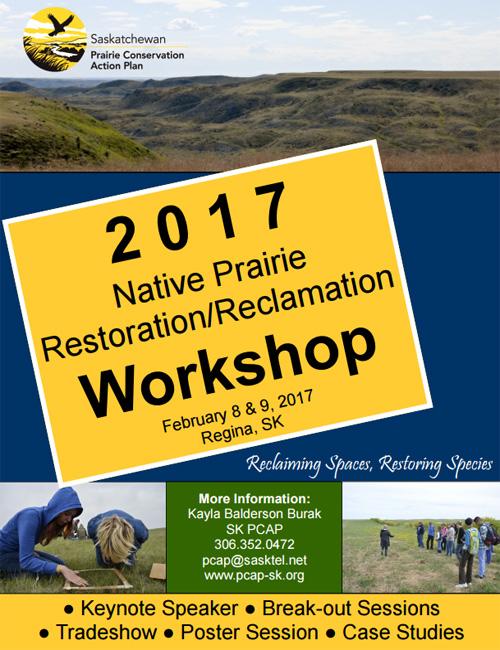
Have you been procrastinating registering for the Native Prairie Restoration and Reclamation Workshop?! Well you're in luck - there is still time to register! Space is limited so REGISTER NOW for the workshop that is taking place on February 8-9 in Regina.
The program
is also available on our website
so be sure to check that out as it is now finalized. Topics include everything from soil remediation, range health, prescribed burning, restoration for wildlife and plant species at risk, to aquatic species, industrial mitigation, as well as presentations about collaboration and the power of partnerships. NPRRW 2017 has so much to offer, including a poster session, a trade show, and numerous networking opportunities. The trade show is full, we have an incredible line up of presenters, and we had more poster submissions then past years - this workshop is shaping up to be one that you don't want to miss!
In January, PCAP attended the Saskatchewan Beef Industry Conference and met with producers and agricultural experts to chat about the importance of native prairie conservation. Also in January, Ryan Fisher from the Saskatchewan Ministry of Environment gave a webinar about current Ministry of Environment land cover and species-habitat modelling initiatives. The presentation was recorded and you can watch the presentation here. On February 16th,
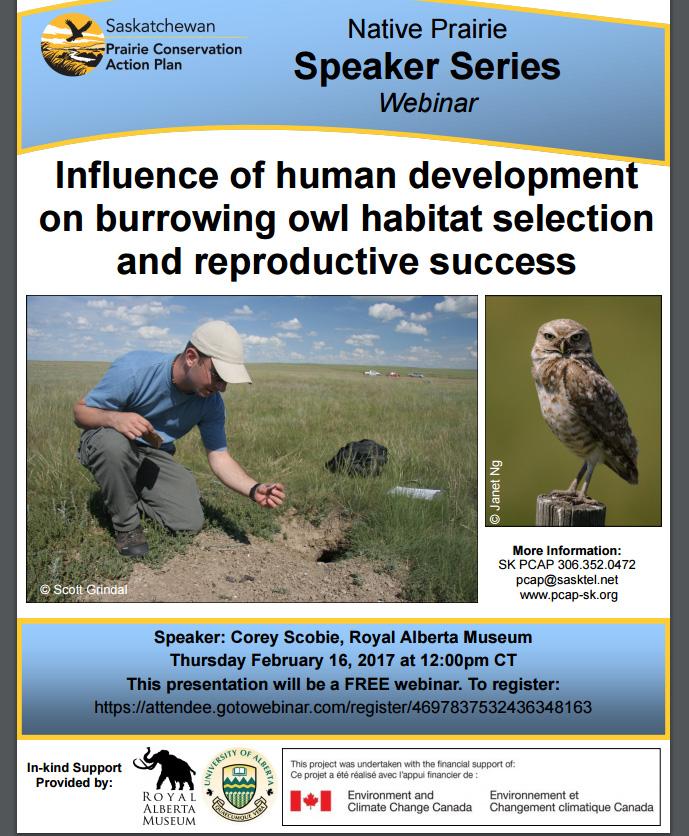
Corey Scobie from the Royal Alberta Museum is giving a webinar about the influence of human development on burrowing owl habitat selection and reproductive success. Register for this webinar here.
Then, on February 27th,
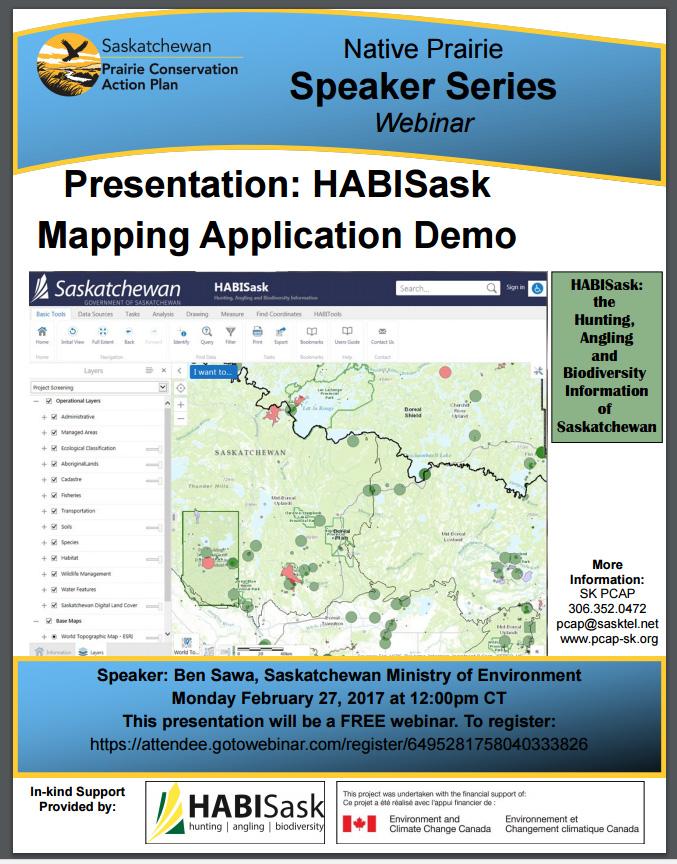
Ben Sawa from the Saskatchewan Ministry of Environment will be giving a webinar about the new online mapping application HABISask - Hunting, Angling and Biodiversity Information of Saskatchewan. This is sure to be a popular presentation so register quickly!
In future news, keep your eyes peeled for a prairie bird identification workshop that PCAP will be hosting in late March. This full-day workshop will be led by Al Smith and will be the perfect refresher before the field season! Details will be available soon.
Have a wonderful week everyone. Feel free to drop me a line about anything and everything, I would love to hear from you. See you at NPRRW!
Kayla Balderson Burak
SK PCAP Manager
306-352-0472
|
|
2017 Native Prairie Restoration and Reclamation Workshop
Reclaiming Spaces - Restoring Species
Register NOW for the 2017 Native
Pra
irie Restoration
and Reclamation Workshop on February 8 & 9, 2017 in Regina, SK! Click to REGISTER.
For a look at the agenda, or for more information on sponsorship opportunities, trade show details or accommodations, visit
our NPRRW2017 webpage.
|
|
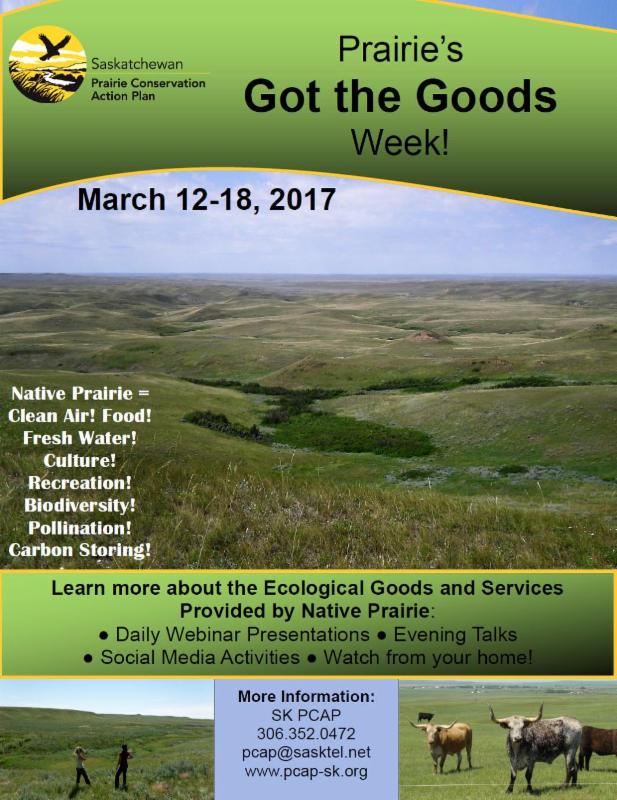
SK PCAP is Proud to Present Ecological Goods and Services Week ~ March 12-18, 2017!
|
Grasslands go Modern: New Modelling Methods Show Promise for Saskatchewan
By Tara Mulhern Davidson, PAg, originally published in the January 2017 issues of Beef Business Magazine
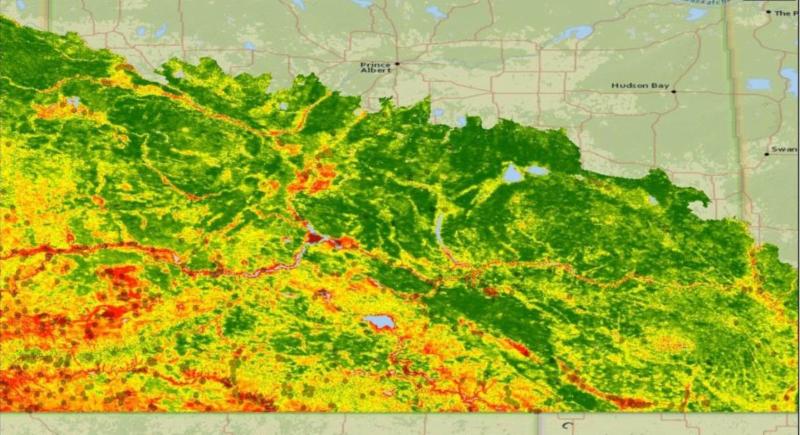
Images courtesy of the SK Ministry of Environment
It has been more than fifteen years since land cover images, dating back to 1994, were evaluated to estimate Saskatchewan's native prairie land cover. Based on that assessment, in 2001
Saskatchewan's Native Prairie: Statistics of a Vanishing Ecosystem and Dwindling Resource reported that approximately 21% of Saskatchewan's native prairie was left remaining. The need to update this information using modern technologies to better identify conservation priorities has long been on the radar of Saskatchewan prairie stakeholders. The Saskatchewan Ministry of Environment is working on some promising land cover assessment techniques and habitat models that may change the way prairie and species at risk concerns are prioritized.
These innovative modelling initiatives will prove useful for issues like species at risk habitat, big game habitat, and resource development. "Right now industry only has access to actual known locations of species from the Saskatchewan Conservation Data Centre and relies on their own surveys to help guide development. Using our developing habitat model that highlights high, medium, or low likelihoods of species occurrence, they can plan accordingly," described Ryan Fisher, a landscape conservation specialist with the Ministry of Environment. Ben Sawa, a habitat ecologist with the Ministry of Environment, agreed that both the land cover and habitat projects will have benefits to industry and other stakeholders. "The more accurate land cover assessments we have, the more successful other models will be. We can provide industry with a way to pre-plan their siting and help other conservation organizations guide and prioritize their conservation efforts," he added.
The Ministry's land cover modelling project tested three methods of delineating native prairie from tame grasslands in a specific study area in southwest Saskatchewan. The project evaluated the use of heads-up digitization of photo imaging, which is a more traditional land cover assessment method; a normalized difference vegetation index, which estimates cover based on how green an area is to distinguish between native and tame types; and a third method, called LiDAR which is a remote sensing technology that measures height differences in vegetation as well as on the ground.
"All modelling techniques were actually more successful than originally anticipated," said Sawa, who coordinated the land cover project. The techniques were verified by field crews who visited test sites to ensure that digital results were reflective of what was happening on the ground. "This is a fairly novel approach to determine the difference between native and tame cover," explained Sawa who added that the next steps may be to apply the normalized difference vegetation index on a larger area, perhaps on an ecoregion level, starting with the mixed grassland ecoregion and expanding from there. "Our initial promising results turned mapping land cover on a larger part of the province from a decade long project into perhaps a three year project, just by using modelling," Sawa said.
Fisher is leading the habitat modelling project which involves compiling species data from the Saskatchewan Conservation Data Centre, as well as a variety of citizen science projects, such as breeding bird surveys, and points recorded on online forums such as eBird and iNaturalist. "One of the biggest challenges is consolidating all of the information. There is a wide range of species at risk and biodiversity data in Saskatchewan, especially in the southern part, but it mainly exists in point form," Fisher explained. "You can look at a map and see a point here that depicts a burrowing owl or a rare plant, but for areas that haven't been surveyed, if there isn't a point, is it fair to say they don't exist there?"
Fisher is developing habitat models on a species by species basis, prioritizing those that are more at risk or potentially in trouble. As the project continues, more species are added and they plan to incorporate rare plant info or groups of species that are often found together in similar conditions. "We are trying to make these models as realistic as possible, and have sought expert feedback to make sure that everything looks like it is in place," Fisher explained.
"We're hoping that a lot of outcomes of the models and native and tame work will end up on HabiSask - the Ministry of Environment's online mapping platform," Fisher said, adding that partners will be able to access the information on a broad scale. Similar modelling initiatives are taking place in other parts of the Prairies, including work done by the Alberta Biodiversity Monitoring Institute. "They are doing a lot of modelling at the same scale using similar info so hopefully the maps that we generate will cross borders and the two mapping projects will be able to talk to each other," Fisher added.
It is impossible to beat the experience of actually being on the prairie, along with the sights, sounds, smells, and real life species observations that happen out on the grasslands. However, the application of effective technologies such as these models, will help industry and other organizations save time, plan accordingly, and conserve Saskatchewan's original natural resource - our prairie grasslands.
|
|
Watch for some exciting upcoming events near and far!
|
|
|
|
|
|
|
SK PCAP February Speaker Series
Join SK PCAP for our next Speaker Series on Thursday, February 16, 2017. This presentation is a FREE ONLINE WEBINAR, everyone is welcome to register and participate!
Corey Scobie with the Royal Alberta Museum will discuss the influence of burrowing owl habitat selecion and reproductive success. To
register, click here.
We will also host a Speaker Series on February 27, 2017. This presentation is a FREE ONLINE WEBINAR, everyone is welcome to register and participate!
Ben Sawa with the SK Ministry of Environment will be providing a HABISask Mapping Application Demonstration.
To register, click here.
Catch up on any past PCAP Speaker Series presentations by watching them on our
YouTube channel
!
|
|
Canadian Ag Day
#CdnAgDay
Celebrate February 16!
Native prairie grasslands are a vital part of Canadian agriculture. Prairie provides forage, shelter, water and space for many grazing livestock. In turn, the grazing sector helps to maintain prairie grasslands in their natural state, contributing to carbon sequestration, biodiversity and wildlife habitat conservation, and so many more ecosystem goods and services!
Join the #CdnAgDay celebration on February 16! For more information and ways to learn how you can help, visit here!
|
SK Breeding Bird Atlas is Open for Registration!
Bird Studies Canada is excited to announce the launch of the Saskatchewan Breeding Bird Atlas website:
http://sk.birdatlas.ca/
. At this stage, the website provides an overview of the project and includes instruction manuals and maps, but be sure to bookmark the site and check for updates and expansions in the coming weeks. Prompt registration will help with accommodating and planning a scheduling of regional training workshops.
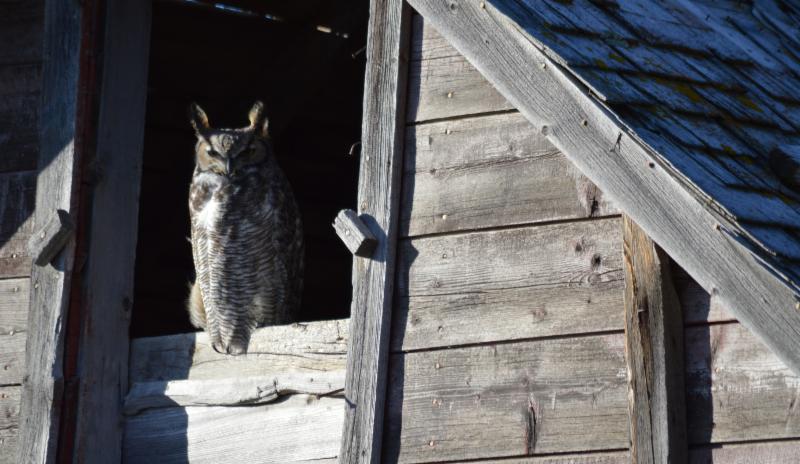
The Saskatchewan Breeding Bird Atlas is the result of a partnership between Bird Studies Canada, Environment and Climate Change Canada, Saskatchewan Ministry of Environment, the Nature Conservancy of Canada, Nature Saskatchewan and the Saskatchewan Wildlife Federation. Other sponsors and participants are being sought for this ambitious project, which will be the largest citizen scientist volunteer effort ever conducted in the province. This tool for bird conservation will map species distributions, identifying hot spots of avian biodiversity and will help to determine the status of breeding birds in the province. Registration is now open for the project, so get involved today!
|
|
Job Opportunities
Nature Saskatchewan
is hiring summer field staff. Apply by February 20, 2017.
Nature Conservancy of Canada
is hiring Natural Area Assistants. Apply by February 20, 2017.
More information...
The
University of Saskatchewan is hiring an Assistant Professor in Range and Forage Management. Apply by February 28, 2017.
More information...
|
|
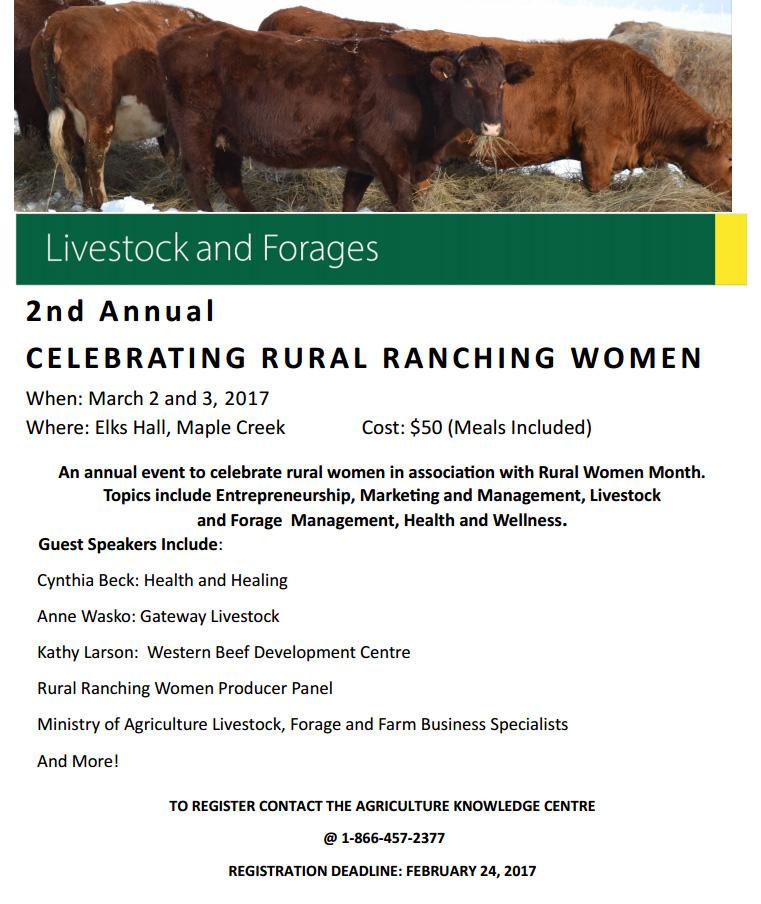
Join the 2nd Annual Celebrating Rural Ranching Women - Maple Creek - March 2 & 3, 2017!
|
|
SK PCAP Save the Date for Upcoming Speaker Series!
March 1, 2017
Greater Sage-Grouse - presented by Beatriz Preito, SK Conservation Data Centre
Grasslands Inn, Mankota, SK, 7:30pm (to be confirmed)
March 25, 2017
Burrowing Owls - presented by Lori Johnson, SK Burrowing Owl Interpretive Centre
Cabela's, Regina, SK, 1:30pm
March 29, 2017
Greater Sage-Grouse and Cropland Conversion - presented by Joe Smith, University of Montana
Free WEBINAR, Noon
April 4, 2017
Managament of Last Mountain Lake - presented by Kerry Hecker, Environment Canada
Winston's Pub, Saskatoon, SK, 7:30pm
April 26, 2017
Citizen Science - presented by Brenda Dale, retired from Canadian Wildlife Service
Free WEBINAR, Noon
|
|
Upcoming Events
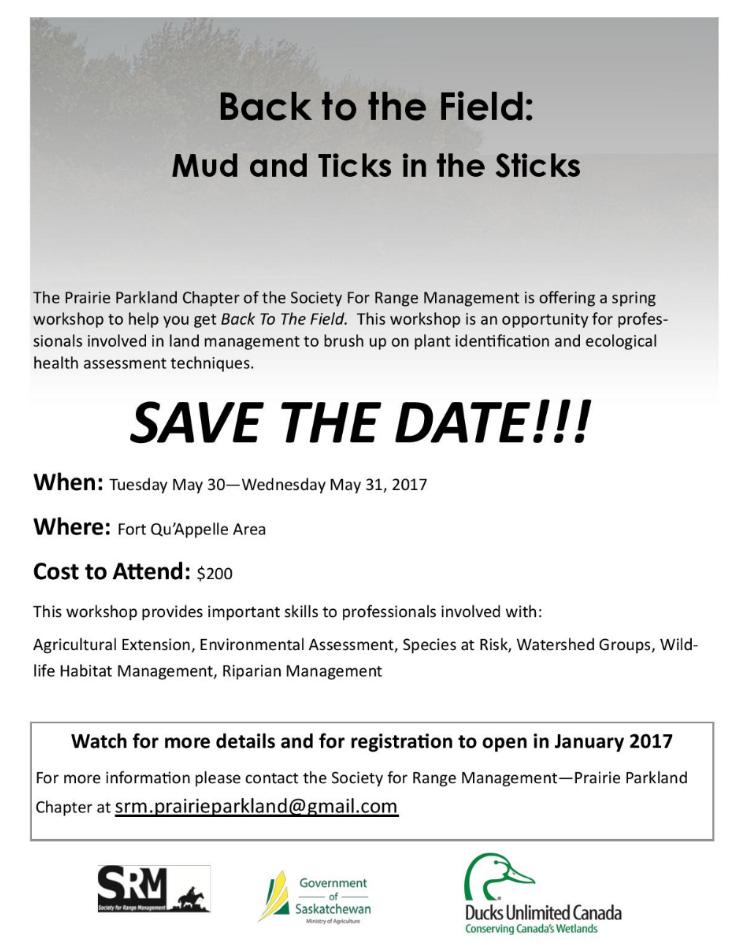
Invasive Weed Workshop - Lake Lenore, SK - February 7, 2017
|
|
Tara Mulhern Davidson, Editor, Saskatchewan Prairie Conservation Action Plan Newsletter
306-625-7345 |
|
|
SK PCAP gratefully acknowledges financial support in 2016-2017 from:
Ducks Unlimited Canada, Government of Canada - Habitat Stewardship Program for Species at Risk, Parks Canada - Grasslands National Park of Canada, Saskatchewan Beef Industry Development Fund,
Saskatchewan Ministry of Agriculture, Saskatchewan Ministry of Environment - Fish and Wildlife Development Fund,
SaskPower, University of Saskatchewan - College of Agriculture and Bioresources, Water Security Agency of Saskatchewan.
SK PCAP gratefully acknowledges in-kind support for 2016-17 from:
Agriculture and Agri-Food Canada - Science and Technology Branch, Canadian Parks and Wilderness Association, Canadian Western Agribition, Environment Canada - Canadian Wildlife Service, Friends of Wascana Marsh, Meewasin Valley Authority, Native Plant Society of Saskatchewan, Nature Conservancy Canada, Nature Saskatchewan, Parks Canada - Grasslands National Park, Prairie Wind & Silver Sage, Redberry Lake Biosphere Reserve, Saskatchewan Association of Rural Municipalities, Saskatchewan Environmental Society, Saskatchewan Forage Council, Saskatchewan Forage Industry Network, Saskatchewan Ministry of Agriculture, Saskatchewan Ministry of Environment, Saskatchewan Ministry of Economy, Saskatchewan Ministry of Education, Saskatchewan Ministry of Tourism, Parks, Culture and Sport - Royal Saskatchewan Museum and Friends of the Royal Saskatchewan Museum, Saskatchewan Research Council, Saskatchewan Stock Growers Association, Saskatchewan Wildlife Federation, Saskatoon Nature Society, SaskOutdoors, SaskPower, Society for Range Management - Prairie Parkland Chapter, University of Regina - Prairie Adaptation Research Collaborative, University of Saskatchewan - College of Agriculture and Bioresources, Wanuskewin Heritage Park, Wild About Saskatoon-Nature City Festival.
|
|
|
|