|
It’s May – a time representing change… in the weather (grab your sunglasses and fans), in academic years (congrats to all the graduates!), and planning for the change in Section leadership in June. Change is crucial to our success in life and as an organization. President John F. Kennedy observed, “But Goethe tells us in his greatest poem that Faust lost the liberty of his soul when he said to the passing moment: 'Stay, thou art so fair.' And our liberty, too, is endangered if we pause for the passing moment, if we rest on our achievements, if we resist the pace of progress. For time and the world do not stand still. Change is the law of life. And those who look only to the past or the present are certain to miss the future.”[1]
In harmony with President Kennedy’s insight, our Section has considered the past, present, and future together throughout our 50th anniversary year to generate purposeful change and growth. April has been another splendid example of this. In April, Section members, friends, and family gathered to rejuvenate together at Disney’s Yacht & Beach Club Resort during our In-State Retreat. Thank you to Sarah Sullivan for your guidance on planning considerations for special needs families. Thank you to Smolin, Kim Rommel Enright, Abigail Beebe, and Andrea Reid for your sponsorship and camaraderie, to Kim Rommel-Enright, William “Trace” Norvell, and Phil Schipani for your leadership, and to our Section Administrator Willie Mae Shepherd, without whose organizational prowess the event would not have been magical. We also benefitted from an informative CLE on Evidence which is available in our 24/7 CLE catalog. Thank you to Chelsea Miller for hosting and to Judge Laura Burkhart and Meghan M. Clary for your expertise. The Section and the Office of State Courts Administrator were in South Florida in April with the Trauma in Family Law Workshop series. We had a stupendous response with 70 attendees in Palm Beach (15th & 19th Circuits), a record breaking 101 in Ft. Lauderdale (17th Circuit), and 84 in Miami (11th & 16th Circuits). Thank you to all the chief judges for your warm welcomes and to our local workshop leaders for your leadership and enthusiasm! We hope the workshops have sparked trauma responsive revolutions in your circuits.
Congratulations to the Florida Chapter of the AAML for the remarkable 46th Annual Institute in Orlando this past weekend. It upheld its brand of being inspiring, interactive, and insightful. Missed out? Not to worry, the 47th Annual Institute will be April 25-26, 2025 at the JW Marriott Waterstreet in Tampa, FL. Save the date!
As we look forward to the future this month, nominate by May 12th an individual who has made a difference in the lives of Florida’s underserved or disadvantaged for the Alberto Romero Making a Difference Award to be honored during our June Annual Awards & Installation Luncheon. Then level up your case strategy skills by joining our CLE on Hot Topics for Appellate Review – What can you appeal and When on May 16th at 12:00 PM. Thank you to Jennifer Patti for moderating and to our speakers Alexander Bottone, Jamie Girgenti, Erin Newell, Matthew Thatcher, Cash Eaton, and Mark Baseman.
Our year concludes in June with three notable events. The Trauma in Family Law Workshops visit the 6th & 13th Circuits in Tampa on June 5th and the 12th & 20th Circuits in Ft. Myers on June 7th. We expect our final two workshops will end this series on a high note, breaking the Ft. Lauderdale record of 101 attendees. Register today!
Then, as part of the Annual Bar Convention at the Hilton Orlando Bonnet Creek, our live committee meetings and Awards & Installation Luncheon are on June 19th and our executive council meeting is on June 20th. The room block often sells out, so reserve today!
Excited to get more involved in our Section? Contact Chair-Elect Christopher Rumbold at chair-elect@familylawfla.org to express your interest today.
The Section’s 50th anniversary has been a year of investing in the next generation of our profession, our organization, and our state. Thank you to everyone for your dedication and passion throughout this year. We await with anticipation the magnificent activities and opportunities our next generation of leadership has planned in our 51st year and beyond.
Sarah E. Kay, B.C.S.
Chair, 2023-2024
[1] Address in the Assembly Hall at the Paulskirche in Frankfurt (266)," June 25, 1963, Public Papers of the Presidents: John F. Kennedy, 1963 (available at: https://www.jfklibrary.org/learn/about-jfk/life-of-john-f-kennedy/john-f-kennedy-quotations)
| |
UPCOMING NOMINATION/APPLICATION DEADLINES | | |
|
|
SUNDAY, MAY 12: Submission deadline for 'Alberto Romero Making a Difference Award.' Info and nomination form can be found HERE.
WEDNESDAY, MAY 15: Scholarship applications due for the upcoming Section Leadership Retreat. Info and application form is HERE.
FRIDAY, MAY 31: Applications due for The Florida Bar Robert A. Butterworth Public Service Scholarship Award. Submit your application HERE
| |
STAY INFORMED AND ENGAGED WITH SECTION EVENTS | | |
|
|
A number of important Family Law Section events are on the horizon in the coming months, so bookmark THIS PAGE to stay informed and engaged in Section activities, such as:
JUNE 19-20: The Florida Bar Annual Meeting, Section Committee Meetings, and Installation of Officers. CLICK HERE.
JULY 24-27: Leadership Retreat & Fall Committee Meetings. CLICK HERE.
| |
|
CLE WEBINAR
Hot Topics for Appellate Review:
What Can You Appeal and When?
Thursday, May 16, 12PM - 1:30PM EST
| |
|
You have an order, is it proper for appellate review now or later? Contempt, temporary support, attorney’s fees, child-related orders, and discovery are a few issues the panel will discuss. Open panel discussion to follow.
SCHEDULE
12:00 PM – 12:05 PM
Introduction of speakers and overview of seminar
Jennifer A. Patti, Esquire Young Berman Karpf and Karpf PA Boca Raton, Florida
12:05 – 1:15 PM
Discussion on non-final orders vs. final orders
Alexander Bottone, Esquire Probasco Singer Payne, PLLC Tampa, Florida
Appellate review of temporary support orders
Jaime R. Girgenti, Esquire Older Lundy Koch & Martino Tampa, Florida
Appellate review of contempt orders
Erin Newell, Esquire Open Book Appeals Fort Lauderdale, Florida
Appellate review of discovery orders
Matthew Thatcher, Esquire The Solomon Law Group, P.A. Tampa, Florida
Appellate review of child-related orders
Cash Eaton, Esquire Sasser, Cestero & Roy, P.A. West Palm Beach, Florida
Appellate review of attorney’s fee orders
Mark Baseman, Esquire Felix, Felix & Baseman Tampa, Florida
Appellate review of issues submitted by participants
Jennifer A. Patti
1:15 PM – 1:25 PM
Q&A
Jennifer Patti and Alexander Bottone
1:25 PM – 1:30 PM
Closing Remarks from the panel
| |
|
TRUSTEE SPOTLIGHT:
Maria Gonzalez, Esq., Section Chair 2015-2016
| |
|
- What was the “theme” for your year and why?
I was Chair of the Section in 2015-2016. My theme was professionalism. It was important for me to promote professionalism for all Section members regardless of the number of years practicing law. Younger lawyers may have never had a mentor to guide them on how to practice with professionalism and more seasoned lawyers will benefit from a reminder of those principles. Practicing family law can be extremely intense and emotional. Justice Ricky Polston presented on professionalism at our Trial Advocacy Workshop and the message was simple and inspiring. You can be a zealous advocate and nevertheless practice with professionalism and civility. Twenty-three Section members were admitted and sworn into the Supreme Court of the United States and witnessed oral argument in 2015 to further support the theme of professionalism.
2. What does the Section mean to you?
The Section means service, dedication, hard work, mentorship, collaboration, and a means to effectively improve the lives of Florida's families. It provides an effective means for the exchange of ideas and different points of view with the purpose of improving our statutes and rules which we interpret and enforce. It also means everlasting relationships with colleagues across the state which one would not otherwise have an opportunity to meet and exchange ideas with.
3. How have you seen the Section change in the past 50 years?
I have witnessed the exponential growth of charitable initiatives and the promotion of education which is amazing and worthy of acknowledgement. The Section's leadership throughout the years continues to promote dozens of annual scholarships based on need and diversity to attend the Marital Certification Review Course, the Leadership Retreat, and the Trial Advocacy Workshop. It also supports Florida's legal aid organizations and overall access to justice.
4. What’s the funniest memory you have from your Section involvement?
I have many fun and memorable moments from attending many Section retreats, but one in particular stands out from the Napa Valley, California retreat. Imagine two large buses crossing paths on a single lane dirt road winding up and down the mountain, in the rain and the drivers had to manually close their side view mirrors for the buses not to touch each other as the buses crossed paths! The person next to me started to hum a song to distract me from looking out the window to the abyss that we did not want to fall into! I am still in disbelief that the tires didn’t fall off the narrow road. I am forever grateful to my friend who transformed into a hummingbird.
5. Share a favorite memory from one of the retreats from your year.
One of my favorite memories from my out-of-state retreat was in Washington, D.C. during the actual swearing-in ceremony before the Supreme Court of the United States. Addressing the Court and introducing each of our members for admission to the highest Court in our nation and seeing the emotion in the member's faces will be something I will never forget. Yes, tears and hugs were exchanged by all.
| |
|
GRAY DIVORCE:
The Family Lawyer's Contemplation During Older Americans' Month
| |
|
By: Sarah Sullivan, Esq. on behalf of the Diversity and Inclusion Committee
We don’t often consider older adults divorcing in their later years, but the statistics on “gray divorce” are on the rise. Over the past 50 years, Americans have witnessed a “graying” of divorce with a considerable rise in divorce in people over 65 in the past 15 years.[i]
The financial consequences for the parties (especially women) can be catastrophic, and the emotional toll on adult children is considerable. An adult child described the end of her parents’ 60-year marriage as “mourning a family and people who are still alive. This is a different type of grief.”[ii]
While projected reasons for this increase in divorce rates among older Americans would seem to point to wanting a fresh start after child rearing, or staying married until the children reach majority, the reality is that the majority of those seeking a gray divorce are “serial divorcees” with multiple marriages and divorces throughout their lives.[iii] Although older age divorces often divide fixed income and assets, women tend to fare significantly worse than men. Studies show that women’s’ standard of living decreased by 45% compared to men after a gray divorce. Both husband and wife saw a more than 50% reduction in wealth.[iv] Beyond wealth, gray divorces take a toll on the relationship between parents and their adult children. Where mothers’ involvement doubles, fathers’ involvement is cut by half.
The statistics may imply that the father in a gray divorce might be free of financial and emotional obligation, it actually signifies a vulnerability in an isolated older person who will need familial and professional supports, connectivity and caregiving in the future.[v] And with division of assets, resources, and income later in life, the question of how medical care, residential care and other costly familial and professional supports needed in later years is left hanging in the balance. In stark contrast to representing younger adults in divorce, parties in a gray divorce don’t have their “whole lives ahead of them.” They don’t have the luxury of time. Because of that, lawyers need to understand how to counsel older clients contemplating divorce and ask hard questions like who will provide day-to-day care for them when they need it? How will this affect their relationship with adult children? How will they afford living expenses on one-half of their already fixed income? Questions with difficult answers.
[i] Susan L Brown, I-Fen Lin, The Graying of Divorce: A Half Century of Change, The Journals of Gerontology: Series B, Volume 77, Issue 9, September 2022, Pages 1710–1720, https://doi.org/10.1093/geronb/gbac057
[ii] Hobbs, Allyson, “When 80 Year Old Parents Divorce,” New York Times, February 10, 2020. Accessed April 20, 2024, https://www.nytimes.com/2020/02/13/opinion/parents-divorce.html
[iii] Supra note i.
[iv] I-Fen Lin, Susan L Brown, The Economic Consequences of Gray Divorce for Women and Men, The Journals of Gerontology: Series B, Volume 76, Issue 10, December 2021, Pages 2073–2085, https://doi.org/10.1093/geronb/gbaa157
[v] Id.
| |
|
By: Cash A. Eaton, Esq.
Nadja Marcela Bazan Vassallo v. Edelmo Escalona Socarras, 2024 WL 1894732 (Fla. 3d DCA 2024).
This month’s Case Law Update comes to us from the exotic lands of the Third District Court of Appeals. This update is a bit of a refresher on how practitioners and the Court are to address the pay down of a mortgage attached to a non-marital asset, when the payments are made with marital funds.
The parties were married in 2005. In 2015, the Former Wife filed a petition for dissolution of marriage. Previously in this matter, the Appellate Court held that the Former Husband's Miami Property must be classified as a nonmarital asset, and it remanded for the trial court to determine whether there was any appreciation in the value of the property during the marriage. On remand, the trial court entered an amended final judgment finding that the Former Wife was not entitled to a share of the appreciation because the Miami Property depreciated in value during the marriage. The Former Wife appealed.
The Third District affirmed the trial court’s ruling that the Former Wife was not entitled to a share of the appreciation because the Miami Property depreciated in value during the marriage. However, the trial court still erred by failing to give the Former Wife a credit for any use of marital funds to pay down the mortgage, which reduced the indebtedness on the Miami Property during the marriage. Essentially, the Former Wife should have still received half of the amount of marital funds used to pay for the mortgage on the non-marital property. Accordingly, that issue was remanded to the trial court.
Often, practitioners, when dealing with the use of marital funds to pay a nonmarital liability, will only use the “Kaaa calculation” as found in § 61.075, Fla. Stat. to address the appreciation value. However, that calculation does not account for the credits that should be an afforded to a non-owning spouse when marital funds were used to pay a non-marital mortgage. It is necessary to account for both amounts. Failure to do so could cause a party to receive significantly less in equitable distribution.
| |
TECH TIP:
Enhancing Multicultural Engagement - Leveraging A.I. Powered Translations While Embracing Diversity & Preserving Compassion | |
|
By: Jenny Vargas, Esq.
As the demographic landscape of Florida evolves, family law attorneys increasingly encounter existing and/or prospective non-English speaking clients. Despite being fully bilingual myself, meeting the communication demands of my Spanish/Latino existing and/or prospective clients at times proves quite time-consuming. Inevitably, a growing non-English speaking presence in Florida will continue to thrive.
Consequently, if we expect to not merely communicate but connect with existing and/or prospective non-English speaking clients efficiently and effectively, we must become equipped to serve this demographic competently and sensitively, especially when cultural norms, values, and traditions are prevalent within these diverse communities. Fortunately, Artificial Intelligence (AI) is poised to revolutionize the way we engage across languages.
Providing documents whether simple brochures or complex legalese in the native language of an existing and/or prospective client is an excellent tool that may foster trust and confidence in any meaningful existing or potential attorney-client relationship. However, connecting with non-English speaking populations is tricky, and even trickier if the documentation to be provided to your non-English speaking audience does not translate expeditiously and masterfully. This is where Artificial Intelligence (AI) assisted translators help facilitate an efficient solution for legal professionals.
With the advent of AI-assisted translations, several options are available to legal teams aiming to maximize their ability to build rapport with existing and/or prospective non-English-speaking clients. The benefits of AI-assisted translations include increasing accuracy and quality improvement, real-time translation capabilities that facilitate seamless communication, incorporation of multimodal communication capabilities, customization, and personalization to meet the specific needs and preferences of users, domain-specific translation tailored to specialized fields, and platforms facilitating collaborative translation efforts among human translators. However, as AI translation technologies become more omnipresent, intentionally, and consciously addressing cultural considerations is vital. Guarding against the use of triggering words or unintended euphemisms is of paramount importance. Ensuring not only accuracy but also cultural sensitivity and safeguarding against bias and misinformation are acute challenges that must be addressed as AI translation programs continue to evolve.
Fortunately, numerous AI-assisted translation options are available each with unique capabilities that are tailored for busy and conscientious legal professionals:
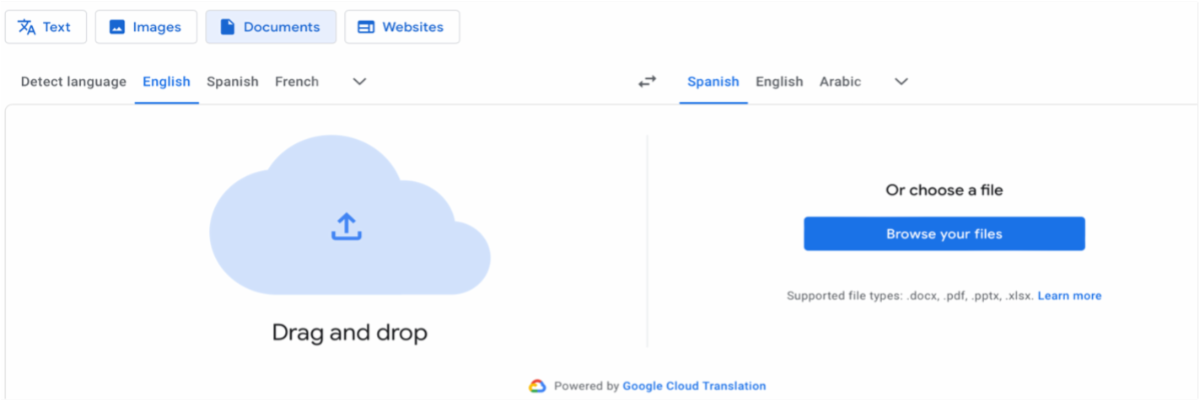
1. Google Translate: A widely used, no-cost, AI translation tool that offers translations for over 100 languages. While not specifically designed for legal professionals, its vast database and continuous improvements make it a reliable option for basic legal translation needs. However, it, too, has pitfalls. For example, when using the “Text” feature as opposed to the “Documents” feature, the translation may result in more informal speech, which may result in putting off your reader. Therefore, the “Documents” feature illustrated below may yield the most accurate results.
| |
|
2. DeepL: An AI-powered translation platform known for its high-quality translations, DeepL is increasingly popular among legal professionals because it utilizes neural network technology for accurate translations in multiple languages. However, it may not have as extensive legal-specific terminology as other options. Depending on the doc translator feature, payment may be required, as editing is unavailable with the unpaid version.
3. SYSTRAN: This AI translator offers solutions tailored for legal professionals. It provides specialized translation software designed to handle legal terminology and documents such as contracts. This option offers accuracy and confidentiality, making it suitable for law firms requiring precise on-demand translation.
4. SDL Language Cloud: This translation service is also specifically tailored for legal content. It provides customizable translation solutions that can handle complex legal terminology and comply with industry regulations and confidentiality requirements.
5. Lilt: Another option that combines human expertise with machine translation technology, Lilt offers specialized solutions for legal translation, providing accurate and efficient translations of legal documents. Lilt's adaptive learning capabilities help improve translation quality over time. However, it requires patience to allow the adaptive learning capabilities to enhance translation quality over time.
6. Lingvanex: An AI translation platform that also offers accurate translations of legal documents and terminology, Lingvanex supports a wide range of languages and provides customizable solutions for legal professionals who require precise and reliable translations.
7. SYSTRAN Pure Neural Server: A dedicated translation solution for enterprises, offering advanced neural machine translation technology for accurate and secure translation of legal documents, this AI translator supports customization and integration with existing systems, making it suitable for legal professionals in corporate environments.
Overall, AI-powered translators hold tremendous potential for breaking down language barriers, facilitating mutual collaboration, fostering comprehensive understanding, and harnessing cross-cultural communication. While there are cultural sensitivity challenges and considerations to navigate, the ongoing advancements in AI-driven translation technologies promise to reshape the way we communicate and interact in a multilingual world. However, when selecting an AI translator, it is essential to consider factors such as accuracy, language support, legal terminology specialization, confidentiality, and compliance with industry standards and regulations. Testing different platforms is advisable to determine the best option for seamless communication between your legal team and your non-English speaking audience.
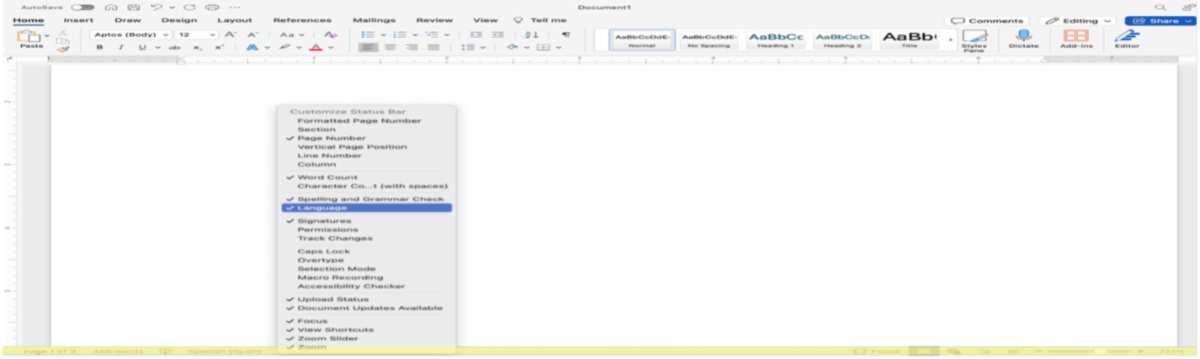
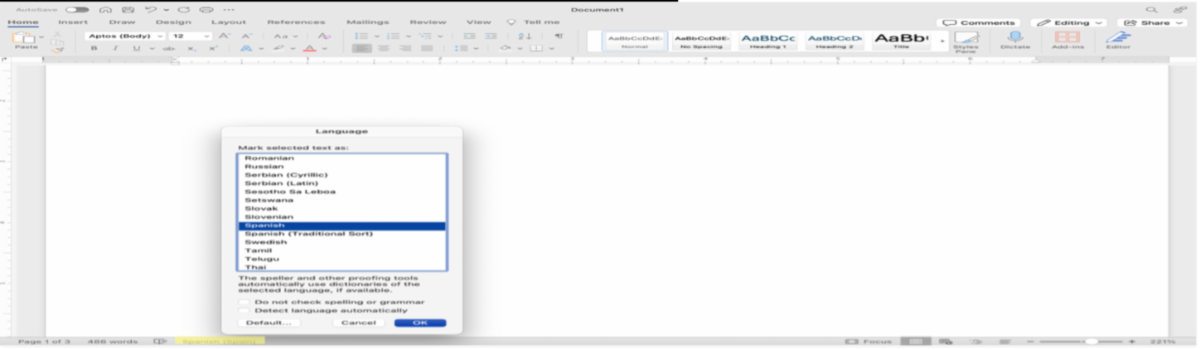
A final word to the wise: remember that you may always spellcheck your preferred language translation efficiently. You may do this conveniently, if you are using the latest version of Microsoft Word, by navigating to your “Status Bar”. Once selected, you will find the “language” option, which may be changed to your preferred language, as illustrated below.
RIGHT-CLICK ON THE STATUS BAR TO CUSTOMIZE AND CHECK OFF LANGUAGE:
| |
CLICK ON THE LISTED LANGUAGE TO CALL UP THE LANGUAGE PROOF TOOL TO SELECT THE DESIRED LANGUAGE TO USE WHEN PROOFREADING: | |
Want to submit an article for our monthly FAMSEG e-news, or our quarterly magazine, The Commentator? We can always use Tech Tips, Case Law Updates, and other relevant family law-related news for our 4,000+ members. Just email publications@familylawfla.org for more information. Thank you for your interest in contributing to our member publications! | |
Did you know that our Section Sponsorship has grown over the years? We have received 8 times the number of sponsorships that we had 7 years ago! Thank you to all of our past and current sponsors for supporting the mission of the Family Law Section! To learn more about getting involved, click HERE. | | | | |