A Judge Stopped Their Eviction, But The Law That Started It Looms Large In California
The 1985 Ellis Act blocks cities from preserving rent-controlled housing. Critics say it needs to go.
| |
|
By Mark Kreidler
June 27, 2024
When a judge ruled in June that the owner of the Barrington Plaza in West Los Angeles llegally tried to evict nearly 600 of the building’s residents, the decision was hailed as a victory for those trying to protect rent-controlled housing in a market with sky-high rental rates.
In truth, Barrington Plaza’s owner, Douglas Emmett Inc., was found to have violated a condition of a law that was written to favor landlords — that is, the company tripped up on a technicality. The bigger problem, tenants’ rights experts say, is the law itself, which paves the way for mass evictions of those living in rent-controlled buildings.
“The best change to the Ellis Act? That would be to get rid of it totally,” said Larry Gross, executive director of the Coalition for Economic Survival, which fights for the rights of low- and moderate-income Angelenos.
| |
|
Passed by the California Legislature in 1985 and enacted the following year, the Ellis Act was originally explained as a way to help “mom and pop” landlords exit the rental game. The law followed a California Supreme Court ruling that upheld the City of Santa Monica’s power to prevent a 17-year-old who had been given an apartment building by his mother from evicting tenants to tear down the building and sell the property. The Santa Monica law was meant to protect affordable rental housing.
Under the state law, though, landlords were given the unconditional right to evict tenants from rental units if the landlords plan to “go out of business” and take the homes or apartments off the rental market entirely.
Critics say the law has become a tool of advantage for large corporations, institutional investors and developers, who have moved aggressively to snap up larger residential buildings, invoke Ellis and get rid of lower-paying renters in the process.
“In actual practice, [Ellis] is used almost exclusively by corporate landlords and developers to flip buildings and tenants out of rent stabilization,” says the Los Angeles Tenants Union. “They then either demolish the buildings, convert them into condos or boutique hotels, or list vacated units on Airbnb illegally.”
| |
|
Precise numbers are hard to come by. Even at the state level, it’s unclear what percentage of California’s residential market is owned by corporations or institutional investors, and single-unit owners may also hold their property under an LLC or similar type of corporate structure.
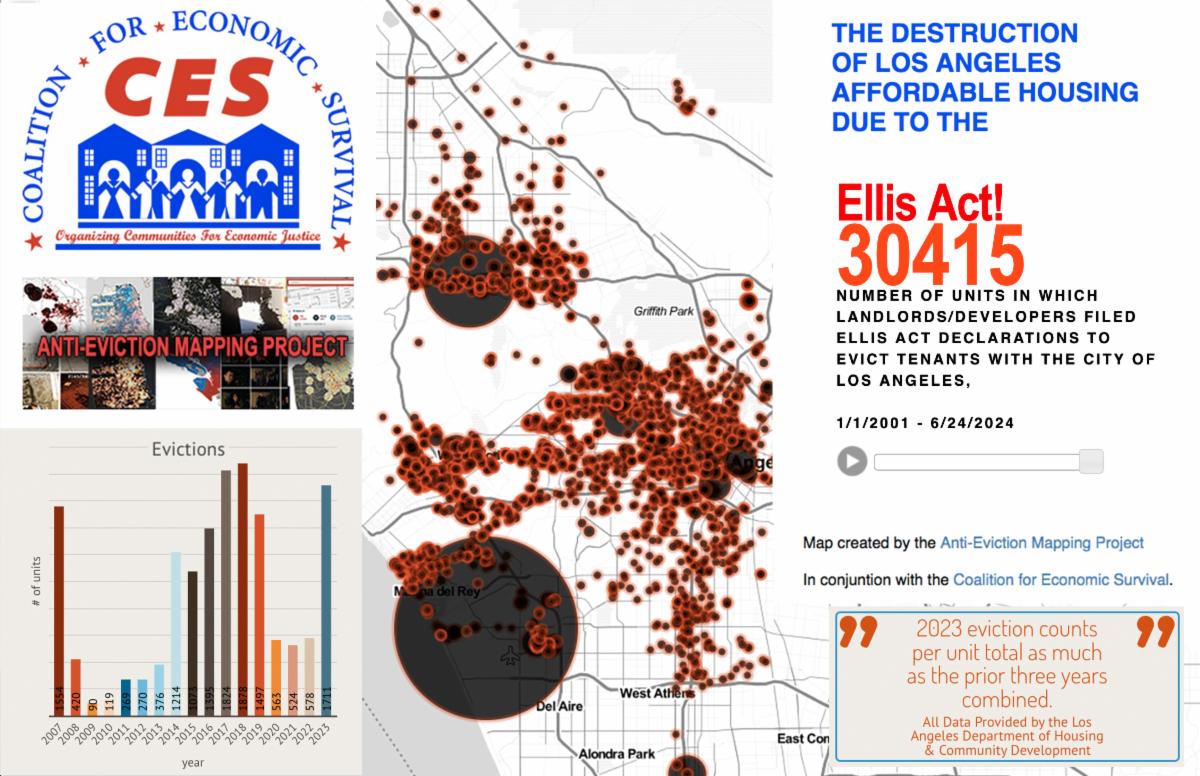
But the upshot is the loss of affordable, often rent-stabilized housing. Gross’s organization tracks the loss of rent-controlled units in the city of Los Angeles. From 2001 through the end of last year, 30,000 such units were removed from the city’s inventory, which Gross said currently sits at about 640,000.
“And those are just the ones that were removed through the process,” Gross said. “Obviously, there are other ways that are not recorded, like using them as Airbnbs, offering cash for keys [paying renters to move out] — things like that that do not involve the process at all.”
In certain circumstances in Los Angeles, developers can be required to build some new units of rent-controlled housing when they’re demolishing a formerly rent-stabilized building. But a recent Los Angeles Times report found that such new construction isn’t keeping pace with the number of rent-controlled units that are leaving the market.
| |
Those kinds of transactions, though, are legal under Ellis — one reason its critics want to get rid of it. That’s not what happened in the Barrington case, in which Superior Court Judge H. Jay Ford III found that developer Douglas Emmett Inc. failed to meet the requirements for eviction set forth in both the Ellis Act and the local LA Rent Stabilization Ordinance.
Ford ruled that it was clear Emmett’s company never intended to stop renting. The company wanted lower-paying tenants out so that it could renovate units and re-rent them at dramatically higher rates, and had even made presentations to that effect. “You can’t evict people on those grounds unless your intent is to permanently go out of [the rental] business with regard to a particular building,” said Frances Campbell, the attorney whose firm represented Barrington tenants who sued Emmett Inc.
It’s unclear whether the Emmett company will appeal Ford’s decision, which has not yet been finalized. A spokesperson for the company declined comment when contacted by Capital & Main.
| |
|
Tenants’ rights groups have called for the repeal or modification of the Ellis Act for years, but state-level legislation has repeatedly been batted back, usually with heavy involvement from the powerful developer lobby in Sacramento.
Former State Sen. Mark Leno (D-San Francisco) twice failed in his efforts to modify Ellis about 10 years ago, as pro-business groups like the California Association of Realtors and the California Chamber of Commerce rallied legislators to kill the proposals. In 2021 and 2022, the California Apartment Association bragged that it sent thousands of emails to assemblymembers to help defeat a modification of Ellis by Assemblymember Alex Lee (D-San Jose).
Whether the law can be rewritten in a way that protects both tenants and property owners is a fair question. Though the original legislation was the result of a single property owner’s wish to get out of the rental business, the passage of Ellis was roundly supported by the real estate lobby — prescient, considering that corporate ownership of residential buildings wasn’t nearly as prevalent in the 1980s as it is now, critics say.
| |
|
What would a better Ellis Act look like? Some of the most often mentioned ideas for modifying the law include:
-
A five-year moratorium before a new owner could use Ellis to start forcing out tenants. Alex Lee noted that studies show the vast majority of Ellis Act evictions occur within the first five years of ownership — an indication, he said, that “these property owners have no intention of being in the rental business in the first place.”
- A minimum of one year’s notice to tenants before they can be removed. Under the current provisions of the law, some people can be evicted 90 days after seeing a note on their door.
- Much higher relocation fees paid to evicted tenants. While current payouts from developers run to thousands of dollars, that money is quickly wiped out when tenants face drastically higher rents as they attempt to secure new housing.
- A limit on the number of times a developer can invoke Ellis.
Each of these ideas would face the same pushback from the real estate lobby as past efforts, one reason that people like Gross would rather see Ellis taken off the books altogether. In the meantime, property owners like Douglas Emmett Inc. will continue to invoke the law to attempt evictions — even if they’re ultimately found to have done so illegally. At the Barrington, nearly 500 of the 600 tenants have already moved out, though under the recent ruling they needn’t have.
“Hopefully, [the Barrington] ruling will give more courage to state officials to support legislation that would prevent the Ellis Act from being used to undermine our ability to preserve existing affordable housing,” Gross said. That is — and will remain — an uphill battle.
| |
|
Number of Affordable Rent Controlled Units Lost Due to the Ellis Breaks 30,000 Units in Los Angeles Since 2001
Ellis Act eviction filing numbers are in for first half of 2024 and the results should worry those concerned about our affordable housing and homelessness crisis in Los Angeles.
From January through June 2024, there were 475 more rent controlled affordable housing units slated to be lost to the Ellis Act,
Thus, in 2024 the City of LA saw the lost of over 1 1/2 units per day due to the Ellis Act. This has brought the total of lost affordable rental units to nearly a staggering 30,415 units, all because to the Ellis Act!
The Ellis Act, passed by the state legislature in 1985, was adopted to allow small mom and pop landlords to remove their rent control units from the market by permanently going out of the rental business.
The Coalition for Economic Survival (CES), with map-creating assistance from the Anti-Eviction Mapping Project, is releasing an update of our web-based interaction map, showing where 30,415 rent stabilized affordable units have been destroyed in the City of LA from 2001 through June 2024 due to the Ellis Act. Click to view map.
The map, using data provided by the Los Angeles Housing Department (LAHD), visually shows the devastating impact the Ellis Act has had on tenants being displaced and affordable rent controlled housing lost. One can view the address of the buildings and the number of units lost there, due to the Ellis Act, by hovering over the dot using a computer mouse or laptop touch pad.
| |
|
New CA Security Deposit Law
Limits Amount Landlord Can Demand
Coalition for Economic Survival Executive Director Larry Gross is interviewed by NBC-Los Angeles regarding a new rental security deposit law.
Under a new California law that went into effect on July, renters can no longer be asked for a security deposit that’s more than one month’s rent. A security deposit is money a landlord holds to cover potential damages, cleaning costs or unpaid rent if the renter breaks the lease agreement.
The previous security deposit amount ranged from one to two months’ rent but can sometimes be as high as three months’ rent. That changed on July 1, when Assembly Bill 12 took effect.
The new law limits most landlords to only charging renters a security deposit that’s equivalent to one month’s rent. This law applies to both furnished units and unfurnished units.
However, there are certain exceptions for small landlords who own just two properties, provided the total rental units between these properties does not exceed four. Landlords who qualify as small property owners may charge up to two months' rent.
| |
|
CES Urges a YES Vote for Proposition 33 on the November Ballot for Stronger Rent Control Laws
The ongoing rent crisis has set the stage for the Justice for Renters Act, the third time in six years that housing advocates have attempted to repeal the Costa-Hawkins Rental Housing Act, a 1995 law that they argue has stifled local rent control efforts.
The state Costa-Hawkins Housing Act prohibits communities from placing rent controls on single-family homes and any housing built after February 1, 1995. It also prevents cities from capping rent increases when a new tenant moves in. The campaign’s supporters argue that these restrictions have exacerbated the state’s affordable-housing crisis, making it difficult for cities to protect tenants from skyrocketing rents.
What is the Yes on 33 Act?
The Yes on 33 Act states: "The state may not limit the right of any city, county, or city and county to maintain, enact or expand residential rent control.
What will the Yes On 33 Act Do?
- Removes CA ban on Rent Control
- Allows cities and counties to expand Rent Control.
- Allows local communities to stop predatory corporate landlords from charging unfair and unaffordable rents
Who Supports the Yes on 33 Act?
Pro-renter, Social Justice, Veterans, Senior Groups and Labor Unions support the Yes on 33 Act.
| |
ATTENTION ALL RENTERS!
Know Your Rights By Attending the
Coalition for Economic Survival
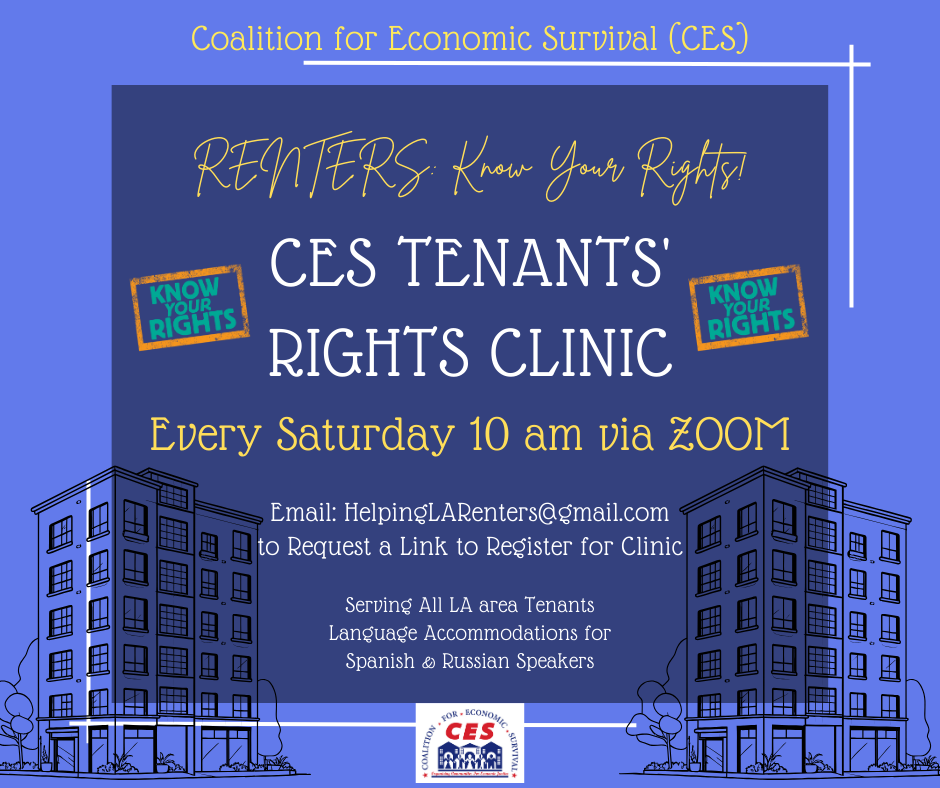
Tenants' Rights Zoom Clinic
Tenants’ Rights Clinic via ZOOM
Request a Link by emailing:
The Clinic serves the entire Southern California area.
Accommodations for Spanish, Russian speakers are provided.
One-On-One Assistance With an Attorney.
CES holds the Clinic Every Saturday via Zoom at 10 am.
and every Wednesday at 6 pm for West Hollywood Renters.
| |
Coalition for Economic Survival
| | | | |