We've got a guest author this week! Race historian Maryanna Skowronski joins us to bring us the history of the Elkridge-Harford Races, celebrating 100 years this Saturday. | |
Elkridge-Harford Celebrates 100 Years | |
|
By Maryanna Skowronski
Photos courtesy the author and the Voss family
| |
|
On April 8th the Elkridge-Harford Hunt Club will celebrate 100 hundred years of formal steeplechase racing under its auspices with the 2023 running of the Elkridge-Harford Point-to-Point.
It is a meet with a lengthy and sometimes complicated history and, as with many storied race meetings, one hundred years do not always mean one hundred renewals as war, economic downturns, occasional severe weather, and the recent pandemic have caused some dark years. None the less the sport has persevered for a century and that is an anniversary to recognize.
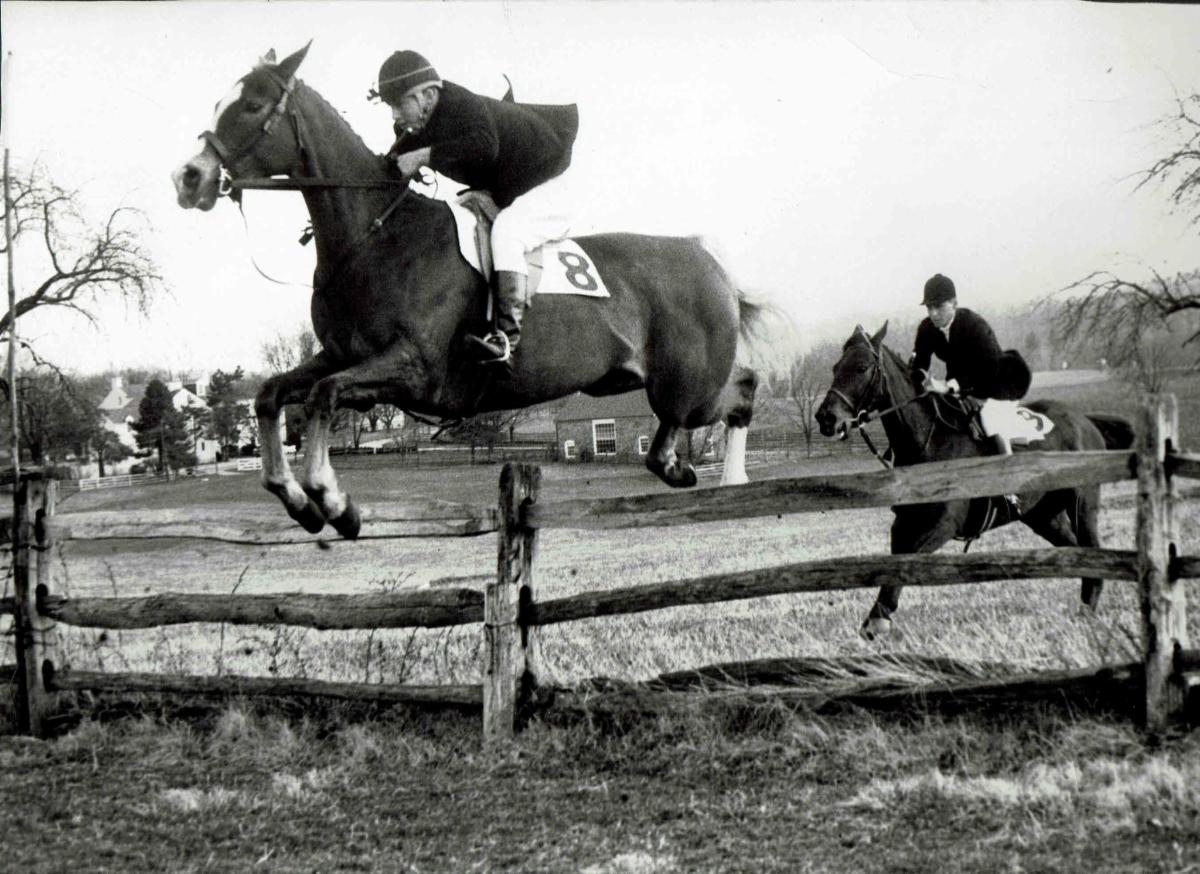
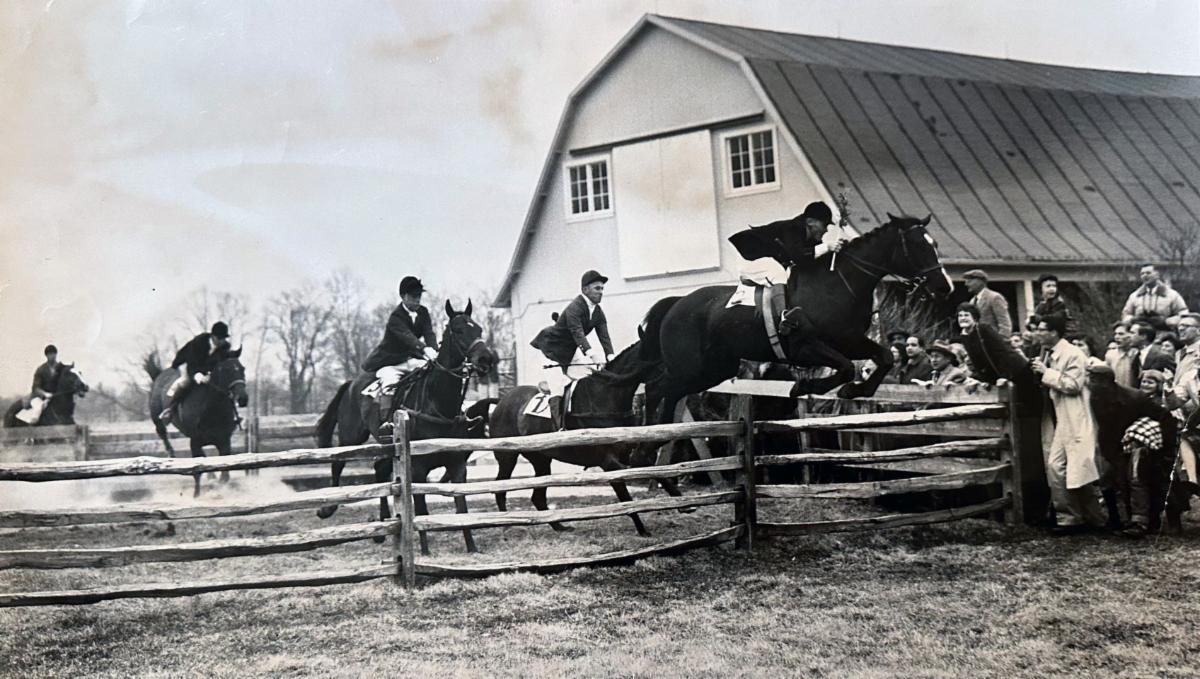
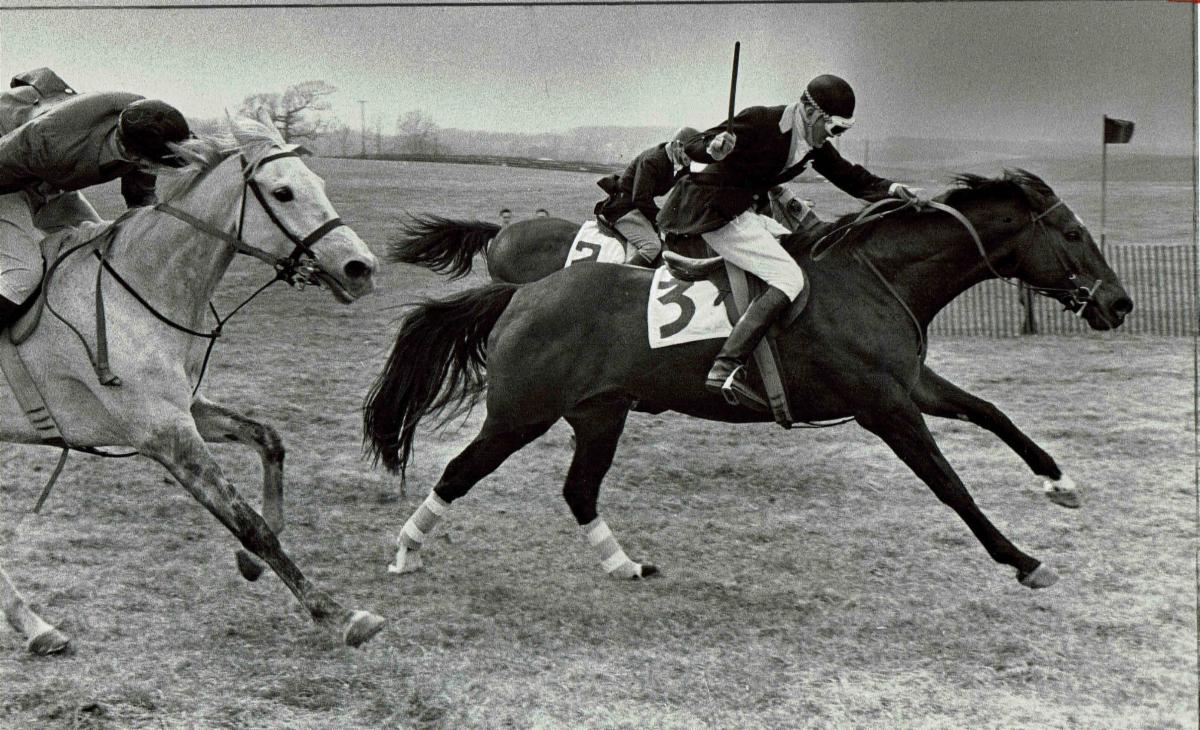
(Photo: 1959- B. H. Griswold, IV on #8, Country Boy, leads #9, Golden Fly, with D. M. "Mikey" Smithwick in the irons. (photo, Joe Di Paola/The Sun). The studio and "big house" of Atlanta Hall can be seen in the background.)
| | |
|
Celebrate with Elkridge-Harford
All pass levels offer a direct view of the course and the beautiful Atlanta Hall farm. Start your day off with the junior pony races at 10:45 am and continue on with the featured race, the $10,000 Edward S. Voss Memorial, at 12:30 pm.
Tickets for Saturday's races can be purchased HERE.
| | |
During the nineteen teens and very early ‘20s, The Aegis, Harford County, Maryland’s newspaper of record, ran advertisements for local horse shows held at Verdant Valley. Verdant Valley was home to the foxhunting Bonsal, and later Drennan families and was the location of the Harford Hunt’s first kennels. The newspaper ads cited “steeplechase classes” but these were far from organized race meetings. The earliest concrete, or should we say silver, evidence of a Harford Hunt race comes in the form of a 1923 trophy in the collection of a local horseman and inscribed “Harford Hunt Steeplechase Cup.” It was presented by the then Harford Hunt Master of Foxhounds, Mrs. William Goadby Loew, to be awarded annually unless won three times by the same owner at which time it would be retired. F. Hambleton Cockey’s Perfect Day, won the inaugural presentation while J. Myers Pearce was the owner of the 1924 winning horse, Smoky. Cockey’s horse took the wins again in 1925 and 1926, retiring the cup which had remained within the family until recently. | | |
Harford Hunt Master of Foxhounds, Mrs. William Goadby Loew, watching the start. | |
|
The December 4th, 1925 issue of The Aegis touted | |
What promises to be one of the largest fields of cross country racers ever to face a starter will line up Saturday at eleven o’clock on the Manor to compete in a four mile race, finishing at Farmington the club house of the Harford Hunt. | |
The paper stated that at time of press thirty owner-rider entries had been received and went on to say | |
With a large entry list of high class horses, a country which abounds in hill, dale and sturdy post-and-rail fences, and riders who (sic) and daring is everywhere known the event should prove truly thrilling. | |
By race day, December 12th, the field had narrowed to fifteen. “Well known lawyer and cross-country horseman” Redmond C. Stewart riding the imported Irish mare Krona, won the Harford Hunt Club Steeplechase. The trophy from that race came to light a number of years ago and remains connected to the hunt club through a local hunting family. The 1925 race is unique in that immediately afterward the club members went hunting! | | |
|
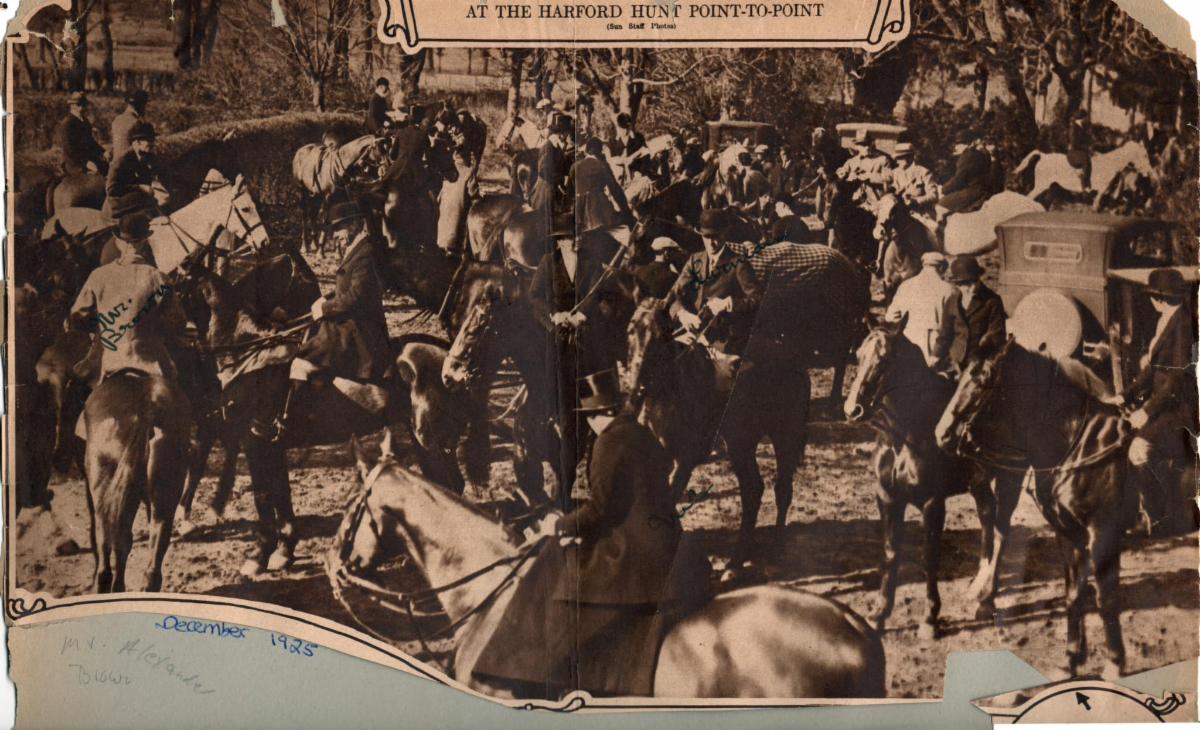
The earliest known photo at a point-to-point meet in Elkridge-Harford country was taken on the front lawn of the clubhouse. The image is from the Baltimore Sun's "brown section." The 1925 race was held in late November and reported on in early December. To the left with his back to the camera, is Alexander Brown. To the right in the bowler hat reining in his horse is Lurman Stewart. Redmond Stewart was the winner of the race. A hunt took place after the race. | |
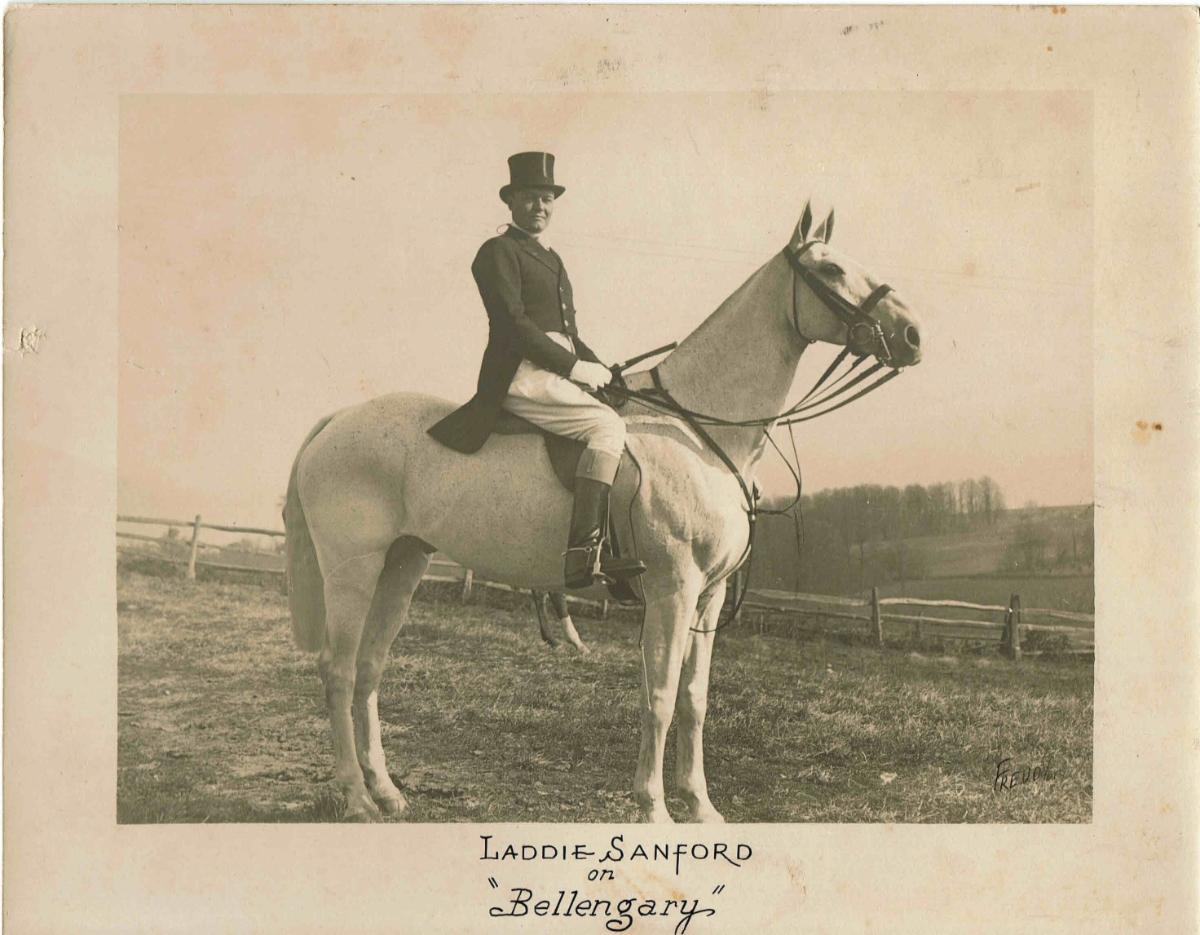
1925 also saw internationally known horseman Stephen “Laddie” Sanford honor his 1923 English Grand National winner with the inaugural Sergeant Murphy Point-to-Point. Sanford and his wife, the former stage and screen actress Mary Duncan Sanford, were members of the Harford Hunt and maintained a hunting box on the club grounds. Although Sergeant Murphy never ran in Maryland, the cup race was run by the Harford Hunt through 1934 (no race, 1931). Its final two years were as part of the formally organized Harford Hunt Races and Livestock Fair. The winning rider that final year was local jockey Walter “Wassie” Ball who rode Sanford Stud Farm’s Snap Back to victory. Ball, the father of Maryland Horse magazine photographer the late Skip Ball, eventually went on to work at Atlanta Hall Farm for the Edward S. Vosses and taught many local youngsters how to ride. The trophy, which was sent back to its home country by the Sanford family is now presented periodically by The Manor Conservancy as its land conservation award. Recognizing the historic significance of the cup the Conservancy chose not re-engrave it. Rather, a base was crafted on which recipients are listed. | | |
Stephen “Laddie” Sanford riding Bellengary. | |
|
In 1928, Harford Hunt racing had a new venue, Loafer’s Lodge. For three years transplanted New Yorker and accomplished horseman, Van Duzer Burton, hosted the Harford races at his Monkton home, a proverbial stone’s throw from the grounds of the hunt club. Formerly known Foxhall Farm during its tenure as the home of all round American sportsman Foxhall P. Keene, Burton had given the farm its Colonial name. Burton was known as the owner of the famous Golden Eagle which he rode to blue ribbons in hunter classes in many prominent shows. He is however, perhaps better known for the following incident which Time magazine recorded in 1929. | |
Van Duzer Burton, Baltimore socialite, gave a ball at his home near Monkton, Md. (once the house of dandaical Sportsman Foxhall Keene). At midnight, while the orchestra was playing a waltz, into the ballroom in his pink hunting coat gravely rode Van Duzer Burton on Golden Eagle, his favorite hunter. | |
An excellent description of the Harford races of 1929 can be found in William B. Street’s Derrydale Press book, Gentlemen Up. Street gives detailed accounts of both the Sergeant Murphy Cup and of the Harford Cup in the tome illustrated by Paul Brown. Flying Horse Farms’s, Soissons was the Sergeant Murphy winner that year with Mr. J. Skinner in the irons. | | |
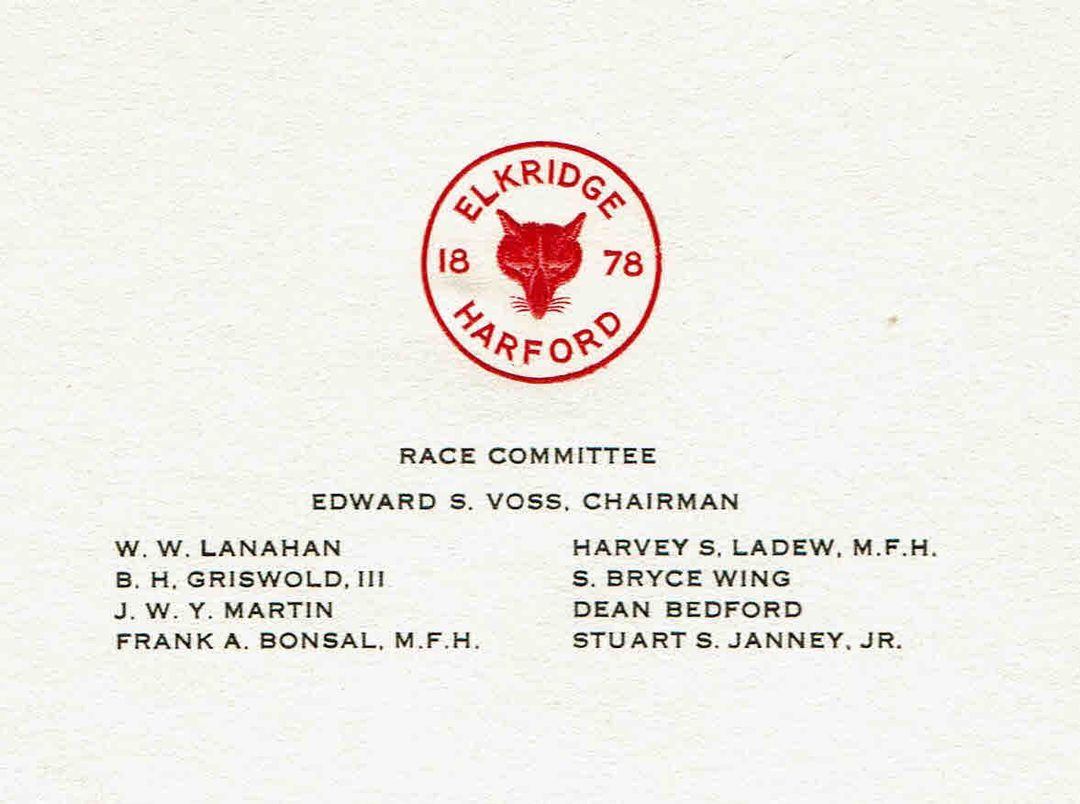
There are some notable names included in this mid-1930s race committee. | |
|
The Harford Hunt Races and Livestock Fair were inaugurated in 1932. Future Master of Foxhounds, Harvey S. Ladew with the help of his friend William du Pont personally designed an expansive course on the grounds of Ladew’s Pleasant Valley farm (now Ladew Gardens). In an interview the late Robert M. Six, Ladew’s former hunt groom, stated that the Pleasant Valley course was the first to have fences that leaned rather than straight verticals. Mr. Six went on to say that the course was encircled by a six-furlong track with brush jumps in the interior. The timber used for the course was felled on the farm and then cut by hand. The fences consisted of brush, timber, hurdles, and sheep hurdles. A handful of surviving period photographs show the elaborate course. The land on which the course was constructed was boggy and had to be drained and tiled. The woods have grown back and sections of the old drain tiles occasionally surface with the change in weather and ground water. The racing barn which stood in the woods is now a memory. Today a portion of the old course is the fields of the Maryland Polo Club. | | |
Fred Colwill (foreground) and Hugh O'Donovan (on the grey, Just a Racket) at the second fence in the 1937 race. The others are unidentified. O'Donovan went on to win. | |
|
Among the races run at Ladew’s were the Harford Pink Coat Cup, Breezewood Cup, Little Gunpowder Cup, Lindenhope Cup, Alligator Cup, and the Harford Hunt Hurdle as well as the previously mentioned Sergeant Murphy. The famous Foxhall Farm Challenge Cup was also a part of those race meets. The seemingly always in attendance Paul Brown, captured many exciting Harford race moments in his steeplechase books while Baltimore, New York and Philadelphia newspapers carried stories and photos of social functions leading up to the races as well as of the races themselves. | |
No races were held in 1935 and 1936. By 1937 the then Harford Hunt Races and Livestock Fair had become, with the 1934 merger of the Elkridge and Harford Hunts, the Elkridge-Harford Hunt Races and Livestock Fair, run at Pleasant Valley until 1938. Ladew retired as MFH in 1939 and racing on his course ended. | |
|
On March 30th, 1940, Elkridge-Harford Master of Foxhounds Edward S. Voss (pictured) and his wife Elsa, hosted a point-to-point on their Atlanta Hall Farm, the precursor of today’s Elkridge-Harford Point-to-Point. According to historian J. Rieman McIntosh, the 4 and one- half mile course over natural fences crossed the farms of the Vosses, Mrs. L. H. Drennan, Miss Edna Parlett, Mr. S. Lurman Stewart, and Mr. Charles Patterson. Edward Voss, a native New Yorker whose family had Baltimore roots, had himself competed in steeplechase races and in fact rode in point-to-points well into his sixties. The fact is proven in a photo of Voss inscribed in his own hand which reads “66 years old, Thimble Rigger, 1949 Point-to-Point.” The race meet, sponsored by the Elkridge-Harford Hunt Club and hosted by the Voss family, has been held at Atlanta Hall since that time.
| |
Edward S. Voss in 1949, age 66 years |
|
|
By the time the 1950s and ‘60s rolled around names such as Smithwick (Mikey and Paddy), Griswold (Ben and Jay), Hugh Wiley, Laddie Murray, Paddy Neilson, Secor, J. W.Y. Martin, Fenwick, and Janney among others could be found regularly on the cards for the meet. In the March, 1950 issue of The Maryland Horse writer, Ann Woods describes a thrilling, down to the wire, won by a nose finish to the S. Lurman Stewart Challenge Cup, an annual race that was hotly contested well into the 1960s. | |
Jay Griswold on New Bull leads over the third in the 1958 S. Lurman Stewart. Jay was 15 years old at the time. Mr. Hannum Sr. followed, riding Zenbars. Hannum's eldest son Jock, also age 15, followed in third riding Enfield. | |
|
1963’s race meet was an anomaly. According to writer Edward Kilner, the normal ten horse fields and two race cards usually expected had been reduced to a total of four entrants. It was decided to combine them into one, two-division race. 17-year-old Vivian Rall riding her own Tuff-Enuff and Karen Campbell on Jane Flaccus’s Bold Visitor went to the post with Peter Winants on his own horse, Fanny, and Frank Bonsal, Jr. on Sagahash. According to Kilner, it was a close, hard fought race with the ladies besting the men. Campell was first with Rall second while Winants finished third, Bonsal having come off his mount. | |
In 1966, United States Ambassador, Kingdon Gould, a true gentleman jockey, won the S. Lurman Stewart Memorial. In 1968 Olympic and Pan American Games show jumper rider, Kathy Kusner on Mrs. T.A. Randolph’s Walrus won the Ladies Race despite crashing through a rail at the 18th fence. The moment was captured by photographer Peter Winants and can be seen in the Look Back column of the April 29, 1988 issue of The Chronicle of the Horse. Kusner went on to ride Whackerjack in the 1971 Ladies Race. Later that year she became the first woman to ride in the Maryland Hunt Cup. 1971 also saw the inauguration of the Edward S. Voss Memorial which is now the feature of each year’s race meeting. | |
By the 1970s and 1980s the names Fisher, Weymouth, Merryman, Brewster, Cocks, Jackson, McKnight, Cochran, Phipps, Valentine, Strawbridge, Naylor, Bird, Small, Mahoney, Clagett, Hannum, Yovanovich, and others were seen in owner, trainer, or rider columns. Old races retired to make way for new races which in turn gave way to others. The S. Lurman Stewart, B. Frank Christmas, Babe Saportas, Frederic Cross Memorial Old Fashioned, and others live on only in memory old race programs. | |
Paddy Neilson on #5 Grey Wave, Kingdon Gould on #3 Hurdy Gurdy and Alfred Knowles in the background on Tingaling News, in the 1966 running of the S. Lurman Stewart Memorial. Gould and Hurdy Gurdy were the winners. | |
|
The Harford/Elkridge-Harford races have survived the Great Depression, WWII, the Korean and Viet Nam eras, gas rationing in the ‘70s, recession, wind, snow, rain, heat, and lockdown. Maryland Hunt Cup and Aintree Grand National horses and riders have traversed the courses as have Hall of Fame jockeys and trainers. Thousands of spectators and hundreds of race subscribers, committee members, officials and volunteers have supported the meet over the decades. Citing them all individually would be impossible. Suffice to say they are all appreciated. | |
|
From the 1990s through the present- second, third, and today some probable fourth generations of horsemen and horsewomen have taken part or are taking part in the Elkridge-Harford races. The future looks strong.
100 years. Surely, somewhere, in unknown Elysian hunt fields the men and women who started it all must be smiling.
| |
|
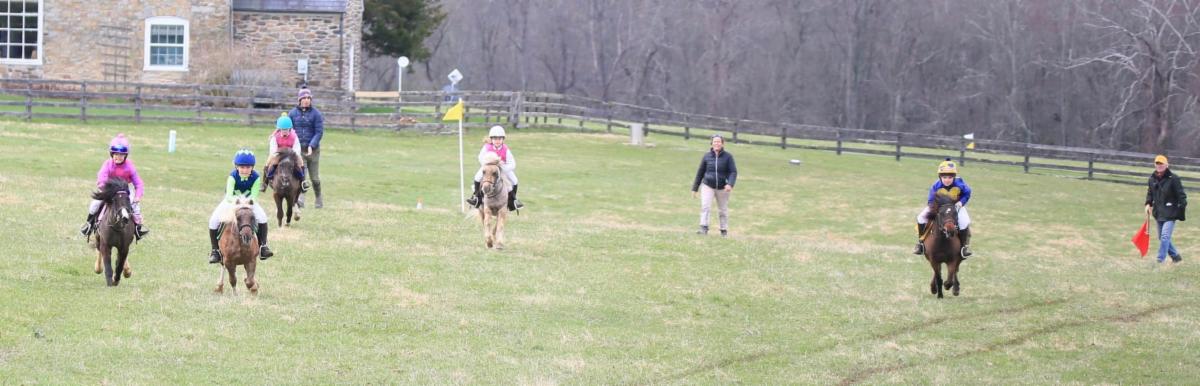
The future looks strong, indeed. The Very Small division of the Small Pony races at the 2022 Elkridge-Harford Point to Point Races.
©Carol Fenwick
| |
Maryanna Skowronski is an ex-Honorary Whipper-in to the Elkridge-Harford Hounds and the Hunt’s historian. She sends thanks to J. Montgomery Santoro and Michael H. S. Finney for their help in providing historical details for this article. | | | | |