|
East River Collaborative
• September 2023 Newsletter •
| |
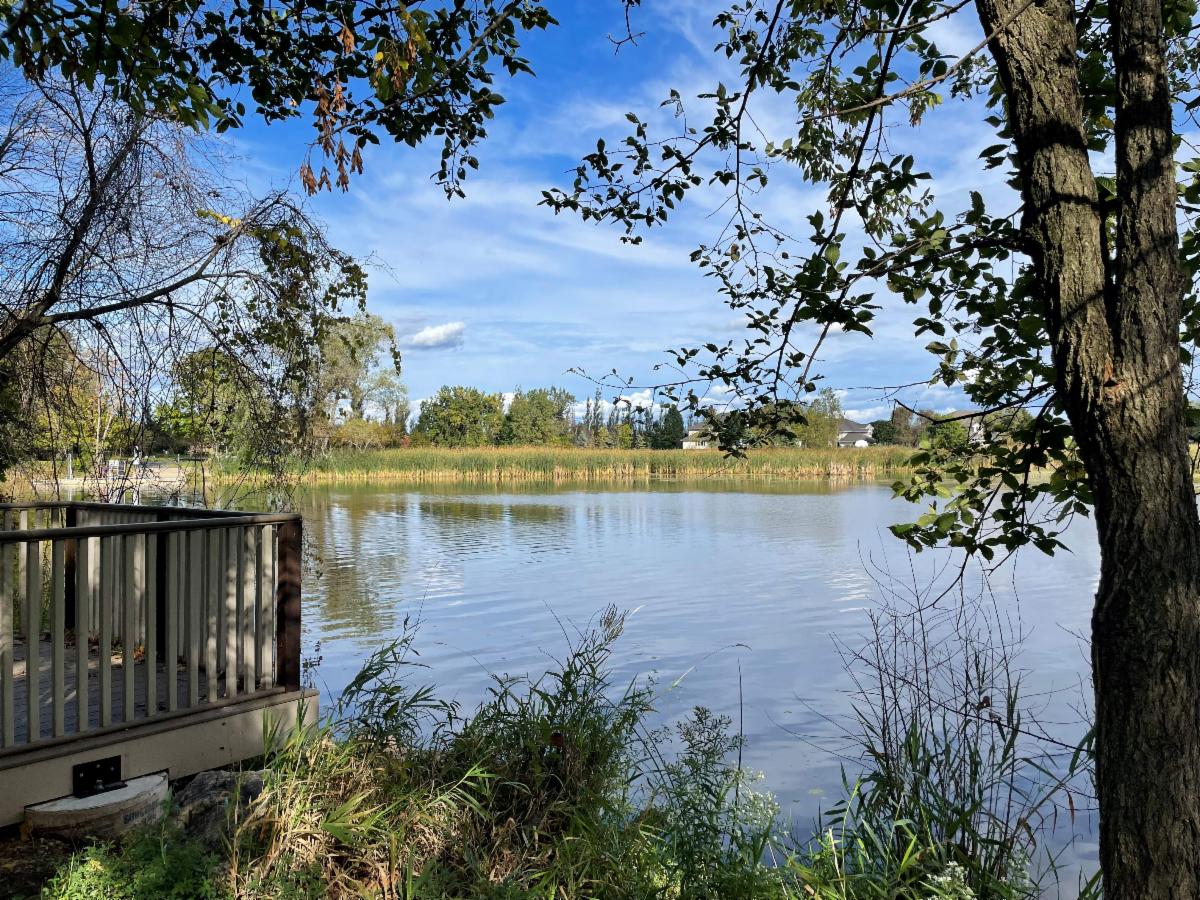
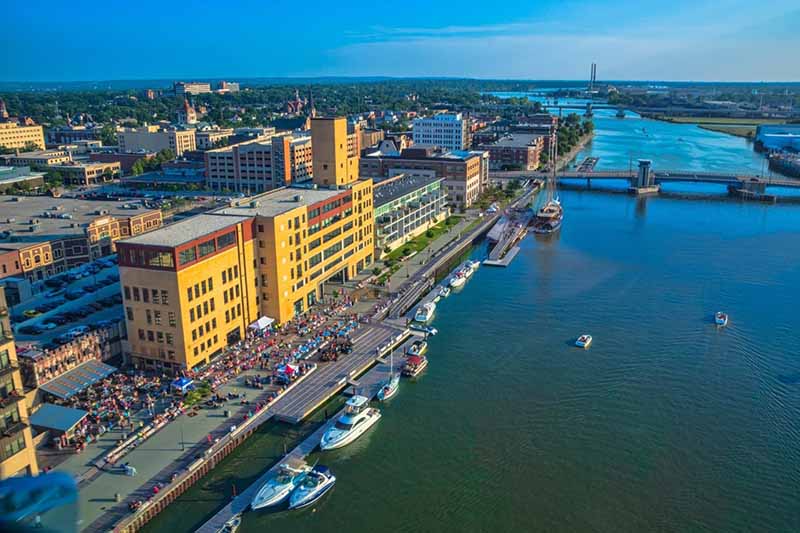
Village of Allouez, Green Isle Park in the summer. Photo credit: Kayla Wandsnider | |
|
The Village of Allouez received a grant from the Wisconsin Coastal Management Program for a community-driven planning process for the East River Recreational Trial. We recently met with all municipalities involved in this grant (Allouez, Green Bay, Ledgeview, Bellevue, De Pere) during the kickoff meeting to review the Request for Proposal for developing an East River Recreational Trail Master Plan. It will involve participation from municipal staff and outreach with community members to identify and prioritize areas of the trail that need flood mitigation, habitat improvements and restoration adjacent to the trail, as well as funding recommendations for implementation. Check out this factsheet for more information!
In funding news, we applied to track 1 of the NOAA Climate Resilience Regional Challenge to expand the capacity of the East River Collaborative partnership. Funding would go towards providing the needed technical expertise, coordination, and community engagement across the watershed to implement nature-based projects and other flood-resilient actions that will reduce flood risk and increase flood preparedness and adaptive capacity to recover. As described in the letter of intent, community engagement will be central to our activities. It will focus on at-risk residents and property owners such as rural farmers impacted by flooded fields and socially vulnerable residents in urbanized neighborhoods affected by storm sewer back-ups, river overtopping, and coastal inundation. We will find out if we are selected to submit a full application in October and will keep you updated.
Lastly, check out our municipal flood study maps just added to the ERC website.
| |
Case Study: Nature Based Solutions and Social Media | |
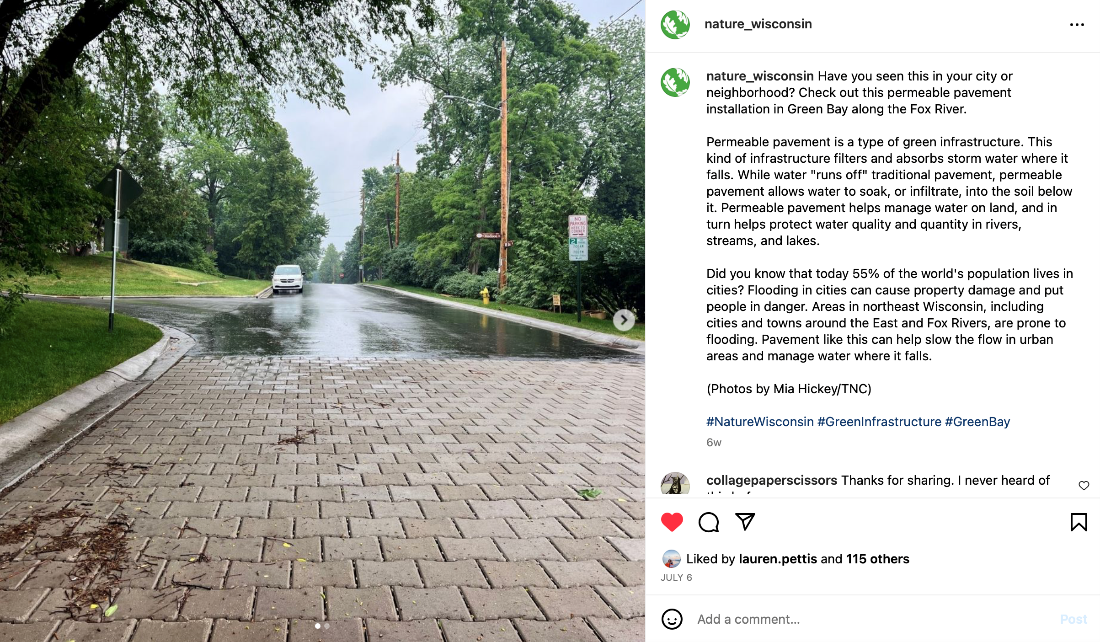
Do you follow The Nature Conservancy on Instagram and Facebook? If not, you’re missing out on daily updates about conservation projects, including those happening on the East River. Earlier this summer, TNC Communications and Outreach Intern, Mia Hickey visited the East River and created the post below about green infrastructure in the Green Bay area that went out to TNC social media channels. | |
|
Social media plays an important role in today’s world. Social media is where more and more people tend to get their news and information. That includes news and information on conservation and environmental issues too. In today’s climate, it is extra important that information shared on social media comes from trusted sources.
TNC Wisconsin Media and PR Manager, Emily Mills, also wrote an article for TNC’s website highlighting the ERC, its work across municipalities, green infrastructure and nature-based solutions. They write, "Nature has an important role to play, too. Wetlands are one kind of nature-based solution, providing a wide range of ecosystem benefits, including flood mitigation, water quality and habitat protection. That’s where municipalities come into play. By creating clear, consistent standards for permitting and development, communities can work together to protect places that, in turn, protect all of us.
An example of this important work can be found in TNC’s collaboration with the Green Bay, Allouez, and Ledgeview communities to use native plantings within the floodplain where 500- and 100-year rainfall events are most likely to occur. These relatively small projects have the potential for big impacts, increasing rainfall infiltration, improving water quality, and boosting wildlife habitat. The work can also help with streambank stabilization, which prevents erosion that is a contributing factor to high sediment loads in the river and Lake Michigan itself.”
The East River Collaborative is a great example of communities working together to solve large-scale problems. All of this is to help people, communities, habitats, and nature be more resilient to our changing world. Read the full article here.
Have a story of resilience you are interested in highlighting? Contact Kayla Wandsnider at kayla.wandsnider@tnc.org to share your story.
| |
|
Wisconsin Water Explorer (WEx)
Use this tool to explore watershed characteristics like land use, geology, and soils. You may also view conditions and trends in lake water quality and run nutrient loading models for lakes and streams. To access WEx, go directly to this webpage. Please help guide future improvements by taking this survey! Contact: Justin Chenevert, Justin.Chenevert@wisconsin.gov.
| |
|
EPA Case Study: Exploring Opportunities for Financing Distributed Infrastructure Projects Using Wisconsin’s CWSRF Program
Wisconsin used EPA’s assistance to develop a strategy that would allow a wastewater utility to invest in a water quality trading approach for meeting a phosphorus reduction target by bundling together disparate NPS projects distributed throughout a watershed, all within a single loan agreement.
This watershed financing partnership strategy offers a low-cost and comprehensive way for public utilities to easily finance a wide range of projects that leverage many partners throughout a watershed using a mechanism known as programmatic financing. This approach is likely to reduce phosphorus more cost-effectively in state waters when compared with the more conventional point source-only approach for meeting nutrient reduction targets. Read more.
| |
|
Article: One- to Four-Family Properties with Multiple Losses Insured by the National Flood Insurance Program
This new report from Rand examines properties with multiple losses insured by the NFIP to help inform decisions related to floodplain management, flood insurance, and mitigation efforts. Read more.
| |
|
Wisconsin Academy of Science, Arts, and Letters Webinar: Appreciating and Writing the Short Story with Kim Suhr
Sept. 11 - Oct. 16 | Monday 6-8 pm
Do you need to brush up on your writing skills to effectively tell stories for your organization? The short story is its own art form with its own nuance and emphasis. Join Kim Suhr, author and director of Red Oak Writing, in this workshop to discuss selected example stories, practice writing techniques & and exercises, and optionally receive feedback on excerpts from works in progress. Read more.
| |
|
Webinar Recordings and Upcoming Webinars: Healthy and Resilient Communities Research Webinar Series
Watch, learn more, and sign up here
- Previous webinars from July and March are recorded and available at the link above
-
September 12 | Benefits of the Environment and Environmental Cleanup and Revitalization for Communities
-
December 12 | Health Impact Assessment Research
EPA's Office of Research and Development began hosting this webinar series in 2023 to communicate research and tools intended to help communities and local decision-makers protect their assets and reduce vulnerabilities. Topics include site remediation and restoration, community health and well-being, and community resilience. The webinars in the series are free and typically held on a quarterly basis on the second Tuesday of the month from 2 to 3 pm CT.
The series will be of particular interest to local government, Tribal Nations, and nonprofit organizations (NGOs), particularly when focused on community planning, resilience, and superfund; universities with community/environmental justice-focused research; and consultants and tech assistance providers.
| |
|
Virtual training: Building Blocks for Sharing Science
Training information and registration
The Lake Superior Reserve Coastal Training Program and Ohio Coastal Training Program are hosting a virtual series tailored for professionals, practitioners and leaders working on Great Lakes coastal issues and is designed to address communication challenges commonly encountered in environmental and science-adjacent careers. Course topics include how to facilitate meetings, develop graphics, author reports or proposals, articulate the value of the natural world, and more! *There is a $20 charge for each two-hour course*
- September 12 |1 - 3 pm: How to Design a Compelling Grant Proposal and Presentation
-
October 17 |9 - 11 am: Economic Guidance: Pathways to Valuing Ecosystem Services
| |
Great Lakes Area of Concern Conference
September 13-14 | Green Bay, WI
Register and learn more
U.S. EPA and Wisconsin DNR Office of Great Waters will host the Great Lakes Area of Concern Conference. Join participants and speakers in Green Bay for a two-day conference focusing on the different aspects of Great Lakes areas of concern. Each day, participants can choose from four different breakout sessions to attend. The fee for the conference is $95 and includes breakfast and lunch on Wednesday and breakfast on Thursday. Register by Wednesday, September 6.
| |
NASA BOUND Coastal Issues Workshop
September 18, 19, 25, 26
Learn More
Data practitioners involved in coastal zone management, flood risk management, or tackling sea-level rise and subsidence issues are invited to participate in UNBOUND CI: a multi-session workshop to identify recommendations to make NASA data products more discoverable and suitable for analyses to address issues in coastal zones, encompassing both coastal and inland areas. CFMs who participate in all four workshops are eligible for 10 CECs. Space is limited.
| |
|
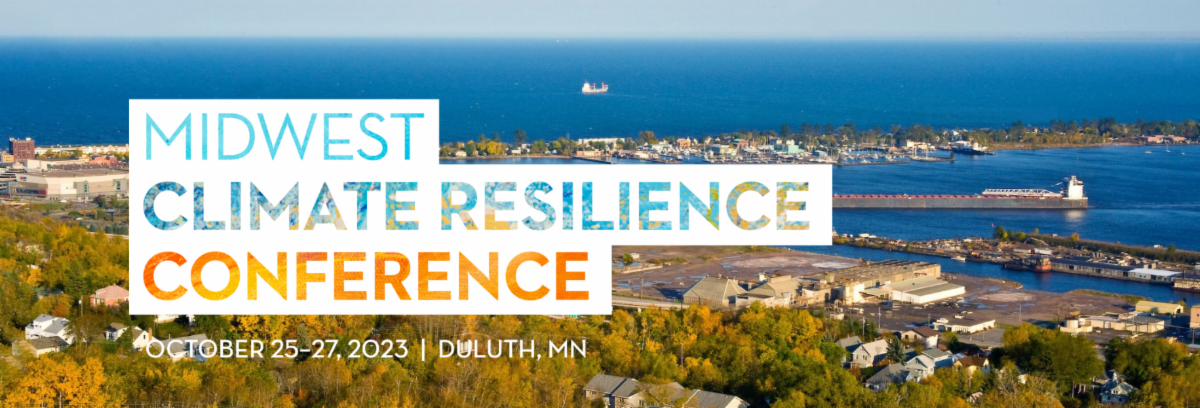
Midwest Climate Resilience Conference
October 25-27 | Duluth, MN
Learn more and register for this event here
The University of Minnesota Climate Adaptation Partnership (MCAP), in collaboration with regional and national partners, will host the Midwest Climate Resilience Conference. Originally a statewide event, this regional conference is designed to bring together representatives from the public, private and nonprofit sectors to inspire and enable climate adaptation in communities throughout the Midwest. The conference will serve as a regional adaptation forum in alternate years of the National Adaptation Forum for community leaders, policy and decision-makers, resource managers, researchers, and others working actively on climate adaptation and resilience.
| |
|
Deadline EXTENDED: Great Lakes Environmental Justice Grant Programs (GLEJGPs) Request for Applications
Due Date (extension): September 15, 2023
GLEJGPs is aimed at issuing and overseeing subawards for environmental restoration projects in underserved Great Lakes communities. This RFA expects to provide funding available for two types of applications: applications that aim to provide funding for projects in a particular region of the Great Lakes Basin, and applications that aim to provide funding for projects across the entire Great Lakes Basin. Potential applicants can refer to the RFA website for eligibility information and specific submission instructions, as well as to review questions received and answered by the GLEJGP RFA Team.
| |
|
DNR Surface Water Grants
Pre-application due Sept. 15 | Details here.
Counties, municipalities, agencies, and universities are eligible to apply for cost-sharing grants for surface water protection and restoration. Funding is available for education, ecological assessments, planning, implementation, and aquatic invasive species prevention and control. Relevant surface water management grants include Applied management studies which ask for a research-based approach to solving management challenges, and AIS Research and Demonstration grants which fund projects that increase scientific understanding of ecological and economic implications of AIS and management.
| |
|
2024-25 Wisconsin Coastal Management Program Grants Available
Applications due November 3, 2023.
The Wisconsin Coastal Management Program (WCMP) is seeking proposals to enhance, preserve, protect, and restore resources within the state’s coastal zone – all counties adjacent to Lakes Superior and Michigan. Up to $1.6 million total in grant funding will be available for projects addressing coastal wetland protection and habitat restoration, nonpoint source pollution control, coastal resource and community planning, Great Lakes education, public access, and historic preservation. To learn more, join an informational webinar on September 19th from 1-3 pm through this link. If you cannot make the webinar, view the recorded presentation here.
Applicants are encouraged to contact WCMP staff early to discuss ideas for project proposals and application requirements. Staff are available to answer questions about eligibility, application details, review process, etc., as well as to discuss the substantive aspects of a proposal. Contact staff at coastal@wisconsin.gov.
| |
National Wildlife Federation: Nature-Based Solutions Funding Database
Link to database
As natural hazards like flooding and drought increase in intensity and frequency each year, communities face growing pressure to develop and implement plans that protect vulnerable communities, infrastructure, natural habitats and farmland. Nature-based solutions offer a cost-effective, long-term approach to addressing environmental issues like polluted water, eroded soils or degraded habitats, while considering social and economic outcomes. While there are several funding sources for nature-based practices, this database focuses on federal funding and technical assistance programs.
| |
More Info
About Us
The East River Collaborative is a partnership between local, county, state, and federal officials, as well as representatives from various regional organizations, non-profits and the UW system committed to increasing flood resilience in Wisconsin’s East River watershed by improving the collaborative capacity of its stakeholders. Visit our website to learn more.
Sign up
To get our monthly newsletter delivered directly to your inbox, fill out the sign-up form on our website. You can also subscribe to our Google Group listserv to send and receive emails from The Collaborative.
Content requests or questions
Want to share an opportunity, event, or other information with the East River Collaborative? Have questions? Send an email to kayla.wandsnider@tnc.org.
| | | | |