|
East River Collaborative
• August 2023 Newsletter •
| |
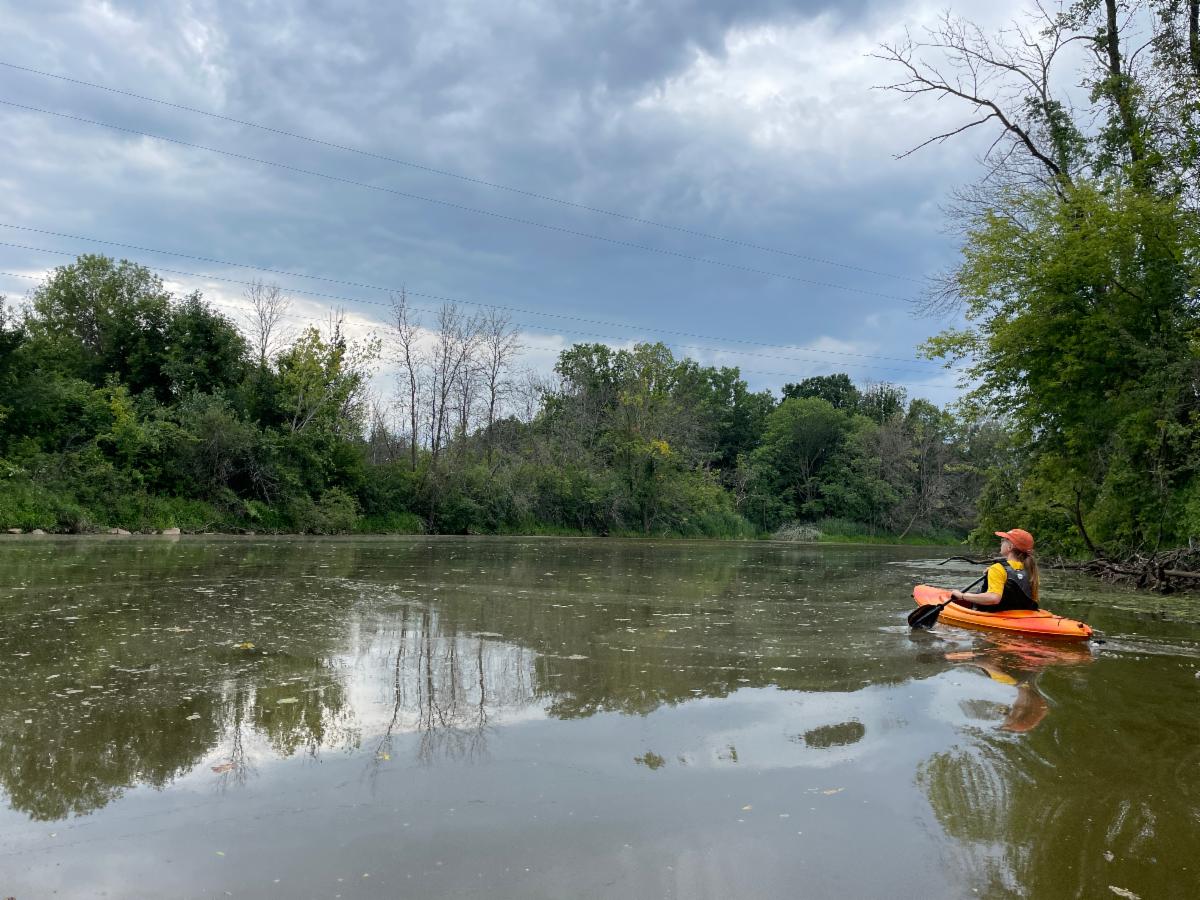
Have you gone kayaking yet on the East River this summer? TNC summer 2022 intern, Julia Buskirk kayaking the East River. | |
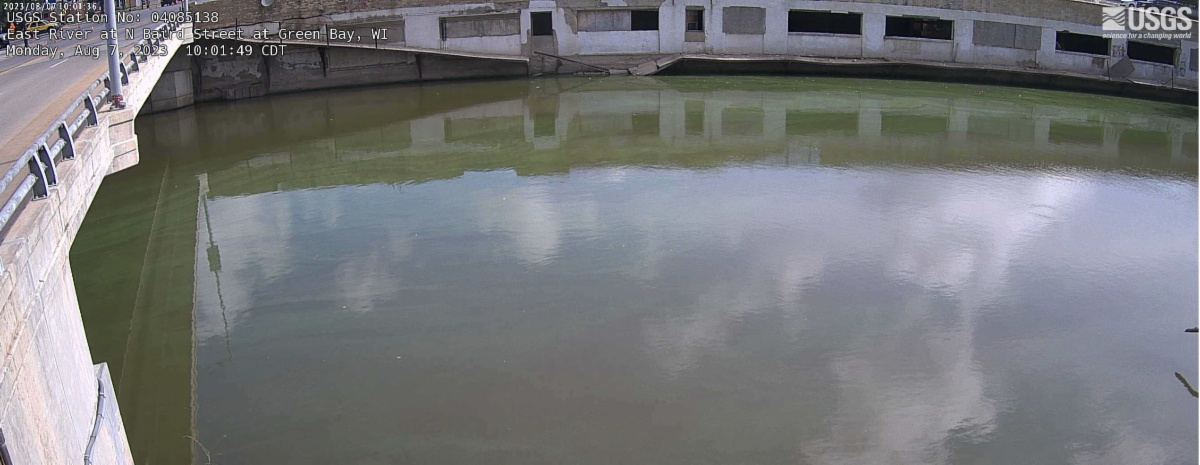 | |
Last month, the USGS funded and installed a stream gauge on the East River at Baird St. in Green Bay as part of a Great Lakes Restoration Initiative project. Currently, there is no hydrologic data to display as it has only been active for less than a month, however, it will be updated in the next 6 months as more data is collected. The gauge was installed to monitor flow, nutrient and sediment loads, and record stage data to understand the impacts from edge-of-field practices (ex: vegetative buffers) within the Lower Fox watershed. It will be used for the duration of the 3-5 year project after which, maintenance costs will need to be taken over by local partners. You can watch the current Timelapse of the East River at N Baird Street here.
The East River Collaborative has received funding through the Digital Coast Connects grant to further existing efforts to help marginalized communities address coastal inundation while collaborating with local representatives from the Digital Coast Partnership. This funding will be used for knowledge and technology transfer and learning opportunities for East River communities. Funds will be dispersed at the end of 2023 with work starting in early 2024.
The next phase of community engagement workshops has begun. The goal is to engage municipal staff in ground-truthing and developing community flood risk and asset maps and identifying opportunities for nature-based solutions to inform an East River Collaborative implementation plan. We are excited to continue this work to make a more resilient East River watershed for generations to come.
| |
Case Study: The Importance of Regional Network Collaboration for Coastal Resiliency with CALM and CHAOS
| |
|
The Collaborative Action for Lake Michigan (CALM) Coastal Resilience Network and The Coastal Hazards Of Superior (CHAOS) Community of Practice are two regional networks putting in the work when it comes to coastal resiliency. CHAOS was founded in 2020, and CALM in 2021. Both of these networks connect diverse non-governmental and governmental organizations, leaders, managers, researchers, community members, among others across jurisdictional boundaries. They do this through sharing information related to hazards and impacts that affect their respective coastline communities.
Why is it important to work across boundaries and state lines? The simple answer is that hazards do not care about property or municipal lines. Communities on Lake Michigan and Lake Superior experience similar coastal hazards including fluctuating water levels, coastal erosion, flooding, and storms. These hazards can impact coastal bluffs and beaches, damage coastal properties, and threaten infrastructure. Both Lake Superior and Lake Michigan are experiencing an increase in surface water temperatures and reduction of winter lake ice. These issues can cause additional threats to coastlines like algal blooms and flooding and erosion.
CALM and CHAOS have helped communities collaborate, share information, and work across boundaries to mitigate coastal hazards. Both of these groups are doing critical work to increase regional coastal resiliency!
Read the full case study
More information about CHAOS and CALM can be found at their websites.
| |
|
U.S. Army Corps of Engineers Dredging Operations Technical Support
Learn more here
The U.S. Army Corps of Engineers routinely creates value from dredged sediments through beneficial uses such as beach nourishment, enhancing wetland habitat, and brownfield reconstruction. Using dredged sediment beneficially is an important component of USACE’s dredged material management strategy, significantly reducing disposal requirements. With interest in beneficial use of dredged sediments at an all-time high, the timing is ripe to increase beneficial use.
The website features guidance documents and USACE manuals related to BU as well as success stories of projects that have incorporated beneficial uses of dredged sediment. USACE has a goal to ensure that 70% of navigational dredging sediment is used beneficially by 2030. In Wisconsin’s Lake Michigan coastal communities, dredged materials have been used for projects including the Samuel Myers Park Restoration Project in Racine, Kenosha Dunes Natural Infrastructure Project in Kenosha, and the Cat Island Restoration Project in Green Bay.
| |
|
Natural Flood Management Addendum Added to Ashland County Hazard Mitigation Plan
Learn more here
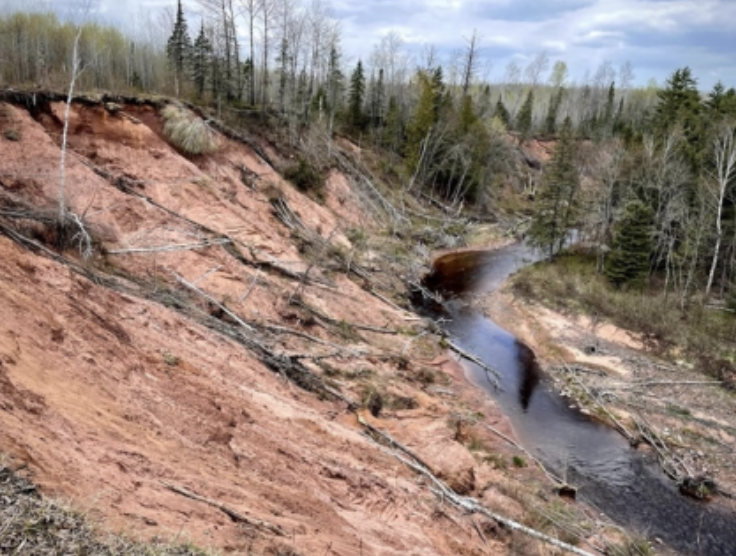
In March 2023, Ashland County approved an addendum to the county’s Hazard Mitigation Plan. The addendum, titled A Strategy for Natural Flood Management & Climate Resilient Infrastructure in Ashland County, incorporates pre-disaster mitigation strategies focused on natural flood management into the existing Hazard Mitigation Plan. Section I describes vulnerability factors that apply to high-risk watersheds in Ashland County. Section II describes goals & strategies for addressing fluvial erosion hazards & degraded hydrology. Ashland County collaborated with the Northwest Regional Planning Commission, the U.S. Geological Survey, and Wisconsin Wetlands Association to prepare this strategy. The effort was funded by a 2019 FEMA Pre-Disaster Mitigation Advance Assistance Grant. Image courtesy of Wisconsin Wetlands Association
| |
|
Pollinators are the Unsung Heros of Wildland Systems
Watch and learn more
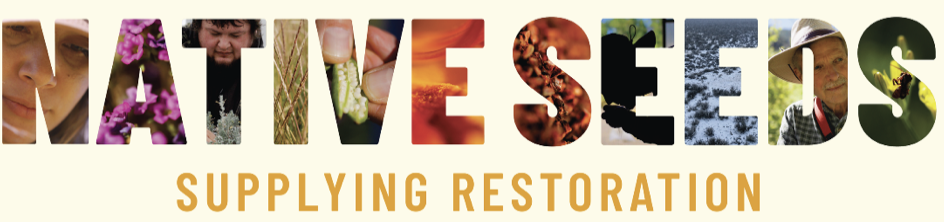
Native Seeds: Supplying Restoration is a nine-part video series that explores the native seed supply chain in the western United States. Filmed over four seasons, this series weaves together footage of seed collectors, farmers, researchers, and land managers working to scale up the supply of native seeds to meet the growing restoration demand. We see the staggering scale of damage to vast landscapes and meet tenacious people who are finding creative, scrappy solutions to restore ecosystems.
| |
|
Webinar Recordings and Upcoming Webinars: Healthy and Resilient Communities Research Webinar Series
Watch, learn more, and sign up here
- Previous webinars from July and March are recorded and available at the link above
- September 12 | Benefits of the Environment and Environmental Cleanup and Revitalization for Communities
- December 12 | Health Impact Assessment Research
EPA's Office of Research and Development began hosting this webinar series in 2023 to communicate research and tools intended to help communities and local decision-makers protect their assets and reduce vulnerabilities. Topics include site remediation and restoration, community health and well-being, and community resilience. The webinars in the series are free and typically held on a quarterly basis on the second Tuesday of the month from 2 to 3 pm CT.
The series will be of particular interest to local government, Tribal Nations, and nonprofit organizations (NGOs), particularly when focused on community planning, resilience, and superfund; universities with community/environmental justice-focused research; and consultants and tech assistance providers.
| |
|
Virtual training: Building Blocks for Sharing Science
Training information and registration
The Lake Superior Reserve Coastal Training Program and Ohio Coastal Training Program are hosting a virtual series tailored for professionals, practitioners and leaders working on Great Lakes coastal issues and is designed to address communication challenges commonly encountered in environmental and science-adjacent careers. Course topics include how to facilitate meetings, develop graphics, author reports or proposals, articulate the value of the natural world, and more! *There is a $20 charge for each two-hour course*
- September 2 |1 - 3 pm: How to Design a Compelling Grant Proposal and Presentation
-
October 17 |9 - 11 am: Economic Guidance: Pathways to Valuing Ecosystem Services
| |
Interactive Webinar: Embedding Lakes into the Global Sustainability Agenda
August 15 at 9:00 am CST
Watch and learn more here
The recent White Paper Embedding lakes into the global sustainability agenda is an output of the United Nations Environment Program coordinated World Water Quality Alliance (WWQA) – Ecosystems Workstream. The White Paper has been produced to support management and restoration of lakes.
This webinar highlights Key Action Areas advocated in the White Paper to: 1) Build Capacity in Monitoring and Assessment; 2) Embed Sustainable Lake Management within National Policy; 3) Foster Green Finance Partnerships; and 4) Raise Global Awareness of the Benefits of Change. The webinar will be an interactive session to discuss how we can progress the ambitions of the White Paper, and those of the Decades of Restoration, and how to maximize synergies across partners such as the Society of Ecological Restoration.
| |
Great Lakes Area of Concern Conference
September 13-14 | Green Bay, WI
Register and learn more
The Great Lakes Area of Concern Conference will be hosted by U.S. EPA and Wisconsin DNR Office of Great Waters. Join participants and speakers in Green Bay for a two-day conference focusing on the different aspects of Great Lakes areas of concern. Each day, participants can choose from four different breakout sessions to attend. The fee for the conference is $95 and includes breakfast and lunch on Wednesday and breakfast on Thursday. Register by Wednesday, September 6.
| |
|
Midwest Climate Resilience Conference
October 25-27 | Duluth, MN
Learn more and register for this event here
The University of Minnesota Climate Adaptation Partnership (MCAP), in collaboration with regional and national partners, will host the Midwest Climate Resilience Conference. Originally a statewide event, this regional conference is designed to bring together representatives from the public, private and nonprofit sectors to inspire and enable climate adaptation in communities throughout the Midwest. The conference will serve as a regional adaptation forum in alternate years of the National Adaptation Forum for community leaders, policy and decision-makers, resource managers, researchers, and others working actively on climate adaptation and resilience.
| |
|
EPA Great Lakes Environmental Justice Grant Programs
Applications Due: August 11
Find more information on the RFA.
The U.S. Environmental Protection Agency (EPA) has announced the availability of $30 million from the Bipartisan Infrastructure Law for restoration projects that advance environmental justice in underserved and overburdened communities across the Great Lakes. The request for applications is targeted at potential pass-through entities with established relationships with underserved communities or with the ability to quickly build and sustain such relationships with those communities. Applicants will apply to set up Great Lakes Environmental Justice Grant Programs to fund environmental restoration and protection work on a Basin-wide basis or on a smaller, more localized basis. Projects funded through this program must improve the environmental health of the Great Lakes or Great Lakes watersheds.
| |
|
Annual Urban & Community Forestry National Challenge Cost Share Grant Announcement
Applications Due: August 15 at 4 pm CT
More information
The U.S. Forest Service for this year's annual Urban and Community Forestry Challenge Cost Share Grant Program is providing up to $500,000 for Urban and Community Forestry investments that address the National Ten Year Urban and Community Forestry Action Plan (2016-2026), (Action Plan): Goal 5 Improve Urban and Community Forest Management, Maintenance and Stewardship.
The Action Plan’s National Action Plan’s Five-Year Benchmark Accomplishment Report also recommends expanding, refining, and customizing technology tools for different regions and prioritizing technology that provides accessible data for a range of foresters, decision-makers, and community members. This includes identifying best management practices, training, and technology suitable for the size and capacity that a community can utilize.
| |
|
NOAA Climate Resilience Regional Challenge
Letters of Intent Due: August 21, 2023
The NOAA Climate Resilience Regional Challenge will support collaborative approaches to achieving resilience in coastal regions emphasizing risk reduction, regional collaboration, equity, and building enduring capacity. The Challenge is a $575 million competition with a Letter of Intent phase and two exclusive funding tracks designed to meet the needs of coastal communities wherever they are in the resilience and adaptation process. There is no matching requirement for this opportunity.
Track 1: Regional Collaborative Building and Strategy Development
Supports building capacity for, development of, and collaboration on transformational resilience and adaptation strategies for coastal communities. Successful applicants will receive $500,000 to $2,000,000 to support regional scale coordination, engagement, planning, advancement of equitable outcomes, and capacity building for resilience and adaptation.
Track 2: Implementation of Resilience and Adaptation Actions
Supports implementation of transformational resilience and adaptation strategies and associated actions for coastal communities anchored in previous planning efforts. Applicants must propose a suite of complementary adaptation actions that together build the resilience of multiple communities within a coastal region, including those that have been marginalized, underserved, or underrepresented. Applicants can apply for not less than $15,000,000 and not more than $75,000,000, with most awards being between $25,000,000 and $50,000,000.
| |
|
Fox River Trustee Opportunity
View the restoration plan and instructions for submittal
Does your organization have a project idea? The Trustees support projects that restore, acquire, or enhance natural resources and their supporting habitats injured by the release of PCBs in the Lower Fox River & Green Bay ecosystem through settlement funds provided by Responsible Parties. If your organization has a project concept that matches with Fox River Trustee goals, please contact us.
The U.S. Army Corps of Engineers (USACE) Small Water Resources Project funding:
Due Date: August 21
The U.S. Army Corps of Engineers USACE) is launching a pilot program to fully fund small water resources projects for economically disadvantaged communities. The pilot program will fund planning activities including feasibility studies, design, and implementation for navigation, flood risk management, and ecosystem restoration projects. Proposals can be sent to: wrda20cap165a@usace.army.mil. Learn more about USACE here
| |
More Info
About Us
The East River Collaborative is a partnership between local, county, state, and federal officials, as well as representatives from various regional organizations, non-profits and the UW system committed to increasing flood resilience in Wisconsin’s East River watershed by improving the collaborative capacity of its stakeholders. Visit our website to learn more.
Sign up
To get our monthly newsletter delivered directly to your inbox, fill out the sign-up form on our website. You can also subscribe to our Google Group listserv to send and receive emails from The Collaborative.
Content requests or questions
Want to share an opportunity, event, or other information with the East River Collaborative? Have questions? Send an email to kayla.wandsnider@tnc.org.
| | | | |