|
Product Stewardship Updates
September 5, 2024
| |
|
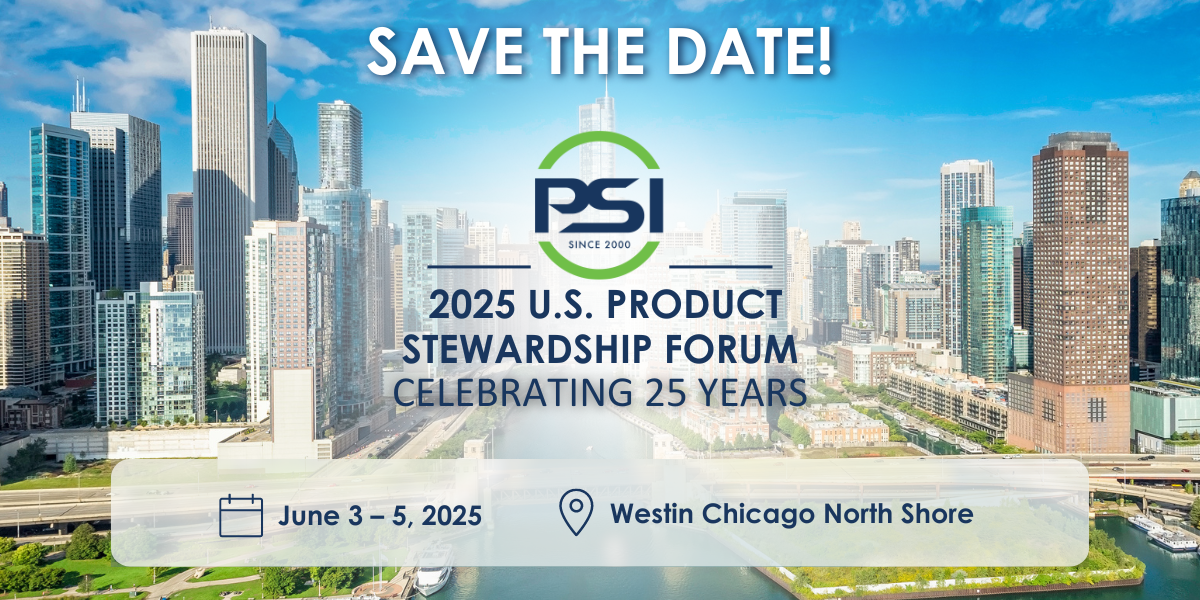
Celebrating 25 Years!
2025 U.S. PRODUCT STEWARDSHIP FORUM
June 3 - 5, 2025 | Westin Chicago North Shore
| |
|
Mark your calendars for the 2025 U.S. Product Stewardship Forum, the place to go for meaningful content and in-depth conversations on the EPR issues that matter most. PSI’s inaugural forum in 2000 launched the U.S. EPR movement. As PSI enters its 25th year, the organization continues to play a leadership role – bringing together diverse stakeholders from around the globe for information sharing, the development of collaborative EPR solutions, and networking.
Sponsorship and registration information is coming soon!
Contact info@productstewardship.us to learn more!
| |
ILLINOIS ENACTS BATTERY EPR LAW | |
|
Last month, Illinois enacted the nation’s 16th extended producer responsibility (EPR) law (SB 3686) that will create a statewide program requiring battery producers to fund and manage the collection, transportation, and recycling of portable primary and rechargeable batteries (e.g., from cell phones, TV remote controls, and small power tools), as well as medium format batteries (e.g., from bicycles, hoverboards, and scooters).
The law, which will take effect on January 1, 2026, earned significant support from a broad array of stakeholders, including local governments across the state, the Illinois Product Stewardship Council, Illinois Recycling Association and Foundation, the National Waste and Recycling Association, and the Rechargeable Battery Association.
The bill was developed with technical support from PSI staff and incorporated best practices from PSI’s battery EPR policy model, which also shaped similar recent laws enacted in Washington D.C., California, Washington State, and Vermont.
‘’This new EPR law is an impactful win for Illinois, delivering needed collection convenience for consumers, reduced risk of fires at waste and recycling facilities, and enhanced public safety by removing toxins from the waste stream,” said Christina Seibert, Executive Director of the Solid Waste Agency of Northern Cook County, a key bill advocate and PSI board member. “The Product Stewardship Institute’s (PSI’s) battery EPR policy model and technical expertise provided a strong foundation, supporting us in crafting a bill that benefits all Illinois residents and the environment.’’
Read more in our press release.
| |
|
ERR BILLS ON CALIFORNIA GOVERNOR'S DESK
REFLECT STRONG AND GROWING MOVEMENT
| |
|
This week, the California Legislature passed significant EPR bills to establish several new programs and strengthen existing ones. Now awaiting Governor Newsom's signature, the bills include first-in-the-nation EPR programs for textiles and marine flares, the second EPR law for EV batteries in the country, and meaningful amendments to California’s carpet and paint stewardship programs. These bills incorporate best practices learned in the past 10 years and put on display the blossoming of the EPR movement in the U.S. They also exemplify the important state-based advocacy of the California Product Stewardship Council, Californians Against Waste, and the National Stewardship Action Council. The Governor has until September 30 to sign the bills.
Read more about each of these bills in our blog.
| |
MICHIGAN INTRODUCES PACKAGING EPR BILL | |
Michigan introduced a packaging EPR bill on July 31, becoming the 10th state in 2024 to do so, in addition to the four states with laws and two additional states with pre-EPR packaging needs assessments. HB 5902 would establish a statewide packaging reduction and recycling program, which would cover packaging, but not paper products or packaging-like products (e.g., food serviceware). The program would be funded by fees assessed on packaging producers by the Department of Environment, Great Lakes, and Energy (EGLE), which would be placed in a packaging reduction and recycling fund. Under the bill, EGLE would select and appoint a packaging reduction organization to run the program and administer the fund via a competitive bidding process, similar to the process currently used in Maine. The bill includes a statewide needs assessment every five years, outreach and education requirements, producer funding for government oversight, eco-modulated fees, and bans on toxic materials to be identified by EGLE. It also includes other provisions that stipulate the recycling rates of materials used in the manufacture of new packaging. Michigan’s legislative session ends on December 31. | |
ALBERTA TO IMPLEMENT PACKAGING EPR PROGRAM | |
Starting April 1, 2025, Alberta’s EPR program, which covers single-use products, packaging, and printed paper products, will officially begin operations. The program will be fully funded by producers, reducing the financial burden for governments and taxpayers. Circular Materials, the national nonprofit producer responsibility organization (PRO), will manage the collection and recycling of accepted materials. These materials, including certain types of paper, cardboard, metal, and glass will be returned to producers for use as recycled content in new packaging and products, thereby boosting recycling rates and creating a more circular economy. | |
|
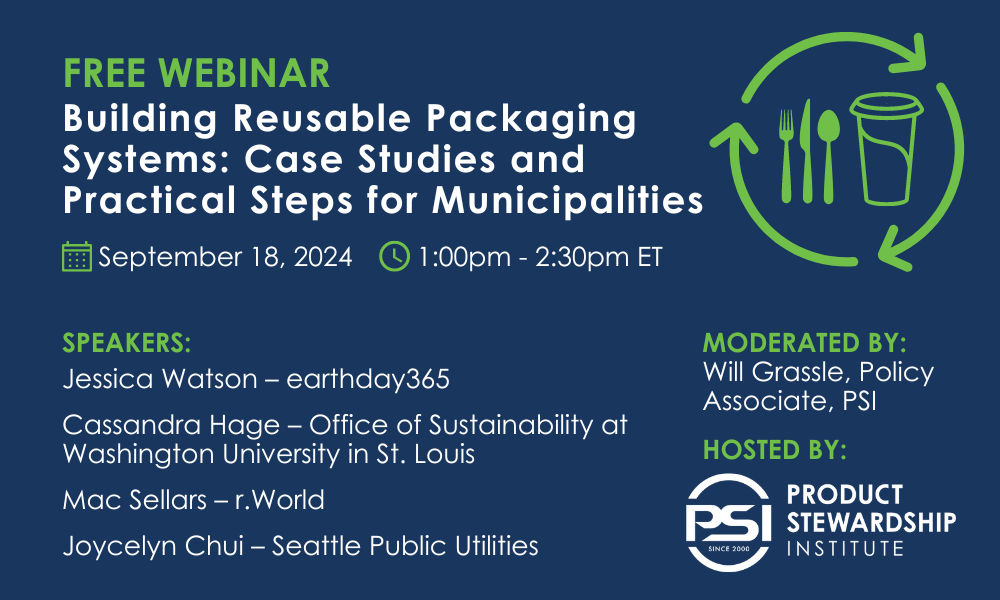
Building Reusable Packaging Systems:
Case Studies and Practical Steps for Municipalities
PSI and earthday365 with Seattle Public Utilities, r.World, and WashU
September 18, 1:00pm-2:30pm ET
| |
|
The proliferation of single-use food serviceware – much of which is plastic – poses significant environmental and economic challenges. But growing public demand for more sustainable options has sparked a shift toward alternative packaging materials and systems. In 2021, PSI and earthday365, with grant funding from the U.S. EPA and others, launched a project to implement a reusable take-away packaging system with restaurants in St. Louis, Missouri.
In this webinar, earthday365 will discuss barriers, lessons, and next steps for reuse in St. Louis. We’ll also hear from Washington University about their closed-loop reuse system, r.World, a reusable packaging solutions company that worked with earthday365 to conduct a feasibility study for centralized packaging reuse services in St. Louis, and Seattle Public Utilities about their award-winning Reuse Seattle program, which is building citywide reuse systems. PSI will moderate the webinar and release its municipal guide to supporting scalable packaging reuse systems.
| | |
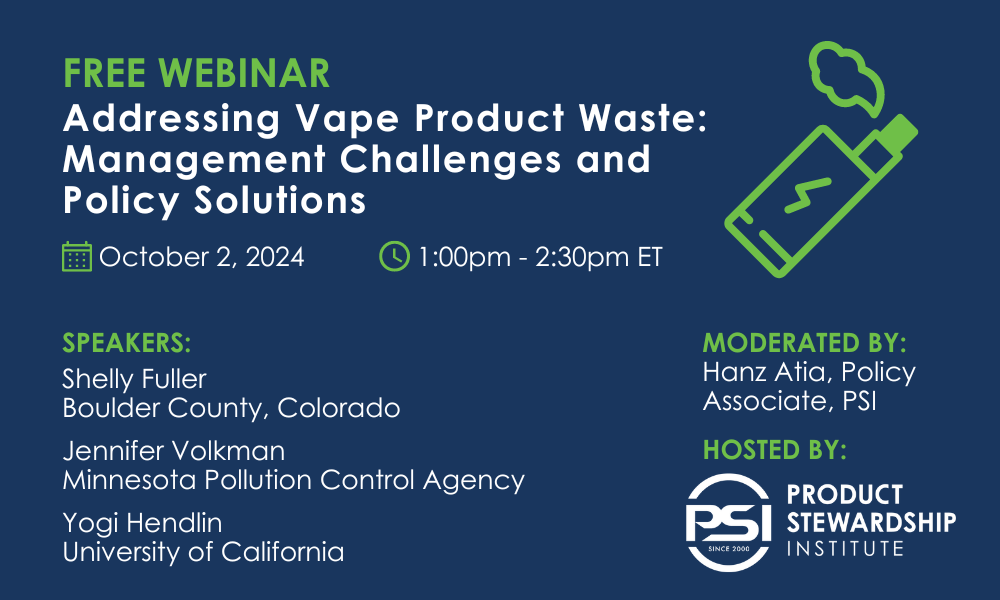
Addressing Vape Product Waste:
Management Challenges and Policy Solutions
PSI, Boulder County (CO), Minnesota Pollution Control Agency
October 2, 1:00pm-2:30pm ET
| |
|
Managing vape product waste (VPW) is a growing national concern, with more than 309 million e-cigarette units sold in U.S. retail stores in 2023. Aside from the escalating use rates among both adults and youth, improper disposal leads to battery fires and environmental contaminants.
This webinar will cover the full breadth of VPW, including generation, state and local policy options, best management practices, challenges, and management successes. Participants will hear insights from Boulder County’s Vape Aware program, which offers community vape waste disposal opportunities. PSI will share policy options identified through a research project that PSI staff conducted for Boulder County. Additionally, we’ll hear from the Minnesota Pollution Control Agency about specific challenges and complexities of vape end-of-life management, as well as the Environmental Health Initiative at University of California about the broader environmental issues associated with VPW disposal.
| |
|
Preparing Producers for Oregon Packaging EPR:
4-part Webinar Series
PSI, Circular Action Alliance, Oregon Department of Environmental Quality
Final Webinar: September 10
2:30pm – 4:00pm ET (11:30am – 1:00pm PT)
| |
|
In June, PSI launched a four-part series of educational webinars to inform producers about their upcoming obligations under Oregon’s EPR law for packaging. PSI is coordinating the webinars on behalf of the Oregon Department of Environmental Quality (DEQ) and in partnership with Circular Action Alliance (the producer responsibility organization operating in Oregon). The first three webinars addressed the specific obligations of producers of food service ware, printing and writing paper, and consumer goods. The September 10 webinar will address e-commerce and online retail packaging.
The recordings of the first three webinars are available on PSI’s website, where registration is open for the remaining webinar.
If you are a producer selling packaging into Oregon, don’t miss this opportunity to learn about your compliance obligations under Oregon’s EPR law and ways to stay abreast of regulatory developments.
| |
Packaging EPR in Minnesota: Unpacking the Process | |
|
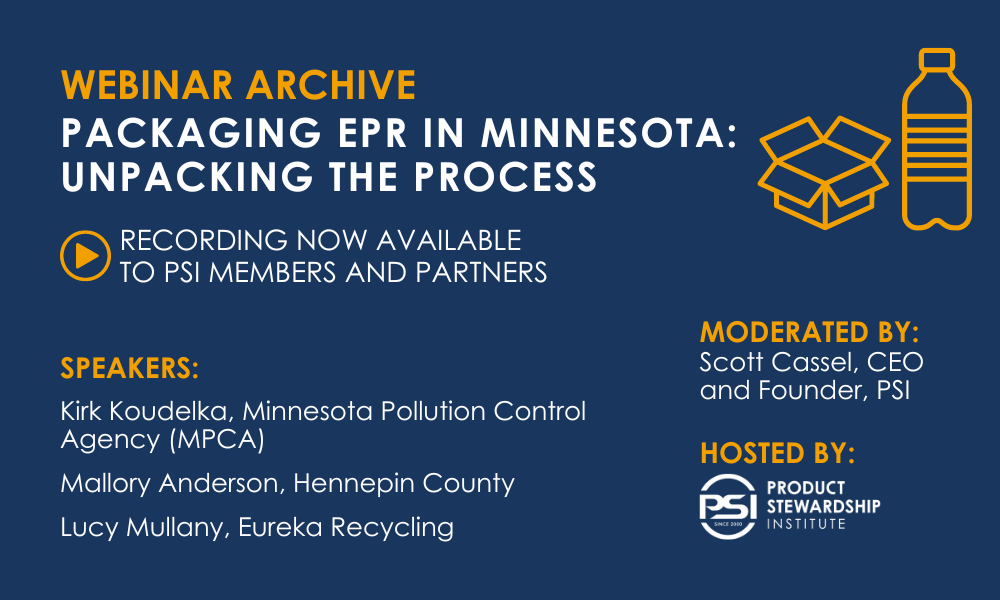
PSI’s August 7 webinar unpacked the process that led Minnesota to enact the fifth packaging EPR law in the U.S. At the start of this process, PSI was hired by the Partnership on Waste and Energy (PWE), a Minnesota joint powers authority comprised of Hennepin, Ramsey, and Washington counties, to assist in developing the initial Minnesota packaging bill.
This webinar covered the process PSI and PWE used to develop the draft bill, incorporate stakeholder input, and gain stakeholder support. The webinar also addressed the law’s provisions, unique aspects, implementation timelines, and the collaborative leadership required to pass such significant legislation. Speakers included key players who contributed significantly to the final agreement, including a local government leader who guided the bill over its 3-year development, a state agency official who provided important policy guidance, and other bill advocates.
The recording of this webinar is now available to PSI Members and Partners in our Resource Library.
| |
|
Toxics in Packaging Clearinghouse Virtual Open House
September 9, 11:00am – 12:30pm ET
| |
|
The Toxics in Packaging Clearinghouse (TPH) is hosting a virtual Open House for state agencies and industry groups interested in understanding how TCPH helps with harmonization of, and compliance with, toxics in packaging laws. In 2024, the landscape of legislation addressing emerging concerns about toxics in packaging is evolving. We encourage you to join the event to hear how TPCH has been using an existing framework for over three decades to assist both states and industry.
Register here!
Want to learn more? Earlier this year, PSI co-hosted a webinar with the Northeast Waste Management Officials’ Association, the organization that runs the TCPH, about ways to ensure consistency among packaging EPR, toxics in packaging, and other laws regulating toxics and packaging. The webinar recording is available to PSI Members and Partners in our Resource Library.
| |
|
CANADIAN STEWARDSHIP CONFERENCE
September 24-25 | Toronto, Ontario
| |
|
Join Scott Cassel, CEO and Founder of PSI, at the iconic Fairmont Royal York in Toronto on September 24 and 25, 2024 for the Canadian Stewardship Conference. For the past two decades, the Canadian Stewardship Conference has brought together industry leaders, government policymakers, business operators, and innovators from across Canada, the United States, and Europe to compare insights and intelligence on what we can expect from the next phase of EPR.
Scott will moderate a U.S. EPR update session on the first day, continuing to foster cross-border EPR dialogue for joint learning and problem solving. A big turnout is expected at the conference, as EPR evolves from compliance to optimization. Learn more and register.
| |
A MUST-READ FOR ALL EPR PROFESSIONALS! | |
|
PERSPECTIVES ON PRODUCT STEWARDSHIP:
Navigating an extended producer
responsibility path to a circular economy
by Scott Cassel, CEO and Founder of PSI
| |
Learn about the emergence of the EPR movement in the U.S., Canada, and Europe; the basic elements of all effective EPR bills; how to build consensus with other stakeholders; and key definitions, terminology, and issues. Includes in-depth case studies on packaging, paint, and batteries. | |
|
NAHMMA Hazardous Materials Management Conference
September 22-27 – Austin, TX: Hanz Atia, PSI Policy and Programs Associate, will present at two sessions at the NAHMMA Hazardous Materials Management Conference. If vape product waste management is on your short list, join Hanz and Shelly Fuller, Hazardous Materials Program Manager for Boulder County, Colorado, for a presentation on the challenges and opportunities for vapes management and updates on Boulder’s pioneering collection pilots and policy development initiative. Hanz will also share PSI's work leveraging GIS software to enhance hazardous materials management infrastructure and create compelling EPR advocacy materials. Register here.
Public Health in the Rockies Conference, Presented by the Colorado Public Health Association
September 24-26 – Keystone, CO: Hanz Atia, PSI Policy and Programs Associate, will present alongside Amanda Trinh of Boulder County Public Health at the Public Health in the Rockies Conference. Hanz and Amanda will discuss vape product waste (VPW) management and present policy solutions and best practices to address this growing issue. Their interactive session will lead participants through the impacts of different policy options and provide practical recommendations to empower participants to implement VPW management strategies in their own jurisdictions. Register here.
| |
|
Packaging Dive covered PSI's recent webinar about the development process and implications of Minnesota's new packaging EPR law. The article highlights the stakeholder collaboration behind the law and the ongoing work needed to implement and enforce its goals.
PSI CEO and Founder Scott Cassel was featured in a recent Packaging Digest article about the evolving landscape of EPR laws and how producers can navigate these changes. In the piece, Scott highlights the challenges brands face in adapting to varied state policies and emphasizes the importance that early engagement between producers, industry associations, and government agencies plays in fostering more harmonized state policies.
In the Summer 2024 edition of Recycling Magazine, James Asali, Senior Counsel at Chamberlain Hrdlicka’s Philadelphia office, discusses the debate surrounding advanced recycling technologies as a solution to plastic pollution. The article, draws from PSI’s 2022 paper, Making Sense of Chemical Recycling, which offers criteria by which governments might assess non-mechanical recycling technologies.
In this August Pluribus News article about Illinois’ recently enacted battery EPR law, PSI CEO and Founder Scott Cassel shares insights into the legislative landscape and growing trend toward battery EPR laws. Sign up for Pluribus News if you enjoyed this article.
In another recent Pluribus News article, PSI CEO and Founder Scott Cassel discusses California’s electric vehicle battery EPR bill, noting that, if enacted, it may prompt other states to expand their battery EPR laws to include EV’s, a critical step as the market for electric vehicles continues to grow. Sign up for Pluribus News if you enjoyed this article.
PSI CEO and Founder Scott Cassel recently appeared on the Sustainable Packaging podcast with host Cory Connors, available for free on Apple Podcasts and Spotify.
In the episode, Scott discusses the origins and evolution of EPR, the recent momentum on packaging EPR, how addressing waste issues is a climate change strategy, and the critical role of stakeholder collaboration in achieving continued progress. Scott also talks about his book, Perspectives on Product Stewardship, which traces the co-evolution of PSI and the U.S. product stewardship movement, with case studies on packaging, batteries, and paint.
“This concept has become very familiar in the United States, but when we started out in 2000, hardly anyone knew what product stewardship was. It’s really gratifying to see that the big problem we set out to address is finally being recognized.”
| |
|
Oregon Packaging EPR: The Oregon Department of Environmental Quality (OR DEQ) rejected the first draft of Circular Action Alliance’s (CAA) program plan under the state's packaging EPR law, seeking revisions to 14 sections by September 27. Rejection does not mean that there is a problem. OR DEQ and CAA are working collaboratively and iteratively to develop and review plan details in a phased approach. Read more.
Oregon Mattress EPR: The Oregon Department of Environmental Quality approved the Mattress Recycling Council’s (MRC) program plan on July 25. MRC has until January 25, 2025 to implement the requirements of the state's mattress EPR program. Read more.
Textiles EPR: There is growing global momentum behind EPR policies for textiles, with ongoing efforts in the EU, Australia, and the U.S. (California and New York) to develop and enforce regulations that address textile waste. Read more.
| |
The Product Stewardship Institute is a policy expert and consulting nonprofit that pioneered product stewardship in the United States. Since 2000, PSI has helped enact 140 extended producer responsibility (EPR) laws across 19 product categories in 33 states — the bedrock on which the circular economy is built. We work with businesses, nonprofits, academia, and governments to ensure that products are responsibly managed from design to end of life. Join us at www.productstewardship.us. | |
|
The Product Stewardship Institute, Inc. is an equal opportunity employer and provider. Persons with disabilities who require alternatively formatted materials to ensure effective communication should contact Amanda Nicholson at info@productstewardship.us or 617.236.4855.
| | | | |